
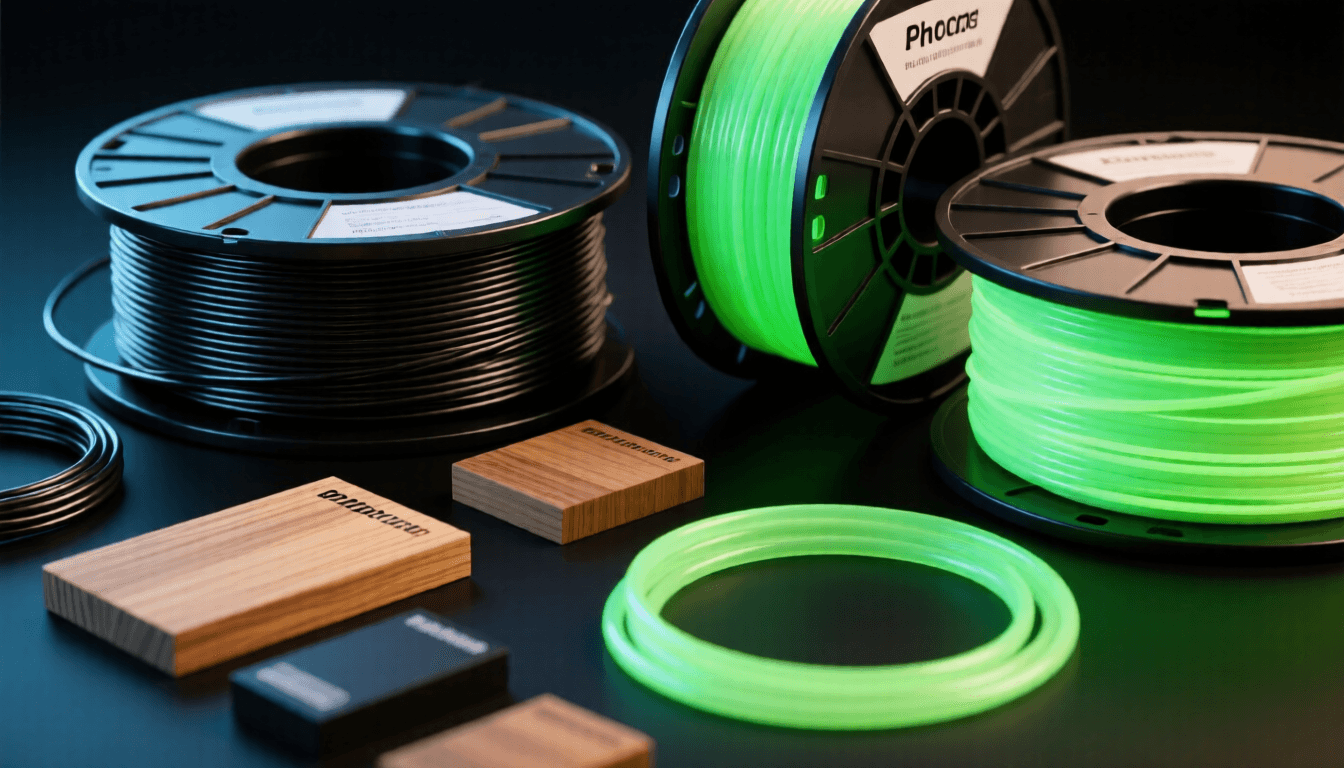
SEO Title: Best Specialty 3D Printer Filaments for 2026: TPU, Nylon, Carbon Fiber, Wood, and More
Slug: best-specialty-3d-printer-filaments-tpu-nylon-carbon-fiber-2026
Meta Description: Discover the best specialty 3D printer filaments beyond PLA and PETG. Compare TPU for flexibility, nylon for strength, carbon fiber for rigidity, and wood composite for aesthetics.
Excerpt: A practical guide to the best specialty 3D printer filaments for 2026, including TPU, nylon, carbon fiber composites, and wood filaments with product recommendations and buying advice.
Primary Category: Filaments & Materials
Suggested Tags: specialty filaments, TPU, nylon, carbon fiber filament, wood filament, flexible 3D printing
Primary Keyword: best specialty 3D printer filaments
Search Intent: commercial investigation
Article Type: comparison post
Disclosure: As an Amazon Associate, 3dput.com earns from qualifying purchases. This supports our independent testing and reviews.
Quick Picks
- Best Overall TPU: Hatchbox TPU 95A
- Best Nylon for Beginners: Hatchbox Nylon PA12
- Best Carbon Fiber Composite: MatterHackers NylonX Carbon Fiber
- Best Wood Filament: ColorFabb WoodFill
- Best Budget Option: Hatchbox Wood PLA
Comparison Table
| Product | Type | Hardness | Best For | Price Range |
|---|---|---|---|---|
| Hatchbox TPU 95A | TPU | Shore 95A | Flexible parts | Moderate |
| Taulman3D Nylon 645 | Nylon | Industrial | High-strength parts | High |
| Hatchbox Nylon PA12 | Nylon PA12 | Beginner | Functional parts | Moderate |
| ColorFabb CF PLA | CF-PLA | Standard | Stiff parts | High |
| MatterHackers NylonX | CF-Nylon | Premium | Ultimate strength | Very High |
| ColorFabb WoodFill | Wood | Standard | Wooden finish | High |
Why Specialty Filaments Matter
PLA and PETG are excellent starting materials, but specialty filaments unlock applications that standard materials cannot handle. Flexible TPU creates seals, phone cases, and wearable components. Nylon delivers industrial strength for gears and mechanical assemblies. Carbon fiber composites offer exceptional stiffness without metal weight. Wood filaments provide aesthetic appeal for decorative prints and artistic projects.
Choosing the right specialty filament requires understanding material properties, printer requirements, and the tradeoffs between ease of printing and final part performance. This guide covers the best options in each category, along with practical advice on what works best for different applications.
If you are still deciding between basic materials, our PLA vs PETG vs ABS comparison guide explains when standard filaments make sense versus moving into specialty materials.
Best Specialty Filament Options
Hatchbox TPU 95A
Best for: Flexible phone cases, gaskets, and functional parts requiring elasticity.
Hatchbox TPU 95A strikes a practical balance between flexibility and printability. At Shore 95A hardness, it offers enough give for phone cases and seals while still holding shape during printing. The filament produces consistent results without extreme stringing, making it more approachable than softer TPUs.
- Hardness: Shore 95A
- Print Temp: 220-240°C
- Bed Temp: 40-60°C
- Requires direct drive extruder
Pros: Good balance of flexibility and printability, consistent diameter, widely available.
Cons: Requires direct drive for best results, slower print speeds needed.
Taulman3D Nylon 645
Best for: High-strength mechanical parts, industrial prototypes, and components that need to withstand significant stress.
Taulman3D Nylon 645 is an industrial-grade nylon designed for serious mechanical applications. The material offers exceptional tensile strength and impact resistance, making it suitable for functional prototypes and end-use parts that must survive real-world loading. The tradeoff is demanding print requirements including thorough drying, precise bed preparation, and an enclosed build chamber.
- Type: Nylon 645
- Print Temp: 245-265°C
- Bed Temp: 90-110°C
- Requires drying before printing
Pros: Excellent strength, impact resistance, chemical resistance, suitable for functional parts.
Cons: Requires thorough drying, demanding print environment, higher skill level needed.
Hatchbox Nylon PA12
Best for: Functional parts and mechanical components requiring strength without extreme printing difficulty.
Hatchbox Nylon PA12 is one of the more approachable nylons for printers that can handle higher temperatures. Unlike industrial nylons that demand extreme drying and bed prep, PA12 prints relatively cleanly with good layer adhesion and strength. The material works well for gears, hinges, and other functional parts that need to withstand stress.
- Type: Nylon PA12
- Print Temp: 240-260°C
- Bed Temp: 70-90°C
- Better moisture resistance
Pros: Easier to print than industrial nylons, good strength-to-weight ratio, lower moisture sensitivity.
Cons: Benefits from drying, requires heated bed and enclosure.
ColorFabb Carbon Fiber PLA
Best for: Functional parts requiring stiffness and a matte finish without the difficulty of carbon fiber nylon.
ColorFabb Carbon Fiber PLA combines the ease of PLA printing with the added stiffness of carbon fiber reinforcement. The material produces rigid parts with a distinctive matte finish and minimal warping. It is well-suited for drone frames, functional brackets, and any application where dimensional stability matters more than extreme strength.
- Type: CF-PLA
- Print Temp: 200-220°C
- Bed Temp: 50-60°C
- Requires hardened steel nozzle
Pros: Easier to print than CF-Nylon, stiff parts, minimal warping, matte finish.
Cons: Abrasive to standard nozzles, requires hardened steel nozzle.
MatterHackers NylonX Carbon Fiber
Best for: Ultimate strength applications where maximum rigidity and durability are required.
MatterHackers NylonX Carbon Fiber represents the high end of carbon fiber composites, combining nylon strength with carbon fiber reinforcement for exceptional performance. The material produces parts that rival aluminum in some applications while maintaining the layer-by-layer advantages of 3D printing. This is not a beginner material, but for serious functional parts, it delivers results that justify the effort.
- Type: CF-Nylon
- Print Temp: 250-270°C
- Bed Temp: 90-100°C
- Requires hardened steel nozzle and drying
Pros: Maximum strength and stiffness, excellent dimensional stability, premium quality.
Cons: Expensive, demanding print requirements, abrasive to nozzles.
ColorFabb WoodFill
Best for: Aesthetic wooden prints, decorative objects, and artistic projects that require a real wood appearance.
ColorFabb WoodFill combines PLA with wood fibers to create a filament that prints, feels, and smells like real wood. The material can be sanded, stained, and finished similarly to natural wood, making it ideal for decorative pieces, architectural models, and artistic applications. Post-processing brings out realistic wood grain patterns.
- Type: Wood Composite
- Print Temp: 200-220°C
- Bed Temp: 50-60°C
- Sandable and stainable
Pros: Realistic wood appearance, sandable and stainable, pleasant wood smell.
Cons: More prone to stringing than standard PLA, requires larger nozzle recommended.
Buying Guide
TPU: When You Need Flexibility
TPU is the go-to material for flexible 3D printing. Shore hardness determines how soft or stiff the final part will be, with 85A being very soft and 95A offering moderate flexibility. Phone cases, gaskets, seals, and wearable components are common applications.
TPU demands a direct drive extruder. Bowden systems often struggle with the flexible filament, causing feeding issues and underextrusion. Reduce retraction distance and slow print speeds to 20-30 mm/s.
Nylon: Industrial-Strength Parts
Nylon excels in strength, durability, and chemical resistance. It is ideal for functional parts like gears, hinges, and mechanical assemblies that must withstand stress and repeated use.
Nylon is highly hygroscopic and absorbs moisture from the air. Wet nylon produces steam bubbles, poor layer adhesion, and weak prints. Dry nylon at 70-80°C for several hours before printing. For serious nylon printing, filament dryers provide consistent moisture control. Use a heated bed at 90-110°C with adhesion aids like PEI sheets or glue stick. An enclosed build chamber helps reduce warping.
Carbon Fiber Composites: Maximum Rigidity
Carbon fiber reinforced filaments combine base materials like PLA, PETG, or nylon with carbon fibers for added stiffness and dimensional stability. The result is rigid parts with minimal flex and a distinctive matte finish.
Carbon fiber is abrasive and will wear down standard brass nozzles quickly. Use a hardened steel nozzle. Our guide to the best 3D printer nozzles covers suitable options for abrasive filaments. CF-PLA prints easier but offers moderate strength. CF-Nylon provides maximum strength but requires high printing temperatures and thorough drying.
Wood Composite: Aesthetic Appeal
Wood filaments combine PLA or other base polymers with wood fibers for a material that looks and behaves somewhat like wood. These filaments are primarily used for decorative and artistic projects.
Sand printed parts to reveal wood grain patterns, then apply wood stain or finish for a realistic appearance. Higher printing temperatures can darken the color. Wood filaments are prone to stringing, so use a slightly larger nozzle like 0.6mm to reduce clogging.
Printer Requirements
Before buying specialty filaments, ensure your printer can handle them:
- Heated bed: Essential for nylon and recommended for TPU and wood composites.
- Enclosure: Highly beneficial for nylon and carbon fiber materials.
- Hotend temperature: Must reach at least 260°C for nylon and carbon fiber nylon.
- Extruder type: Direct drive required for TPU. Bowden will not work reliably.
- Nozzle: Hardened steel recommended for carbon fiber materials.
When to Choose Specialty vs Standard
Specialty filaments add capability but also complexity, cost, and print difficulty. Consider these factors before moving beyond PLA and PETG:
- Does the part need flexibility, extreme strength, or specific aesthetic qualities?
- Can your printer handle the required temperatures, bed adhesion, and extruder requirements?
- Are you comfortable with material-specific tuning and potentially higher failure rates?
- Specialty filaments cost 2-5x more than PLA and PETG.
- Specialty materials often require slower print speeds, drying prep, and post-processing.
FAQ
What is the easiest specialty filament to print?
Hatchbox Nylon PA12 is the most approachable nylon, printing with less difficulty than industrial nylons while still delivering good strength. For flexible materials, Hatchbox TPU 95A offers a good balance between printability and flexibility. Carbon fiber PLA is easier to print than carbon fiber nylon, making it a good starting point for reinforced materials.
Do I need a special nozzle for carbon fiber filaments?
Yes, carbon fiber filaments are abrasive and will wear down standard brass nozzles quickly. Use a hardened steel nozzle or other wear-resistant material. Brass nozzles may work for a few hundred grams of CF filament, but continued use leads to inconsistent extrusion and poor print quality.
How do I store specialty filaments to keep them dry?
Nylon and some other specialty materials absorb moisture rapidly, which ruins print quality. Store filaments in sealed containers with desiccant packs. For serious printing, especially with nylon, a dedicated filament dryer provides consistent moisture control. Even wood composites benefit from dry storage to prevent print issues.
Can I print TPU with a Bowden extruder?
It is possible but difficult and often frustrating. TPU flexes in the Bowden tube, causing underextrusion and feeding failures. A direct drive extruder places the drive gear close to the hotend, pushing TPU directly into the melt zone. If you plan to print flexible parts regularly, upgrading to a direct drive system is strongly recommended.
Conclusion
Specialty filaments expand what is possible with 3D printing beyond basic functional prototypes. TPU enables flexible parts, nylon delivers industrial strength, carbon fiber composites provide maximum rigidity, and wood filaments offer realistic aesthetics. The tradeoff is increased complexity, higher cost, and demanding printer requirements.
Start with materials that match your printer capabilities and experience level. Hatchbox Nylon PA12 and TPU 95A provide accessible entry points into functional printing. ColorFabb Carbon Fiber PLA offers an easier path into reinforced materials. Choose specialty filaments when the application demands specific properties that standard materials cannot provide.
Related Reading
- PLA vs PETG vs ABS Filament Comparison Guide
- Best 3D Printer Filament Dryers for 2026
- Best 3D Printer Nozzles and Hotends for 2026
Where to Buy
Find the best deals on these products:
Buy Nylon Filament on Amazon
Buy Carbon Fiber Filament on Amazon
Buy Wood Filament on Amazon
Buy Metal Filament on Amazon
Buy 3D printer supplies on Amazon
Frequently Asked Questions
What is the best 3D printing filament for beginners?
PLA is the best starting filament — it prints easily at 190-220°C without an enclosure and produces good results. Once comfortable, PETG offers better strength and temperature resistance for functional parts.
How do I choose the right filament?
Consider the application: PLA for display models, PETG for functional parts, ABS/ASA for heat/sunlight exposure, TPU for flexible parts, and specialty filaments for engineering applications. Each has specific printer requirements.
What temperature should I print different filaments at?
PLA: 190-220°C nozzle / 50-60°C bed. PETG: 220-250°C / 70-80°C. ABS: 230-260°C / 100-110°C (enclosure needed). Nylon: 240-270°C / 70-90°C. Always check manufacturer recommendations for specific brands.
📌 Related Articles
- ABS 3D Printing Settings Guide: Temperature, Enclosure, and Cooling for Strong Parts
- Creality Creality Ender 3 V3 Plus vs Creality Ender 3 Pro: Full Specs Comparison & Buyer’s Guide
- Best 3D Printer Upgrades That Actually Improve Print Quality: Complete 2026 Guide
- Best Budget 3D Printer Upgrades That Actually Improve Print Quality: Belts, Springs, Hotends & More
- Bambu Lab A1 vs Elegoo Centauri Carbon: Full Specs Comparison & Buyer’s Guide