
Quick Answer: What is Modular 4D Printing?
Modular 4D printing is an advanced fabrication technique where 3D-printed components can self-assemble, transform, or adapt their shape in response to environmental stimuli like heat or light. Unlike traditional 3D printing, which creates static objects, 4D printing adds the dimension of time—objects change shape or properties after printing. Zhejiang University’s breakthrough uses interfacial welding of digital light-controllable dynamic covalent polymer networks, allowing separate material modules to be combined into complex, multi-functional structures that respond to temperature changes.
Understanding 4D Printing: Beyond 3D Fabrication
4D printing represents the next evolutionary step in additive manufacturing. While 3D printing creates three-dimensional objects layer by layer, 4D printing introduces time as the fourth dimension—printed objects can transform, self-assemble, or adapt their properties after fabrication when triggered by external stimuli such as heat, light, moisture, or magnetic fields.
Researchers from the College of Chemical and Biological Engineering at Zhejiang University have been exploring an even more complex realm of digital fabrication, releasing their findings in ‘Modular 4D Printing via Interfacial Welding of Digital Light-Controllable Dynamic Covalent Polymer Networks.’
Historically, 3D printing has offered a wide range of benefits to users on many levels; however, users are still often restricted and challenged due to issues like slower speed or lack of suitable materials. 4D printing may be faster, but the authors note that more complex geometries may not be accessible, and the potential for using multiple materials may be restricted.
The Breakthrough: Modular 4D Printing Technology
In this study, the authors steer away from the typical mode of layered fabrication, using a modular system developed through interfacial welding of digital light-controllable structures that can be customized, 3D printed, and assembled in a modular network.
“This expansion is non-trivial as it opens up ways to fabricate geometrically complex devices with sophisticated functions that are otherwise difficult with existing approaches. We note that recent work has shown multi-materials integration in 4D printing via direct ink writing. Although the method involves stresses from bilayers, at the global level the shape shifting is still limited to single-layer 2D-to-3D transformation.”
Modular 4D Printing via Interfacial Dynamic Bond Exchange
How the Technology Works
Double-sided digital light is projected onto a ‘printing precursor’ made of monomers that are not only photocurable but also encompass the following:
- Dynamic covalent bonds – Chemical bonds that can break and reform, enabling material welding and transformation
- Photo-initiator – A compound that initiates polymerization when exposed to light
- Light absorber – Controls light penetration depth for precise curing gradients
- Solvent (toluene) – Facilitates material processing and removal of uncured components
Exposure of the light results in curing, along with ‘enhancing the light attenuation,’ and consequently creating a curing gradient that exists in the out-of-plane gradient.
“Subsequent removal of the uncured monomers and solvent from the cured film develops the 2D film into 3D due to the material heterogeneity in the out-of-plane dimension,” state the researchers. “Following this process, independent variations in the printing precursors can result in 3D objects with tailorable materials properties, which we call 3D material modules.”

Quantitative Characterization of the Folding Behaviors
Material Modules: Building Blocks of 4D Structures
The modules feature shapes that are separately manipulated and connected through interfacial welding via dynamic covalent bond exchange. The authors used a set of monomers/crosslinker to offer a better understanding of this principle. Variations caused different types of material modules, as follows:
- PPIA20-IBOA80 – A formulation with 20% PPIA and 80% IBOA monomers
- PPIA50-PEA50 – A balanced formulation with equal parts PPIA and PEA
- PPIA20-PEA80 – A formulation with 20% PPIA and 80% PEA monomers

Modular 4D Printing of PPIA50-PEA50
Comparison: 3D Printing vs. 4D Printing Approaches
| Feature | Traditional 3D Printing | Conventional 4D Printing | Modular 4D Printing (ZJU) |
|---|---|---|---|
| Post-Print Transformation | None – static objects | 2D to 3D transformation limited to single layer | Complex multi-module 3D assembly with reversible transformations |
| Multi-Material Integration | Limited, requires complex multi-nozzle systems | Restricted to bilayer stress-based transformations | Full modular integration via interfacial welding |
| Geometric Complexity | High, but static | Limited by bilayer constraints | Geometrically complex devices with sophisticated functions |
| Reversibility | Not applicable | Limited, often one-way transformation | Dynamic bond exchange enables reversible shape changes |
| Production Speed | Slower for complex geometries | Faster but geometry-restricted | Fast modular fabrication with parallel printing capability |
Material Modules Comparison
| Material Module | Composition | Key Properties | Best Applications |
|---|---|---|---|
| PPIA20-IBOA80 | 20% PPIA + 80% IBOA | High flexibility, low rigidity | Soft robotics, flexible hinges |
| PPIA50-PEA50 | 50% PPIA + 50% PEA | Balanced flexibility and strength | Structural components, multi-functional devices |
| PPIA20-PEA80 | 20% PPIA + 80% PEA | Higher rigidity, moderate flexibility | Load-bearing modules, framework structures |
Demonstrating 4D Capabilities
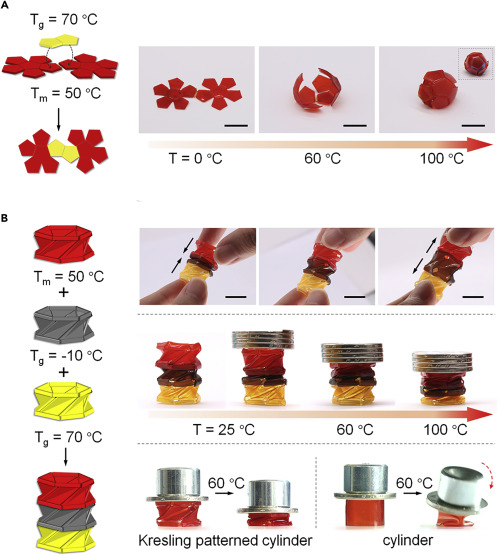
The 4D modular structure not only expands beyond 3D printing but is more robust and offers versatility, as displayed in the two samples printed—one of PPIA20-IBOA80 and one of PPIA50-PEA50. Both were connected by applying pressure to the hinged area while welding. The 4D qualities, deformation and then returning to the initial state, were displayed due to temperature as they were reheated.
Multi-material Modular Assembly
The Kresling Pattern Advantage
“An important feature during the process is that the deformation is dictated by the Kresling pattern, yielding a pattern-directed controlled rotation that improves the mechanical stability of the device,” concluded the researchers.
“Besides having the advantages of current 4D printing technologies, the exchangeable nature of the dynamic bonds in the printed polymer networks brings several rather notable benefits. The solid-state plasticity via bond exchange in the material bulk permits further manipulation of the printed shapes. The interfacial bond exchange between material modules formulated separately allows the integration of multiple distinct materials in a modular fashion. These features allow versatile integration of materials and structures, leading to unusual opportunities to construct multi-responsive devices with geometry-dictated functions.”
Applications of 4D Modular Printing
4D printing offers greater options to many users today, especially as they seek to use objects capable of transforming due to environmental stimulus. The modular approach from Zhejiang University opens new possibilities across multiple fields:
- Soft Robotics – Create robots that can adapt their shape and movement in response to their environment. The modular assembly allows different sections of a robot to have different properties—soft joints for flexibility and rigid segments for structure—all integrated through interfacial welding.
- Biomedical Devices – Develop implantable devices that can adapt to body temperature or other physiological conditions. The reversible nature of the transformations enables devices that change shape for minimally invasive delivery and then conform to their intended configuration.
- Autonomous Structures – Build structures that can self-assemble or reconfigure without human intervention, useful in space applications or harsh environments where manual assembly is impractical.
- Optics and Photonics – Create adaptive lenses or optical components that change focus or light transmission properties in response to temperature changes.
- Deployable Systems – Design systems that can be compactly stored and then expand into complex 3D configurations when triggered, useful for satellites, emergency shelters, or temporary infrastructure.
Why Dynamic Covalent Bonds Matter
The key innovation in this research is the use of dynamic covalent bonds in the polymer networks. Unlike traditional covalent bonds, which are permanent once formed, dynamic covalent bonds can break and reform under specific conditions. This property enables:
- Interfacial Welding – Separate material modules can be joined at their interfaces through bond exchange, creating strong, seamless connections between different materials.
- Solid-State Plasticity – The printed objects can be reshaped or reconfigured even after curing, providing flexibility in post-processing and design iteration.
- Reversible Transformations – Objects can deform and return to their original shape multiple times without degradation, essential for applications requiring repeated actuation cycles.
- Multi-Material Integration – Different modules with distinct properties can be combined into a single structure, enabling functionality that would be impossible with a single material.
Comparison with Other 4D Printing Research
Zhejiang University’s modular approach differs significantly from other 4D printing methods. While previous research has demonstrated 4D printing through bilayer structures where different materials have different expansion rates, or direct ink writing of multi-material filaments, these methods have inherent limitations.
Bilayer approaches are restricted to simple 2D-to-3D transformations and struggle with complex geometries. Direct ink writing faces challenges with material compatibility and interface strength between different printed materials. The modular welding approach from Zhejiang University overcomes these limitations by:
- Enabling true 3D modular assembly, not just 2D sheet folding
- Creating strong chemical bonds between modules, not just physical adhesion
- Allowing reversible transformations through dynamic bond exchange
- Supporting virtually unlimited material combinations through separate module fabrication
Future Implications and Research Directions
The modular 4D printing technology developed at Zhejiang University represents a significant advancement with wide-ranging implications for the future of manufacturing and materials science. As this technology matures, we can expect to see:
- More Complex Geometries – The ability to fabricate devices with intricate internal structures and sophisticated functions that were previously impossible to create.
- Customized Material Properties – Tailored material formulations for specific applications, from medical implants to aerospace components.
- Scalable Manufacturing – The modular approach could enable parallel production of standardized components that are later assembled, improving efficiency.
- Self-Repairing Systems – The dynamic bond exchange could potentially enable structures that repair themselves when damaged.
- Programmable Matter – Objects that can change their properties and configuration on demand based on programming or environmental cues.
Frequently Asked Questions (FAQ)
1. See also: ABS 3D Printing Settings Guide: Temperature, Enclo…. What is the difference between 3D and 4D printing?
3D printing creates static three-dimensional objects layer by layer, while 4D printing adds the dimension of time—objects can transform, self-assemble, or change properties after printing when triggered by external stimuli like heat, light, or moisture. 4D printed objects are typically made from smart materials that respond to these stimuli.
2. What makes Zhejiang University’s modular 4D printing different from other 4D printing methods?
Unlike conventional 4D printing that relies on bilayer stress or direct ink writing with limited multi-material integration, Zhejiang University’s approach uses modular components that are separately printed and then welded together through dynamic covalent bond exchange. This enables true 3D modular assembly, reversible transformations, and integration of multiple distinct materials with strong chemical bonds between modules.
3. What are the main applications of modular 4D printing?
Key applications include soft robotics (robots that adapt their shape and movement), biomedical devices (implants that conform to body conditions), autonomous structures (self-assembling systems for space or harsh environments), adaptive optics (lenses that change focus with temperature), and deployable systems (compact storage with expansion capabilities for satellites or emergency infrastructure).
4. What are dynamic covalent bonds and why are they important in this research?
Dynamic covalent bonds are chemical bonds that can break and reform under specific conditions, unlike permanent traditional covalent bonds. They are crucial for modular 4D printing because they enable interfacial welding between separate material modules, solid-state plasticity for post-print reshaping, and reversible transformations without material degradation. This creates strong chemical connections between different materials rather than just physical adhesion.
5. What material modules were developed in this research and how do they differ?
The research developed three material modules: PPIA20-IBOA80 (high flexibility, suitable for soft hinges), PPIA50-PEA50 (balanced properties for structural components), and PPIA20-PEA80 (higher rigidity for load-bearing applications). These different formulations allow engineers to select appropriate materials for different parts of a modular structure, then weld them together into a unified device.
6. How does the Kresling pattern improve 4D printed structures?
The Kresling pattern is a geometric origami pattern that guides the deformation of 4D printed structures. When used in modular 4D printing, it provides pattern-directed controlled rotation that improves the mechanical stability of the device. This ensures that transformations occur predictably and that the structure maintains its integrity during shape changes.
7. Can 4D printed objects return to their original shape after transformation?
Yes, one of the key advantages of the modular 4D printing approach is reversibility. The dynamic covalent bonds in the polymer networks enable objects to deform and return to their initial state multiple times when triggered by stimuli like temperature changes. This is essential for applications requiring repeated actuation cycles.
8. What are the limitations of current 4D printing technologies?
Conventional 4D printing faces limitations including restricted geometric complexity (limited to simple 2D-to-3D transformations), challenges with multi-material integration (often limited to bilayer structures), and limited reversibility (many transformations are one-way). Modular 4D printing addresses these by enabling complex 3D assembly, true multi-material integration through interfacial welding, and reversible dynamic bonds.
Conclusion
Zhejiang University’s modular 4D printing technology represents a significant leap forward in additive manufacturing capabilities. By combining the flexibility of 4D transformation with the versatility of modular assembly and dynamic covalent chemistry, this approach opens new possibilities for creating complex, multi-functional devices that can adapt and respond to their environment.
The ability to separately fabricate material modules with different properties and then weld them together through dynamic bond exchange provides unprecedented design freedom. As this technology continues to develop, we can expect to see increasingly sophisticated applications in fields ranging from robotics and medicine to aerospace and beyond.
What do you think of this news? Let us know your thoughts! Join the discussion of this and other 3D printing topics at 3DPrintBoard.com.
Sources:
Related: Researchers Imitate Natural Vascular Structures to 3D Print New Systems for Self · China: Researchers Test 3D Printed Modular Microfluidic Systems · Aston University Researchers Review Current Approaches in 3D Printing Solid Oral
- Modular 4D Printing via Interfacial Welding of Digital Light-Controllable Dynamic Covalent Polymer Networks
- Zhejiang University College of Chemical and Biological Engineering
- 4D printing review: Current status and future perspectives
- Soft Robotics Applications of 4D Printing
- Autonomous Structures and Biomimetic Design
Frequently Asked Questions
What is the best 3D printing filament for beginners?
PLA is the best starting filament — it prints easily at 190-220°C without an enclosure and produces good results. Once comfortable, PETG offers better strength and temperature resistance for functional parts.
How do I choose the right filament?
Consider the application: PLA for display models, PETG for functional parts, ABS/ASA for heat/sunlight exposure, TPU for flexible parts, and specialty filaments for engineering applications. Each has specific printer requirements.
What temperature should I print different filaments at?
PLA: 190-220°C nozzle / 50-60°C bed. PETG: 220-250°C / 70-80°C. ABS: 230-260°C / 100-110°C (enclosure needed). Nylon: 240-270°C / 70-90°C. Always check manufacturer recommendations for specific brands.
📌 Related Articles
- Best 3D Printer Upgrades That Actually Improve Print Quality: Complete 2026 Guide
- ABS 3D Printing Settings Guide: Temperature, Enclosure, and Cooling for Strong Parts
- Prusa Research Mini+ vs Prusa MK4: Full Specs Comparison & Buyer’s Guide
- Best Budget 3D Printer Upgrades That Actually Improve Print Quality: Belts, Springs, Hotends & More
- Bambu Lab A1 vs Elegoo Centauri Carbon: Full Specs Comparison & Buyer’s Guide