
UK researchers from the Department of Engineering, University of Cambridge are studying new systems for construction materials, outlining their results in the recently published ‘A novel biomimetic design of a 3D vascular structure for self-healing in cementitious materials using Murray’s law.’
Some of the most interesting scientific breakthroughs are founded in nature as researchers are inspired by a host of different features—and especially in 3D and 4D printing—from shoe collections to programmable ink to recyclable liquid polymers. This study is unique, however, as the authors work to develop a system for healing defects in cement. Cracking is an ongoing issue with the use of cement-based materials, and there is ‘limited intrinsic ability’ to heal such maladies. Self-healing systems are an ongoing topic of research as cracking is so prevalent in a material that is so commonly used.
While most of us equate the word vascular with the human body, ultimately it pertains to a vessel allowing for the transport of materials. While there are numerous other traditional methods for creating vascular networks related to use with cement, in this study, the researchers realize that ‘maximum volume coverage’ can be achieved with 3D gridded channels.
“The resultant dense connected network provides redundancy for blockage and increase vessel coverage,” state the authors. “However, the increase in vessel density may affect the mechanical properties of the sample and blockage becomes the main concern in rectangular bend tunnels.”
Understanding Filament Properties
“To minimize turbulent flow at junctions while also maximizing the volume, researchers such as Justin et al. [14] investigated a biomimetic vessel structure in cellularized hydrogels via inkjet printing technique following Murray’s law [for circulatory blood volume transfer].”
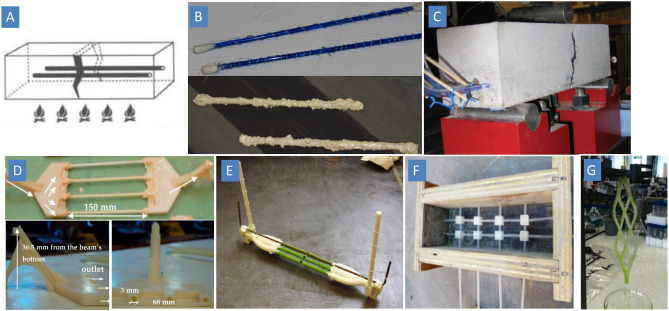
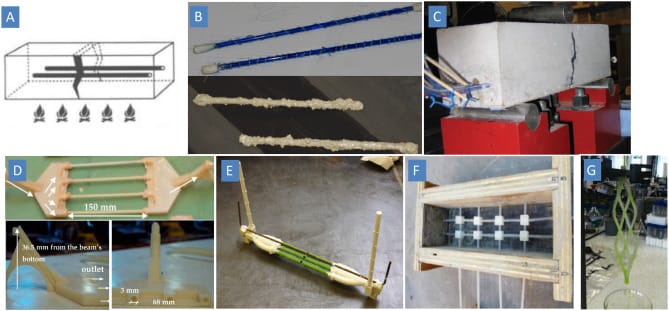
Examples of 1D (A–C) and 2D (D–F) cementitious vascular systems investigated (A) Wax coated 1D vascular system [8], (B) glass tubes with protective spiral wire coated with 3.5 mm-thick mortar layer [11], (C) specimens with individual tubes connected to the external environment [9], (D) 3D printed ABS distribution with individual inorganic phosphate cement (IPC) tubes [16], (E) layout of a 2D network printed by PLA and ABS [7], (F) 2D gridded polyurethane network with PLA connections [13], (G) Individual 3D network fabricated by PLA [15].
The network designed in this study imitates nature in its level of self-healing distribution. The research team 3D printed the design using PLA on an Ultimaker, and then analyzed the materials, and compared them with traditional 1D and 2D networks. Ultimately, they were able to show that the network was effective in delivering sodium silicate, serving as a healing agent—with all original cracks ‘healed’ after 28 days. The researchers used the following to evaluate each systems’ self-healing abilities:
- Recovery in mechanical properties
- Reduction in sorptivity
- Crack mouth closure
- Healed volume
“Biomimetic design obeying Murray’s law have great future potential for delivering healing agent for self-healing and the investigation could be expanded to other healing agents,” stated the researchers.
Material Comparison and Selection
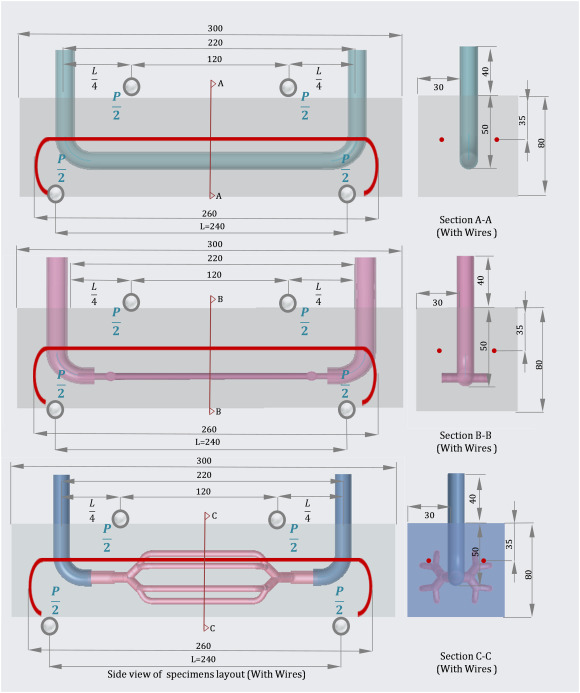
A schematic of the experimental setup for the four-point bending of specimens with the different internal vascular structures (a) 1D system, (b) 2D system and (c) 3D system.
The networks were printed in two separate parts and then soldered together.

Print Settings and Optimization
A biomimetic design of 3D vascular network; (A) designed model following Murray’s law; (B) parameters considered in the model; (C) fluid dynamic diagram adapted in this model.

Designing model of 1D/2D/3D structures (A, B, C) and front view of final manufactured structures (D, E, F).
The vascular structures possessed both brittle fractural response and the interfacial bond required to cause mechanical triggering.
“A recovery in mechanical properties of ~20% for 1D and 2D-structures and 34% for 3D vascular network specimens were attributed to self-healing. Additionally, the inclusion of 1D, 2D and 3D vascular network led to around 25, 69 and 77% reduction in sorptivity in comparison with the values of the cracked control specimens. An increased amount of crack healing was observed in the 2D vascular-cement system compared with the 1D system, and nearly all the cracks were reduced in the 3D vascular-cement system,” concluded the authors.
Strength and Durability Testing
“Through SEM-EDX, Na2HCO3 and silica mixed gel were found as healing products as the sodium silicate was exposed to air and reacted with CO2 and water vapor. The healed crack volume was investigated by CT-scanning and indicated partial healing could be drastically reduced by applying a 3D vascular structure, which contains more connected daughter tubes and enables large tube coverage. The systematic improvement in the healing performance of the 3D vascular network specimens was attributed to the design obeying Murray’s law and therefore broadening the coverage of healing agent distribution while reducing the energy required for pumping.”
What do you think of this news? Let us know your thoughts! Join the discussion of this and other 3D printing topics at 3DPrintBoard.com.
[Source / Images: ‘A novel biomimetic design of a 3D vascular structure for self-healing in cementitious materials using Murray’s law’]
The post Researchers Imitate Natural Vascular Structures to 3D Print New Systems for Self-Healing in Cement appeared first on 3DPrint.com | The Voice of 3D Printing / Additive Manufacturing.
Frequently Asked Questions
What is the best 3D printing filament for beginners?
PLA is the best starting filament — it prints easily at 190-220°C without an enclosure and produces good results. Once comfortable, PETG offers better strength and temperature resistance for functional parts.
How do I choose the right filament?
Consider the application: PLA for display models, PETG for functional parts, ABS/ASA for heat/sunlight exposure, TPU for flexible parts, and specialty filaments for engineering applications. Each has specific printer requirements.
What temperature should I print different filaments at?
PLA: 190-220°C nozzle / 50-60°C bed. PETG: 220-250°C / 70-80°C. ABS: 230-260°C / 100-110°C (enclosure needed). Nylon: 240-270°C / 70-90°C. Always check manufacturer recommendations for specific brands.
📌 Related Articles
- The Current State of Metal 3D Printing in 2020
- The Complete 3D Printing Filament Guide: Types, Properties & When to Use Each
- Best Budget 3D Printer Upgrades That Actually Improve Print Quality: Belts, Springs, Hotends & More
- 3D Printing News: Multi-Material Breakthrough and Aerospace Market Boom
- Best 3D Printer Upgrades That Actually Improve Print Quality: Complete 2026 Guide