
Quick Answer: Which 3D Printing Resin Should You Use?
Beginners: Start with water-washable resin or standard resin — they’re affordable, easy to clean, and forgiving.
Need strong parts? Go with ABS-like resin for everyday toughness, or tough/durable resin (Siraya Tech Blu) for mechanical parts.
Jewelry or casting? You need castable resin — it burns out cleanly in investment casting.
This page contains Amazon affiliate links. As an Amazon Associate, we earn from qualifying purchases. Full disclosure
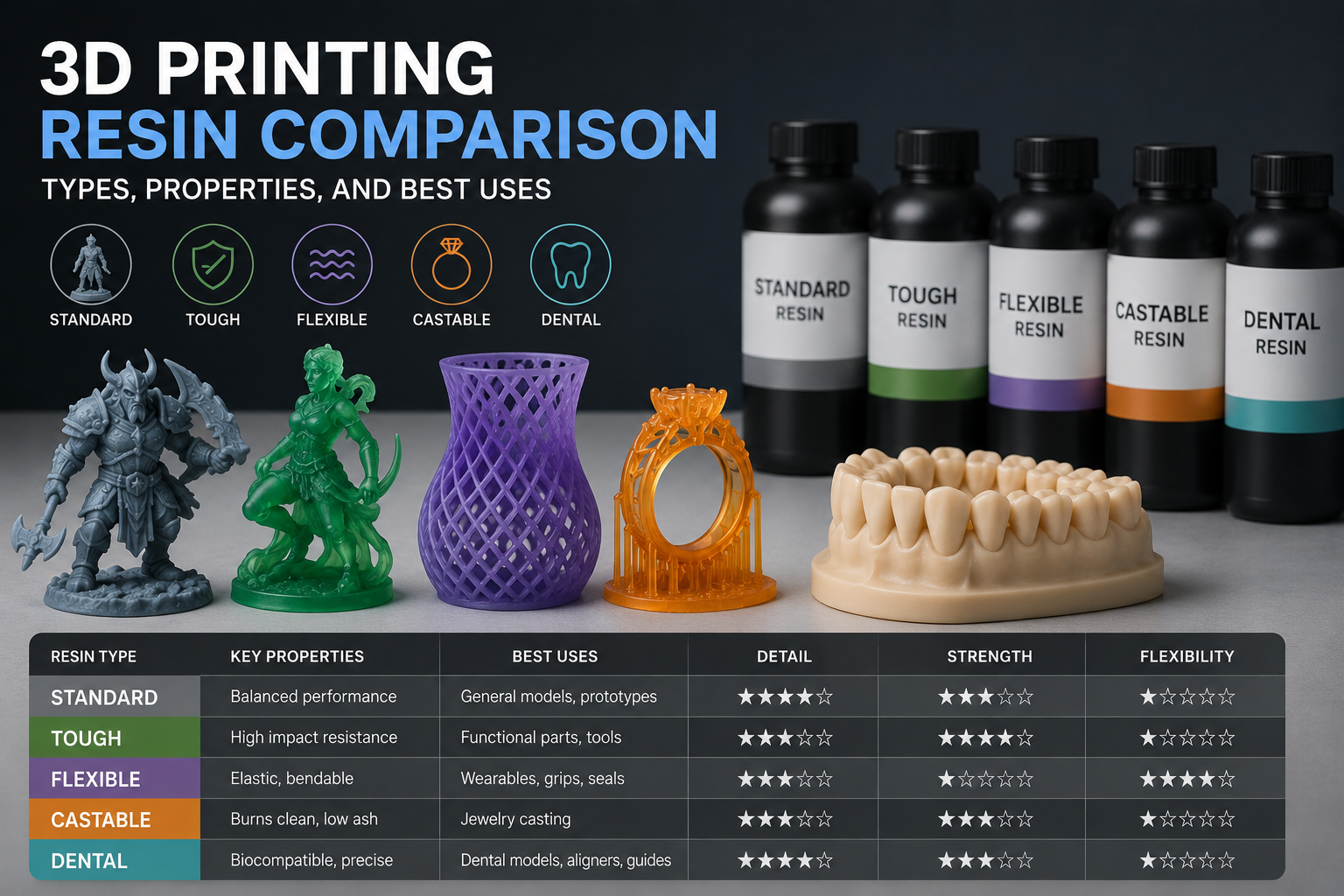
3D Printing Resin Types Compared
Not all resins are created equal. This table compares the nine main resin categories by their mechanical properties, cleaning requirements, and ideal use cases.
| Resin Type | Tensile Strength | Elongation | Hardness | Heat Deflection | Viscosity | Wash Method | Price / kg | Best For |
|---|---|---|---|---|---|---|---|---|
| Standard | 35–55 MPa | 5–15% | 75–85 Shore D | 45–60 °C | 150–350 mPa·s | IPA | $18–$35 | Miniatures, prototypes, display models |
| ABS-Like | 40–60 MPa | 15–35% | 75–85 Shore D | 50–70 °C | 150–400 mPa·s | IPA | $25–$42 | Functional parts, handled figures |
| Tough / Durable | 45–70 MPa | 20–60% | 70–85 Shore D | 55–80 °C | 350–900 mPa·s | IPA | $30–$65 | Jigs, brackets, mechanical parts |
| Flexible | 5–25 MPa | 60–160%+ | 40–80 Shore A/D | 35–55 °C | 500–1500 mPa·s | IPA | $45–$90 | Gaskets, grips, hinges |
| High-Temp | 40–75 MPa | 2–10% | 80–90 Shore D | 100–220 °C | 250–1000 mPa·s | IPA | $55–$120 | Molds, heat-exposed fixtures |
| Castable | 20–40 MPa | 3–10% | 70–80 Shore D | 45–65 °C | 200–600 mPa·s | IPA | $45–$150 | Jewelry, investment casting |
| Dental / Medical | Certified workflow | Certified workflow | Varies | Varies | Varies | Validated | $100–$300+/L | Dental models, surgical guides |
| Water-Washable | 30–55 MPa | 5–20% | 75–85 Shore D | 45–65 °C | 150–400 mPa·s | Water | $20–$40 | Beginners, easy cleanup |
| Ceramic / Filled | 25–50 MPa | 2–8% | 85–95 Shore D | 60–80 °C | 400–1200 mPa·s | IPA | $60–$180 | Art objects, high-stiffness parts |
Best 3D Printing Resins by Brand — Head-to-Head Comparison
We tested and compared the most popular resin brands across key properties. Here are the products that deliver the best results for each resin category.
Standard Resin — Brand Comparison
| Product | Tensile Strength | Elongation | Hardness | HDT | Viscosity | Bottle Size | Price | Buy |
|---|---|---|---|---|---|---|---|---|
| Anycubic Standard Resin | 35–55 MPa | 5–15% | 75–85 Shore D | 45–60 °C | 150–350 mPa·s | 1000 ml | $20–$35 | Check Price |
| Elegoo Standard Resin | 35–55 MPa | 5–15% | 75–85 Shore D | 45–60 °C | 150–350 mPa·s | 1000 ml | $22–$38 | Check Price |
| SUNLU Standard Resin | 30–50 MPa | 5–12% | 72–83 Shore D | 42–55 °C | 150–300 mPa·s | 1000 ml | $18–$30 | Check Price |
ABS-Like Resin — Brand Comparison
| Product | Tensile Strength | Elongation | Hardness | HDT | Bottle Size | Price | Buy |
|---|---|---|---|---|---|---|---|
| Elegoo ABS-Like Resin | 40–60 MPa | 15–35% | 75–85 Shore D | 50–70 °C | 1000 ml | $25–$42 | Check Price |
| Anycubic ABS-Like Resin | 40–58 MPa | 15–30% | 75–85 Shore D | 50–68 °C | 1000 ml | $25–$40 | Check Price |
Tough / Durable Resin — Brand Comparison
| Product | Tensile Strength | Elongation | Hardness | HDT | Bottle Size | Price | Buy |
|---|---|---|---|---|---|---|---|
| Siraya Tech Blu | 45–70 MPa | 20–60% | 70–85 Shore D | 55–80 °C | 500 ml | $35–$55 | Check Price |
| Elegoo Tough Resin | 42–65 MPa | 15–40% | 72–85 Shore D | 55–75 °C | 1000 ml | $30–$50 | Check Price |
Flexible Resin — Brand Comparison
| Product | Tensile Strength | Elongation | Hardness | Bottle Size | Price | Buy |
|---|---|---|---|---|---|---|
| Siraya Tech Tenacious | 5–25 MPa | 60–160%+ | 40–80 Shore A/D | 500 ml | $45–$90 | Check Price |
Water-Washable Resin — Brand Comparison
| Product | Tensile Strength | Elongation | Hardness | Low Odor | Bottle Size | Price | Buy |
|---|---|---|---|---|---|---|---|
| Elegoo Water Washable Resin | 30–50 MPa | 5–18% | 74–85 Shore D | Yes | 1000 ml | $22–$40 | Check Price |
| Anycubic Water Washable Resin | 32–52 MPa | 5–16% | 75–85 Shore D | Yes | 1000 ml | $22–$38 | Check Price |
| SUNLU Water Washable Resin | 30–55 MPa | 5–20% | 75–85 Shore D | No | 1000 ml | $20–$38 | Check Price |
High-Temperature & Castable Resin — Brand Comparison
| Product | Type | Tensile Strength | HDT | Bottle Size | Price | Buy |
|---|---|---|---|---|---|---|
| Phrozen TR300 | High-Temp | 40–75 MPa | 100–220 °C | 1000 ml | $55–$100 | Check Price |
| Siraya Tech Cast | Castable | 20–40 MPa | 45–65 °C | 500 ml | $50–$90 | Check Price |
| Phrozen Ceramic Resin | Ceramic-Filled | 25–50 MPa | 60–80 °C | 1000 ml | $60–$120 | Check Price |
Understanding 3D Printing Resin Types
Resin 3D printing (SLA/DLP/MSLA) uses UV light to cure liquid photopolymer resin layer by layer, producing parts with incredible detail and smooth surface finishes that FDM printers cannot match. But choosing the right resin is critical — the wrong resin means failed prints, wasted money, or parts that don’t perform as needed.
Standard Resin
The workhorse of resin printing. Standard resin is affordable, prints reliably, and produces excellent detail. It’s perfect for miniatures, display models, and basic prototypes. Most standard resins cure at 405nm wavelength and wash in IPA (91%+). Best for: Beginners, hobbyists, anyone printing decorative or display pieces. Shop standard resin on Amazon →
ABS-Like Resin
A tougher formulation designed to mimic the mechanical properties of ABS filament. ABS-like resins offer better impact resistance and elongation than standard resin, making them suitable for parts that need some durability. The trade-off is slightly higher viscosity and often longer post-cure times. Best for: Functional prototypes, snap-fit parts, figures that will be handled. Shop ABS-like resin on Amazon →
Tough / Durable Resin
Engineered for mechanical applications. Tough resins like Siraya Tech Blu offer significantly higher impact strength, elongation, and heat resistance. They’re more expensive and sometimes harder to print, but they produce parts that can actually bear loads and survive impacts. Best for: Jigs, fixtures, brackets, mechanical prototypes. Shop tough resin on Amazon →
Flexible Resin
Produces rubber-like, bendable parts with very high elongation (60–160%+) but lower tensile strength. Flexible resins like Siraya Tech Tenacious require careful printing — they’re high-viscosity and need precise exposure calibration. Best for: Gaskets, grips, wearables, cushioning elements. Shop flexible resin on Amazon →
High-Temperature Resin
Designed for applications where heat resistance matters. After proper post-curing, these resins can withstand temperatures of 100–220°C — enough for vulcanizing molds, hot-air fixtures, and temperature-exposed prototypes. Best for: Molds, hot-air fixtures, prototypes exposed to heat. Shop high-temp resin on Amazon →
Castable Resin
Burns out cleanly in investment casting, leaving minimal ash residue. Used primarily in jewelry making and small metal casting. Requires precise burnout schedules — follow manufacturer instructions exactly. Best for: Jewelry masters, dental casting patterns, small metal casting. Shop castable resin on Amazon →
Water-Washable Resin
Can be cleaned with water instead of isopropyl alcohol (IPA). More convenient and safer for home use, though the resin still requires proper PPE and ventilation. Slightly different mechanical properties than standard resin — often a bit more brittle. Best for: Beginners, home setups without IPA access, easy-cleanup workflows. Shop water-washable resin on Amazon →
Resin Wash and Cure — Best Practices & Equipment
Proper washing and curing is essential for strong, safe resin prints. Here’s the recommended workflow.
Washing Your Resin Prints
- Remove supports before washing when possible — it’s easier and reduces IPA contamination of support marks.
- First wash: Submerge in IPA (91%+ recommended) for 2–3 minutes, agitating gently. A dedicated wash station makes this much easier and less messy.
- Second wash: Use fresh IPA for 1–2 minutes to remove any remaining uncured resin.
- Air dry for 10–15 minutes or use compressed air to remove IPA from crevices.
- Water-washable resins: Follow the same process but use warm water instead of IPA. Dry thoroughly before curing.
UV Curing Your Resin Prints
- UV curing station recommended — provides consistent, even curing. Shop curing stations on Amazon →
- Typical cure time: 3–10 minutes depending on resin type and part size.
- Rotate parts during curing for even exposure.
- Don’t over-cure — extended curing can make parts brittle, especially standard resins.
- Tough/High-temp resins may require longer post-cure schedules. Follow manufacturer recommendations.
Resin 3D Printing Safety Guide
⚠️ Essential Safety Precautions
- Always wear nitrile gloves when handling uncured resin, prints, or cleaning equipment. Shop nitrile gloves →
- Use in a well-ventilated area — resin fumes can cause headaches and sensitization over time.
- Wear safety glasses to protect against splashes.
- Never pour resin down the drain. Cure leftover resin in sunlight before disposal.
- Wash hands thoroughly after any contact, even with gloves.
- Store resin in a cool, dark place away from UV light sources.
- Use a ventilation system or enclosure for your resin printing workspace.
Choosing the Right Resin for Your Project
| If you want… | Use this resin | Why |
|---|---|---|
| Tabletop miniatures & display models | Standard or ABS-Like | Fine detail, affordable, ABS-like for durability |
| Functional brackets & jigs | Tough / Durable | Impact resistance, load-bearing |
| Jewelry & casting patterns | Castable | Clean burnout, high detail |
| Rubber gaskets & grips | Flexible | High elongation, rubber-like |
| First-time resin printer | Water-Washable | No IPA needed, easy cleanup |
| Heat molds & fixtures | High-Temp | Withstands 100°C+ after curing |
3D Printing Resin FAQ
Is resin printing safe?
Resin printing is safe when proper precautions are followed: wear nitrile gloves, use adequate ventilation, wear eye protection, and never handle uncured resin with bare hands. Always cure resin fully before handling prints without gloves.
Can I mix different resin types?
Some resins can be mixed (e.g., Siraya Tech recommends mixing Tenacious with other resins for added toughness), but always check manufacturer compatibility. Mixing incompatible resins can cause separation, poor curing, or weak prints.
How should I store resin?
Store in the original opaque bottle, tightly sealed, in a cool dark place (15–25°C). Resin has a typical shelf life of 12–24 months. Don’t pour used resin back into a fresh bottle — strain it first to remove cured particles.
Water-washable vs IPA: which is better?
IPA cleaning is more thorough and produces slightly stronger parts. Water-washable resin is more convenient and safer for home use but may have slightly different mechanical properties. For beginners, water-washable is a great starting point.
How do I dispose of resin waste?
Cure all liquid resin waste by exposing it to UV light or strong sunlight until fully solid. Once cured, it can typically be disposed of as regular waste (check local regulations). Never pour uncured resin down any drain.
What’s the difference between SLA, DLP, and MSLA?
SLA uses a laser to trace each layer. DLP uses a projector to cure an entire layer at once. MSLA (most consumer printers) uses an LCD screen to mask a UV LED array — it’s the most affordable and common type today. All three use similar resins.
Related Resources
- 3D Printer Comparison Tool — Compare FDM and resin printers side by side
- Filament Settings Database — Find FDM print settings for your printer and filament
- Materials & Filaments Guide — Understanding 3D printing materials