
Researchers from Romania have studied the mechanical properties of parts fabricated from polylactic acid, releasing the details of their recent study in ‘Mechanical Behavior of 3D Printed PLA Hollow Spherical Parts Under Axial Compression.’
Often used in the construction of bearings and spherical joints, spherical parts usually assist as intermediates in the movement of other components; for example, they may allow rotation to occur or for one part to slide smoothly toward another. Filled spheres tend to be more rigid, while cave spheres are elastic.
Users may employ both metallic and non-metallic materials, and the authors note that ‘plastics present a particular interest.’ In this study, the researchers focused on cave spheres produced from plastic while under compression.
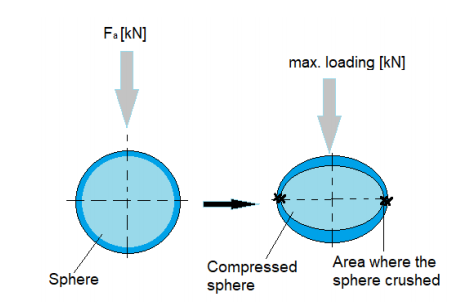
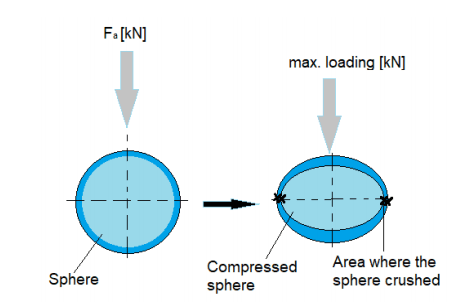
Expected elastic behavior of a spherical hollow part under the action of an axial compression force
While there are numerous methods for fabrication of parts, additive manufacturing is of interest to the authors in this study—especially in terms of the following results:
- Surface roughness
- Surface layer properties
- Material homogeneity
“In the case of the technological process of manufacturing the spherical parts, some process input factors can influence the surface roughness of the final product,” explain the researchers. “If 3D printing is taken into consideration as a manufacturing solution, then the process seems to be simple enough and of good quality from the surface aspect.”
“In practice, there is some important kind of stresses which are convenient for the technical uses of the parts. For example, the compression stress reveals how resistant is a spherical part under a certain force until the part is deformed and loses the properties of being used.”
A hollow sample part was 3D-printed to understand more about typical mechanical properties, along with compression-resistance, and elastic behavior.
“Sometimes there are situations when the elastic behavior under compression axial forces is of technical and functional interest,” said the authors.
The sample was composed in an L9 Taguchi orthogonal design, featuring four different variables for three experimental levels. Nine combinations are considered total with that particular design, revealing the effects of axial compression tests. A simulation was prepared, using the finite element method, offering insight into material behavior before beginning formal research—along with assisting in projections for crack generation.
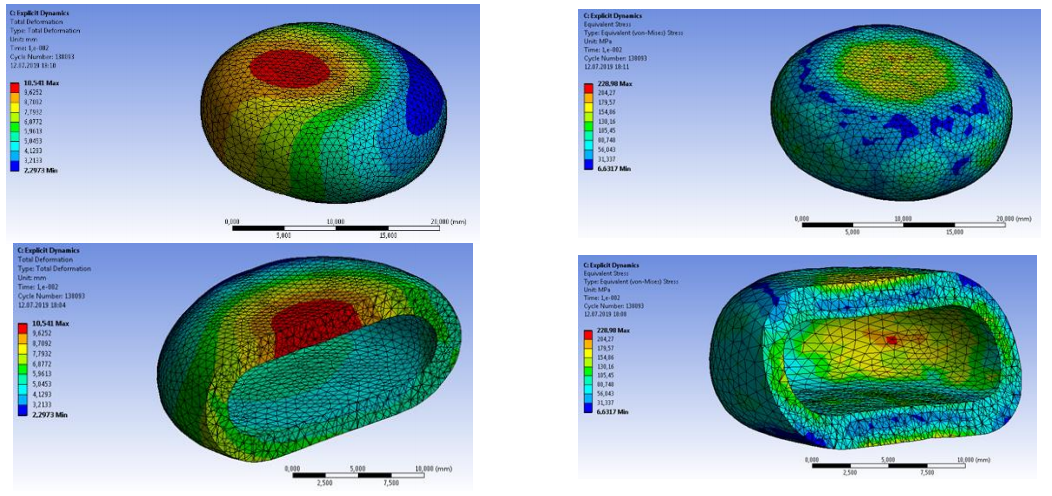
Simulation using the finite element method of the new shape of the plastic
spherical hollow part under the action of the axial compression force
(wall thickness h= 2 mm, axial force max. Fa=7.189,97 daN)
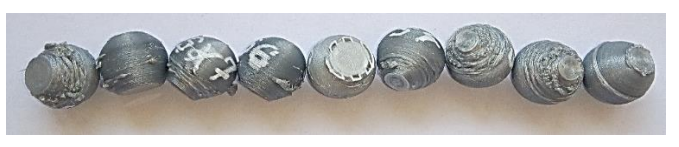
Test pieces obtained by 3D printing before applying the axial compression tests
The test sample was printed with silver metallic PLA on an Ultimaker 2+, with no finishing permitted after fabrication—lest new elements introduced into the part could affect compression testing.

Experimental conditions and results
“One could remark the similarities between the plastic spherical hollow parts behaviors simulated employing the finite element method and the real behavior proved by the experimental testing; this means that the considerations formulated when theoretically analyzing the deformation conditions of the spherical parts were correct,” concluded the authors.
“The analysis of the model showed that the maximum influence on the elasticity of the parts was exerted by the printing plate temperature. See also: The Current State of Metal 3D Printing in 2020. As expected, the increase of the part wall thickness determines an increase of the plastic spherical part elasticity. In the future, extended experiments could be developed, to evaluate the effect exerted also by other manufacturing process input factors on the behavior of the parts under axial compression efforts.”
Researchers continue to find better ways to predict and improve mechanical properties, studying other influences like color, porosity, and more. What do you think of this news? Let us know your thoughts! Join the discussion of this and other 3D printing topics at 3DPrintBoard.com.
[Source / Images: ‘Mechanical Behavior of 3D Printed PLA Hollow Spherical Parts Under Axial Compression’]
The post Testing the Strength of Hollow, 3D-Printed PLA Spheres appeared first on 3DPrint.com | The Voice of 3D Printing / Additive Manufacturing.
from Your daily news from 3DPrint.com https://bit.ly/2XhV8LK
Where to Buy Filament
Disclosure: Some of the links below are affiliate links. If you make a purchase, we may earn a commission at no extra cost to you. This helps support this site.
- PLA: Hatchbox
Looking for Filament? Check the best deals on Amazon:
These links go to Amazon with our affiliate tag. If you prefer to support local retailers or buy directly from manufacturers, we encourage that as well!
Related Articles
Frequently Asked Questions
What is the best 3D printing filament for beginners?
PLA is the best starting filament — it prints easily at 190-220°C without an enclosure and produces good results. Once comfortable, PETG offers better strength and temperature resistance for functional parts.
How do I choose the right filament?
Consider the application: PLA for display models, PETG for functional parts, ABS/ASA for heat/sunlight exposure, TPU for flexible parts, and specialty filaments for engineering applications. Each has specific printer requirements.
What temperature should I print different filaments at?
PLA: 190-220°C nozzle / 50-60°C bed. PETG: 220-250°C / 70-80°C. ABS: 230-260°C / 100-110°C (enclosure needed). Nylon: 240-270°C / 70-90°C. Always check manufacturer recommendations for specific brands.
📌 Related Articles
- Best 3D Printer Upgrades That Actually Improve Print Quality: Complete 2026 Guide
- The Current State of Metal 3D Printing in 2020
- Best Budget 3D Printer Upgrades That Actually Improve Print Quality: Belts, Springs, Hotends & More
- 3D Printing News: Multi-Material Breakthrough and Aerospace Market Boom
- 3D Printing Tungsten Carbide: How Hot-Wire Laser Technology Creates Metal Harder Than Steel