
When it comes to tech news, we always have to be wary of new technologies, particularly when they come from startups. We don’t need to remind readers of Theranos and the impact it had on the perception of revolutionary new companies.
Today, Colorado-based Boom Supersonic has made a first step toward dispelling any disbelief about the startup’s ability to build aircraft that can travel faster than the speed of sound with the unveiling of the XB-1, a prototype vehicle meant to demonstrate the firm’s capabilities. While the potential to travel faster than sound is impressive in itself, the XB-1 project is notable for the fact that it features 21 3D printed parts.
The XB-1 is a demonstrator one-third the size of the ultimate Overture passenger plane Boom aims to roll out in 2025, with certification completed in 2029. Boom relied on metal 3D printing technology from VELO3D, as well as polymer additive manufacturing from Stratasys, in the construction of the aircraft. In total, 21 3D printed parts can be found in its engine hardware and environmental control system, as well as structural parts.
The partnership between Boom and Stratasys began as early as 2017. Not only was Stratasys fused deposition modeling (FDM) used to create production tools and aids, but parts produced on the Stratasys F900 made it into the final aircraft as well.
VELO3D’s unique metal 3D printing process was deployed for the production of critical titanium parts, including 12 Variable Bypass Valve engine and fuselage manifolds, four NACA ducts, and various louvers. While the Variable Bypass Valve manifolds are used to cool the plane’s outer mold line by directing air released by the engine’s compressor, the NACA ducts send exterior air to cool the XB-1’s engine bays. Exit louvers act as part of the environmental control system to cool the systems bay and cockpit of the aircraft, with other louvers also being used to cool the outer mold line of the vehicle.
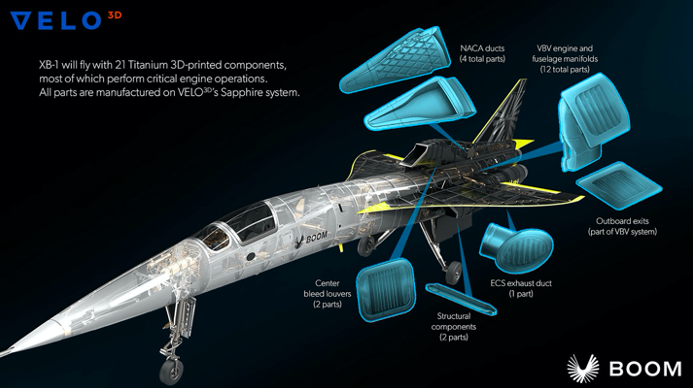
Image courtesy of VELO3D.
VELO3D founder and CEO, Benny Buller, explained: “Most of where we’ve been working with Boom has been on the engine system–specifically on the intake of the engines. Our parts help them control the air coming in, and help with cooling of the engine. They’re titanium parts that are very mission-critical.”
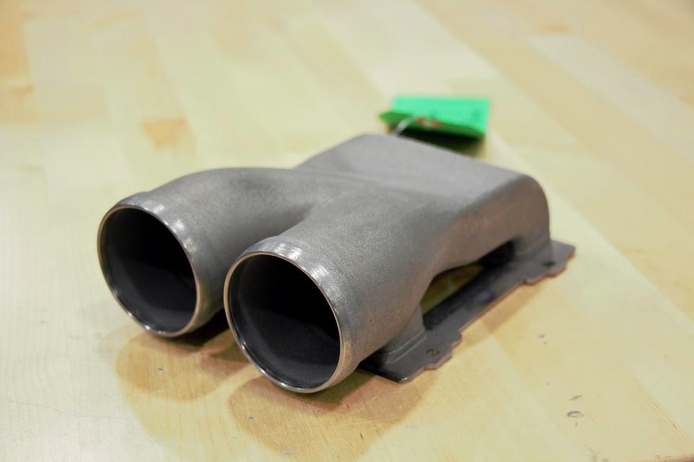
Internal flow passages from the XB-1 ‘s Variable Bleed Valve fuselage manifolds, 3D-printed by VELO3D. Image courtesy of VELO3D.
Not only was Boom Supersonic able to construct the XB-1 in just a year’s time, but it was able to do so amid a devastating pandemic. 3D printing clearly played a role in that process, given the ability to quickly iterate complex designs and then bring them into production.
Boom CEO and founder Blake Scholl said, “With 3D printing, we were able to prototype a lot of parts much faster. With old design methods, you’d design a part in CAD, have the part made, try it, find the problems, then reiterate over and over. Each iteration could take weeks. With 3D printing, you mock the parts up, print them, and try them the next day. You can try things you wouldn’t try otherwise, because it’s too expensive and time-consuming the old way.”
As Boeing and Airbus halted production in response to the COVID-19 outbreak, Boom found itself moving more quickly, with Scholl saying, “Covid has actually allowed us to go faster on Overture. The Boeing and Airbus pause helped our supply situation.” The company hired on Gulfstream’s Brian Durrence from Gulfstream as SVP of Overture Development and partnered with Rolls-Royce for the creation of Overture’s engines. The startup plans to unveil designs for a single engine at a later point in October.
So far, the only successful supersonic aircraft for commercial travel was the Concorde, which was decommissioned in 2003. See also: 3D Printing News: Multi-Material Breakthrough and …. Boom believes it has overcome issues faced with this predecessor jet through the use not only of 3D printing, but advanced materials, as well. Due to the extreme heat faced by aircrafts in supersonic flight, carbon fiber has been seen as the ideal replacement for aluminum, which can’t deal with high temperatures as well. This caused some problems the Concorde experienced, according to Scholl.
The XB-1 is scheduled for its first flight in 2021. The ultimate goal is to fly passengers aboard the Overture at speeds of 1,500 mph from destinations such as Tokyo to Seattle in just four-and-a-half hours, rather than the current eight hours and thirty minutes. Perhaps more importantly, given the state of our planet’s ecosystem, Boom aims to do deliver this capability in what it claims to be a sustainable manner. The startup suggests that it uses carbon neutral production, alternative fuels and is obtaining LEED certification on its manufacturing facility. The proof is in the pudding, of course, given that many so-called sustainability initiatives in the corporate sector often use such terms as “carbon neutral” as a means of adding a green coating to what is typically business as usual.
The post Boom Supersonic Unveils XB-1 Airplane with 21 3D Printed Parts appeared first on 3DPrint.com | The Voice of 3D Printing / Additive Manufacturing.
from 3DPrint.com | The Voice of 3D Printing / Additive Manufacturing https://bit.ly/3iC7NQR
Where to Buy Filament
Disclosure: Some of the links below are affiliate links. If you make a purchase, we may earn a commission at no extra cost to you. This helps support this site.
These links go to Amazon with our affiliate tag. If you prefer to support local retailers or buy directly from manufacturers, we encourage that as well!
Related Articles: The Value Proposition of 3D Printed Airplane Parts, via Stratasys Aerospace · Czinger Unveils 1232-HP Hypercar with 3D Printed Parts · ORNL’s New AI Platform Assesses 3D Printed Parts in Real-Time
Frequently Asked Questions
What is metal 3D printing?
Metal 3D printing (additive manufacturing) builds metal parts layer by layer using techniques like laser powder bed fusion, directed energy deposition, and binder jetting. It enables complex geometries impossible with traditional manufacturing while reducing material waste significantly.
How strong are 3D printed metal parts?
3D printed metal parts can achieve mechanical properties comparable to traditionally manufactured metals. Tensile strength and fatigue resistance depend on the process and post-processing, but many meet or exceed ASTM standards for wrought materials.
What are the main metal 3D printing technologies?
The primary technologies include Laser Powder Bed Fusion (LPBF), Electron Beam Melting (EBM), Directed Energy Deposition (DED), Binder Jetting, and Metal FDM (with bound filaments). Each has different strengths in terms of resolution, speed, and material options.
📌 Related Articles
- The Current State of Metal 3D Printing in 2020
- 3D Printing News: Multi-Material Breakthrough and Aerospace Market Boom
- ABS 3D Printing Settings Guide: Temperature, Enclosure, and Cooling for Strong Parts
- Best 3D Printer Upgrades That Actually Improve Print Quality: Complete 2026 Guide
- 3D Printing Tungsten Carbide: How Hot-Wire Laser Technology Creates Metal Harder Than Steel