
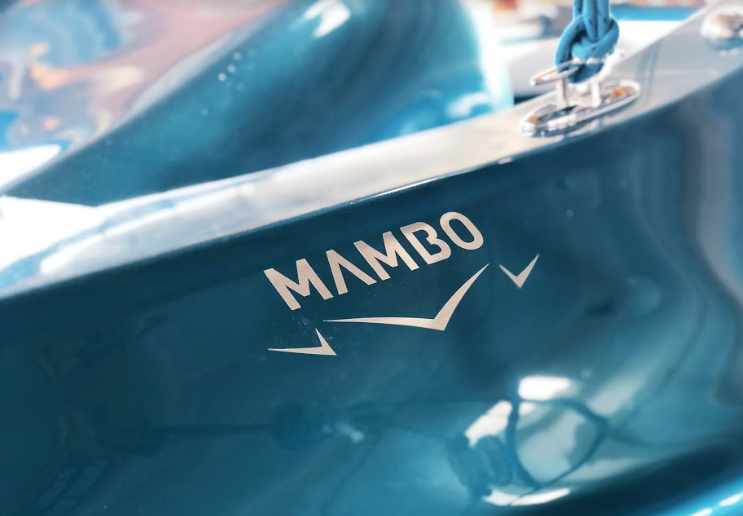
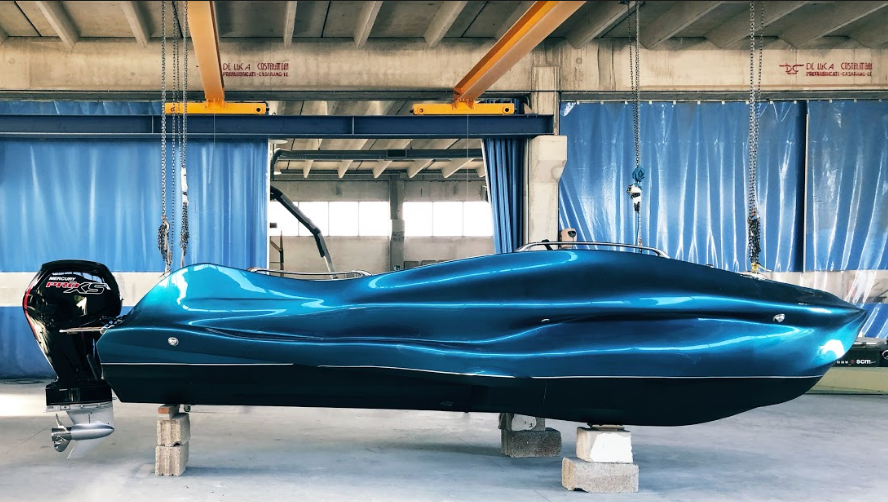
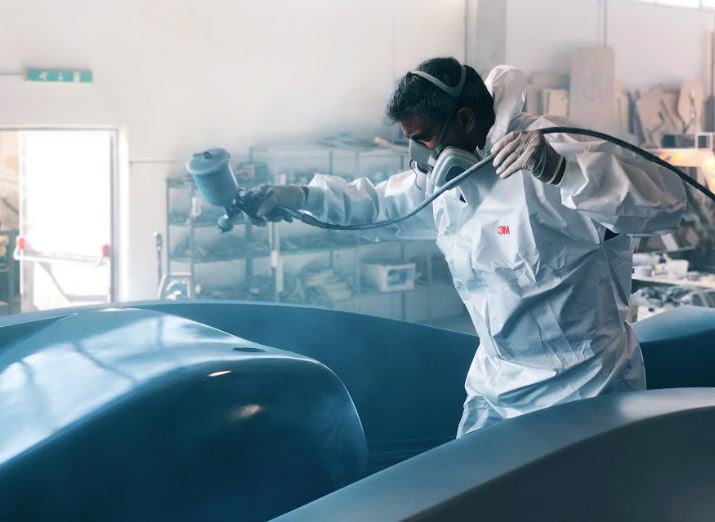
European tech startup moi composites has just announced the unveiling of the completed MAMBO—a 3D printed fiberglass boat. The innovative motor additive manufacturing boat has been fabricated via continuous fiberglass thermoset material to form a trimaran featuring a glossy blue hull.
 Showing their boat off on display (as well as their talent at cross-scaling and cross-marketing as they dabble in marine applications) at the 2020 Genoa Boat Show from October 1-6, moi composites plans to introduce their target audience to “the next generation of boat design and manufacturing.”
One of the most exciting benefits of 3D printing and additive manufacturing processes is that while the technology is able to make improvements on many items in comparison to those made with traditional methods, many times new and unique products (of all shapes and sizes) are also now possible when they would not have been previously with conventional techniques.
The MAMBO boat is a good example. 3D printed with continuous fiber manufacturing (CFM), a patented, proprietary 3D printing technology from moi, the MAMBO is meant to be incredibly durable (a requirement for any boat, actually) and strong, but also light in weight.
Understanding Filament Properties
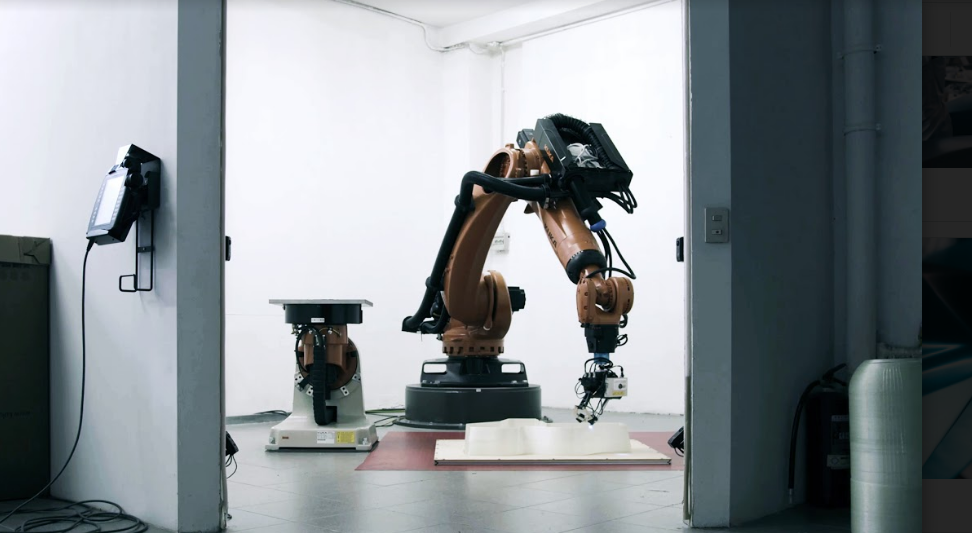
CFM relies on a set of generative algorithms to guide KUKA Quantec High Accuracy robots in 3D printing parts with scalability, customization, and high mechanical performance. The robots begin by depositing the fibers, filled with thermosetting resin—allowing for greater efficiency and affordability in creating on-demand parts and prototypes that are reinforced with features similar to unidirectional fiberglass. The resulting product is made without any requirements for models, molds, or tooling equipment.
“We participated in the Genoa boat show in 2017, and it was during this event that we came up with the idea of making MAMBO. We saw the project take shape first, then brought it to life, and finally MAMBO arrived today at the sea,” says Gabriele Natale, CEO & Co-founder of Moi Composites.
Material Comparison and Selection
“We have 3D printed a boat, enhancing the concept of customization with a one-of-a-kind design created and tailored from the owner’s mind, to give everyone the opportunity to understand and experience the sea in their own way. All this would not have happened without the support of our partners, who believed with us in this ambitious project.”
The 3D printed boat is 6.5 meters long by 2.5 meters wide, featuring a dry weight of 800 kg. It also includes plush leather seats, a functional navigation system, cork floors, and a 115 cv engine. Inspired by the work of Sonny Levi (specifically, “Arcidiavolo”), the boat hull is created after an inverted tricycle design. Large pieces were printed and then joined into a “sandwich structure,” eliminating any separation between the hull and deck.
Sponsors behind the development of the MAMBO included Autodesk, Owens Corning, Osculati, Cat Marine, Mercury Marine, Micad, and UCINA. Visit moi at stand BB9 of the 60th Genoa Boat Show!
Print Settings and Optimization
[Source / Images: moi composites]
The post MAMBO Fiberglass 3D Printed Boat Complete, On Display at Genoa Boat Show appeared first on 3DPrint.com | The Voice of 3D Printing / Additive Manufacturing.
Strength and Durability Testing
from 3DPrint.com | The Voice of 3D Printing / Additive Manufacturing https://bit.ly/2HGKKYj
Related Articles: 3D Printed Hotel Habitas Todos Santos to Feature 80 Units, First Suite Complete · Czech Republic: 3D-Printed Home to Be Anchored on Pontoon Boat · Following Up on Patients with Complete 3D Printed Dentures Made with Hybrid Nanocomposite
Frequently Asked Questions
What is the best 3D printing filament for beginners?
PLA is the best starting filament — it prints easily at 190-220°C without an enclosure and produces good results. Once comfortable, PETG offers better strength and temperature resistance for functional parts.
How do I choose the right filament?
Consider the application: PLA for display models, PETG for functional parts, ABS/ASA for heat/sunlight exposure, TPU for flexible parts, and specialty filaments for engineering applications. Each has specific printer requirements.
What temperature should I print different filaments at?
PLA: 190-220°C nozzle / 50-60°C bed. PETG: 220-250°C / 70-80°C. ABS: 230-260°C / 100-110°C (enclosure needed). Nylon: 240-270°C / 70-90°C. Always check manufacturer recommendations for specific brands.
📌 Related Articles
- Best 3D Printer Upgrades That Actually Improve Print Quality: Complete 2026 Guide
- ABS 3D Printing Settings Guide: Temperature, Enclosure, and Cooling for Strong Parts
- Best Budget 3D Printer Upgrades That Actually Improve Print Quality: Belts, Springs, Hotends & More
- 3D Printing Safety Equipment Guide: Respirators, Gloves, and Ventilation for 2026
- Creality Creality Ender 3 V3 Plus vs Creality Ender 3 Pro: Full Specs Comparison & Buyer’s Guide