
Researchers from Greece experiment with sustainability in materials, detailing the findings of their study in the recently published ‘Sustainable Additive Manufacturing: Mechanical Response of Acrylonitrile-Butadiene-Styrene Over Multiple Recycling Processes.’
The study of materials science is enormous within the 3D printing user and research community today, ever-expanding as one innovation after another comes along—requiring specific software, hardware, and filaments, resins, or powders. Polymers, in particular, continue to be popular with users on all experience levels, mainly due to good operating temperatures, thermal properties, and corrosion resistance.
“Several studies have focused on the recyclability of polymer wastes by extruding them and then injection molding them into new parts or specimens to examine their mechanical, physical, and thermal properties,” stated the researchers. “Another novel strategy is to mix natural biodegradable material wastes, i.e., banana fibers or mussel shells with recycled polymer wastes, that can lead to the effective reduction of plastic waste.”
Research has also centered around recycling for industrial additive manufacturing technology, allowing for a variety of materials to be re-used. The following show good potential for recycling too: polyethylene terephthalate (PET), polyamide (PA) powders, aluminum oxide powders, and stainless-steel powders.
Researchers are also considering the feasibility of recycling and combining low-and high-density polyethylene (LDPE/HDPE). For FFF 3D printing, low-density polyethylene (LDPE), high-density polyethylene (HDPE), polyethylene (PE), polypropylene (PP), nylon, and other alternatives like recycled tires.
Much research has also centered around the recycling of and biodegradability of polylactic acid (PLA), one of the most popular 3D printing materials too, with the authors noting that while there has been increased focus on re-using materials, differences in quality have been noted regarding comparisons with virgin 3D printing filaments.
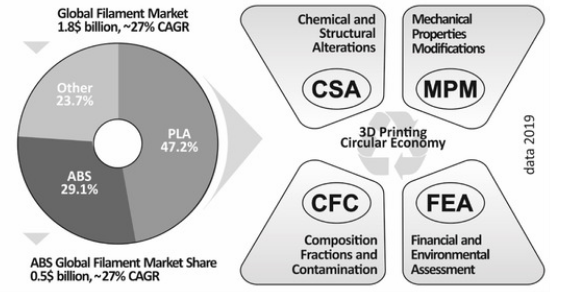
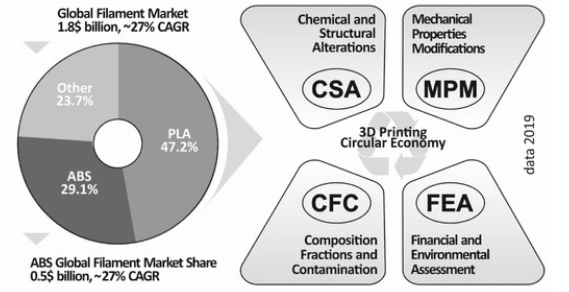
3D printing circular economy critical parameters and global filament market volume in 2019 (market volume data source: https://www.marketwatch.com/).
For this study, the researchers were mainly concerned with the effects on mechanical properties when printing with recycled acrylonitrile-butadiene-styrene (ABS) polymers. The powder was used to create a virgin filament for extrusion, fabricating test samples for the study which were then measured, evaluated, and tested. The leftover filament was recycled into pellets for extruding (using a 3devo shredder), with mechanical properties then tested further.
The researchers performed six series of recycling in all, with samples 3D printed on a Flashforge Inventor.

ABS samples were printed for the following tests:
- Tensile
- Compression
- Flexion
- Impact
- Micro-hardness
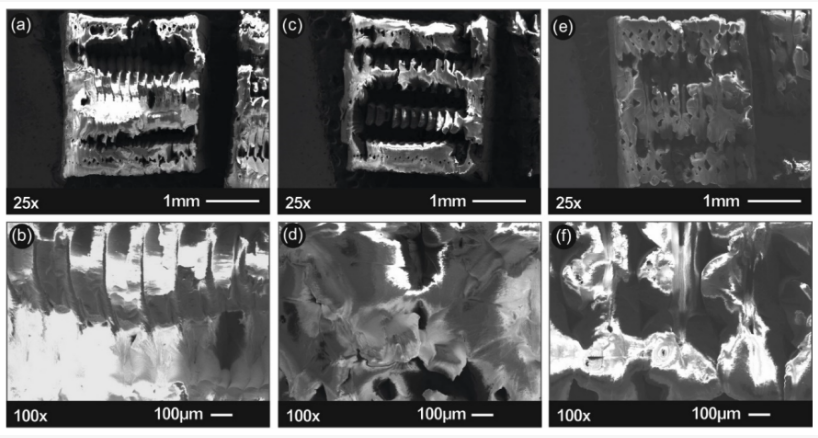
SEM images of the tensile fracture area of the representative specimens for 1st (a,b), 2nd (c,d) and 3rd (e,f) recycle course.
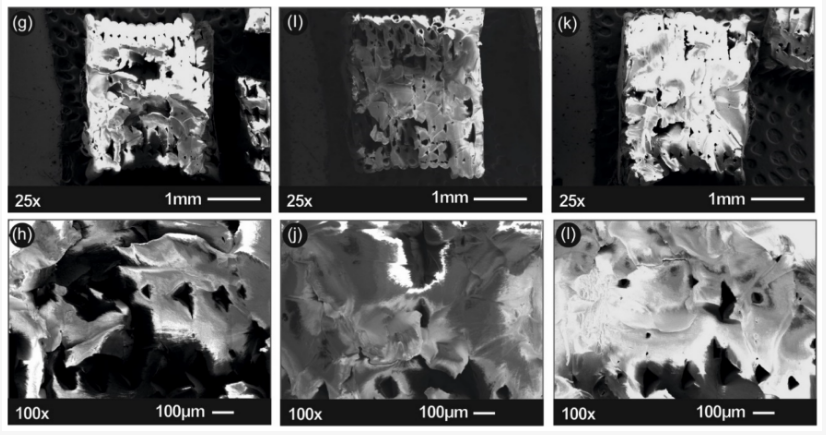
SEM images of the tensile fracture area of the representative specimens for 4th (g,h), 5th (i,j) and 6th (k,l) recycle course.
Overall, mechanical properties increased until the fifth recycling series.

Overall results on the mechanical properties of the virgin and recycled ABS in the 6 recycle courses studied.
“The increase in the mechanical properties of the specimens until the fifth cycle and the decrease in the sixth cycle can be justified due to the assumption that the first polymer thermal cycling courses cause re-alignment of the amorphous polymer chains, thus increasing the molecule interactions, stability and overall mechanical response of the polymer,” concluded the researchers. “After the fifth recycling course, chemical degradation takes place, breaking parts of the polymer chains, which is responsible for the decrease in the mobility of the ABS chains and increase in the Tg temperature of the polymer.”
“The next steps based upon this work are to study the structuring, morphology and thermal properties changes of ABS filament throughout this recycling process.”
What do you think of this news? Let us know your thoughts! Join the discussion of this and other 3D printing topics at 3DPrintBoard.com.
[Source / Images: ‘Sustainable Additive Manufacturing: Mechanical Response of Acrylonitrile-Butadiene-Styrene Over Multiple Recycling Processes’]
The post Recycling Filaments: Evaluating the Mechanical Response of ABS in Multiple Cycles appeared first on 3DPrint.com | The Voice of 3D Printing / Additive Manufacturing.
Where to Buy Filament
Disclosure: Some of the links below are affiliate links. If you make a purchase, we may earn a commission at no extra cost to you. This helps support this site.
- ABS: Hatchbox
- Nylon: Hatchbox, eSUN, Overture
- PLA: Hatchbox
Looking for Filament? Check the best deals on Amazon:
These links go to Amazon with our affiliate tag. If you prefer to support local retailers or buy directly from manufacturers, we encourage that as well!
Frequently Asked Questions
What is the best 3D printing filament for beginners?
PLA is the best starting filament — it prints easily at 190-220°C without an enclosure and produces good results. Once comfortable, PETG offers better strength and temperature resistance for functional parts.
How do I choose the right filament?
Consider the application: PLA for display models, PETG for functional parts, ABS/ASA for heat/sunlight exposure, TPU for flexible parts, and specialty filaments for engineering applications. Each has specific printer requirements.
What temperature should I print different filaments at?
PLA: 190-220°C nozzle / 50-60°C bed. PETG: 220-250°C / 70-80°C. ABS: 230-260°C / 100-110°C (enclosure needed). Nylon: 240-270°C / 70-90°C. Always check manufacturer recommendations for specific brands.
📌 Related Articles
- The Complete 3D Printing Filament Guide: Types, Properties & When to Use Each
- The Current State of Metal 3D Printing in 2020
- 3D Printing News: Multi-Material Breakthrough and Aerospace Market Boom
- 3D Printing Tungsten Carbide: How Hot-Wire Laser Technology Creates Metal Harder Than Steel
- ABS 3D Printing Settings Guide: Temperature, Enclosure, and Cooling for Strong Parts