
Chinese researchers experiment with new pumps for flow delivery systems, 3D printing prototypes. Their study is detailed in full in the recently published ‘Improved design and experimental analysis of valveless piezoelectric pump based on hemisphere-segment bluff-body.’
Piezoelectric devices are often connected with 3D printing today, from creating new materials to testing new techniques in bioprinting, to fabrication of sensors; however, in this study, the authors create a model for a valveless pump that can deliver fluids based on the inverse effects of a piezoelectric vibrator.
Previous studies have resulted in valveless designs, but in this work, the scientists sought to improve performance in flow further, by modifying the splitting angle of the hemisphere-segment bluff-body (HSBB). 3D printed prototypes allowed the researchers to test the pumps and analyze computational fluid dynamics, with the working process being split into four phases:
- The absorbing process – as the vibrator moves up, increasing chamber volume, the left pipe absorbs added fluid volume.
- The vibrator moves down, and the chamber volume decreases.
- The right pipe drains more fluid volume than the left.
- The ‘reciprocating vibration’ results in unidirectional fluid delivery in the chamber.
The Role of 3D Printing in Medicine
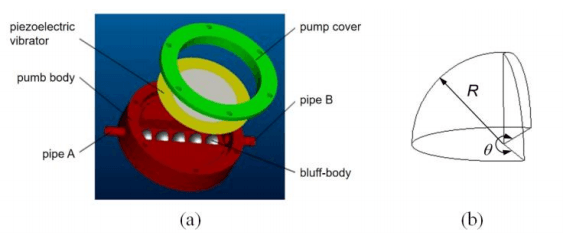
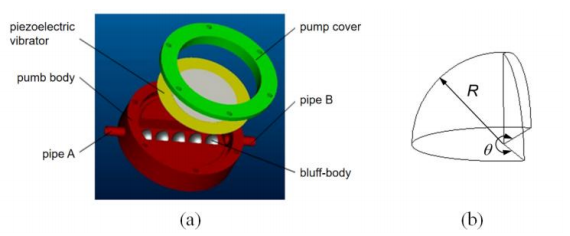
Structure of improved valveless piezoelectric pumps with HSBB of different splitting angles: (a) assembled structure, (b) geometry parameters of HSBB
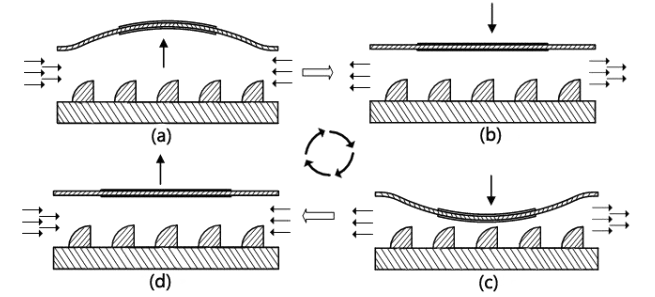
Working process of valveless piezoelectric pumps: (a) horizontal position to upper maximum position, (b) upper maximum position to horizontal position, (c) horizontal position to bottom maximum position, (d) bottom maximum position to horizontal position
“In the process of reciprocating motion of vibrator, the equation of paraboloid surface is utilized to simulate the deformation of vibrator for convenient calculation since the deformation surface of first order vibration is similar to paraboloid of revolution,” explain the researchers.
Biocompatible Materials and Processes
“Supposing the initial state of piezoelectric vibrator is at horizontal position when t = 0 and starts to move upward. The vibration amplitude at each point for piezoelectric vibrator keeps invariant.”
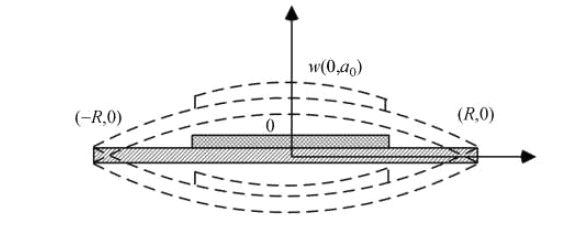
Structure of piezoelectric vibrator
Performance of flow ultimately relies on the difference between positive and negative directions in flow resistance.
“The bluff-body resistances in the flow field include fiction and shape resistance. The shape resistance plays a dominant role in piezoelectric pump due to common laminar flow state in the chamber,” state the researchers.
Clinical Applications and Case Studies
Simulation models were built, and the research team calculated flow velocity and pressure.
Regulatory Considerations and Safety
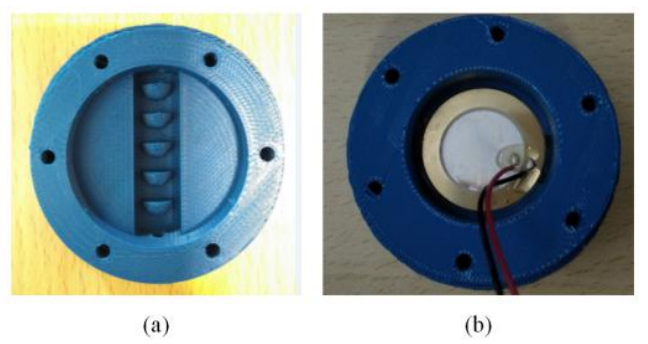
Valveless piezoelectric pump with HBSS of 180 degree splitting angles: (a) pump body, (b) assembled prototype
“For all pumps with HSBB of different splitting angles, the vortex of positive flows between HSBB are larger than that of negative flows, and the velocity of positive flows on the outlet are obviously greater than that of negative flows on the outlet. Moreover, the velocity difference between positive flows and negative flows on the outlet firstly increases and then decreases, suggesting that the proper enlargement of splitting angle can facilitate the unidirectional flow. Besides, for all pumps with HSBB of different splitting angles, the pressure difference between the inlet and outlet of positive flows are less than that of negative flows,” explained the authors.
“The simulation and experiment results on the flow resistance of different pumps suggest that the valveless piezoelectric pump with HSBB of 210° splitting angle exhibits the best flow transportation performance, which is a promising candidate for various flow delivery applications.”
What do you think of this news? Let us know your thoughts! Join the discussion of this and other 3D printing topics at 3DPrintBoard.com.
Research Breakthroughs and Innovations
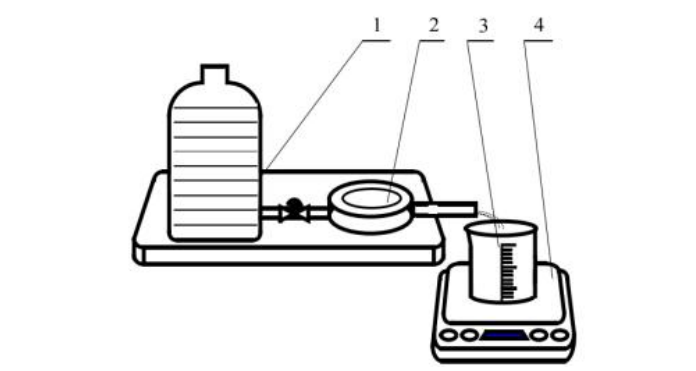
Schematic diagram of flow resistance experimental test: 1 container, 2 test pump, 3 collect breaker, 4 electronic scale
[Source / Images: ‘Improved design and experimental analysis of valveless piezoelectric pump based on hemisphere-segment bluff-body’]
The post China: 3D Printing Prototypes for Valveless Piezoelectric Pumps appeared first on 3DPrint.com | The Voice of 3D Printing / Additive Manufacturing.
Related Articles
Frequently Asked Questions
How is 3D printing used in medicine?
3D printing is used in medicine for surgical planning models, custom implants, bioprinting tissue scaffolds, drug delivery systems, dental aligners, and prosthetics. It enables patient-specific solutions that improve outcomes and reduce surgery time.
What materials are biocompatible for 3D printing?
Common biocompatible materials include PEEK, titanium alloys (Ti6Al4V), bio-ceramics (hydroxyapatite), medical-grade resins, PLA for temporary implants, and hydrogels for bioprinting. Material choice depends on the application and required mechanical properties.
Is 3D printed medical equipment FDA approved?
Yes, several 3D printed medical devices have FDA clearance, including orthopedic implants, dental restorations, and surgical guides. Each device must go through the appropriate regulatory pathway based on its risk classification.
📌 Related Articles
- The Current State of Metal 3D Printing in 2020
- Best 3D Printer Upgrades That Actually Improve Print Quality: Complete 2026 Guide
- 3D Printing Tungsten Carbide: How Hot-Wire Laser Technology Creates Metal Harder Than Steel
- Best Budget 3D Printer Upgrades That Actually Improve Print Quality: Belts, Springs, Hotends & More
- The Complete 3D Printing Filament Guide: Types, Properties & When to Use Each