

Researchers from Poland are examining better ways to use materials in 3D printing, detailing their study in the recently published ‘Polymer Composites Used in Rapid Prototyping Technology.’ As accessibility and affordability continue to play a huge role in the growing mainstream popularity of 3D printing, the demand for materials of all kinds increases.
While ABS and PLA are the most commonly used thermoplastics—each with their own pros and cons—many new alternative materials have arrived on the market today. Additives, blended with more primary sources to create composites, allow for a much greater range to choose from when faced with requirements for new projects.
PLA is often made into a composite. As the top choice in FDM 3D printing, it offers benefits such as being plant-based and non-toxic, biodegradable, and operating from a low melting point.
“PLA also has undesirable features such as low toughness, elongation at break of less than 10%, and slow degradation; therefore, unfilled PLA should be supplemented by the introduction of additives, that is, the synthesis of nanocomposites,” state the researchers.
Understanding Filament Properties
“By creating polymer composites based on a biodegradable polymer, we obtain a composition that is degradable and meets practical requirements.”
Nanoadditives promote better efficiency, strength, and functionality in parts and prototypes, with powder or fillers composed of flakes becoming more popular due to flexibility in production, corrosion resistance, and improved processing.
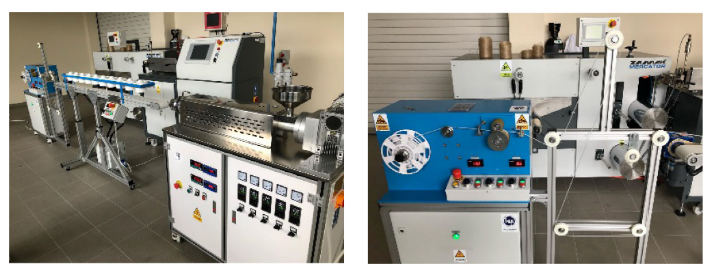
“Fillers with a large specific surface are, for example, metal particles to be introduced in a certain amount and the content that causes the particles to be packed close together, which guarantees an uninterrupted conducting path (guarantee of high-electrical conductivity),” stated the researchers.
Material Comparison and Selection

Specification of received filaments.
In this study, bronze, copper, brass, and steel were added to the PLA.
Print Settings and Optimization
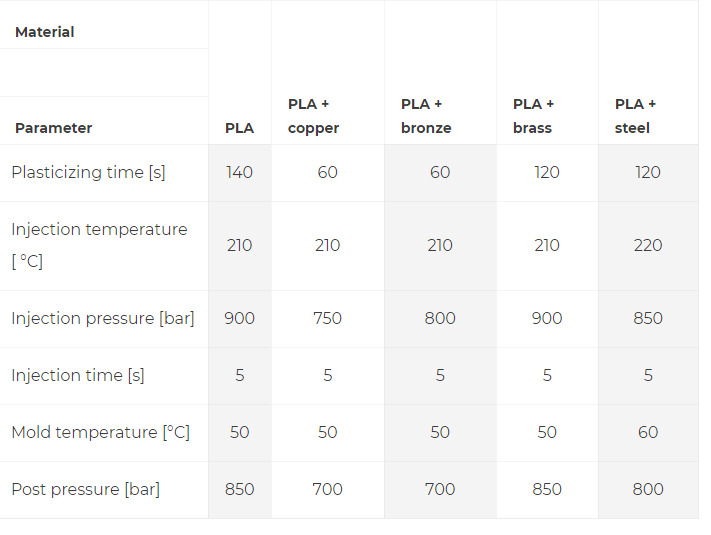
Parameters of the injection molding process-obtaining paddles.
Materials were used to fabricate fittings such as bars and paddles via injection molding and FDM 3D printing.
Strength and Durability Testing
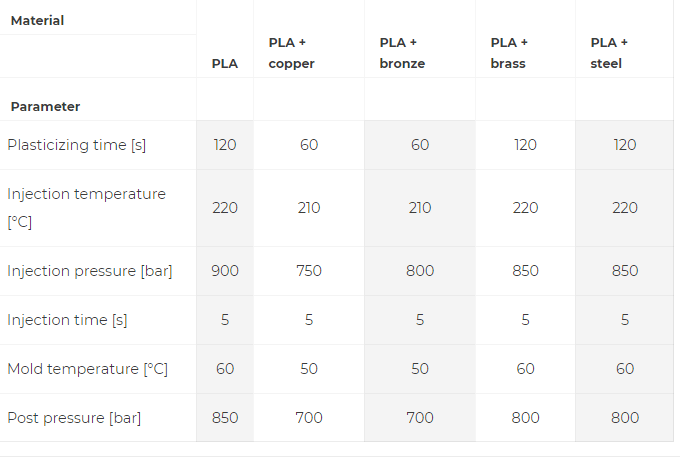
Parameters of the injection molding process-obtaining bars.
An Ultimaker 3 Extended printer was used for rapid prototyping, with testing performed at the Rzeszów University of Technology. See also: 3D Printing Tungsten Carbide: How Hot-Wire Laser T…. The researchers assessed materials for the following:
- Mass melt flow index
- Rockwell hardness
- Charpy impact strength
- Strength during static tensile test

Cost and Availability Considerations
The results of the MFR study
“By analyzing the results obtained, it can be concluded that the introduction of reinforcing fillers of various shapes and sizes (nanometer scale) facilitates the flow of the material, which improves the usability of the composition in the processing processes and reduces the processing shrinkage,” concluded the researchers.
“The introduction of metallic nanofillers caused a decrease in the hardness of the unfilled material. The composition of PLA filled with steel obtained the lowest results among the tested materials (52.52 N/mm2 for details obtained by 3D printing and 85.4 N/mm2 for elements obtained by the second method).”
So many different types of composites are being used today, from carbon composites to wood to natural fiber. What do you think of this news? Let us know your thoughts! Join the discussion of this and other 3D printing topics at 3DPrintBoard.com.
Advanced and Specialty Filaments
[Source / Images: ‘Polymer Composites Used in Rapid Prototyping Technology’]
The post Poland: Evaluating Polymer Composites in Rapid Prototyping Technology appeared first on 3DPrint.com | The Voice of 3D Printing / Additive Manufacturing.
Frequently Asked Questions
What is the best 3D printing filament for beginners?
PLA is the best starting filament — it prints easily at 190-220°C without an enclosure and produces good results. Once comfortable, PETG offers better strength and temperature resistance for functional parts.
How do I choose the right filament?
Consider the application: PLA for display models, PETG for functional parts, ABS/ASA for heat/sunlight exposure, TPU for flexible parts, and specialty filaments for engineering applications. Each has specific printer requirements.
What temperature should I print different filaments at?
PLA: 190-220°C nozzle / 50-60°C bed. PETG: 220-250°C / 70-80°C. ABS: 230-260°C / 100-110°C (enclosure needed). Nylon: 240-270°C / 70-90°C. Always check manufacturer recommendations for specific brands.
📌 Related Articles
- The Current State of Metal 3D Printing in 2020
- 3D Printing Tungsten Carbide: How Hot-Wire Laser Technology Creates Metal Harder Than Steel
- Best 3D Printer Upgrades That Actually Improve Print Quality: Complete 2026 Guide
- Best Budget 3D Printer Upgrades That Actually Improve Print Quality: Belts, Springs, Hotends & More
- 3D Printing News: Multi-Material Breakthrough and Aerospace Market Boom