
The development of sea transport routes in one of the most extreme environments on Earth, the Arctic Circle, is of significant strategic importance to the third largest Russian oil producer, Gazporm Neft. The sea ice that lasts for most of the year, could be more than two meters thick, and temperatures may fall below -50°C, yet for Gazprom’s subsidiary, these northern Arctic sea routes potentially reduce transport time by no less than 40%, not to mention save fuel, reduce emissions and avoid the risk of piracy.
Fundamental to the access and use of these Arctic sea routes are Icebreakers, ships that break huge blocks of sea ice using specially designed hulls and propellers. In 2019, as part of their efforts to expand Arctic oil production, Gazprom Neft began to operate two next-generation icebreakers, Alexandr Sannikov, and sister ship Andrey Vilkitsky to clear the arctic ice for its oil tankers transporting fuel to northern Europe and Asia.

Overview and Context
Sea routes in the Arctic (Images courtesy Gazprom Neft)
In extremely remote, harsh environments such as the Arctic Sea, repairs and replacement of parts for ships, especially Icebreakers, is challenging to say the least. Access and supply of resources is highly limited far in the northern seas, and only limited cargo and spare parts can be carried to address any contingencies due to weather or mechanical failure. And so just as in space, where environmental characteristics are similar, the application of 3D printing has offered critical solutions to these challenges. Gazprom Neft has produced the first consignment of metal 3D printed parts that will be used to refurbish and repair equipment on the Icebreaker Andrey Vilkitsky, and three other bunker vessels, the Gazpromneft-Zuid, Gazpromneft-Nord and Gazpromneft-Nord-Vest.
The company is now working to certify them for quality and compliance with the standards of the Russian Maritime Register of Shipping. This is critical for operations on iceabreakers such as the Andrey Vilkitsky which will operate for 40 days at arctic temperatures of -50°C.

Technical Details and Analysis
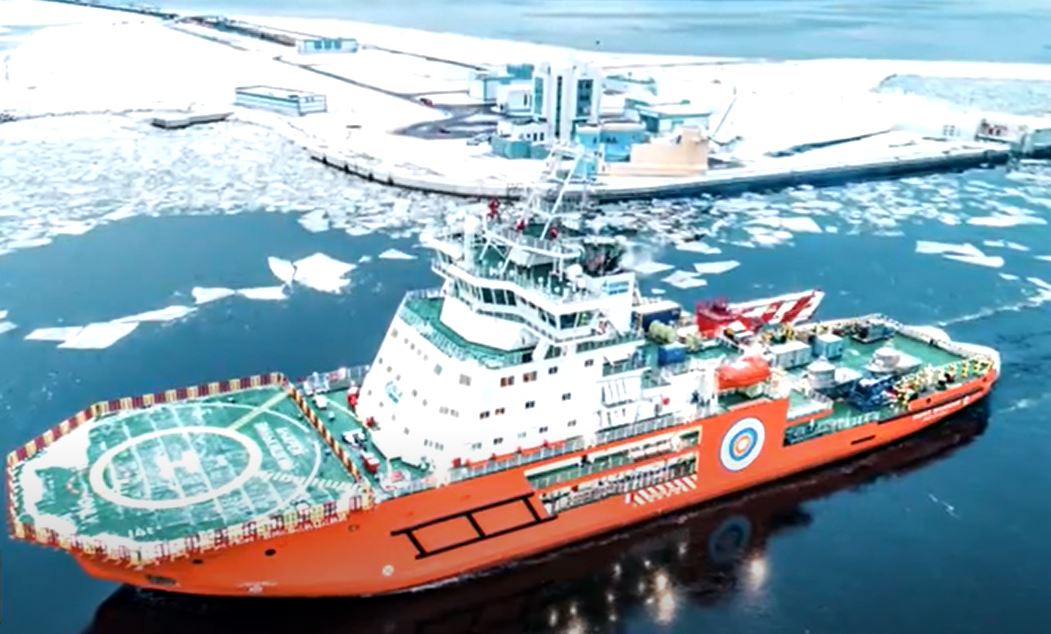
Above and Below: the Icebreaker Andrey Vilkitsky (Images courtesy Gazprom Neft)
The company has also supported the certification process by developing a roadmap for the technological process for 3D printing metal hardware, detailing every stage in technologically certifying products made in this way for use in maritime vessels such as icebreakers and tankers. See also: Best Budget 3D Printer Upgrades That Actually Impr…. It is a part of the effort the company is making in regional or national standardization of AM technologies, through its own research in AM, and as a member of the Technical Committee for Standardization of TC Additive Technologies. Approval for such products, granted by the Russian Maritime Register of Shipping will encourage the use of 3D printed parts and additive manufacturing processes, help support reduction in costs, and enable the critical repair of onboard equipment for operation in extreme conditions.
We’ve previously seen similar applications in maritime vessels, yet for purposes and not directly operational as with Gazprom Neft’s icebreakers. US Coast Guard academy professor, Ron Adrezin, has previously tested 3D printers for applications in remote area operations aboard the Cutter Healy, an icebreaker that conducts research and scientific missions in the Arctic and Bering Seas. In severe or extreme maritime conditions, polymer and metal-based additive manufacturing has been applied in submarines, ships, icebreakers, and other vessels to provide critical support or to extend the life of operations in these conditions.
Practical Applications
The post Breaking Ice: 3D Printed Parts Refurbish Icebreaker Ships for Arctic Sea Transport appeared first on 3DPrint.com | The Voice of 3D Printing / Additive Manufacturing.
from 3DPrint.com | The Voice of 3D Printing / Additive Manufacturing https://bit.ly/3lkjFJ5
Related Articles: New Automated System for Unpacking & Cleaning Powder 3D Printed Parts Announced by Solukon · Boom Supersonic Unveils XB-1 Airplane with 21 3D Printed Parts · 3D Printed Egg Decoys Help Endangered Sea Turtles in Costa Rica
Frequently Asked Questions
What is 3D printing and how does it work?
3D printing (additive manufacturing) builds objects layer by layer from a digital model. The most common type, FDM, extrudes melted plastic filament. Other methods include resin (SLA) and powder-based (SLS). Each layer solidifies before the next is added.
What can you make with a 3D printer?
3D printers can create functional parts, prototypes, tools, art, replacement components, toys, household items, and much more. Applications range from hobby projects to industrial aerospace components and medical implants.
📌 Related Articles
- The Current State of Metal 3D Printing in 2020
- Best Budget 3D Printer Upgrades That Actually Improve Print Quality: Belts, Springs, Hotends & More
- Best 3D Printer Upgrades That Actually Improve Print Quality: Complete 2026 Guide
- 3D Printing Tungsten Carbide: How Hot-Wire Laser Technology Creates Metal Harder Than Steel
- ABS 3D Printing Settings Guide: Temperature, Enclosure, and Cooling for Strong Parts