

Seven years after Afate Gnikou, an inventor working in a Tongolese maker space created Africa’s first 3D printer from e-waste, the piqued interest in this innovative construction led to the development of more than 20 other 3D printers made from unwanted electronics dumped in the West African nation of Togo, according to a report from WeeTracker. The technological revolution is happening at WoeLab (originally spelled WɔɛLab) known to many as street-level FabLab. The innovative hub was created by architect Sénamé Koffi Agbodjinou as a safe haven for technological democracy and is the first free laboratory of social and technological innovation of Togo to divert the use of discarded electronic material by creating sustainable technology.

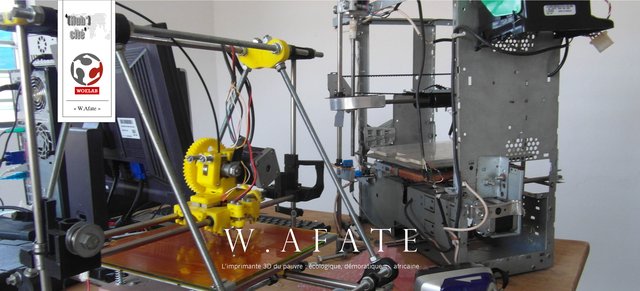
WoeLab’s signature 3D printer, called the W.Afate is named after Gnikou’s early invention while the W stands for WoeLab. The W.Afate is inspired by the Prusa Mendel after one of the models was put together at WoeLab thanks to a kit brought from France. Gnikou quickly found a way to manufacture a machine that was easily reproduced and was based entirely on reusing discarded materials, mainly central processing units (CPUs), printers, scanners, Arduino boards, and lead wires.
Physically located in the Togolese city of Lomé, WoeLab has access to incredible supplies of unwanted electronic material. Unfortunately, the city, like many others in Africa, have large informal e-waste dumping and processing sites. Togo imports an estimated 500,000 tonnes of e-waste a year, and with one of the largest ports in West Africa, it has great potential to become the continent’s e-waste leading country. This is why turning used electronics into low-cost 3D printers could offer a potential solution to this risky, unhealthy, and illegal tendency that pose a threat to the environment and its inhabitants. Electronics contain toxic substances such as lead, mercury, cadmium, arsenic, and flame retardants, for instance, an old cathode-ray tube (CRT) computer screen can contain up to three kilograms of lead.
How 3D Printing Responded to COVID-19
Innovative minds like Gnikou and Agbodjinou could provide solutions to a harsh African reality, by providing the know-how to co-create 3D printers, and drawing the population closer to technology.
HP and the Pandemic Manufacturing Shift
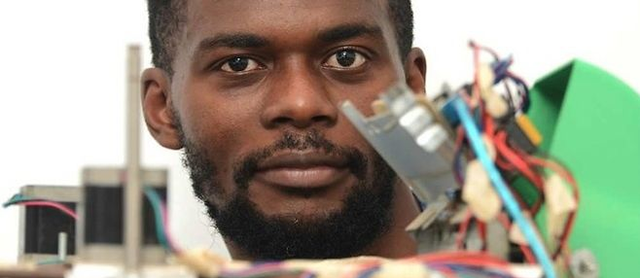
Sénamé Koffi Agbodjinou (Credit: WoeLab)
Using crowdfunding from Ulule, a community-backed incubator of positive impact projects around the world, WoeLab raised over 4,600 dollars to develop the Woebots1 W.Afate, the first artisanal 3D printer, openSource and outside the RepRap family tree. The money was used to constitute the first series of practical kits based on the rational conversion of waste to 3D printers for fab labs around the world and to finance extension workshops in Togo.
Providing solutions adapted to African conditions and realities is an initiative on its own. The young architect and anthropologist understands what it takes to supply a broad context, both ethically and productively, to bring the various social strata in the city closer to technology, by offering the ability to create their own machines thanks to very detailed and simplified documentation that explains how to manufacture the W.Afate in 10 steps. The company claims to ambitiously think about African cities around these places of innovation. Under the SiliconVilla program, WoeLab has helped create and incubate 11 collaborative startups working around waste management, and resources.
More than a year ago, on the weekend following the opening of the research and exhibition project Digital Imaginaries: Africas in Production, Agbodjinou described WoeLab as “a utopia where everyone can launch projects to have an impact in the neighborhood and address ways to collect waste.”
Supply Chain Disruptions and Digital Solutions
Moreover, the founder of WoeLab, revealed that since 2013, they had launched a second lab called WoeLab Prime, an incubator for startups and a way to identify the great potential of young children by incorporating hackathons, coding classes, and more. Both WoeLab sites also have 600 square meters of space each that are used as living quarters for people to visit.
As the biggest tech hub in Western Africa, they are not only interested in continuing to manufacture their pioneering W.Afate, which has become very well known around the world, but they have also developed a new 3D printer that they expect to commercialize, the Woebots Tavio. Agbodjinou had described that, although W.Afate is an incredible concept that encompasses sustainability, creativity, and knowledge, it is very difficult to build industrially because it relies on electronic waste, and he said that it’s not easy to find the same e-waste for every machine.
Medical PPE and Equipment Production
The W.Afate 3D printer (Credit: WoeLab)
Powered by L’Africained’Architecture – an activist structure also set up by Agbodjinou to promote an original approach to planning and design in Africa – the WoeLab has become a very popular site for young people of Lomé with a curious desire to learn. Creating 3D printers with material that would otherwise end up in dumps, or incinerated, helps these communities value the need for sustainability in their designs, and like most brilliant ideas, the WoeLab innovation space has encouraged the development of other makers pace, fab labs and creativity centers that manufacture disruptive technology, like students in Tanzania’s Buni Hub, who also build an e-waste 3D printer just three years after WoeLab was created.
While encouraging students to manufacture 3D printers, WoeLab also provides the community of Lomé an opportunity to generate a tool that can improve their lives, empowering everyone to become a growing force for change. Every year, we generate 50 million tons of electronic waste worldwide, and 85 percent of these products are discarded in landfills or incinerators. This should be a great incentive to follow in the footsteps of Agbodjinou, who early on saw what others didn’t, potential to create a 3D printer out of junk.
Lessons Learned for Future Emergencies
The post Tongo’s WoeLab Has Produced Over 20 3D Printers Made From E-Waste appeared first on 3DPrint.com | The Voice of 3D Printing / Additive Manufacturing.
Frequently Asked Questions
How did 3D printing help during COVID-19?
During the COVID-19 pandemic, 3D printing enabled rapid production of critical medical supplies including face shields, ventilator components, nasal swabs, and PPE. Distributed manufacturing allowed makers worldwide to produce items locally without waiting for traditional supply chains.
What was the pandemic digital manufacturing shift?
The pandemic accelerated adoption of digital manufacturing including 3D printing, as companies sought more resilient supply chains. Organizations shifted from centralized to distributed production, using digital files to produce parts locally on demand.
Can 3D printing supply chains be resilient in emergencies?
Yes, 3D printing provides supply chain resilience through distributed manufacturing — designs can be shared digitally and produced anywhere with compatible equipment, eliminating the need for physical inventory and shipping of parts.
📌 Related Articles
- Best 3D Printer Upgrades That Actually Improve Print Quality: Complete 2026 Guide
- Best Budget 3D Printer Upgrades That Actually Improve Print Quality: Belts, Springs, Hotends & More
- Best 3D Printers Under $500: 2026 Comparison Guide
- Prusa Research Mini+ vs Prusa MK4: Full Specs Comparison & Buyer’s Guide
- 3D Printing Tungsten Carbide: How Hot-Wire Laser Technology Creates Metal Harder Than Steel