
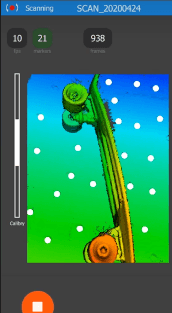
Moscow-headquartered Thor3D continues to refine its software and hardware, allowing customers around the globe to continue scanning items at every range, from smaller industrial parts to facial prosthetics, and larger-scale items like automobiles. Now, the handheld 3D scanner developer is releasing an update to its Calibry Nest software—adding a host of new features for improved workflow.

Why Calibration Matters
Live 3D mode on.
Continuing to develop and enhance products and solutions that offer ease in capturing 3D data, as well as dealing with post-processing, the team at Thor3D has created a Live 3D option for preliminary data finalization. This means that users are able to use the Live3D feature while scanning and then quickly complete assembly of the scene, even while on the go. They can then assess the quality of the scan before uploading it to their PC.
For Calibry users who seek the ultimate in accuracy, they can also now test calibration before beginning any project.
Other tools have been added to this release for streamlined workflow during post-processing efforts. Users engaged in reverse engineering or quality control processes can complete basics like the following:
- Pinpointing deviations in structure by comparing meshes with the Distant Map feature.
- Cutting sections through any type of mesh for adding 2D contours which can then be converted into .SVG or .DXF format.
- Using the inverting tool, noted as especially helpful for engineers involved in orthopedic or prosthetic applications where critical scans are required for body parts.
- Calculating the least amount of distance from two points with the ‘Geodesic Distance’ tool, for use with polygon mesh.
- Detecting false markers during scanning. The Thor3D team notes that while ‘momentary glares’ may occur in the final mesh and look like markers (thus causing inaccuracies), this additional tool prevents such problems.
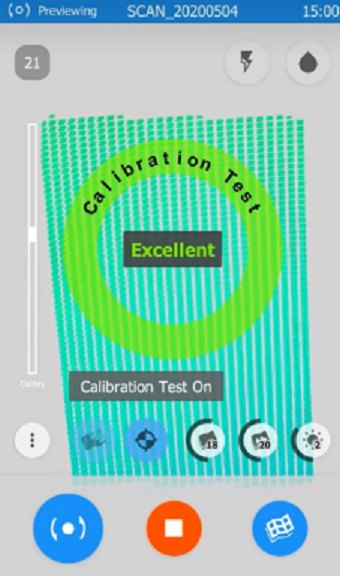
Step-by-Step Calibration Process
Live 3D mode on. See also: The Current State of Metal 3D Printing in 2020. A screenshot from Calibry’s screen
“Thor3D team has also added a random generator of names to label each new result as they are formed,” states a recent press release sent to 3DPrint.com.
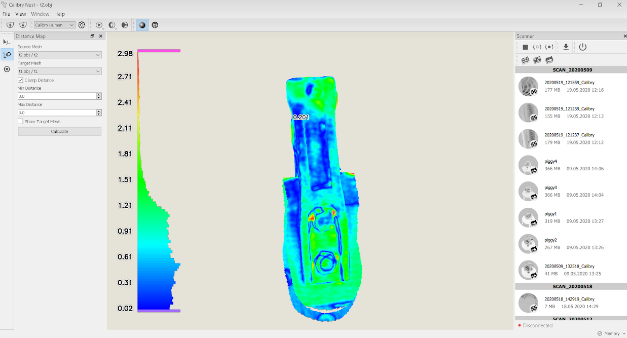
‘Distance Map’ feature in action.
Fine-Tuning Print Quality
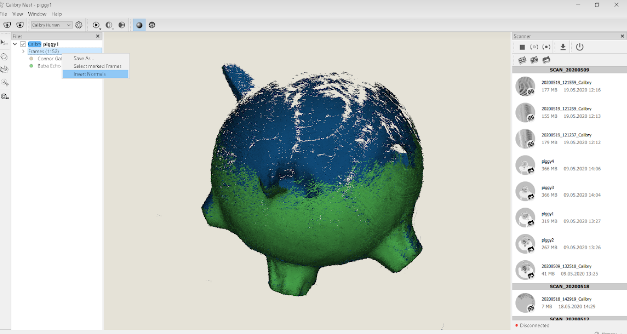
Inverting normal tool
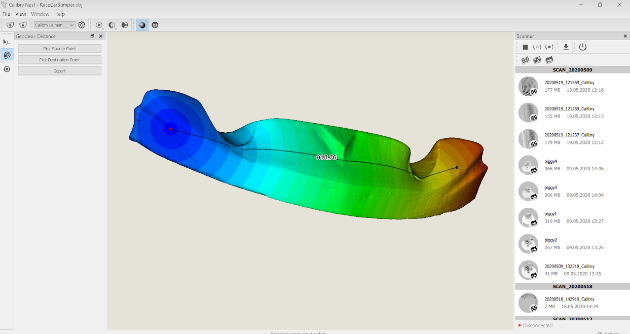
Geodesic Distance tool
Troubleshooting Common Issues
Other small changes have been made to the Calibry Nest software also. Users can now accelerate the speed of loading textured models. A new progress bar has been added for hole-filling functions, with separated hole filling now available in a different thread—leading to further optimization of the workflow. The tracking process has also been further improved for users during the scanning process.
Currently, Thor3D has offices in both Moscow and Dusseldorf. Founded in 2015, the Thor3D team is well-known for the development of their wireless, handheld scanner. Find out more about their products here.
What do you think of this news? Let us know your thoughts! Join the discussion of this and other 3D printing topics at 3DPrintBoard.com.
[Source / Images: Thor3D]
Maintaining Consistent Results
The post Thor3D Updates Calibry Nest Software, Improving Workflow for 3D Scanning appeared first on 3DPrint.com | The Voice of 3D Printing / Additive Manufacturing.
from Your daily news from 3DPrint.com https://bit.ly/3czaVd9
Related Articles
Frequently Asked Questions
Why is 3D printer calibration important?
Calibration ensures dimensional accuracy, proper layer adhesion, and consistent print quality. Without it, parts may have fitting issues, poor surface finish, or structural weaknesses. Regular calibration compensates for mechanical wear and environmental changes.
How often should I calibrate my 3D printer?
Calibrate after any hardware changes, when switching filaments, or if you notice quality degradation. A basic bed level check before each print is good practice, while full calibration (e-steps, flow rate, PID tuning) should be done monthly or after maintenance.
📌 Related Articles
- The Current State of Metal 3D Printing in 2020
- Best 3D Printer Upgrades That Actually Improve Print Quality: Complete 2026 Guide
- The Complete 3D Printing Filament Guide: Types, Properties & When to Use Each
- Best Budget 3D Printer Upgrades That Actually Improve Print Quality: Belts, Springs, Hotends & More
- The Ultimate Guide to 3D Printer Calibration: Complete Step-by-Step Manual