
Researchers from Romania have recently delved further into materials associated with 3D printing, outlining their findings in ‘Polysaccharide-Based 3D Printing Inks Supplemented with Additives.’ In this study, they combined a variety of different polysaccharides to improve 3D printing inks.
“A wide range of materials have shown potential in 3D printing but modeling these materials into self-supporting items with tunable mechanical properties, degradation, and suitable rheological response is still an issue,” explain the authors, as they introduce us to the process of creating new inks, beginning with refining wettability.
Understanding Filament Properties
Wetting agents—or humectants—also reduce the contact angle between bioink and the printer nozzle, as well as decreasing the chances for drying or crusting.
Typical humectants include:
- Polyethylene glycol (PEG)
- Glycerol (Gly)
- Sorbitol
- Urea
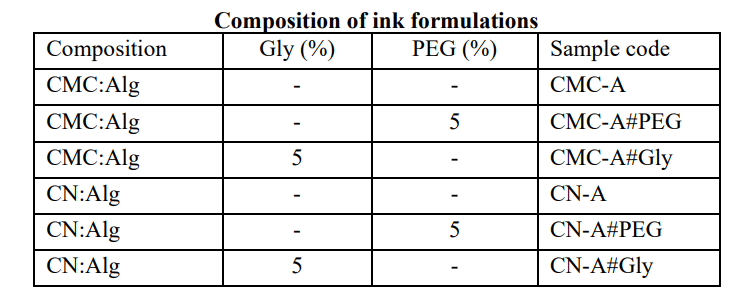
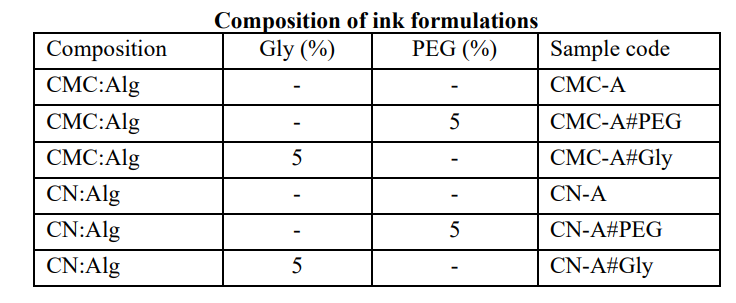
In this study, the researchers created a ‘promising ink formulation’ based on CMC/Alg and CN/Alg, using wetting agents derived from both small and low-molecular weight polymers.
“Printing inks were formulated by using two precursor mixtures, CMC:Alg and CN:Alg in 1:1 mass ratio. For the first mentioned formulations, a solution of 4% CMC was prepared in distilled water and the corresponding amount of Alg was added under gentle stirring,” explained the researchers. “The latter formulations were obtained by directly dissolving Alg within CN suspension.”
Material Comparison and Selection
Inks were printed using the 3D Discovery bioprinter from RegenHU. See also: Best 3D Printer Upgrades That Actually Improve Pri…. 3D printing experiments were performed, along with bioprinting of hydrogel scaffolds. BioCADTM software was used to create the G-code for the 3D constructs used in the study.
While Alg is not the best option for 3D direct writing on its own, CMC and CN ‘enhanced’ viscosity, better cross-linking occurred, and the -OH groups present offered a positive effect over solubility, and both rheological and mechanical behavior.
Print Settings and Optimization
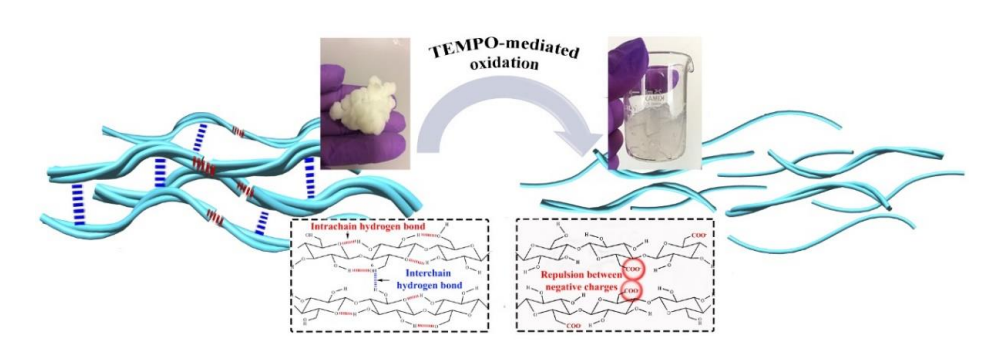
Schematic representation of the fibrillary organization of cellulose
before and after oxidation process
“Both cellulose types used herein, CMC and CN, differ greatly with respect to chemical and morphological features and yet both present favorable printing behavior,” stated the researchers.
Overall, rheological evaluation by the researchers stated that CMS compositions possessed low viscosity, flowing immediately upon stress. High-viscosity drops required ‘adequate external forces’ to engage the printing process.
“Loading an additional compound (such as PEG and glycerol) suggested the improvement of the wetting properties leading to slightly lower filament diameters relative to the corresponding reference composition,” stated the researchers.
Strength and Durability Testing
“Considering the printing performance with respect to the predesigned architecture it can be concluded that a successful 3D printing was achieved using glycerol in the ink composition. See also: Best Budget 3D Printer Upgrades That Actually Impr…. Therefore, the fabrication of 3D scaffolds using a cellulosic material combined with alginate and a suitable additive provide accurate geometries but also guide the applications of the obtained hybrid hydrogels in the biomedical field.”
Researchers around the world are creating bioinks and hydrogels in labs, using materials meant to encourage tissue engineering of the liver, corneas, and more. What do you think of this news? Let us know your thoughts! Join the discussion of this and other 3D printing topics at 3DPrintBoard.com.

Cost and Availability Considerations
TEM images of CN
[Source / Images: ‘Polysaccharide-Based 3D Printing Inks Supplemented with Additives’]
The post Romanian Researchers Create Promising Polysaccharide-Based 3D Printing Inks & Additives appeared first on 3DPrint.com | The Voice of 3D Printing / Additive Manufacturing.
from Your daily news from 3DPrint.com http://bit.ly/37qlmxq
Related Articles
Frequently Asked Questions
What is the best 3D printing filament for beginners?
PLA is the best starting filament — it prints easily at 190-220°C without an enclosure and produces good results. Once comfortable, PETG offers better strength and temperature resistance for functional parts.
How do I choose the right filament?
Consider the application: PLA for display models, PETG for functional parts, ABS/ASA for heat/sunlight exposure, TPU for flexible parts, and specialty filaments for engineering applications. Each has specific printer requirements.
What temperature should I print different filaments at?
PLA: 190-220°C nozzle / 50-60°C bed. PETG: 220-250°C / 70-80°C. ABS: 230-260°C / 100-110°C (enclosure needed). Nylon: 240-270°C / 70-90°C. Always check manufacturer recommendations for specific brands.
📌 Related Articles
- Best 3D Printer Upgrades That Actually Improve Print Quality: Complete 2026 Guide
- Best Budget 3D Printer Upgrades That Actually Improve Print Quality: Belts, Springs, Hotends & More
- The Current State of Metal 3D Printing in 2020
- Prusa Research Mini+ vs Prusa MK4: Full Specs Comparison & Buyer’s Guide
- Bambu Lab P1S vs Bambu Lab P2S: Full Specs Comparison & Buyer’s Guide