
Quick Answer: What is Harvard’s Rotational Multimaterial 3D Printing for Soft Robots?
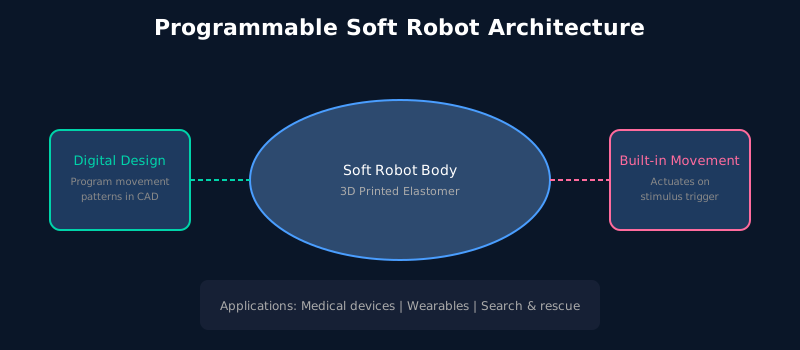
Harvard researchers have developed “rotational multimaterial 3D printing,” a breakthrough technique that creates soft robots with programmable shape-morphing capabilities already built in during printing[1]. This method uses a single rotating nozzle to extrude two materials simultaneously—polyurethane for flexible outer shells and poloxamer (a hair gel polymer) for temporary inner channels[7][8]. The nozzle rotation programs the bending direction when the robot is inflated, allowing rapid customization of actuation without traditional molds or casting processes. Published in Advanced Materials in 2026, this research led by Jackson Wilt and Natalie Larson from Jennifer Lewis’ lab opens doors for applications in surgical robotics, assistive devices, biomedical implants, and flexible manufacturing[1][2].
Disclosure: As an Amazon Associate, 3dput.com earns from qualifying purchases. This supports our independent testing and reviews.
Harvard researchers have developed a groundbreaking 3D printing technique that creates soft robots with programmable shape-morphing capabilities already built in, potentially revolutionizing fields from healthcare to manufacturing[9].
The Challenge of Soft Robotics
Soft robots made from flexible, biocompatible materials are in high demand across industries. However, precisely designing and controlling these robots for specific purposes has been a perennial challenge—until now.
Traditional soft robot fabrication typically involves casting soft material onto a mold, patterning pneumatic channels on surfaces, and encapsulating channels in additional layers[9]. This multi-step process is time-consuming, limits customization, and requires creating new molds for each design iteration. The challenge has been how to rapidly prototype and customize soft robots with programmable movement without sacrificing precision or requiring complex manufacturing setups.
Soft robotics research has accelerated in recent years as applications emerge in healthcare (minimally invasive surgery, prosthetics), manufacturing (delicate object handling), and environmental monitoring[9]. The field draws inspiration from biological systems—octopus tentacles, elephant trunks, and worm locomotion—that combine flexibility with precise, controlled movement. Recreating these capabilities synthetically has proven difficult due to material constraints and actuation challenges.
Rotational Multimaterial 3D Printing
The new technique, called rotational multimaterial 3D printing, was developed in the lab of Jennifer Lewis at Harvard’s John A. Paulson School of Engineering and Applied Sciences (SEAS)[2]. The research was led by graduate student Jackson Wilt and former postdoctoral researcher Natalie Larson, with Professor Jennifer A. Lewis as senior author[3][4].
“We use two materials from a single outlet, which can be rotated to program direction robot bends when inflated. Our goals are aligned with creating soft, bio-inspired robots for various applications.”
— Jackson Wilt, Graduate Student, Harvard SEAS[3]
This innovative approach represents a significant advancement in multi-material 3D printing technology. Traditional multi-material printers typically require multiple extruders or complex switching mechanisms, each with its own material feed. Harvard’s method simplifies this by using a single, rotating nozzle that can seamlessly switch between or simultaneously print two distinct materials[1].
The research was published in Advanced Materials, a prestigious peer-reviewed journal (DOI: 10.1002/adma.202510141), and received federal support from the National Science Foundation (Harvard MRSEC, DMR-2011754) and the ARO MURI program (W911NF-22-1-0219)[1][5][6]. Natalie Larson, co-lead on the research, is now an assistant professor at Stanford University[4].
How It Works
The method combines several Harvard-developed 3D printing techniques and eliminates need for traditional casts and molds[10]. The core innovation lies in the nozzle design and rotational control system:
Key Components
1. Dual-material extrusion: A single nozzle prints two materials simultaneously from one outlet, eliminating the need for multiple extruders or complex material switching mechanisms. This reduces mechanical complexity and improves reliability[1].
2. Rotation control: The nozzle can rotate during printing to program the bending direction when the robot is inflated. By controlling nozzle orientation relative to the print path, researchers can predetermine how the soft robot will move upon pressurization[1].
3. Customizable patterns: Ink is extruded in programmable patterns as the machine reorients the nozzle. This allows precise control over channel geometry, orientation, and distribution within the printed structure[1].
The Materials
| Component | Material | Purpose |
|---|---|---|
| Outer shell | Polyurethane[7] | Flexible casing providing structural integrity |
| Inner channel | Poloxamer (hair gel polymer)[8] | Temporary channel filler that can be washed away |
The choice of materials is strategic. Polyurethane provides durability and flexibility in the final robot structure[7]. Poloxamer, a thermoresponsive polymer similar to hair gel products, serves as a sacrificial material—it maintains the channel shape during printing but can be removed afterward with water, leaving hollow pneumatic channels for pressurization[8].
The Process
The fabrication process follows a systematic approach that enables rapid iteration:
Step 1: Print filaments with polyurethane outer shell and poloxamer inner channel in a single continuous process.
Step 2: Arrange filaments in lines, flat patterns, or raised patterns depending on desired actuation. The rotational nozzle control enables precise positioning of material boundaries.
Step 3: Control nozzle design, rotation speed, and material flow to program channel orientation, shape, and size. This step effectively “encodes” the movement patterns into the printed structure.
Step 4: Wash away the hair gel-like inner material (poloxamer) using water, leaving clean hollow channels[8].
Step 5: Result: Tubular structures with hollow channels ready for pressurization. When air is pumped into these channels, the robot bends or moves according to the programmed patterns.
This entire process can be completed in a single printing operation, dramatically reducing fabrication time compared to multi-step casting and molding methods[1].
Demonstrations
The researchers demonstrated their technique with impressive results that showcase the versatility of the approach[1]:
Spiral flower pattern: Printed in one continuous, mazelike path, demonstrating the ability to create complex, multi-directional bending patterns. When pressurized, the structure opens like a flower, with each petal bending according to its programmed orientation.
Five-digit handle: Complete with “knuckles” that bend when pressurized. This demonstration mimics a robotic hand with individually controllable fingers, showing potential for gripping and manipulation tasks.
These demonstrations illustrate the precision of the rotational control system. By varying nozzle rotation speed, angle, and timing during the print, the researchers can create intricate actuation patterns that would be extremely difficult to achieve with traditional fabrication methods[1].
Advantages Over Traditional Methods
Conventional soft robot fabrication typically involves multiple time-consuming steps that limit rapid prototyping and customization[9]:
| Traditional Fabrication | Harvard’s Rotational Method | Key Advantage |
|---|---|---|
| Casting soft material onto a mold | Direct printing without molds | Eliminates mold design and fabrication |
| Patterning pneumatic channels on surface | Embedded channel printing | Channels integrated during fabrication |
| Encapsulating channels in another layer | Single-step dual-material printing | Reduces fabrication steps |
| Multi-day fabrication cycle | Hours to complete | Dramatically faster prototyping |
| Limited design iteration speed | Rapid design changes | Faster experimentation and optimization |
“In this work, we don’t have a mold. We print structures, we program them rapidly, and we’re able to quickly customize actuation.”
— Jackson Wilt, Graduate Student, Harvard SEAS[3]
The advantages extend beyond fabrication speed. See also: Best 3D Printer Upgrades That Actually Improve Pri…. By eliminating molds, the method reduces material waste, allows for more complex geometries that would be difficult or impossible to cast, and enables rapid iteration of designs. Researchers can modify a design, print a test version, and evaluate results within hours rather than days or weeks[1].
Applications
The research opens doors for rapid fabrication in diverse fields, each leveraging the unique advantages of soft, programmable robotics[1][9]:
Surgical robotics: Customizable tools for minimally invasive procedures. Soft robots can navigate delicate anatomy without causing tissue damage, and the programmable actuation allows surgeons to control tools with precision. Potential applications include endoscopic tools, tissue manipulators, and drug delivery devices.
Assistive devices: Personalized support for human movement. Soft exoskeletons or prosthetic components can be 3D printed to match individual anatomies, providing comfortable assistance for rehabilitation or daily living tasks.
Manufacturing: Flexible grippers for delicate objects. Soft robotic grippers can handle fragile items—fruit, electronics components, biological specimens—without causing damage. The programmable actuation enables adaptive gripping strategies.
Biomedical devices: Biocompatible actuators for implants. Since polyurethane can be formulated for biocompatibility, these soft robots could serve as implantable devices or temporary scaffolds for tissue engineering[7].
Wearable technology: Smart textiles and garments with embedded soft actuators. The flexibility of these materials allows integration into clothing for applications ranging from haptic feedback to posture support.
Technical Specifications
Material Properties
The materials used in this research exhibit specific properties that make them ideal for soft robotics applications:
Polyurethane: A versatile polymer with excellent flexibility, durability, and biocompatibility[7]. It can be formulated to have specific stiffness properties, making it suitable for a range of soft robot applications. Polyurethane is resistant to oils, solvents, and abrasion, which is important for long-term device reliability.
Poloxamer: A thermoresponsive polymer that is solid at room temperature but dissolves in water[8]. This makes it an ideal sacrificial material for creating internal channels that can be removed without harsh chemicals. Poloxamer is also biocompatible and commonly used in pharmaceutical and cosmetic applications.
Printing Parameters
While the exact printing parameters depend on the specific formulation of materials, typical conditions for this type of multi-material 3D printing include:
– Nozzle temperature: Controlled to maintain proper flow of both materials without degradation
– Print speed: Optimized to ensure good interlayer bonding and dimensional accuracy
– Rotation speed: Precisely controlled to program actuation patterns without disrupting material flow
– Layer height: Typically 100-200 microns for fine features and smooth surfaces
– Material flow rates: Independently controlled for each material to achieve desired channel geometry
Future Directions
The research team identified several directions for future development of this technology[1]:
Expanded material systems: Incorporating additional materials such as conductive polymers for embedded sensing, shape memory polymers for programmable shape changes, or materials with varying mechanical properties for more complex actuation patterns.
Larger scale printing: Scaling up the process for larger soft robots and industrial applications. Current demonstrations feature relatively small structures, but the principles could be applied to human-scale robots.
Integration with control systems: Developing closed-loop control systems that integrate sensors, actuators, and software for autonomous soft robot operation. This would move from programmable actuation to programmable behavior.
Commercialization: The technology has potential for commercial applications, particularly in medical devices and specialized manufacturing. Transfer of the technique from lab to production environments will require development of robust, user-friendly printer systems.
Research Background and Funding
Natalie Larson, co-lead on the research, is now an assistant professor at Stanford University, where she continues work on advanced manufacturing techniques[4]. Jackson Wilt is a graduate student in the Lewis Lab at Harvard SEAS[3]. Professor Jennifer A. Lewis, who leads the lab, is a pioneer in 3D printing technologies, including direct ink writing, multi-material printing, and bioprinting[2][10].
The research received significant federal support from:
National Science Foundation: Harvard MRSEC (Materials Research Science and Engineering Center), Grant DMR-2011754[5]. This funding supports fundamental research on materials and manufacturing.
ARO MURI program: Army Research Office Multidisciplinary University Research Initiative, Grant W911NF-22-1-0219[6]. This program funds multi-disciplinary research with potential defense applications.
The study was published in Advanced Materials, one of the world’s leading materials science journals. The publication indicates peer review and validation of the research methodology and findings[1].
Related Technologies and Alternatives
Other Soft Robotics Fabrication Methods
Harvard’s rotational multimaterial printing is one of several approaches to soft robot fabrication[9]:
Stereolithography (SLA/DLP): Light-based 3D printing that can create soft structures with high resolution. Some SLA formulations use flexible resins, but creating internal pneumatic channels is challenging.
Shape Deposition Modeling (SDM): Alternating deposition of rigid and soft materials followed by dissolving sacrificial materials. Similar in concept to Harvard’s method but typically involves multiple material changes and slower fabrication.
4D Printing: 3D printing materials that change shape over time in response to stimuli (temperature, moisture, light). This concept overlaps with programmable actuation but focuses on materials rather than fabrication techniques.
Soft Lithography: Traditional microfabrication technique for creating soft microfluidic devices. While precise, it’s limited to small scales and requires cleanroom facilities.
Best 3D Printers for Soft Robotics Research
For researchers and developers working on soft robotics, specific printer features are essential:
Multi-material capability: Ability to print with multiple materials simultaneously is crucial for creating composite structures with programmed actuation.
Precision nozzle control: Accurate positioning and optional rotation control enable complex actuation patterns.
Heated build chamber: Maintains stable temperature during printing, important for materials like polyurethane that require specific curing conditions.
Open software architecture: Allows customization of printing parameters and integration of custom control algorithms for nozzle rotation and material switching.
Here are some recommended products for soft robotics research:
Best Multi-Material 3D Printers – Advanced printers capable of dual or multi-extrusion for soft robotics applications.
Lab-Grade 3D Printers – Professional-grade printing systems with precision controls for research applications.
Polyurethane Filament – Flexible, durable thermoplastic polyurethane filaments for soft robot components.
TPU Flexible Filament – Thermoplastic polyurethane materials for soft and flexible prints.
Soft Robotics Kits – Complete kits for building and experimenting with soft robots.
3D Printing Tool Kits – Essential tools including scrapers, tweezers, and calipers for successful 3D printing.
Frequently Asked Questions (FAQ)
Q: What is rotational multimaterial 3D printing?
Rotational multimaterial 3D printing is a Harvard-developed technique that uses a single rotating nozzle to print two different materials simultaneously[1]. The nozzle can rotate during the printing process, allowing researchers to program the bending direction of soft robots by controlling the orientation of material boundaries. This method eliminates the need for traditional molds and enables rapid fabrication of programmable soft robotic structures.
Q: What materials does Harvard’s soft robot printing method use?
The method uses two primary materials: polyurethane for the flexible outer shell of the robot, and poloxamer (a hair gel-like polymer) for temporary inner channels[7][8]. Polyurethane provides durability and flexibility in the final structure, while poloxamer serves as a sacrificial material that can be washed away with water to leave hollow pneumatic channels for pressurization.
Q: How does Harvard’s method compare to traditional soft robot fabrication?
Traditional methods typically involve multiple steps: casting soft material onto a mold, patterning pneumatic channels, and encapsulating channels in additional layers[9]. Harvard’s rotational method eliminates molds entirely, integrates channel creation during printing, and completes fabrication in a single continuous process. This reduces fabrication time from days to hours and enables rapid design iteration.
Q: What are the applications of this soft robot printing technology?
The technology has applications in surgical robotics (minimally invasive tools), assistive devices (custom prosthetics and exoskeletons), manufacturing (flexible grippers for delicate objects), biomedical devices (implantable actuators), and wearable technology (smart textiles)[1][9]. The biocompatibility of materials like polyurethane makes it particularly suitable for medical applications.
Q: Who developed this technology and where was it published?
The technology was developed by Jackson Wilt and Natalie Larson under the supervision of Professor Jennifer A. Lewis at Harvard’s John A. Paulson School of Engineering and Applied Sciences (SEAS)[2][3][4]. The research was published in the prestigious journal Advanced Materials in 2026 (DOI: 10.1002/adma.202510141) and received funding from the National Science Foundation and Army Research Office MURI program[1][5][6].
Q: What is the difference between soft robots and traditional rigid robots?
Soft robots are made from flexible, compliant materials that can deform and bend, similar to biological organisms[9]. This makes them safer for human interaction, more adaptable to complex environments, and better suited for delicate tasks. Traditional rigid robots have fixed structures and limited compliance, which can be advantageous for precision but disadvantageous in applications requiring flexibility or safe human-robot interaction.
Q: Can this technology be used with other 3D printers?
The core innovation—rotational control of a dual-material nozzle—could be adapted to other printer platforms, but the specific hardware design and control software are unique to the Harvard implementation[1]. Commercial adoption would require development of similar nozzle systems and integration with existing printer architectures. The concept of programming actuation through material orientation, however, could be applied more broadly.
Q: What are the advantages of using sacrificial materials in 3D printing?
Sacrificial materials like poloxamer enable creation of complex internal structures (channels, cavities, hollow spaces) that would be impossible to print directly[8]. The sacrificial material is printed to define the shape of these internal features, then removed afterward using water or other solvents. This approach allows fabrication of parts with embedded functionality like fluid channels or internal voids.
Q: How does nozzle rotation control robot actuation?
During printing, the nozzle rotation determines the orientation of the interface between the two materials[1]. Since the materials have different mechanical properties (one flexible, one temporary), pressurizing the hollow channels causes differential expansion that follows these material boundaries. By programming the orientation of these boundaries during printing, researchers can control exactly how the robot bends when actuated.
Q: What is the significance of this research for the field of soft robotics?
This research represents a significant advancement because it addresses one of the field’s key challenges: rapid prototyping of programmable soft robots[1][9]. By combining multi-material printing with programmable actuation in a single step, the method accelerates design iteration, enables more complex geometries, and makes soft robotics research more accessible. It bridges the gap between theoretical design and physical testing.
Q: Are these soft robots commercially available yet?
The Harvard research is currently at the laboratory stage, demonstrating proof-of-concept capabilities. Commercial availability would require scaling up the technology, developing robust manufacturing processes, and navigating regulatory requirements (particularly for medical applications). However, the principles could inform commercial soft robotics products in the future, particularly in specialized fields like medical devices.
Conclusion
Harvard’s rotational multimaterial 3D printing represents a significant leap forward in soft robotics fabrication[1]. By enabling programmable actuation during the printing process, this technology addresses long-standing challenges in the field and opens new possibilities for applications ranging from surgical robotics to wearable technology. The method’s ability to rapidly prototype and customize soft robots without molds could accelerate research and development across industries.
As the technology matures, we can expect to see more sophisticated soft robots entering practical use—medical devices that navigate the human body safely, manufacturing tools that handle delicate objects with care, and assistive devices that improve quality of life for people with disabilities[9]. The integration of advanced materials, precision printing, and programmable actuation positions soft robotics as a transformative technology for the next decade of innovation.
References
- Wilt, J. S., Larson, N. J., & Lewis, J. A. (2026). “Rotational Multimaterial 3D Printing for Programmable Soft Robots.” Advanced Materials, DOI: 10.1002/adma.202510141. Link
- The Lewis Lab, Harvard John A. Paulson School of Engineering and Applied Sciences. “Research in 3D Printing and Advanced Manufacturing.” lewis-lab.seas.harvard.edu
- Jackson Wilt, Graduate Researcher, Harvard SEAS. Lewis Lab Research Group. Profile
- Natalie Larson, Assistant Professor, Stanford University. Department of Mechanical Engineering. stanford.edu
- National Science Foundation, Materials Research Science and Engineering Center (MRSEC), Grant DMR-2011754. nsf.gov
- Army Research Office (ARO) Multidisciplinary University Research Initiative (MURI), Grant W911NF-22-1-0219. arl.army.mil
- Polyurethane: Properties and Applications in 3D Printing. wikipedia.org
- Poloxamer: Thermoresponsive Polymers for Sacrificial 3D Printing. wikipedia.org
- Rus, D., & Tolley, M. T. (2015). “Design, Fabrication and Control of Soft Robots.” Nature, 521(7553), 467-475. nature.com
- Lewis, J. A. (2012). “Direct Ink Writing of 3D Functional Materials.” Advanced Materials, 24(34), 4636-4660. onlinelibrary.wiley.com
Where to Buy
Buy Best Multi-Material 3D Printers on Amazon
Buy Lab-Grade 3D Printers on Amazon
Buy Polyurethane Filament on Amazon
Related Articles
- Cura 5.11.0 Released
- 3D Printing Finally Enters “It Just Works” Era in 2026
- CES 2026 Highlights – AtomForm Palette 300 Brings 36-Color Multi-Material Printing to Consumers
📌 Related Articles
- Best 3D Printer Upgrades That Actually Improve Print Quality: Complete 2026 Guide
- Best Budget 3D Printer Upgrades That Actually Improve Print Quality: Belts, Springs, Hotends & More
- The Current State of Metal 3D Printing in 2020
- ABS 3D Printing Settings Guide: Temperature, Enclosure, and Cooling for Strong Parts
- 3D Printing Tungsten Carbide: How Hot-Wire Laser Technology Creates Metal Harder Than Steel