
Nagendra G. Tanikella, Ben Wittbrodt, and Joshua M. Pearce, all researchers at Michigan Technological University, further explore the area of materials science in the recently published ‘Tensile Strength of Commercial Polymer Materials for Fused Filament Fabrication 3D Printing.’
Samples were tested regarding mechanical properties, fabricated on open-source RepRap-style 3D printers. With open-source hardware and the countless 3D designs available, users today have infinite options for inspiration and innovation. Materials such as PLA are popular for FFF 3D printing, offering benefits like accessibility and affordability, low melting point (150°-160° C), and the ability to offer a better alternative to ABS due to biocompatibility and biodegradability. Many other materials are available today though such as nylon, polycarbonate (PC), high-density polyethylene (HDPE), high impact polystyrene (HIPS), and more.
Previous research has demonstrated that RepRap 3D printing is comparable to typical FDM 3D printers, matching—and in some cases even outperforming—in terms of tensile strength and the same materials. For this study, the researchers used an open-source RepRap Lulzbot TAZ and the following range of materials for evaluation of tensile strength:
- Ninjaflex (five colors)
- SemiFlex (four colors)
- HIPS (five colors)
- T-Glase (five colors)
The authors 3D printed ten samples using each material and both TAZ 3.1 and TAZ 4 3D printers.
“Flexible filaments such as Ninjaflex, SemiFlex and Nylon Bridge were printed on Lulzbot 3.1 as the “flexystruder” tool head [41] was installed on it,” explained the researchers. “All other materials, which were rigid were printed using Lulzbot TAZ 4. Cura 15.04, an open source slicer, was used to generate G-code from the specimen model [43]. All specimens were printed indoors in a temperature controlled environment with 100% infill.”
“Other printing parameters such as layer height, speed and custom controls were fine tuned for each material using the supplier’s recommendations as a baseline to produce acceptable print quality and uniformity.”

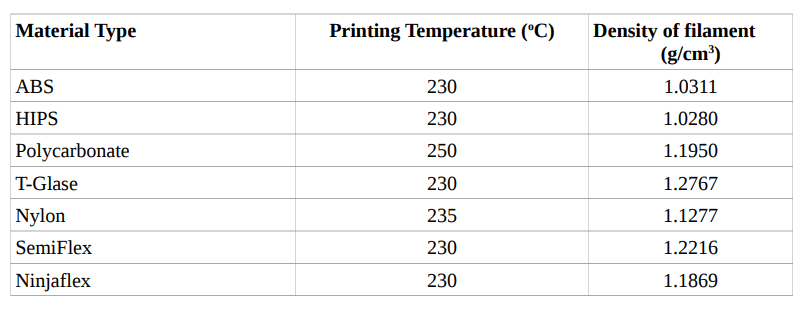
3D printing materials, printing temperature and density of the filament.
The majority of the materials tested well, and proportionality limits were low. Rigid material orientation was diagonal in all cases, with flexible materials fabricated in two different directions to evaluate flexibility in samples with varied orientation too. Further, orientations were 3D printed in vertical and diagonal orientations.
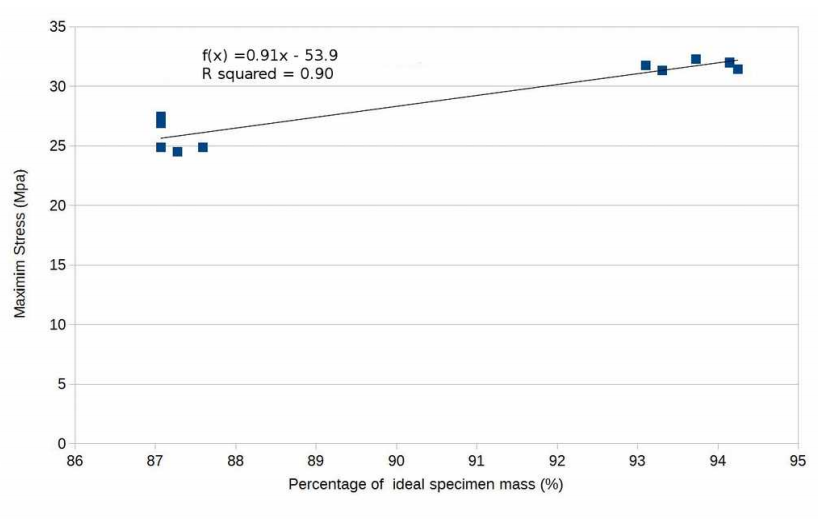
The maximum stress (MPa) of ABS as a function of sample mass to filament mass percentage.
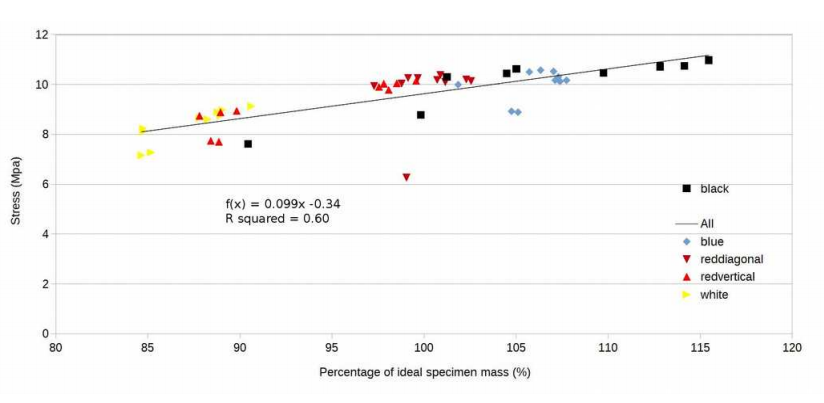
Stress at 60mm extension (MPa) of SemiFlex as a function of sample mass to filament mass percentage.
Testing also reflected the following:
- Polycarbonate was strongest, maximum tensile strength of 49.08 MPa
- Ninjaflex was most flexible, not breaking after extension of around 800 % (and tensile stress of 12.69 MPa)
- Nylon materials were stronger than Ninjaflex and SemiFlex
- Color demonstrated substantial impact on the amount of stress a 3D print can handle
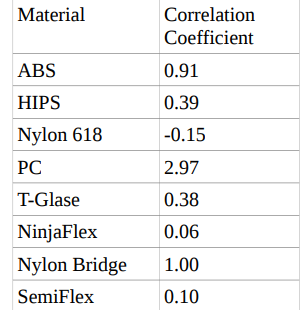
Correlation coefficients as a function of 3D printed material
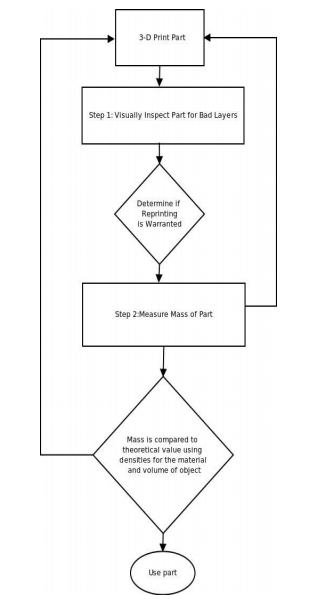
Illustration of low-cost two step process to determine under extrusion in 3D printed parts
“The study clearly demonstrates that the tensile strength of a 3D printed specimen depends largely on the mass of the specimen, for all materials. This dependence enables prosumers to solve the challenge of unknown print quality effects on the mechanical properties of a 3D printed part using a two step process to estimate the tensile strengths for a given material,” concluded the researchers. “First, the exterior of the print is inspected visually for sub-optimal layers from under or over extrusion. Then, to determine if there has been under-extrusion in the interior, the mass of samples is measured. This mass is compared to what the theoretical value is using the densities provided in this study for the material and the volume of the object.”
“This two-step process provides a means to assist low-cost open-source 3D printers expand their range of object production to functional parts. See also: ABS 3D Printing Settings Guide: Temperature, Enclo…. The strongest material among those tested was polycarbonate with a maximum tensile strength of 49 MPa. The most flexible material was Ninjaflex, which did not break after an extension of about 800%. The tensile stress for Ninjaflex at 800% extension was over 12 MPa (average of all colors). Nylon materials were stronger than Ninjaflex and SemiFlex, and much more flexible than ABS, HIPS, T-Glase, and polycarbonate, which provides a good balance between strength and flexibility.”
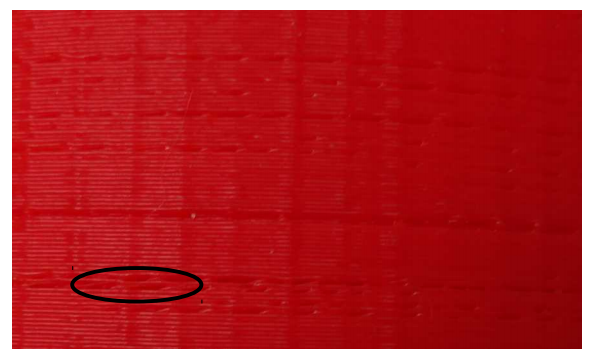
Under extrusion on exterior surface of 3D printed object (observable as dark lines).
Studying parameters for and resulting properties in parts created via FFF 3D printing, researchers around the world have developed new composites and other materials, experimented with printing 4D structures, and created monitoring systems.
What do you think of this news? Let us know your thoughts! Join the discussion of this and other 3D printing topics at 3DPrintBoard.com.
[Source / Images: ‘Tensile Strength of Commercial Polymer Materials for Fused Filament Fabrication 3D Printing’]
The post Desktop FDM 3D Printing: Tensile Strength of ABS, PC, HIPS, PA and Ninjaflex appeared first on 3DPrint.com | The Voice of 3D Printing / Additive Manufacturing.
Where to Buy Filament
Disclosure: Some of the links below are affiliate links. If you make a purchase, we may earn a commission at no extra cost to you. This helps support this site.
These links go to Amazon with our affiliate tag. If you prefer to support local retailers or buy directly from manufacturers, we encourage that as well!
Frequently Asked Questions
How is 3D printing used in medicine?
3D printing is used in medicine for surgical planning models, custom implants, bioprinting tissue scaffolds, drug delivery systems, dental aligners, and prosthetics. It enables patient-specific solutions that improve outcomes and reduce surgery time.
Product Comparison
| Product | Category | Best For | Check Price |
|---|---|---|---|
| Hatchbox | Desktop FDM 3D Printing: Tensile Strength of ABS, PC, HIPS, PA and Ninjaflex | General use | Amazon → |
| Overture | Desktop FDM 3D Printing: Tensile Strength of ABS, PC, HIPS, PA and Ninjaflex | General use | Amazon → |
| Buy Hatchbox on Amazon | Desktop FDM 3D Printing: Tensile Strength of ABS, PC, HIPS, PA and Ninjaflex | General use | Amazon → |
| Buy eSUN on Amazon | Desktop FDM 3D Printing: Tensile Strength of ABS, PC, HIPS, PA and Ninjaflex | General use | Amazon → |
| Buy Overture on Amazon | Desktop FDM 3D Printing: Tensile Strength of ABS, PC, HIPS, PA and Ninjaflex | General use | Amazon → |
What materials are biocompatible for 3D printing?
Common biocompatible materials include PEEK, titanium alloys (Ti6Al4V), bio-ceramics (hydroxyapatite), medical-grade resins, PLA for temporary implants, and hydrogels for bioprinting. Material choice depends on the application and required mechanical properties.
Is 3D printed medical equipment FDA approved?
Yes, several 3D printed medical devices have FDA clearance, including orthopedic implants, dental restorations, and surgical guides. Each device must go through the appropriate regulatory pathway based on its risk classification.
📌 Related Articles
- The Complete 3D Printing Filament Guide: Types, Properties & When to Use Each
- ABS 3D Printing Settings Guide: Temperature, Enclosure, and Cooling for Strong Parts
- Best Budget 3D Printer Upgrades That Actually Improve Print Quality: Belts, Springs, Hotends & More
- Best 3D Printers Under $500: 2026 Comparison Guide
- Best 3D Printer Upgrades That Actually Improve Print Quality: Complete 2026 Guide