
If we plan on continuing to make plastics past the point that oil is no longer profitable, easily accessible or socially acceptable, we will need to turn to more ecologically sustainable materials. Like everything in our industrial world, we may ultimately learn that these things are actually harmful to our ecosystem in one way or another, but it is at least worth considering how we might use chitin and keratin in manufacturing.
Chitin/Chitosan
Looking beyond plant life, we can find biopolymers in the tougher parts of fungi, mollusks, arthropods, crustaceans and bugs. Chitin is a glucose-derived polymer that makes up cell walls, scales, beaks, shells and exoskeletons in the aforementioned creatures and has been used to thicken paper, as well as food. Because it is found in excess when it comes to crustacean waste, it is increasingly looked to for a growing number of applications, including as a fertilizer to activate plant defense mechanisms. A related polymer is chitosan, obtained from chitin treated with an alkaline substance, like sodium hydroxide.

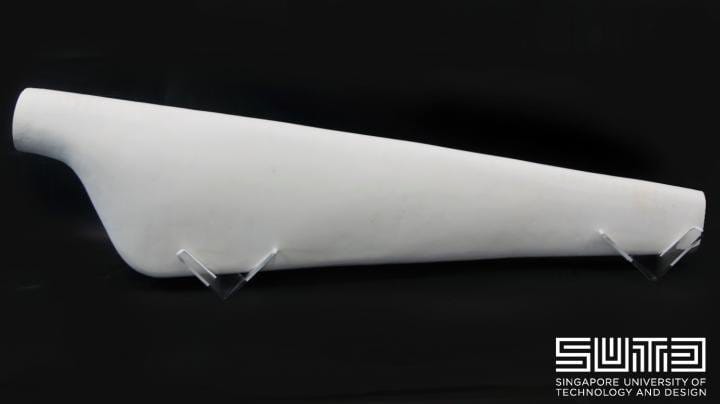
1.2m, 5.2kg turbine blade fabricated entirely with cellulose and chitosan, the most ubiquitous biopolymers on earth and produced in large amounts in almost every ecosystem. Both ingredients are obtained from by-products of the industry, resulting in production with negative ecological footprint. Image courtesy of Singapore University of Technology and Design.
Though chitin- and chitosan-based plastics have been developed, industrial scale production of the materials has yet to be developed—not that plastic production should always be “industrial scale”. One startup called The Shellworks is working on what seems to be fairly small-scale chitin plastic production. There are also a number of research projects in the works dedicated to 3D printing chitin materials, as well as Chitinous, a startup spun-out of Singapore University of Technology and Design based on some pretty interesting research combining chitin and cellulose.
MIT’s Mediated Matter Lab has performed some interesting work using chitin, in which an industrial robotic arm mounted with an extruder deposited different mixtures of chitin-based materials. Arthropod shells were ground to create chitosan and combined with water and Cyanobacteria that added such functional properties as water resistance and conductivity. Different mixtures of the materials were deposited to create structures with functional, mechanical and optical gradients. Once deposited, the materials dried and hardened in the air.
Keratin
With a similar toughness to chitin, keratin is the key structural proteins that make up hair, fingernails, feathers, claws, hooves, horns and the outer layer of skin on vertebrates. Like the other tough structural materials we’ve discussed here, researchers have explored the production of plastic materials using keratin, but with less success, given the fact that it is a protein and cannot be easily heated without destroying the protein in the process.
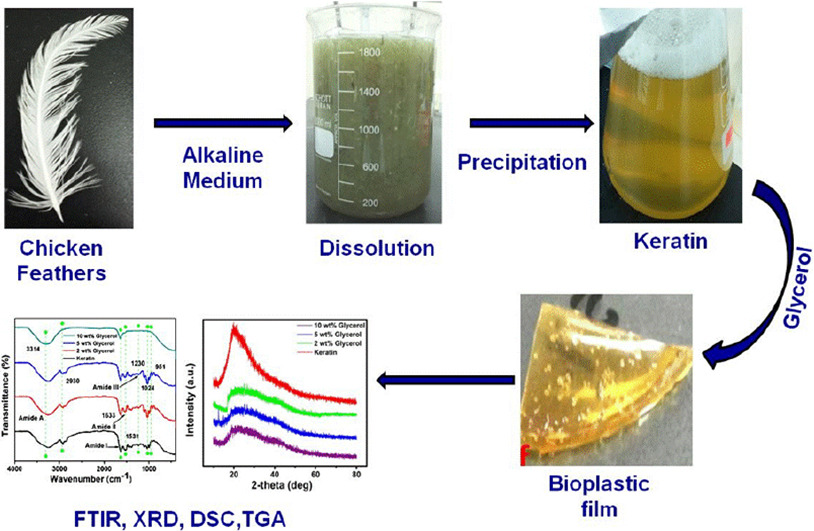
Keratin-based bioplastic film derived from chicken feathers. Image courtesy of the International Journal of Biological Macromolecules.
Some studies have resulted in keratin-based films, including keratin derived from chicken feathers and sheep’s wool. Such films can also be blended with cellulose to create a strong bioplastic. There has been some research into 3D printing with keratin, but far more projects involved in bioprinting human keratinocytes, skin cells produce keratin.
Most of the skin printing projects we’ve covered on 3DPrint.com involve the deposition of keratinocytes, usually to heal wounds. See also: The Current State of Metal 3D Printing in 2020. Examples include the technology developed by Poietis, work being performed by Wake Forest, skin printing research in Singapore, and studies being conducted in South Korea. While this is not currently an area of research with these groups as far as we know, we can at least imagine the possibility of growing keratin-based polymers from bioprinted keratinocytes.
In the next post in our series, we will discuss the prospects of recycling, how it’s done, how it can be done, and where 3D printing can fit into the mix.
[Feature image courtesy of the MIT Mediated Matter Lab.]
The post Climate Disrupted: Chitin and Keratin Bioplastics appeared first on 3DPrint.com | The Voice of 3D Printing / Additive Manufacturing.
Where to Buy Filament
Disclosure: Some of the links below are affiliate links. If you make a purchase, we may earn a commission at no extra cost to you. This helps support this site.
- ABS: Hatchbox
- PLA: Hatchbox
Looking for Chitin/Chitosan
Looking beyond plant life, we can find biopolymers in the tougher parts of fungi, mollusks, arthropods, crustaceans and bugs. Chitin is a glucose-derived polymer that makes up cell walls, scales, beaks, shells and exoskeletons in the aforementioned creatures and has been used to thicken paper, as well as food. Because it is found in excess when it comes to crustacean waste, it is increasingly looked to for a growing number of applications, including as a fertilizer to activate plant defense mechanisms. A related polymer is chitosan, obtained from chitin treated with an alkaline substance, like sodium hydroxide.1.2m, 5.2kg turbine blade fabricated entirely with cellulose and chitosan, the most ubiquitous biopolymers on earth and produced in large amounts in almost every ecosystem. Both ingredients are obtained from by-products of the industry, resulting in production with negative ecological footprint. Image courtesy of Singapore University of Technology and Design.
Though chitin- and chitosan-based plastics have been developed, industrial scale production of the materials has yet to be developed—not that plastic production should always be “industrial scale”. One startup called The Shellworks is working on what seems to be fairly small-scale chitin plastic production. There are also a number of research projects in the works dedicated to 3D printing chitin materials, as well as Chitinous, a startup spun-out of Singapore University of Technology and Design based on some pretty interesting research combining chitin and cellulose.
MIT’s Mediated Matter Lab has performed some interesting work using chitin, in which an industrial robotic arm mounted with an extruder deposited different mixtures of chitin-based materials. Arthropod shells were ground to create chitosan and combined with water and Cyanobacteria that added such functional properties as water resistance and conductivity. Different mixtures of the materials were deposited to create structures with functional, mechanical and optical gradients. Once deposited, the materials dried and hardened in the air.
Keratin
With a similar toughness to chitin, keratin is the key structural proteins that make up hair, fingernails, feathers, claws, hooves, horns and the outer layer of skin on vertebrates. Like the other tough structural materials we’ve discussed here, researchers have explored the production of plastic materials using keratin, but with less success, given the fact that it is a protein and cannot be easily heated without destroying the protein in the process.Keratin-based bioplastic film derived from chicken feathers. Image courtesy of the International Journal of Biological Macromolecules.
Some studies have resulted in keratin-based films, including keratin derived from chicken feathers and sheep’s wool. Such films can also be blended with cellulose to create a strong bioplastic. There has been some research into 3D printing with keratin, but far more projects involved in bioprinting human keratinocytes, skin cells produce keratin.
Most of the skin printing projects we’ve covered on 3DPrint.com involve the deposition of keratinocytes, usually to heal wounds. See also: The Current State of Metal 3D Printing in 2020. Examples include the technology developed by Poietis, work being performed by Wake Forest, skin printing research in Singapore, and studies being conducted in South Korea. While this is not currently an area of research with these groups as far as we know, we can at least imagine the possibility of growing keratin-based polymers from bioprinted keratinocytes.
In the next post in our series, we will discuss the prospects of recycling, how it’s done, how it can be done, and where 3D printing can fit into the mix.
[Feature image courtesy of the MIT Mediated Matter Lab.]The post Climate Disrupted: Chitin and Keratin Bioplastics appeared first on 3DPrint.com | The Voice of 3D Printing / Additive Manufacturing.
Where to Buy Filament? Check the best deals on Amazon:
These links go to Amazon with our affiliate tag. If you prefer to support local retailers or buy directly from manufacturers, we encourage that as well!
Frequently Asked Questions
What is the best 3D printing filament for beginners?
PLA is the best starting filament — it prints easily at 190-220°C without an enclosure and produces good results. Once comfortable, PETG offers better strength and temperature resistance for functional parts.
How do I choose the right filament?
Consider the application: PLA for display models, PETG for functional parts, ABS/ASA for heat/sunlight exposure, TPU for flexible parts, and specialty filaments for engineering applications. Each has specific printer requirements.
What temperature should I print different filaments at?
PLA: 190-220°C nozzle / 50-60°C bed. PETG: 220-250°C / 70-80°C. ABS: 230-260°C / 100-110°C (enclosure needed). Nylon: 240-270°C / 70-90°C. Always check manufacturer recommendations for specific brands.
📌 Related Articles
- The Complete 3D Printing Filament Guide: Types, Properties & When to Use Each
- The Current State of Metal 3D Printing in 2020
- ABS 3D Printing Settings Guide: Temperature, Enclosure, and Cooling for Strong Parts
- Best Budget 3D Printer Upgrades That Actually Improve Print Quality: Belts, Springs, Hotends & More
- Best 3D Printer Upgrades That Actually Improve Print Quality: Complete 2026 Guide