
Since early spring of 2020, there has been much to be serious about, from health to finances. Some of us have had one thing in common though: we have had to find more to do around the house. You may have taken up the art of bread baking and filling the home with delicious aromas, expanded your gardening skills or started a kitchen herb garden, or blazed through that juicy list of books you have been meaning to read. According to sales in China though, many of you have also been busy ordering 3D printers and accompanying supplies.
As economies began to falter and household budgets suffered, there were many questions about the future and how retail, restaurants, and other commercial endeavors would fair. What better time to innovate—using one of the most exciting new and positive disruptive technologies to hit the mainstream—than in the midst of extreme and challenging negative disruption via a viral pandemic.
How 3D Printing Responded to COVID-19
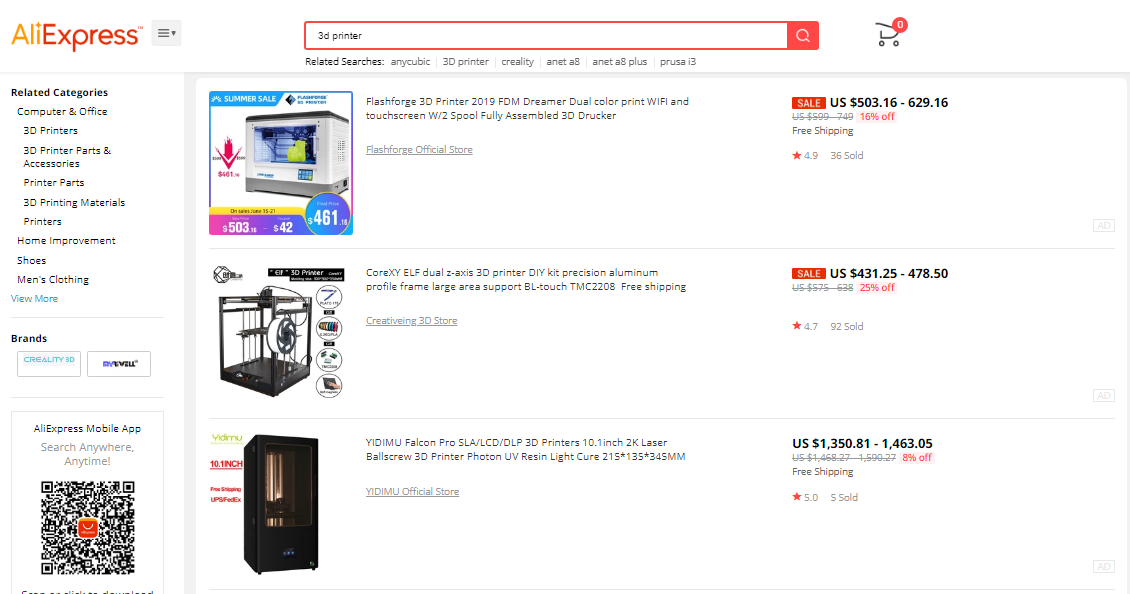
Image: AliExpress
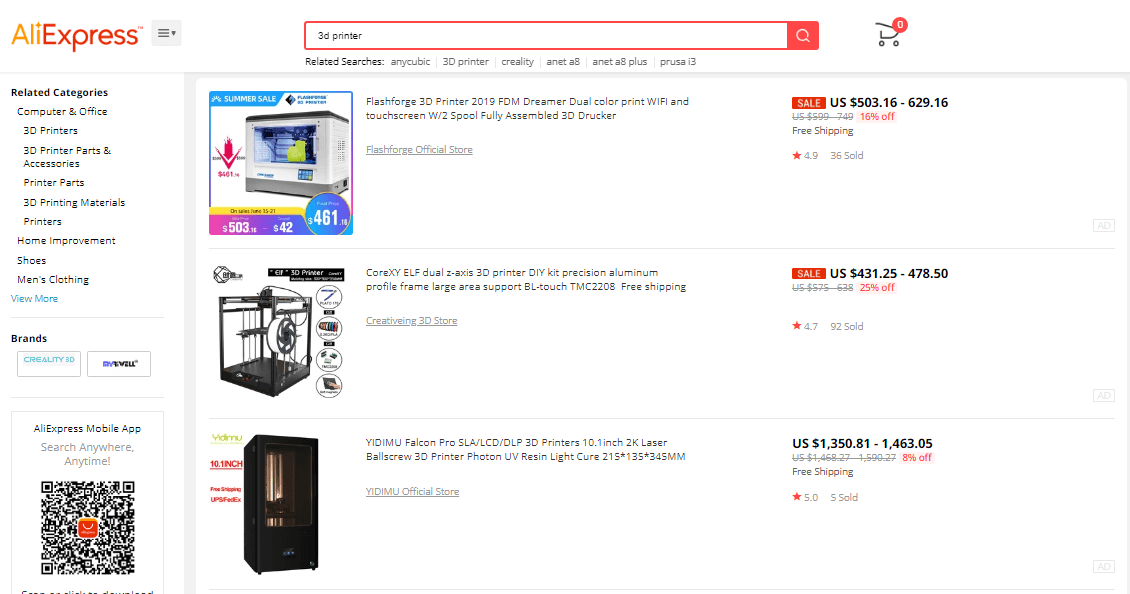
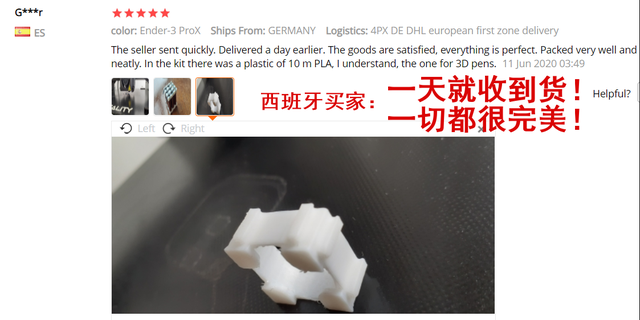
A Chinese news source offers staggering data from online retail service AliExpress regarding Chinese 3D printer exports, stating that sales of their 3D printers doubled during the COVID-19 pandemic “year on year.” Supply chains everywhere have been devastated, but history tends to show that niche businesses will suddenly push ahead and thrive even in uncertain times—and in fact, the receipts show that as overseas sales increased during March and April, the numbers of orders translate to one sold every eight seconds.
Most of the 3D printer manufacturers are centered in areas like Shenzhen, Dongguan, and the Yangtze River Delta region of the Pearl River Delta. The National Bureau of Statistics showed an increase of 87.7 percent in the first quarter because of exports, with further acceleration in numbers to a whopping 344.7% in April.
3D printing also, not surprisingly, continued to make headlines as the need for medical equipment became apparent during the pandemic. This led to an obvious upswing not only in interest around the world as researchers and medical professionals created items like open-source ventilators, face shields and masks, and items like goggles and swabs, but it has obviously led to fantastic rates in sales—whether users were just bored and looking for something new to do, or engaged in complex engineering and design endeavors.
With supply chains around the world being halted indefinitely, 3D printing also allows for a wide range of users—especially the industrially inclined—to continue or take this time of uncertainly as the impetus for making their own parts now.
“We recommended that merchants prepare stocks in overseas warehouses in advance.” said Li Xiang, head of the global AliExpress 3C industry.
Supply Chain Disruptions and Digital Solutions
For those who were and are ready, it sounds as if the customers are available in the droves—leaving companies like the Alibaba Group-owned AliExpress in a prime position to bolster their companies for further product offerings and expansion due to good stores of inventory.
“The first five months of this year have already completed the sales of 500,000 units last year. The shipments of this year are expected to reach 3-4 times last year,” said Chen Chun, CEO of Chuangxinwei—a company selling 3D printers through the AliExpress service. “Because the orders on AliExpress skyrocketed from January to March, the production capacity was under great pressure, and even the office staff went to the factory to help with production and shipment.”
Medical PPE and Equipment Production
Shenzhen-headquartered Vertical Cube has also continued to build up inventory; however, they have reported out-of-stock warehouse statuses overseas.
“Overseas orders began to rise rapidly after the epidemic occurred. See also: Best 3D Printer Upgrades That Actually Improve Pri…. Multiple units, and now more than 20,000 units a month, doubled,” said Feng Ke. “We expect sales to double this year.”
Lessons Learned for Future Emergencies
Sales director Feng Ke has stated that 90 percent of the sales were exports to other markets: the US, Germany, France, Spain, Italy, and more.
“The global supply chain is mainly based on traditional offline channels. During the epidemic, a large number of overseas factories were closed and offline circulation channels were restricted, but online cross-border channels were unblocked, so many People on AliExpress buy 3D printers to print masks, car parts, and even airplane parts, said Wang Mingqiang, general manager of AliExpress.”
How 3D Printing Responded to COVID-19
What do you think of this news? Let us know your thoughts! Join the discussion of this and other 3D printing topics at 3DPrintBoard.com.
[Source: Baidu]
The post Chinese 3D Printer Exports Soar Amid COVID-19 Pandemic appeared first on 3DPrint.com | The Voice of 3D Printing / Additive Manufacturing.
from Your daily news from 3DPrint.com https://bit.ly/2Np60lf
Related Articles
Frequently Asked Questions
How did 3D printing help during COVID-19?
During the COVID-19 pandemic, 3D printing enabled rapid production of critical medical supplies including face shields, ventilator components, nasal swabs, and PPE. Distributed manufacturing allowed makers worldwide to produce items locally without waiting for traditional supply chains.
What was the pandemic digital manufacturing shift?
The pandemic accelerated adoption of digital manufacturing including 3D printing, as companies sought more resilient supply chains. Organizations shifted from centralized to distributed production, using digital files to produce parts locally on demand.
Can 3D printing supply chains be resilient in emergencies?
Yes, 3D printing provides supply chain resilience through distributed manufacturing — designs can be shared digitally and produced anywhere with compatible equipment, eliminating the need for physical inventory and shipping of parts.
📌 Related Articles
- The Current State of Metal 3D Printing in 2020
- Best 3D Printer Upgrades That Actually Improve Print Quality: Complete 2026 Guide
- Best Budget 3D Printer Upgrades That Actually Improve Print Quality: Belts, Springs, Hotends & More
- 3D Printing News: Multi-Material Breakthrough and Aerospace Market Boom
- ABS 3D Printing Settings Guide: Temperature, Enclosure, and Cooling for Strong Parts