
In a final degree project for Biomedical Engineering at Universitat Politecnica de Catalunya, Antonio Molina Herrero tackles the challenging topic of bone regeneration in bioprinting. Investigating 3D printing and varying material morphologies, the student researcher detailed his findings in the recently published ‘Characterization of Calcium Phosphate Structures Obtained by 3D Printing.’
In analyzing properties like the geometry of filament, porosity in structures, and surface and concavity, Herrero used micro-tomography to make comparisons with other images, calculations, and measurements—ultimately leading the researcher to understand more about deviations between nozzles and printing materials and how to use calcium phosphate better for building scaffolds in tissue engineering for bone regeneration.
“Among the synthetic bone grafts, calcium phosphate (CaPs) based ones have been widely studied. However, they do not promote osteogenesis sufficiently,” states Herrero.
The Role of 3D Printing in Medicine
“An interconnected pore network allows the vascularization of all the area and later tissue colonisation. Many studies have been carried out searching for the optimal pore size in a scaffold [1], however the conclusions are not clear and some studies contradict others; What is clear is that the pores have to be big enough to allow the vascularization ( 50 μm), but if they are larger than a certain size (500 μm) the scaffold is not acting anymore as a scaffold.”
Herrero emphasizes what he finds to be key in studying scaffolds: pore shape. Explaining that numerous methods have been used for CaP porous structures such as granulation, foaming, leaching, and freeze drying, with the advent of direct ink writing (DIW), there is even greater potential for success with such structures; however, challenges still arise for in vivo testing and further characterization.

Biocompatible Materials and Processes
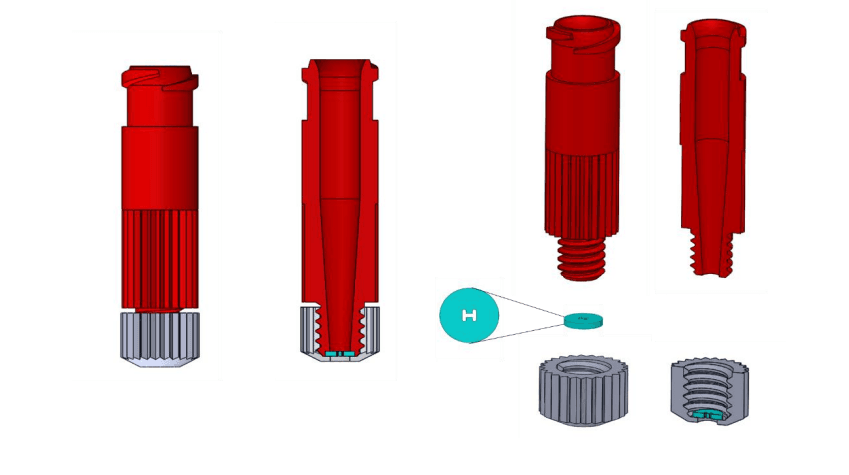
Schema of the custom modular nozzle design. Red: Upper part of the nozzle with ¨Luer lock¨ standard connector of the top section. Grey: Lower part of the nozzle. Unscrewable to fit the custom disk. Turquoise: Disc with variety of central orifice design.
“The complex and imbricated shape of these 3D structures can be studied by advanced imaging techniques such as micro computed tomography (Micro-CT) and scanning electron microscopy (SEM). The image processing to extract quantitative information of these images is at the same time promising and challenging. These tools are increasingly used due to its immediacy and reliability. With them, morphological properties of three dimensional structures can be studied and provide morphological and structural information of a big interest for the design and characterization of new scaffolding shapes for tissue engineering,” states the author.
Samples were prepared and examined, with images and calculations being compared.
Clinical Applications and Case Studies
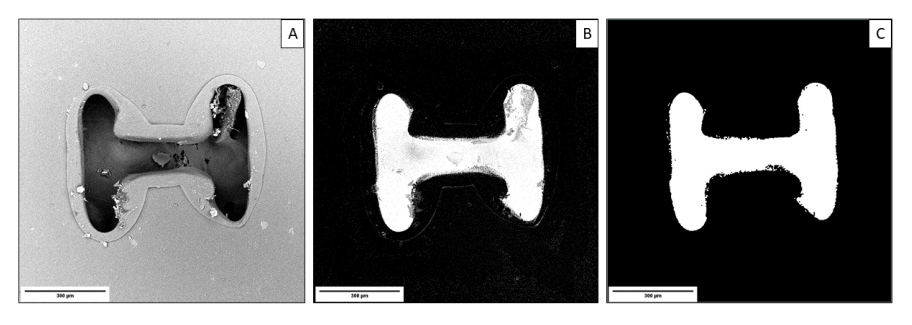
Pattern 1 image segmentation process: A) Original raw image, B) Image segmented with Ilastik and C)Image after Fiji noise reduction. 300μm scalebar.
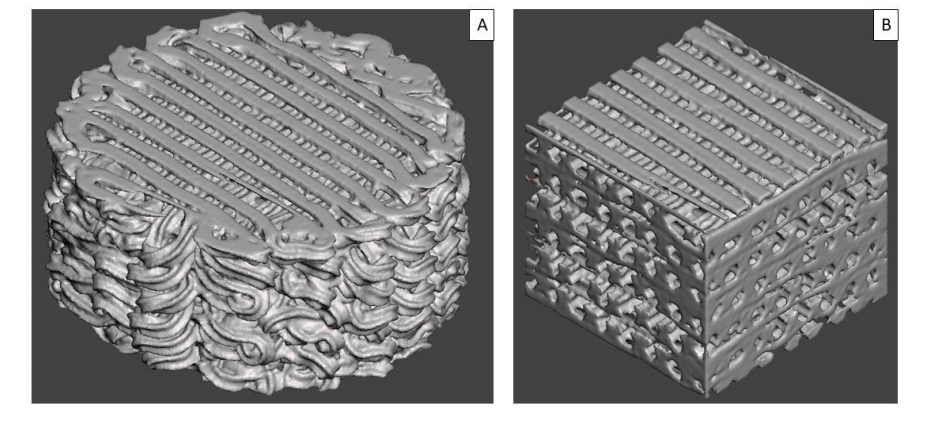
Pattern 2 before (A) and after (B) applying the VOI cropping.
Four techniques were evaluated:
- CTAn
- ImageJ
- MeshMixer
- Manual exercises
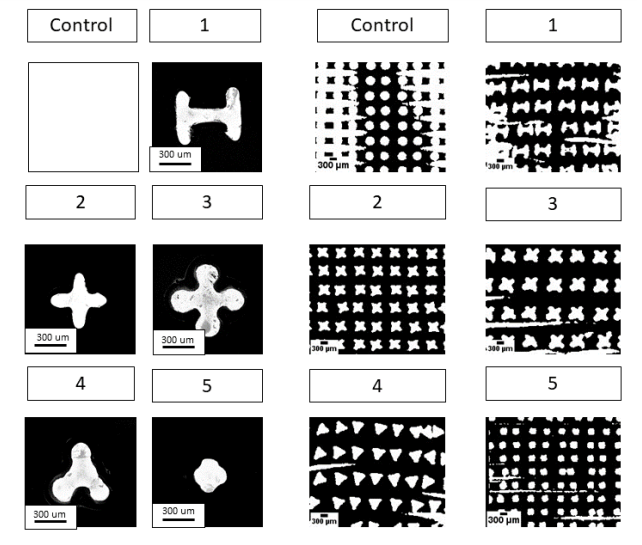
Five sample patterns were evaluated and numbered from control to 1-5.
Regulatory Considerations and Safety
Image of the nozzles by SEM; Right: Scaffold’s sagittal view by Micro-CT.
“In the porosity results there were no large differences between the scaffolds. This it is because the scaffolds were printed in pre-setting conditions so that they would give an equivalent porosity and be able to compare the samples between them (250 μm). A good indicator about that was the pore size distribution results. The peaks in the graph represent regularity and good print quality,” concluded Herrero.
“In the specific surface area, the pattern which has the highest coefficient was the 5 and the lowest the Control. See also: The Current State of Metal 3D Printing in 2020. These results are coherent because the control section is a circle, so it has the least surface/area coefficient and the pattern 5; despite of being small, it was repeated very frequently, causing the sum of all the filaments to give a larger surface than the other patterns. Also, the MeshMixer method have the too much error compared to the other methods, this can be due how the plugin 3D Viewer do the meshing process from the Micro-CT scaffolds before the MeshMixer calculous, however, more trials are necessary to ensure this hypothesis.”

Research Breakthroughs and Innovations
Porosity Percentage. Statistically significant differences indicated with different letters (p=0.05)
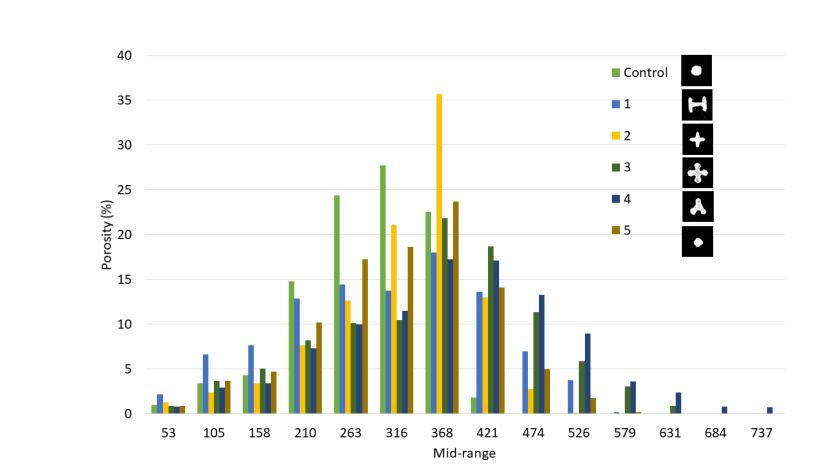
Pore size distribution.
The study of scaffolds for bone regeneration is ongoing and involved in a range of projects and experiments with the use of materials like PLA, coated nanofibers, and bioprinting with antibacterial properties.
The Future of Bioprinting and Medical AM
What do you think of this news? Let us know your thoughts! Join the discussion of this and other 3D printing topics at 3DPrintBoard.com.
[Source / Images: ‘Characterization of Calcium Phosphate Structures Obtained by 3D Printing’]
The post Bone Regeneration Scaffolds: 3D Printing to Study Calcium Phosphate Structures appeared first on 3DPrint.com | The Voice of 3D Printing / Additive Manufacturing.
Frequently Asked Questions
How is 3D printing used in medicine?
3D printing is used in medicine for surgical planning models, custom implants, bioprinting tissue scaffolds, drug delivery systems, dental aligners, and prosthetics. It enables patient-specific solutions that improve outcomes and reduce surgery time.
What materials are biocompatible for 3D printing?
Common biocompatible materials include PEEK, titanium alloys (Ti6Al4V), bio-ceramics (hydroxyapatite), medical-grade resins, PLA for temporary implants, and hydrogels for bioprinting. Material choice depends on the application and required mechanical properties.
Is 3D printed medical equipment FDA approved?
Yes, several 3D printed medical devices have FDA clearance, including orthopedic implants, dental restorations, and surgical guides. Each device must go through the appropriate regulatory pathway based on its risk classification.
📌 Related Articles
- The Complete 3D Printing Filament Guide: Types, Properties & When to Use Each
- The Current State of Metal 3D Printing in 2020
- The Ultimate Guide to 3D Printer Calibration: Complete Step-by-Step Manual
- Best 3D Printers Under $500: 2026 Comparison Guide
- Best Budget 3D Printer Upgrades That Actually Improve Print Quality: Belts, Springs, Hotends & More