
Quick Answer: What is Carboxymethyl Cellulose (CMC) Hydrogel Bioprinting?
Carboxymethyl cellulose (CMC) hydrogel bioprinting is a cutting-edge 3D bioprinting technique using modified CMC as a bioink material for creating tissue engineering scaffolds and regenerative medicine applications. CMC is an FDA-approved, biocompatible, water-soluble polymer derived from cellulose that’s methacrylated to create M-CMC, which can be crosslinked using digital light processing (DLP) with LAP (lithium phenyl-2,4,6-trimethylbenzoylphosphinate) photoinitiator under UV light (405 nm). Key advantages include low cytotoxicity, excellent swelling ability, mechanical stability after UV curing, and similarity to extracellular matrix glycosaminoglycan, making it ideal for cell-laden bioinks and tissue engineering applications.
Disclosure: As an Amazon Associate, 3dput.com earns from qualifying purchases. This supports our independent testing and reviews.
Researchers from Italy and Sweden add to ongoing trend for improving bioprinting techniques and materials. Upon developing bio-based photocurable materials for 3D printing and bioprinting with hydrogels, the authors released the details of their study in ‘DLP 3D Printing Meets Lignocellulosic Biopolymers: Carboxymethyl Cellulose Inks for 3D Biocompatible Hydrogels.’
Understanding Carboxymethyl Cellulose (CMC)
Modified carboxymethyl cellulose was at the center of this experiment for bioprinting with digital light processing (DLP). While more commonly used as a filler, cellulose has been used in other inks. Beginning the research with the study of lignocellulosic biopolymers, the authors explained that they present a range of options for printing with DLP, while carboxymethyl cellulose (CMC) is often used in food, paint, and detergents. For this reason, it is a sustainable material with particular utility in bioprinting.
What is CMC?
Carboxymethyl cellulose (CMC) is a derivative of cellulose, the most abundant biopolymer on Earth, with unique properties that make it valuable for biomedical applications:
- FDA Approved: CMC has been approved by the U.S. Food and Drug Administration for use in pharmaceutical and food applications
- Biocompatible: Well-tolerated by biological systems with minimal immune response
- Water-Soluble: Dissolves readily in aqueous solutions, enabling easy formulation with culture media and bioinks
- Chemically Versatile: Can be functionalized through methacrylation to create photocurable resins for DLP bioprinting
- Sustainable: Derived from renewable cellulose sources including wood pulp and plant fibers
- Low Cost: Economical compared to many specialized biomedical polymers
- ECM-Mimicking: Similar chemical structure to glycosaminoglycan found in extracellular matrix, providing cell-friendly environment
Why CMC for Bioprinting?
CMC offers several advantages specifically for 3D bioprinting applications:
- Easy Functionalization: Hydroxyl groups on CMC backbone can be easily modified to introduce methacrylate groups for photocrosslinking
- Printable with DLP: Can be formulated into photocurable resins compatible with digital light processing 3D printers
- Cell-Friendly Environment: Mimics natural extracellular matrix components, supporting cell attachment, proliferation, and differentiation
- Swelling Ability: Hydrogels maintain hydration and transport nutrients effectively to encapsulated cells
- Mechanical Tunability: Properties can be adjusted through degree of methacrylation and concentration
- Low Cytotoxicity: When properly crosslinked and purified, shows minimal toxicity to mammalian cells
Methacrylation of CMC
Approved by FDA, and deemed biocompatible, CMC is water-soluble, versatile, and considered “an ideal candidate for preparation of novel photocurable resins for DLP.” These types of formulations can also imitate cell microenvironments because of their similar makeup to glycosaminoglycan found within extracellular matrix.
“Due to its versatility, its advantageous properties, water-solubility, and susceptibility to further functionalization, we also expected CMC would be an ideal candidate for preparation of novel photocurable resins for DLP,” explained the authors. “However, use of light-assisted printing techniques requires reactive photocrosslinkable functional groups, which means CMC needs functionalization to produce ink formulation for production of 3D photocured hydrogels.”
“CMC was therefore methacrylated and its photorheology and DLP printability was investigated in two formulations, namely, M-CMC/Dulbecco’s Modified Eagle Medium (DMEM) and M-CMC/water, in presence of a fixed amount of lithium phenyl-2,4,6-trimethylbenzoylphosphinate (LAP) photoinitiator.”
The Methacrylation Process
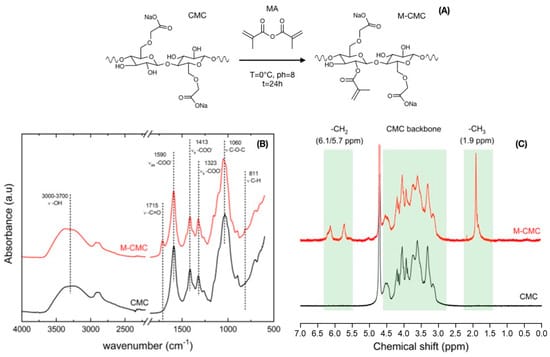
Methacrylation introduces photocrosslinkable methacrylate groups onto the CMC polymer backbone, enabling UV-induced crosslinking. Key aspects include:
- Chemical Modification: Methacrylate groups are attached to CMC hydroxyl groups through esterification reactions
- Photocrosslinkable: Methacrylated CMC (M-CMC) can be crosslinked under UV light in presence of photoinitiator
- Tunable Properties: Degree of methacrylation affects crosslinking density, mechanical strength, and swelling behavior
- UV Curing: Typically uses 405 nm UV light for rapid polymerization
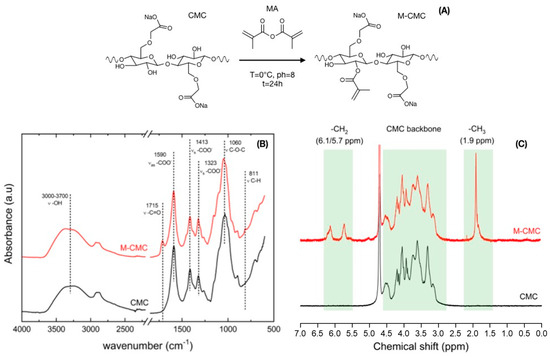
(A) Scheme for methacrylation of carboxymethyl cellulose (CMC). The presented product only presents one of the possible reaction products. (B) FTIR and (C) 1H NMR spectra for methacrylated CMC (M-CMC, red) and neat CMC (CMC, black).
LAP Photoinitiator
Lithium phenyl-2,4,6-trimethylbenzoylphosphinate (LAP) is a highly effective photoinitiator specifically designed for bioprinting applications:
Properties of LAP
| Property | Details | Significance |
|---|---|---|
| Activation Wavelength | 365 nm and 405 nm | Compatible with standard DLP and SLA bioprinters |
| Low Cytotoxicity | Minimal toxicity to mammalian cells | Ideal for cell-laden bioink crosslinking |
| Fast Polymerization | Rapid crosslinking kinetics | Reduces printing time and improves efficiency |
| High Efficiency | High quantum yield | Efficient use of light energy |
| Water Solubility | Soluble in aqueous solutions | Compatible with water-based bioink formulations |
| Thermal Stability | Stable at room temperature | Long shelf life when stored properly |
Advantages Over Traditional Photoinitiators
- Reduced Cell Damage: Lower cytotoxicity compared to Irgacure 2959 and other traditional photoinitiators
- Better Water Solubility: More soluble in aqueous solutions than many alternatives
- Faster Curing: Polymerizes more rapidly under UV light
- Improved Biocompatibility: Better cell viability in cell-laden hydrogels
Rheological Properties and Photocuring
During evaluation, the authors also investigated compatibility for hydrogels, with M-CMC solubilized in a culture medium (DMEM). Rheological properties (storage modulus, G′, and loss modulus, G″) were evaluated during UV curing for CMC/DMEM/LAP and M-CMC/water/LAP:
“Although formulation M-CMC/DMEM/LAP showed a slight delay with respect to onset of curing process, the DMEM medium still allowed sufficient light penetration for the photocuring process in view of 3D printing,” said the researchers.
Understanding Rheology
Rheological measurements are critical for understanding how M-CMC hydrogels behave during and after the printing process:
- Storage Modulus (G′): Represents elastic behavior and solid-like properties of the hydrogel
- Loss Modulus (G″): Represents viscous behavior and liquid-like properties of the hydrogel
- Gel Point: The point where G′ exceeds G″, indicating transition from liquid to gel state
- Curing Onset: Time or light dose required to initiate crosslinking
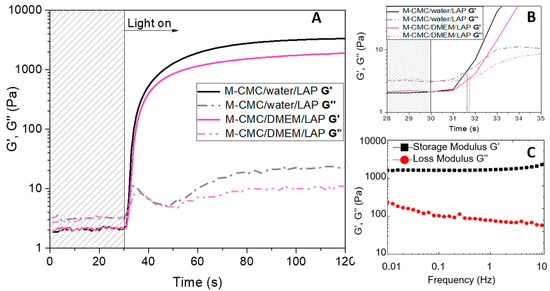
(A) Photorheology of methacrylated carboxymethyl cellulose (M-CMC) 20 mg/mL (2 wt% lithium phenyl-2,4,6-trimethylbenzoylphosphinate (LAP)) solubilized in water (black) or in culture medium (pink). (B) Gel point. Film thickness 300 m. (C) Frequency sweep. Strain rate 1% and oscillation frequency from 0.01 to 10 Hz.
Formulation Performance
Both CMC/DMEM/LAP and M-CMC/water/LAP formulations proved to be stable after 90 s of UV irradiation. Hydrogels were created from both formulations, and deemed “extremely promising” in comparison with other DLP biocompatible materials.
M-CMC/DMEM/LAP Formulation
- Delayed Curing: Slight delay in curing onset due to DMEM composition
- Sufficient Light Penetration: DMEM allows adequate UV light transmission for complete curing
- Cell-Compatible: Contains nutrients and growth factors for cell culture
- Complete Crosslinking: Achieved full crosslinking after 90 seconds UV exposure
M-CMC/Water/LAP Formulation
- Faster Curing: More rapid curing onset compared to DMEM formulation
- Clearer Transmission: Better UV light transmission in pure water
- Stable Hydrogels: Maintains structural integrity after curing
- Excellent Flexibility: Good mechanical properties after crosslinking
3D Printing of M-CMC Hydrogels
The researchers created a variety of 3D printed samples, to include cylinders, parallelepipeds, and other complex structures—all stemming from the M-CMC/DMEM/LAP and M-CMC/water/LAP formulations. On further evaluation, the hydrogels were stable, flexible, and the photocrosslink reaction was completed. Although dyes can be helpful in limiting light diffusion, there is also risk of cytotoxicity, leading the authors to avoid such use in this study.

3D printed M-CMC hydrogels. (A) Simple cylinders and parallelepipeds (solvent: water). (B) The hydrogel exhibited good flexibility and handleability. (C) SEM analysis performed on the freeze-dried hydrogel. (D–F) 3D objects printed from water (D) and from culture medium solution (E,F).
DLP Bioprinting Technique
Digital light processing (DLP) bioprinting offers several advantages for hydrogel fabrication:
- High Resolution: Capable of producing features down to 25-50 microns
- Fast Printing: Prints entire layers simultaneously, increasing speed compared to extrusion bioprinting
- Smooth Surfaces: Produces high-quality surface finish with minimal stair-stepping
- Complex Geometries: Can create intricate structures with overhangs and internal channels
- Consistent Quality: Uniform layer thickness and material properties
Printed Structures
The researchers successfully printed various 3D structures demonstrating the versatility of M-CMC hydrogels:
| Structure Type | Complexity | Properties | Applications |
|---|---|---|---|
| Cylinders | Low | Simple geometry, uniform cross-section | Drug delivery, cell culture scaffolds |
| Parallelepipeds | Medium | Rectangular geometry, controlled dimensions | Tissue patches, mechanical testing samples |
| Complex Geometries | High | Intricate shapes, overhangs, internal channels | Organ models, vascular networks, tissue constructs |
Hydrogel Properties and Characterization
Crosslinking and reactivity were further evaluated, along with compression tests, assessment of swelling ability, and cytotoxicity testing to investigate lack of cell death due to release of LAP photoinitiator or unreacted polymer chains. Ultimately, the team of researchers reported that there were no signs of cytotoxicity, and overall, their work was successful with cells exhibiting viability similar to control samples.
Mechanical Properties
Compression tests revealed important mechanical characteristics of M-CMC hydrogels:
- Elasticity: Hydrogels exhibited good flexibility and handleability
- Strength: Sufficient mechanical integrity for tissue engineering applications
- Shape Retention: Printed structures maintained shape after post-processing
- Crosslinking Completion: Photocrosslink reaction fully completed after UV exposure
Swelling Behavior
Swelling ability is critical for hydrogel performance in biomedical applications:
- Water Absorption: Excellent swelling capacity maintains hydration
- Nutrient Transport: Swelling enables efficient diffusion of nutrients and waste products
- Pore Structure: Freeze-dried SEM analysis revealed porous structure beneficial for cell infiltration
- Volume Change: Controlled swelling maintains dimensional stability
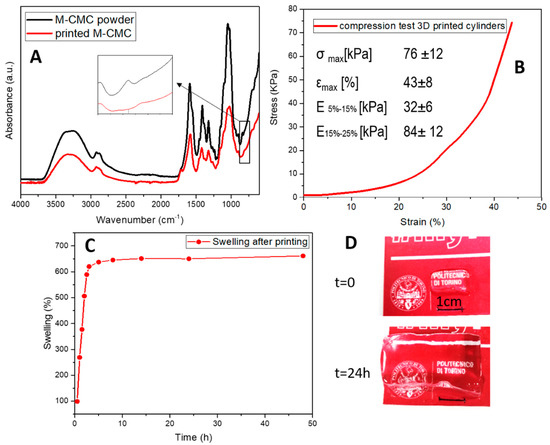
FTIR spectra of hydrogel showing successful methacrylation and crosslinking.
Cytotoxicity Assessment
Cytotoxicity testing is essential for biocompatibility evaluation:
- No Cell Death: No signs of cytotoxicity observed in cell cultures
- High Cell Viability: Cells exhibited viability similar to control samples
- LAP Safety: LAP photoinitiator showed low toxicity at used concentrations
- Polymer Purity: No harmful residues from unreacted polymer chains
Applications of CMC Hydrogels in Biomedicine
CMC-based hydrogels have numerous potential applications in biomedicine and tissue engineering:
Tissue Engineering
- Scaffold Materials: 3D scaffolds for growing tissues and organs
- Cell Encapsulation: Protecting and supporting cells during culture
- Organ Models: Creating realistic organ models for drug testing
- Wound Healing: Dressings and patches for wound treatment
Drug Delivery
- Controlled Release: Sustained release of therapeutic compounds
- Targeted Delivery: Localized delivery to specific tissues
- Injectable Hydrogels: Minimally invasive drug administration
Regenerative Medicine
- Cartilage Repair: Hydrogels mimicking cartilage structure
- Soft Tissue Regeneration: Supporting repair of muscles, tendons, and ligaments
- Stem Cell Culture: Environment for stem cell expansion and differentiation
Comparison with Other Hydrogel Materials
CMC hydrogels offer unique advantages compared to other commonly used hydrogel materials:
| Material | Biocompatibility | Printability | Cost | Sustainability | Key Applications |
|---|---|---|---|---|---|
| CMC (Carboxymethyl Cellulose) | High (FDA approved) | Excellent with DLP | Low | Very high (renewable) | Tissue engineering, drug delivery |
| GelMA (Gelatin Methacryloyl) | Very high (natural protein) | Excellent with DLP | Medium | Medium (animal-derived) | Cell culture, tissue scaffolds |
| Alginate | High (seaweed-derived) | Good (extrusion) | Low | Very high (renewable) | Cell encapsulation, wound healing |
| PEGDA (Polyethylene Glycol Diacrylate) | Medium (synthetic) | Excellent with DLP | Medium-High | Low (petroleum-based) | Drug delivery, tissue engineering |
| Hyaluronic Acid | Very high (natural) | Good (requires modification) | High | Medium (natural source) | Skin regeneration, joint repair |
Best Bioprinting Products on Amazon
For researchers and professionals working with bioprinting and hydrogel materials, here are recommended products available on Amazon:
Carboxymethyl Cellulose Powder – High-purity CMC for bioprinting and pharmaceutical applications.
LAP Photoinitiator – Lithium phenyl-2,4,6-trimethylbenzoylphosphinate for low-cytotoxicity photocrosslinking.
DLP 3D Bioprinters – Digital light processing bioprinters for high-resolution hydrogel printing.
UV Light Sources (405nm) – 405 nm UV light sources for DLP bioprinting and photocrosslinking.
Gelatin Methacryloyl (GelMA) – Natural protein hydrogel for cell culture and tissue engineering.
Alginate Hydrogel Materials – Natural seaweed-derived hydrogel for cell encapsulation.
Cell Culture Media (DMEM) – Dulbecco’s Modified Eagle Medium for cell culture in hydrogel scaffolds.
Bioprinting Inks – Various hydrogel inks for tissue engineering applications.
Frequently Asked Questions (FAQ)
Q: What is carboxymethyl cellulose (CMC) and why is it used in bioprinting?
Carboxymethyl cellulose (CMC) is a water-soluble derivative of cellulose, the most abundant biopolymer on Earth, that has been approved by the FDA for use in pharmaceutical and food applications. CMC is used in bioprinting because it’s biocompatible, sustainable, chemically versatile (can be functionalized through methacrylation), and mimics glycosaminoglycan found in extracellular matrix, providing a cell-friendly environment. When methacrylated to create M-CMC, it becomes photocrosslinkable and can be printed using digital light processing (DLP) with UV light (405 nm) and LAP photoinitiator, enabling high-resolution fabrication of tissue engineering scaffolds and regenerative medicine applications.
Q: How does the methacrylation process work for CMC?
Methacrylation introduces photocrosslinkable methacrylate groups onto the CMC polymer backbone through esterification reactions between CMC hydroxyl groups and methacrylic anhydride or similar reagents. This chemical modification creates methacrylated CMC (M-CMC), which contains reactive vinyl groups that can undergo photopolymerization when exposed to UV light in the presence of a photoinitiator like LAP. The degree of methacrylation affects crosslinking density, mechanical strength, and swelling behavior of the resulting hydrogels, allowing tunability for different tissue engineering applications. The methacrylation process is typically verified using FTIR and 1H NMR spectroscopy to confirm successful functionalization.
Q: What is LAP photoinitiator and why is it preferred for bioprinting?
LAP (lithium phenyl-2,4,6-trimethylbenzoylphosphinate) is a water-soluble photoinitiator specifically designed for bioprinting applications, activated by 365 nm and 405 nm UV light sources compatible with standard DLP and SLA bioprinters. See also: Best Budget 3D Printer Upgrades That Actually Impr…. LAP is preferred over traditional photoinitiators like Irgacure 2959 because it has significantly lower cytotoxicity to mammalian cells, better water solubility, faster polymerization kinetics, and improved biocompatibility in cell-laden hydrogels. When properly formulated and crosslinked, LAP shows minimal toxicity while enabling rapid, efficient crosslinking of methacrylated hydrogels for high-resolution 3D bioprinting.
Q: What are the advantages of DLP bioprinting over extrusion bioprinting?
DLP bioprinting offers several advantages over extrusion bioprinting: higher resolution capable of producing features down to 25-50 microns compared to extrusion’s typical 100-200 microns; faster printing speed as entire layers are printed simultaneously rather than point-by-point extrusion; smoother surface finish with minimal stair-stepping; ability to create complex geometries with overhangs and internal channels without support structures; consistent quality with uniform layer thickness and material properties; and gentle on cells as there’s no shear stress from extrusion through narrow nozzles. However, DLP requires photocurable bioink formulations and UV light exposure, which can potentially affect cell viability if not carefully optimized.
Q: What rheological properties are important for DLP bioprinting of hydrogels?
Key rheological properties for DLP bioprinting include storage modulus (G′) representing elastic/solid-like behavior, loss modulus (G″) representing viscous/liquid-like behavior, gel point (the transition where G′ exceeds G″), and curing onset (time or light dose required to initiate crosslinking). These properties determine whether the hydrogel formulation can be successfully printed with good shape fidelity and structural integrity. Ideally, the bioink should have appropriate viscosity to maintain shape before curing, complete photocrosslinking during UV exposure, and achieve final mechanical properties suitable for intended applications. Photorheology testing evaluates how these properties change during UV curing to optimize printing parameters.
Q: Are there any cytotoxicity concerns with M-CMC hydrogels and LAP photoinitiator?
When properly formulated and crosslinked, M-CMC hydrogels with LAP photoinitiator show minimal cytotoxicity to mammalian cells. Research demonstrates that after thorough UV curing and purification, cells cultured in M-CMC hydrogels exhibit viability similar to control samples with no signs of cell death due to LAP photoinitiator or unreacted polymer chains. However, it’s important to use appropriate LAP concentrations, ensure complete photocrosslinking, and wash away any unreacted components. While LAP itself has low cytotoxicity at typical bioprinting concentrations (1-3% w/v), the combination of LAP and free radicals generated during photocrosslinking can be cytotoxic if not properly controlled, making optimization of UV dose and photoinitiator concentration critical.
Q: What applications are CMC hydrogels best suited for in biomedical research?
CMC hydrogels are particularly well-suited for tissue engineering applications including 3D scaffolds for growing tissues and organs, cell encapsulation for protecting and supporting cells during culture, organ models for drug testing and disease modeling, wound healing dressings and patches for wound treatment, cartilage repair hydrogels mimicking cartilage structure, soft tissue regeneration for muscles, tendons, and ligaments, and stem cell culture environments for cell expansion and differentiation. In drug delivery applications, CMC hydrogels enable controlled sustained release of therapeutic compounds, targeted localized delivery to specific tissues, and minimally invasive injectable formulations. The material’s biocompatibility, FDA approval status, and ECM-mimicking properties make it attractive for regenerative medicine research.
Q: How does CMC compare to other hydrogel materials like GelMA and alginate?
CMC offers unique advantages compared to other hydrogel materials: compared to GelMA (gelatin methacryloyl), CMC is fully synthetic (not animal-derived), has lower cost, is more sustainable (renewable cellulose source), and has similar excellent DLP printability, though GelMA may offer slightly better cell adhesion due to natural protein content; compared to alginate, CMC has better DLP printability (alginate typically requires extrusion or ionic crosslinking), better mechanical properties after crosslinking, and similar sustainability and cost; compared to PEGDA (polyethylene glycol diacrylate), CMC has better biocompatibility, lower cost, higher sustainability, and similar DLP printability; and compared to hyaluronic acid, CMC has better printability, significantly lower cost, though hyaluronic acid may offer better biological activity for skin and joint applications.
Q: What post-processing steps are required after printing M-CMC hydrogels?
After printing M-CMC hydrogels with DLP, typical post-processing steps include washing to remove unreacted LAP photoinitiator and any uncrosslinked polymer chains (using sterile water or PBS solution), optional washing with cell culture medium (DMEM) to replace water and provide nutrients for cell culture, incubation in culture medium to equilibrate before cell seeding or direct encapsulation of cells during printing for cell-laden constructs, and optional sterilization using UV exposure or ethanol washes (though proper formulation and printing in sterile environments can minimize this need). For research applications, hydrogels may be characterized using techniques including compression testing for mechanical properties, swelling ratio measurement to assess water uptake, SEM analysis of freeze-dried samples to examine pore structure, FTIR and NMR to verify crosslinking, and cytotoxicity assays to confirm biocompatibility.
Q: What are the challenges and limitations of using CMC hydrogels for bioprinting?
Challenges and limitations of CMC hydrogels include limited cell adhesion compared to protein-based hydrogels like GelMA (can be addressed by adding cell adhesion peptides like RGD), need for UV crosslinking which may potentially affect cell viability if not optimized (requires careful control of UV dose and photoinitiator concentration), mechanical properties may be lower than some synthetic polymers (can be tuned through degree of methacrylation and concentration), potential batch-to-batch variability in natural cellulose sources (requires quality control), need for methacrylation which adds processing steps and requires characterization, limited enzymatic degradability in vivo compared to some natural hydrogels (may limit applications where rapid resorption is desired), and colorless formulations which can lead to light scattering during DLP printing (dyes can help but may increase cytotoxicity). Despite these challenges, CMC hydrogels remain attractive due to their biocompatibility, cost-effectiveness, sustainability, and good DLP printability.
Where to Buy
Buy carboxymethyl cellulose powder on Amazon
Buy LAP photoinitiator bioprinting on Amazon
Buy DLP 3d bioprinter on Amazon
Conclusion
The development of methacrylated carboxymethyl cellulose (M-CMC) inks for DLP bioprinting represents a significant advancement in bioink materials for tissue engineering and regenerative medicine. By leveraging the natural biocompatibility of CMC, enhanced photocrosslinkability through methacrylation, and low-cytotoxicity LAP photoinitiator, researchers have created hydrogel formulations that combine printability with cell-friendly properties.
The successful demonstration of 3D printed M-CMC hydrogels with excellent swelling ability, mechanical stability, and biocompatibility opens new possibilities for creating complex tissue engineering scaffolds, organ models, and drug delivery systems. The two formulations—M-CMC/DMEM/LAP and M-CMC/water/LAP—provide flexibility for different applications, with DMEM offering cell culture compatibility and water providing faster curing kinetics.
As bioprinting technology continues to advance, materials like CMC-based hydrogels will play an increasingly important role in developing functional tissues, personalized medicine approaches, and novel biomedical devices. The combination of sustainability, cost-effectiveness, FDA approval status, and tunable properties makes CMC an attractive material for both research and clinical applications in the growing field of 3D bioprinting.
[Source / Images: ‘DLP 3D Printing Meets Lignocellulosic Biopolymers: Carboxymethyl Cellulose Inks for 3D Biocompatible Hydrogels‘]
The post Bioprinting Biocompatible Hydrogels from Cellulose Inks appeared first on 3DPrint.com | The Voice of 3D Printing / Additive Manufacturing.
Related: Hydrogels in Bioprinting Today: Design Strategies for Emerging Applications · Bioprinting in Microgravity: Where Do We Stand? · Cryogenic 3D Printing Improves Bioprinting for Bone Regeneration
📌 Related Articles
- Best 3D Printer Upgrades That Actually Improve Print Quality: Complete 2026 Guide
- Best Budget 3D Printer Upgrades That Actually Improve Print Quality: Belts, Springs, Hotends & More
- Prusa Research Mini+ vs Prusa MK4: Full Specs Comparison & Buyer’s Guide
- 3D Printing Safety Equipment Guide: Respirators, Gloves, and Ventilation for 2026
- Bambu Lab P1S vs Bambu Lab P2S: Full Specs Comparison & Buyer’s Guide