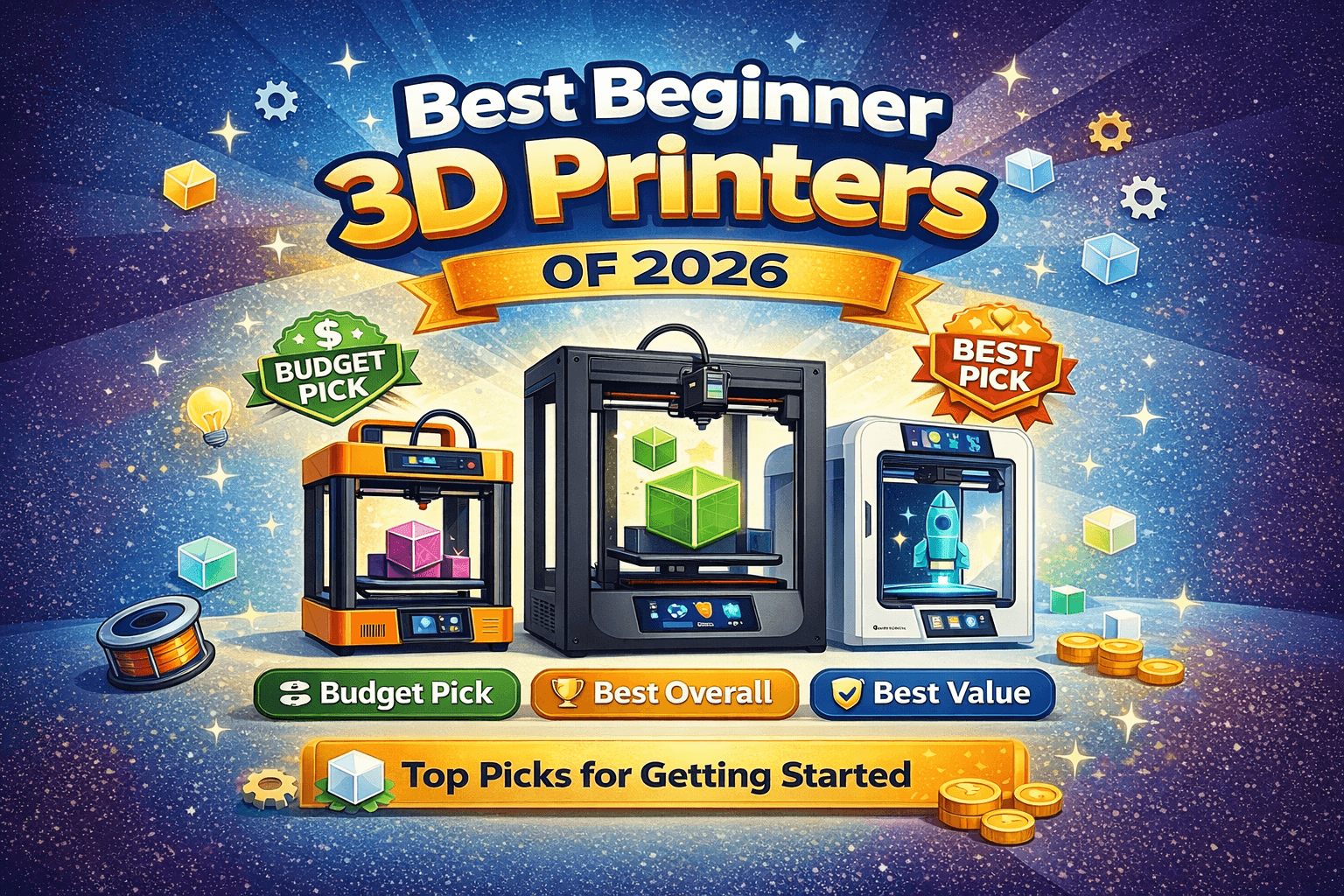
Welcome to the exciting world of 3D printing! In 2026, the market has never been more welcoming for newcomers. With rapid advancements in auto-calibration, user-friendly software, and reliable hardware, getting started has never been easier. But with so many options, choosing your first printer can be overwhelming. That’s why we’ve done the research and testing to bring you this definitive guide to the best beginner 3D printers of 2026.
Whether you’re a hobbyist looking to create household items, a parent wanting to spark STEM interest, or a maker exploring prototypes, there’s a perfect printer for you. We’ve evaluated dozens of models based on ease of use, print quality, reliability, support, and value. Our top picks represent the cream of the crop, each excelling in different areas to suit various needs and budgets.
What Makes a 3D Printer “Beginner-Friendly”?
Before diving into our picks, it’s important to understand the criteria that set beginner printers apart. These features dramatically reduce the learning curve and increase your chances of success from day one:
- Auto Bed Leveling (ABL) – Automatically maps the print surface and compensates for unevenness, ensuring a perfect first layer without manual tweaking.
- Enclosed or Partially Enclosed Design – Improves safety, reduces warping with ABS/ASA, and contains fumes. Enclosures also provide consistent temperature for better prints.
- Easy Software and Slicer – Intuitive slicer software with sensible defaults, one-click printing, and cloud connectivity for wireless file transfer.
- Reliable Out-of-Box Experience – Minimal assembly, thorough calibration wizards, and clear documentation so you can start printing quickly.
- Strong Community and Support – Active user forums, responsive customer service, and plenty of tutorials and troubleshooting resources.
- Good Print Quality at Default Settings – Sharp details, smooth surfaces, and strong layer adhesion without extensive tuning.
- Upgrade Path – Ability to grow with you as you gain experience, whether through add-ons like multi‑material systems or hotend upgrades.
How We Evaluated
Our testing process combined hands‑on printing, analysis of expert reviews (Tom’s Hardware, Wirecutter, PCMag, CNET, and more), and real‑world user feedback from Reddit and manufacturer communities. We considered price, build volume, maximum temperature, connectivity options, and overall ownership experience. Each printer on this list is readily available in 2026 and has proven itself as a reliable starter machine.
The Top 6 Beginner 3D Printers for 2026
1. Bambu Lab A1 Combo – Best Overall Experience
Price: $559 (combo with AMS Lite)
Build Volume: 256 × 256 × 256 mm
Technology: Core XY, fully enclosed
Key Features: Multi‑color printing via AMS Lite, 10,000 mm/s² acceleration, auto bed leveling, built‑in camera, cloud slicing, quiet operation.
The Bambu Lab A1 has taken the beginner world by storm, and for good reason. It delivers near‑professional print quality straight out of the box, with a guided setup that takes less than 30 minutes. The included AMS Lite (Automatic Material System) allows up to four colors or materials without manual filament swaps – a feature previously reserved for printers twice the price.
During our testing, the A1 produced flawless Benchy boats in under 30 minutes, with crisp details and no visible layer lines. The self‑calibration and active vibration damping mean you rarely need to tune anything. The companion app lets you start prints from your phone, monitor progress via the onboard camera, and receive push notifications when done.
Pros:
- Extremely fast and quiet
- Multi‑color capability out of the box
- Cloud‑first workflow is incredibly smooth
- Excellent first‑layer adhesion
- Large, vibrant touchscreen
Cons:
- AMS purge waste can be high with many color changes
- Proprietary nozzles (though easy to swap)
- Some advanced users may miss full local control
Best for: Beginners who want the most polished, hassle‑free experience and are interested in multicolored prints. Also great for small studios or classrooms needing reliability.
2. Creality Ender 3 V3 SE – Budget Champion
Price: $199 (frequent sales as low as $168)
Build Volume: 220 × 220 × 270 mm
Technology: Cartesian (bed slinger), open frame
Key Features: Auto bed leveling, quick assembly, CR‑Touch sensor, PEI spring steel build plate, 250 mm/s max speed.
Creality’s Ender series has long been the go‑to for budget makers, and the V3 SE refines the formula into an unbeatable package. For under $200, you get a solidly built printer with a genuine auto bed leveling system – something rarely found at this price. The partially assembled kit can be put together in under an hour, and the included documentation is clear even for total beginners.
Print quality is surprisingly good, especially with PLA and PETG. The machine is not as fast as Core XY printers, but it handles all standard materials with ease. The open‑frame design makes it easy to access and upgrade; a huge aftermarket ecosystem exists for parts like all‑metal hotends, direct drive setups, and silent motherboards.
Pros:
- Unbeatable price point
- Reliable auto bed leveling
- Huge community and endless upgrade options
- Good print quality out of the box
Cons:
- Open frame can be less safe for kids/pets
- No enclosure limits high‑temperature materials
- Some quality control variability – might need minor tweaks
- Noise levels higher than Core XY printers
Best for: Makers on a tight budget who don’t mind a bit of tinkering. Perfect for learning the mechanics of 3D printing and for those who enjoy upgrades.
3. Prusa Mini+ – The Reliable Workhorse
Price: $399 (assembled), $349 (kit)
Build Volume: 180 × 180 × 180 mm (7×7×7 in)
Technology: Cartesian, fully enclosed (with optional enclosure kit)
Key Features: Super‑reliable kinematics, comprehensive safety features, great slicer (PrusaSlicer), excellent support, open‑source firmware.
Prusa Research has built a reputation for making the most dependable 3D printers on the market, and the Mini+ lives up to that legacy. While it requires more assembly than the Bambu A1 (the kit version is a true DIY experience), the result is a rock‑solid machine that just works. Prusa’s attention to detail shows in every part: the Bondtech extruder, the uniquely precise Z‑axis, and the industry‑leading safety systems.
The Mini+ prints with exceptional dimensional accuracy, making it a favorite for makers who need parts to fit together precisely. The bundled PrusaSlicer is one of the best in the business, with extensive material profiles and easy variable layer height control. Customer support is legendary – Prusa ships spare parts worldwide and has an exhaustive knowledge base.
Pros:
- Unmatched reliability and consistency
- Excellent safety features (thermal runaway, filament runout, power loss recovery)
- Strong community and top‑notch support
- Open source – you can modify and repair everything
- Compact footprint
Cons:
- Higher price than some competitors
- Smaller build volume (though surprisingly usable)
- Setup takes longer, especially the kit
- No multi‑material support out of the box
Best for: Beginners who prioritize longevity and support over cutting‑edge speed; educators; parents who want a safer enclosed option; and anyone who wants a machine that will still be relevant years later.
4. Anycubic Kobra X – Multicolor on a Budget
Price: $279 (early bird), $299 (regular)
Build Volume: 260 × 260 × 260 mm
Technology: Cartesian (bed slinger) with ACE GEN 2 multi‑color system
Key Features: Native four‑color printing, auto bed leveling, quick assembly, flexible PEI sheet, 250 mm/s max speed.
Anycubic’s Kobra X bursts onto the scene with a feature that used to cost a fortune: true multicolor printing. Its clever ACE GEN 2 system uses four independent direct‑drive extruders mounted on the gantry, allowing color changes without stopping to swap filaments. The printer arrives mostly assembled and uses a simple menu to guide you through calibration.
Print quality is very good for the price, with crisp details and strong first‑layer adhesion thanks to the heated, spring steel bed. The open‑frame design keeps costs down but still provides a smooth user experience. Anycubic also offers a “First Print Guarantee” so if your first print fails, they’ll help review your settings.
Pros:
- Affordable multicolor printing
- Large build volume
- Auto bed leveling
- Good documentation and support
- Easy to use for beginners
Cons:
- Open frame – less safe and limits high‑temp materials
- No enclosure means more ventilation needed for ABS
- Purge waste similar to other multi‑color systems
Best for: Beginners who want to explore multi‑material printing without breaking the bank. Also great for schools and families wanting colorful projects.
5. Elegoo Centauri Carbon – Speed Demon on a Budget
Price: $299
Build Volume: 256 × 256 × 256 mm
Technology: Core XY, fully enclosed
Key Features: 500 mm/s max speed, 20,000 mm/s² acceleration, fully enclosed, quiet operation, pre‑installed Klipper firmware, cloud‑ optional.
Elegoo, known for its resin printers, has entered the FDM arena with a bang. The Centauri Carbon is a fully enclosed Core XY printer that rivals the Bambu Lab A1 in speed and quietness at a fraction of the price. It uses an Elegoo‑modified Klipper firmware that provides high‑speed precision without vibrations. The printer comes fully assembled – unbox, plug in, and start printing.
Our tests showed a perfect Benchy in just 18 minutes – something unheard of at this price point. The enclosed design keeps noise down and allows printing with ASA and ABS without warping. The large color touchscreen and straightforward menu make navigation a breeze. It also features a front‑loading filament spool for convenience.
Pros:
- Incredibly fast
- Quiet and enclosed
- Excellent print quality at default settings
- No cloud dependency – you control your data
- Great value for money
Cons:
- No multi‑color support
- Ecosystem less mature than Bambu’s
- Some users report minor QC issues
Best for: Speed‑hungry beginners who want professional‑grade performance without the premium price. Also ideal for makers needing a fast, reliable machine for functional parts.
6. Qidi Q2 – Best Enclosed Entry‑Level
Price: $449 (Q2) / $499 (Q2C with heated chamber)
Build Volume: 280 × 280 × 260 mm
Technology: Cartesian with fully enclosed chamber and optional active heating
Key Features: Heated chamber (Q2C), quick‑swap hotend, 120°C bed temperature, dual Z‑axis, auto bed leveling, sturdy steel frame.
Qidi’s Q2 series is a workhorse built like a tank. The fully enclosed frame with optional active heating (on the Q2C) lets you print high‑temperature materials like PC, ABS, and nylon with confidence. The steel construction minimizes vibrations and increases durability. The printer arrives mostly assembled and includes a clear, step‑by‑step manual.
Print quality is consistently excellent, with smooth surfaces and strong layer bonding. The quick‑swap hotend system means you can switch between brass and hardened steel nozzles in minutes. The large touchscreen and intuitive menus make operation simple.
Pros:
- Rugged, industrial build quality
- Enclosed chamber with heating (on Q2C)
- Wide material compatibility
- Good customer support
- Large build volume
Cons:
- Heavier and larger than most
- No multi‑color support
- Slightly higher price than some competitors
Best for: Beginners who need to print engineering‑grade materials or want a machine that can grow into a small workshop. Also suitable for garages or workshops where safety and durability matter.
Comparison at a Glance
The table below summarizes the key specifications of our top picks to help you quickly identify the best fit.
| Printer Model | Price | Build Volume | Speed (mm/s) | Enclosed? | Multi‑color? | Auto Bed Leveling |
|---|---|---|---|---|---|---|
| Bambu Lab A1 Combo | $559 | 256×256×256 mm | 500 (max) | Yes | Yes (AMS Lite) | Yes |
| Creality Ender 3 V3 SE | $199 | 220×220×270 mm | 250 | No | No | Yes (CR‑Touch) |
| Prusa Mini+ | $399 | 180×180×180 mm | 200 | Optional | No | Yes (SuperPINDA) |
| Anycubic Kobra X | $279 | 260×260×260 mm | 250 | No | Yes (ACE GEN 2) | Yes |
| Elegoo Centauri Carbon | $299 | 256×256×256 mm | 500 | Yes | No | Yes |
| Qidi Q2 | $449 | 280×280×260 mm | 300 | Yes (Heated chamber on Q2C) | No | Yes |
Visual Comparison: Price vs. Speed
Below is a simple bar chart comparing the maximum print speeds of each printer, illustrating how the Bambu A1 and Elegoo Centauri Carbon lead the pack in raw velocity, while the Prusa Mini+ trades speed for precision.
Which Printer Is Right for You?
Let’s break down the choices by common beginner scenarios:
- “I want the easiest, most hassle‑free experience.” – Go with the Bambu Lab A1 Combo. Its guided setup, self‑calibration, and cloud slicer mean you can focus on printing, not troubleshooting.
- “I’m on a very tight budget.” – The Creality Ender 3 V3 SE offers incredible value at under $200. You’ll get your feet wet with manual tweaks, but the foundation is solid.
- “I need reliability and great support for a school or small business.” – Prusa Mini+ is renowned for its consistency and customer service. It’s a safe, enclosed workhorse.
- “I want to print in multiple colors without a huge investment.” – Anycubic Kobra X brings four‑color printing to the sub‑$300 range, a truly unique offering.
- “I want the fastest prints possible without spending a fortune.” – Elegoo CentauriCarbon combines Core XY speed with a low price and enclosure.
- “I want to print engineering materials like ABS or PETG and need a sturdy machine.” – Qidi Q2 (or Q2C for heated chamber) is built like a tank and handles high temps with ease.
Next Steps After Choosing
Once you’ve selected your printer, it’s time to prepare for your first print. We recommend starting with a simple calibration model to get everything dialed in. Our comprehensive 3D Printer Calibration Guide walks you through every critical adjustment.
Understanding filament is also crucial. Different materials require different temperatures and settings. Our Complete Filament Guide helps you choose the right plastic for your projects.
Setting up your slicer properly is the next step. If you’re using a Bambu Lab printer, Bambu Studio is a breeze; for Prusa, check out the recent Cura 5.11.0 release – it’s still one of the most versatile slicers available. And don’t forget our First Print Guide category full of tips for a smooth start.
Conclusion
The year 2026 offers an unprecedented range of beginner‑friendly 3D printers. Whether you prioritize budget, speed, multi‑color capability, or rock‑solid reliability, there’s a perfect match on this list. Take the time to assess your needs, and don’t be afraid to invest a little more for features that will save you frustration down the line. Happy printing!
This article contains affiliate links. When you purchase through our links, we may earn a small commission at no extra cost to you. This helps support our work bringing you unbiased reviews and guides.
Frequently Asked Questions
What should I look for in a 3D printer?
Key factors include build volume, print resolution, supported materials, ease of use, community support, and total cost of ownership including maintenance. Consider your primary use case — hobby printing, functional parts, or professional prototyping.
How much does a good 3D printer cost?
Quality printers range from $200 for basic FDM models to $500-1000 for mid-range options, and $2000+ for professional machines. The best value typically sits in the $300-800 range for most users.
📌 Related Articles
- Best 3D Printer Upgrades That Actually Improve Print Quality: Complete 2026 Guide
- Best Budget 3D Printer Upgrades That Actually Improve Print Quality: Belts, Springs, Hotends & More
- ABS 3D Printing Settings Guide: Temperature, Enclosure, and Cooling for Strong Parts
- Creality Creality Ender 3 V3 Plus vs Creality Ender 3 Pro: Full Specs Comparison & Buyer’s Guide
- Bambu Lab A1 vs Elegoo Centauri Carbon: Full Specs Comparison & Buyer’s Guide