
Jan Huebner recently submitted a dissertation, ‘Inconel 625 – Tungsten Carbide Composite System for Laser Additive Manufacturing,’ to the Faculty of Material Science and Ceramics at AGH University of Science and Technology.
As innovations abound globally regarding 3D printing and additive manufacturing processes, researchers continue to explore techniques and materials further—and especially as specific needs and improvements arise during unique studies and development.
In printing with metal, a wide variety of powders and alloys are being experimented with and used. Ni-based alloys, relied on today in critical applications like energy, transportation, defense, and aerospace, offer advantages like corrosion resistance, weldability, and customization. These materials show good potential in 3D printing and additive manufacturing, and especially with laser technology.
“Because there is no reliable and cost-efficient technique of material regeneration, laser cladding of Ni – based Metal Matrix Composite (MMC) was proposed and investigated in this dissertation. In order to check its potential as material for additive manufacturing, Inconel 625 – WC composite system was subjected to series of experiments,” explained Huebner.
The State of Metal 3D Printing
“Inclusion of WC particles in Ni – based metal matrix was expected to induce microstructure changes and improvement of material hardness. However, due to chemical complexity of the system, it is hard to predict its behavior during high intensity laser processing. Because of that, thorough analysis and evaluation was needed in order to properly describe how processing of Inconel 625 – WC system changes its properties.”
Huebner’s main goal was not just to ‘obtain MMC with uniform distribution of WC in whole volume of the material,’ but also to optimize materials and parameters, and gain a more comprehensive understanding of composites. During the research project, Huebner used differential thermal analysis (DTA) to test two WC metal powders.
Samples were fabricated and evaluated to answer the question of suitability—and more specifically, examining whether such materials could be used in production of parts like turbine blades.
Technical Challenges and Solutions
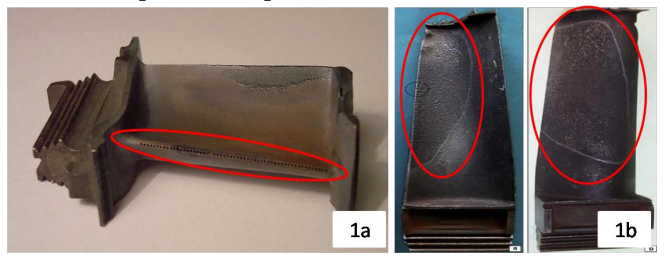
Turbine blades: a) cooling canals inside the blade; b) protective coating on blade
surface
Conventional methods are often not suitable for fabrication of more complex geometries, leading industrial users to turn to more progressive techniques like laser engineered net shaping (often also referred to as laser cladding). Separated by composition, Ni – based alloys also offer the following benefits:
- Ductility and strength at low temperatures
- Superior weldability
- Toughness
- Good corrosion resistance
- Stability
Material Properties and Performance
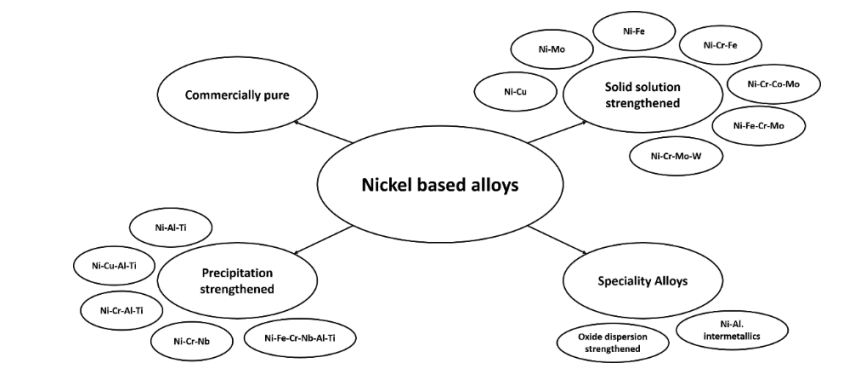
Classification of Ni – based alloys based on composition
“In order to enhance specific properties of alloy, WC was chosen as reinforcement material. It is characterized by excellent wettability by liquid Ni, which guarantees good connection between both phases after laser processing. However, due to increased reactivity on the WC – Inconel 625 boundary, formation of secondary phases containing alloying elements is possible,” said Huebner.
“It is further enhanced by element segregation during rapid solidification of composite material.”
Industrial Applications and Use Cases
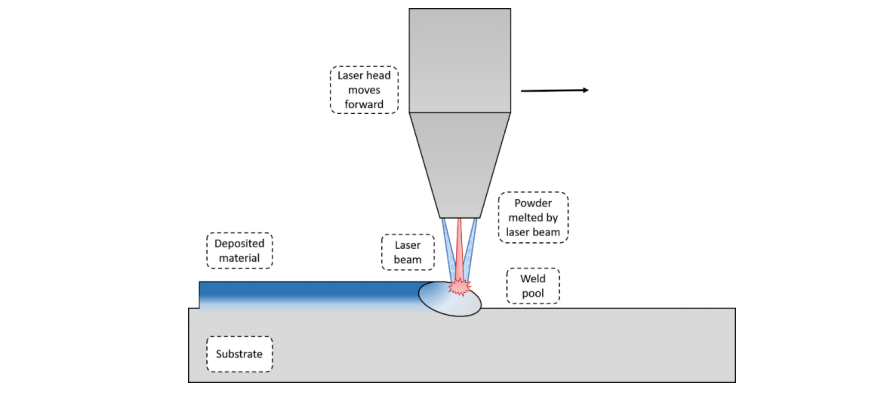
Schematic representation of LENS apparatus
While laser cladding may be a suitable technique in processing Ni-based alloys, parameters must be optimized to maintain ceramic particle morphology and metal melting.
Comparing Metal AM to Traditional Manufacturing
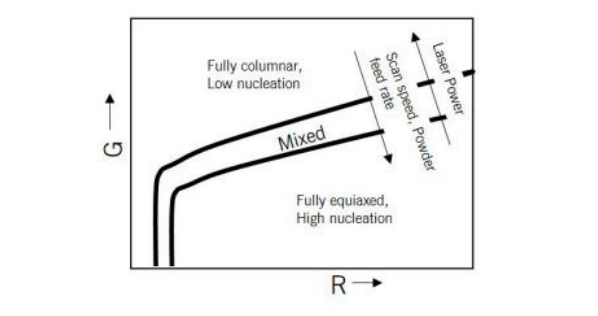
Columnar to equiaxial transition (CET) trend in relation to G and R
While Huebner found the Inconel 625 – WC composite to be ‘promising’ for production, there were also challenges in analysis, leading to more a more in-depth examination with differential thermal analysis (DTA).
Future Developments in Metal Additive Manufacturing
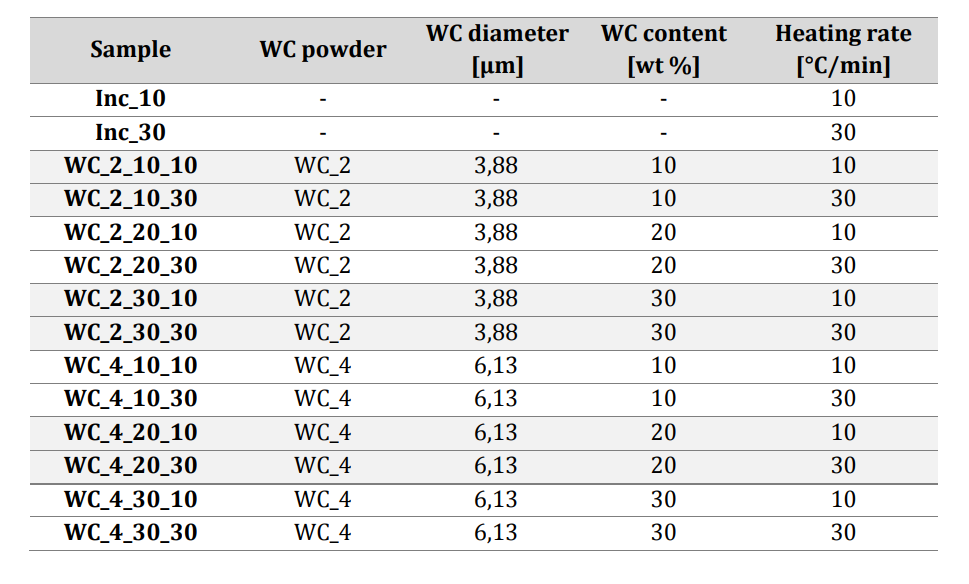
List of samples subjected to DTA analysis with analysis conditions
Overall, better optimization of process parameters was achieved as the composite allowed for an increase in hardness of the materials due to added WC particles. Strength was also noted as secondary phases comprised of intermetallic TCP phases and carbides of alloying elements emerged.
“Precipitates of TCP phases and secondary carbides are much harder and more brittle than γ – Ni matrix,” concluded the author. “It is possible to obtain good quality of material using low laser power of about ≈ 300 W.”
The State of Metal 3D Printing
“Obtained results concluded that Inconel 625 – WC composite system is suitable for laser additive manufacturing.”
Researchers continue to develop a wide variety of other composites like bronze PLA, bio-inspired composites, and graphene oxide elastomers. What do you think of this news? Let us know your thoughts! Join the discussion of this and other 3D printing topics at 3DPrintBoard.com.
Technical Challenges and Solutions
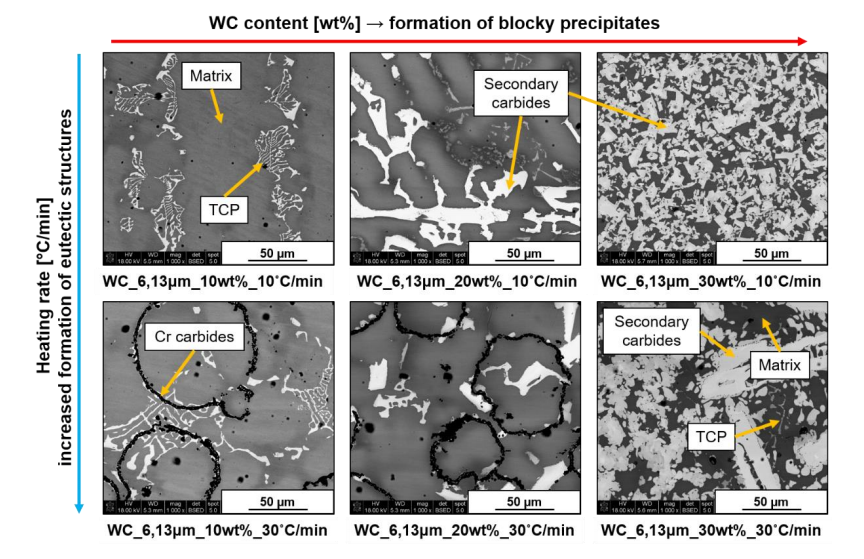
SEM images of DTA melted Inconel 625 – WC 6,13 µm powder mixtures
[Source / Images: ‘Inconel 625 – Tungsten Carbide Composite System for Laser Additive Manufacturing’]
The post AGH University of Science & Technology: Inconel 625 – Tungsten Carbide Composites in 3D Printing appeared first on 3DPrint.com | The Voice of 3D Printing / Additive Manufacturing.
Related Articles
- 3D Printing Tungsten Carbide: How Hot-Wire Laser Technology Creates Metal Harder Than Steel
- Ulsan National Institute of Science and Technology (UNIST): Multicolor 4D Printing of Shape-Memory Polymers
- Success in Education: Michigan Technological University Offers Comprehensive 3D Printing Technology Workshop to Teachers
Frequently Asked Questions
What is metal 3D printing?
Metal 3D printing (additive manufacturing) builds metal parts layer by layer using techniques like laser powder bed fusion, directed energy deposition, and binder jetting. It enables complex geometries impossible with traditional manufacturing while reducing material waste significantly.
How strong are 3D printed metal parts?
3D printed metal parts can achieve mechanical properties comparable to traditionally manufactured metals. Tensile strength and fatigue resistance depend on the process and post-processing, but many meet or exceed ASTM standards for wrought materials.
What are the main metal 3D printing technologies?
The primary technologies include Laser Powder Bed Fusion (LPBF), Electron Beam Melting (EBM), Directed Energy Deposition (DED), Binder Jetting, and Metal FDM (with bound filaments). Each has different strengths in terms of resolution, speed, and material options.
📌 Related Articles
- 3D Printing Tungsten Carbide: How Hot-Wire Laser Technology Creates Metal Harder Than Steel
- The Current State of Metal 3D Printing in 2020
- ABS 3D Printing Settings Guide: Temperature, Enclosure, and Cooling for Strong Parts
- Best Budget 3D Printer Upgrades That Actually Improve Print Quality: Belts, Springs, Hotends & More
- 3D Printing News: Multi-Material Breakthrough and Aerospace Market Boom