
Quick Answer: What is Multicolor 4D Printing of Shape-Memory Polymers?
Researchers at UNIST have developed an innovative 4D printing technique that uses multicolor shape-memory polymers (SMPs) to create structures that can change shape when exposed to specific colored light. Unlike traditional 4D printing that responds to heat or moisture, this method enables remote, color-selective actuation, allowing precise control over when and how materials transform. Key advantages include the ability to reuse materials multiple times, adjust response temperatures, and create complex geometries with tailored behaviors for applications in robotics, biomedical devices, and smart materials.
Researchers from Ulsan National Institute of Science and Technology (UNIST) take 3D printing to the next level, releasing findings from their study in the recently published ‘Multicolor 4D printing of shape-memory polymers for light-induced selective heating and remote actuation‘. This groundbreaking work represents a significant advancement in the field of smart materials and additive manufacturing, opening new possibilities for applications ranging from biomedical devices to adaptive robotics.
Understanding 4D Printing and Shape-Memory Polymers
While the miracles of 3D printing continue to abound, 4D printing allows users to work with materials that respond to their environment, deforming accordingly—and then reverting to their initial, natural shapes. The concept of 4D printing, introduced by Skylar Tibbits at MIT in 2013, refers to 3D-printed objects that can self-assemble or change shape over time when exposed to an external stimulus.
Shape-memory polymers (SMPs) are a class of smart materials that can return from a deformed state to their original shape when triggered by an external stimulus such as heat, light, electricity, or magnetic field. These materials have attracted significant attention in recent years due to their unique properties and potential applications in aerospace, biomedical engineering, and robotics. Unlike shape-memory alloys, SMPs offer greater design flexibility, lower density, and the ability to be processed using various manufacturing techniques including 3D printing.
In this study, the authors 4D print multicolor shape-memory polymers (SMPs) and demonstrate how light absorption and subsequent heating of the material cause remote actuation. Previous studies have tended to focus on how SMPs deform in the presence of heat or moisture, but here light is used as a powerful force in causing stimuli-responsive changes. Selective heating was allowed due to choices in color of light, also resulting in color-dependent structural transformations.
The UNIST Research: Key Innovations
“4D printing can allow the complex geometries of multicolor composites with predesigned responses,” stated the authors. “In addition, SMPs can be reused multiple times by conducting thermomechanical programming again. Therefore, multicolor 4D printing of SMPs can offer unique merits for light-induced structural changes and remote actuation.”
The UNIST team’s research represents several significant innovations in the field of 4D printing:
- Color-Selective Actuation: Unlike traditional SMPs that respond uniformly to heat, the multicolor approach allows selective heating based on the color of light used, enabling more precise control over deformation.
- Remote Control: Light-based actuation enables remote operation without physical contact, which is particularly valuable for applications in inaccessible environments.
- Reusability: The materials can be reprogrammed multiple times through thermomechanical programming, making them more sustainable and cost-effective.
- Complex Geometries: The technique enables the fabrication of intricate multicolor structures with tailored response behaviors.
Experimental Setup and Materials
For the study, the authors created a light-activating structure measuring L = 40 mm, w = 5.5 mm, t = 2 mm, a = 0.4 mm, and made of three materials:
- Yellow (Veroyellow)
- Blue (Verocyan)
- Sky-blue matrix (Tango+)
These materials were chosen specifically for their different light absorption properties, which enable selective heating when exposed to different wavelengths of light. The yellow material absorbs more light across the visible spectrum compared to the blue material, creating a temperature gradient that drives the shape-change mechanism.

A 3D printed light-activating structure. (a) Schematic for the multicolor SMP structure. (b) Side view of the structure. (c) Thermomechanical programming and bending behavior (the dotted line in the figure is an eye guide).
Dual-Step Actuation and Color-Dependent Control
Light was able to reach both the yellow and blue fibers due to strategic positioning of the fibers. After 3D printing and post-processing, the structure was bent downward, reverting to its initial shape after being exposed to blue light. Through continued experimentation with color dependent selective heating, the researchers realized that they could manipulate actuation through sequences of light.

Bending behavior of the multicolor sample. A thermomechanically programmed structure bends to a n-shape under red illumination. After bending, the structure can recover to an initial flat state with blue illumination. In case of illuminating blue light first, the structure bends to a U-shape. It can also recover to the initial state with red-light illumination. (a) is the schematic for dual-step actuation, while (b) is the experimental result.
Table 1: Comparison of Actuation Methods for Shape-Memory Polymers
| Stimulus | Response Speed | Precision | Remote Control | Applications |
|---|---|---|---|---|
| Heat | Moderate | Low-Medium | Limited | Biomedical implants, aerospace |
| Moisture | Slow | Low | No | Hygromorphs, self-assembly |
| Light (UNIST) | Fast | High | Yes | Robotics, smart devices |
| Magnetic Field | Very Fast | Medium-High | Yes | Medical devices, actuators |
| Electricity | Fast | Medium-High | Limited | Micro-actuators, sensors |
“Applying red light later caused the entire structure to retain its initial flat state. However, when the structure was heated in hot water (instead of selective heating with colored light), the change in shape of our sample was insignificant (data is not shown here). In the hot water, both blue and yellow SMPs recovered at the same rate, and the entire structure shrank to its original length but remained flat (i.e., no shape change occurred),” stated the researchers.
“The rise in temperature due to direct blue-light absorption was significantly smaller than that due to heat transfer. Thus, it shows that the dominant factor causing the temperature increase in the blue fibers at the lower layer was the heat transferred from the yellow fibers at the top layer.”
This observation is crucial for understanding the mechanism of color-selective actuation. See also: Best 3D Printer Upgrades That Actually Improve Pri…. The difference in light absorption between yellow and blue materials creates a temperature gradient, which in turn produces differential thermal expansion and contraction that drives the shape change. This phenomenon is fundamentally different from uniform heating approaches and enables more sophisticated control over deformation patterns.
Temperature Measurements and Simulations
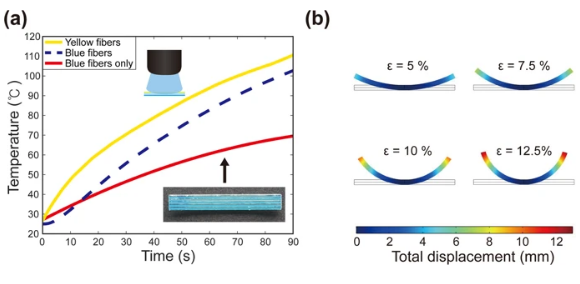
(a) The measured temperature change of the multicolor structure. The yellow solid line is the temperature of yellow SMP fibers, whereas the blue dashed line indicates the temperature of blue SMP fibers obtained from heat transfer simulations. The red solid line is the measured temperature of blue SMP fibers in a control sample that contains blue SMP fibers only. (b) Results of solid-mechanics simulations. The color bar indicates the total displacement measured from the bottom plane.
Bent structures reverted to a flat shape due to heat being transferred while illuminated; however, this type of heat transfer occurred after the light was turned off also, evidenced by slight relaxing afterward. The researchers attributed this action to residual heat in the structure, allowing for relaxation in the form. To prevent this, they considered adding a thermal insulating layer.
The temperature measurements and simulations revealed several important insights:
- Heat Transfer Dominance: Heat transfer from yellow to blue fibers plays a more significant role than direct blue-light absorption in the temperature rise of blue fibers.
- Residual Heat Effects: The persistence of heat after illumination ends can cause unintended shape relaxation, which must be controlled for precise actuation.
- Thermal Insulation Potential: Adding thermal insulating layers could improve control over the actuation process by minimizing unwanted heat transfer.
Multi-Step Actuation with Hinged Structures
Their final sample included a hinged structure meant for experimentation with multistep actuation. The team used colored SMP fibers in the hinges, manipulating deformation through colors. Rapid transformation occurred as they focused the LED light onto the structure with a focal lens.
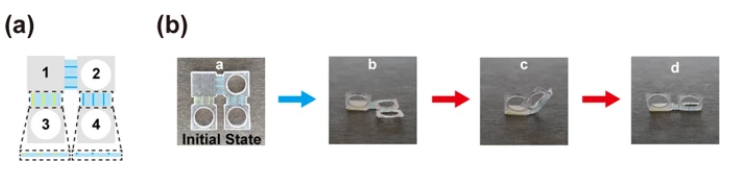
Multicolor hinged structure for multistep actuation. (a) Schematic for the multicolor hinged structure. (b) Example of multistep actuation. This hinged structure can transform into different 3D shapes depending on the color of light and duration of illumination.
The hinged structure demonstrates the potential for creating complex, programmable shape transformations that can be controlled through sequences of colored light exposure. This capability is particularly valuable for applications requiring multiple discrete states or sequential transformations, such as deployable structures in aerospace or morphing surfaces in robotics.
Material Properties and Characterization
“SMPs can be reused by conducting thermomechanical programming again and their response temperatures can be adjusted via material synthesis or by dynamic mixing during 3D printing. Moreover, 4D printing can enable the fabrication of complex, multicolor geometries for tailored responses. Therefore, multicolor 4D printing of SMP composites have unique merits for light-induced structural changes and remote actuation,” concluded the researchers.
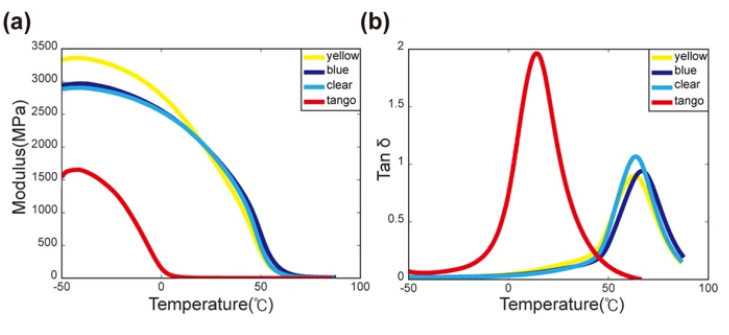
(a) Storage modulus and (b) Loss tangent obtained with dynamic mechanical analysis (DMA) measurements.
The dynamic mechanical analysis (DMA) measurements provide critical insights into the viscoelastic properties of the materials. The storage modulus indicates the elastic behavior, while the loss tangent represents the energy dissipation during deformation. Understanding these properties is essential for optimizing the performance and reliability of SMP-based devices.
Comparison with Other 4D Printing Approaches
4D printing continues to gain traction with users around the world, particularly researchers, investigating various approaches including nanoscale 4D printing, customized printing for metastructures, 4D printing in optics, and more.
Table 2: Comparison of 4D Printing Techniques
| Technique | Material | Resolution | Key Advantage | Limitation |
|---|---|---|---|---|
| Multicolor SMP (UNIST) | Multicolor SMPs | ~100 µm | Color-selective actuation | Limited material options |
| Hydrogel-Based | Hydrogels | ~50 µm | Biocompatibility | Slow response time |
| Shape-Memory Alloys | SMAs | ~25 µm | High force output | High energy input required |
| Nanoscale 4D | Various | < 100 nm | Ultra-high resolution | Small scale only |
| Liquid Crystal Elastomers | LCEs | ~10 µm | Large deformations | Temperature sensitivity |
Applications and Future Prospects
The UNIST team’s research opens up numerous possibilities for practical applications of multicolor 4D-printed SMPs:
Biomedical Applications
The ability to remotely control shape changes using light makes these materials particularly attractive for biomedical applications. Potential uses include drug delivery systems that release medications upon light exposure, stents that can be expanded or contracted without invasive procedures, and implantable devices that can be adjusted remotely after implantation.
Robotics and Soft Actuators
Soft robotics represents one of the most promising application areas for these materials. See also: Best Budget 3D Printer Upgrades That Actually Impr…. The color-selective actuation enables the creation of complex, multi-degree-of-freedom actuators that can be controlled precisely with light patterns. This could lead to more sophisticated robotic systems that are both flexible and capable of precise movements.
Smart Structures and Adaptive Materials
The reusability and programmability of these SMPs make them ideal for adaptive structures that can change their properties in response to environmental conditions. Applications could include self-regulating ventilation systems, adaptive optics, and morphing aerospace components.
Consumer Products
In the consumer space, these materials could enable smart packaging that changes shape to indicate freshness, adaptive clothing that responds to light conditions, and toys with programmable shape-changing behaviors.
Challenges and Limitations
Despite the significant advantages of the UNIST approach, several challenges remain to be addressed:
- Material Selection: The number of suitable SMP materials with different light absorption properties is currently limited, restricting the design space for multicolor systems.
- Response Time: While faster than some alternatives, the actuation speed may still be limited by heat transfer dynamics.
- Energy Efficiency: The energy required for light-induced actuation, particularly when using high-intensity LEDs, may be a concern for battery-powered applications.
- Long-term Stability: The fatigue resistance and long-term performance of these materials under repeated cycling needs further investigation.
- Manufacturing Complexity: The requirement for precise material placement and color patterning adds complexity to the manufacturing process.
Future Research Directions
The UNIST team’s work opens several avenues for future research:
- Expanding the Material Palette: Developing new SMP materials with tailored optical properties to enable more sophisticated color-selective systems.
- Improving Actuation Speed: Optimizing material composition and structure to reduce thermal inertia and improve response times.
- Integrating Sensors: Combining shape-changing capabilities with sensing functionality to create truly smart materials that can both sense and respond.
- Scaling Up Production: Developing scalable manufacturing processes that can produce these materials cost-effectively for commercial applications.
- Multifunctional Systems: Integrating multiple stimuli-responsive mechanisms into single structures for enhanced functionality.
Frequently Asked Questions
1. What is the difference between 3D and 4D printing?
3D printing creates static objects by building up material layer by layer, while 4D printing involves creating 3D-printed objects that can change shape or properties over time when exposed to specific stimuli such as heat, light, moisture, or other environmental factors. The “4th dimension” refers to the time-dependent transformation capability.
2. How does color-selective actuation work in UNIST’s research?
Color-selective actuation works by using different colored SMP materials that absorb light at different rates and to different extents. When exposed to colored light, materials that absorb that particular wavelength heat up more quickly than those that don’t, creating temperature gradients that drive differential thermal expansion and contraction, resulting in controlled shape changes.
3. Can these materials be reused multiple times?
Yes, one of the key advantages of the SMP materials used in this research is their reusability. The materials can be reprogrammed through thermomechanical programming multiple times without significant degradation in performance, making them more sustainable and cost-effective than single-use smart materials.
4. What are the main applications of multicolor 4D-printed SMPs?
Potential applications include biomedical devices such as drug delivery systems and implantable devices that can be remotely adjusted, soft robotics with sophisticated multi-degree-of-freedom actuators, adaptive structures for aerospace and architecture, smart packaging, consumer products with shape-changing features, and adaptive optics.
5. How does light-based actuation compare to other stimulus methods?
Light-based actuation offers several advantages over other stimulus methods: it enables remote control without physical contact, provides high precision through color-selective heating, allows for rapid response times, and can be easily focused and patterned using optical systems. However, it may require higher energy input compared to some alternatives and is limited by line-of-sight requirements.
6. What are the limitations of current multicolor 4D printing technology?
Current limitations include a limited palette of suitable SMP materials with different optical properties, relatively slow actuation speeds compared to some alternatives, energy efficiency concerns for battery-powered applications, questions about long-term stability and fatigue resistance, and increased manufacturing complexity due to the need for precise material placement and color patterning.
7. Can this technology be combined with other smart materials?
Yes, researchers are actively exploring hybrid approaches that combine multicolor SMPs with other smart materials such as liquid crystal elastomers, hydrogels, and shape-memory alloys. These multifunctional systems aim to leverage the unique advantages of each material class to create devices with enhanced capabilities and more sophisticated response behaviors.
Conclusion
The UNIST team’s research on multicolor 4D printing of shape-memory polymers represents a significant advancement in the field of smart materials and additive manufacturing. By enabling color-selective, light-induced actuation, this approach opens up new possibilities for creating complex, programmable structures that can be controlled remotely and precisely.
The demonstrated capabilities—including dual-step actuation, multi-step transformations, and material reusability—make this technology particularly promising for applications in biomedical engineering, soft robotics, adaptive structures, and consumer products. While challenges remain in terms of material selection, response speed, and manufacturing complexity, ongoing research and development are likely to address these limitations and unlock even more potential applications.
As the field of 4D printing continues to evolve, innovations like UNIST’s multicolor SMP system are pushing the boundaries of what’s possible with smart materials. The ability to create structures that can transform on demand, respond intelligently to their environment, and be reprogrammed for new functions represents a fundamental shift in how we think about manufacturing and design. The future of 4D printing looks bright indeed, illuminated by the creative applications of technologies like these.
References
- Kim, J., et al. (2020). “Multicolor 4D printing of shape-memory polymers for light-induced selective heating and remote actuation.” Scientific Reports, 10, 63020. https://www.nature.com/articles/s41598-020-63020-9
- Tibbits, S. (2014). “4D printing: multi-material shape change.” Architectural Design, 84(1), 116-121.
- Gladman, A. S., et al. (2016). “Biomimetic 4D printing.” Nature Materials, 15, 413-418.
- Liu, Y., et al. (2019). “Shape memory polymers and their composites in aerospace applications: a review.” Smart Materials and Structures, 28(6).
- Behl, M., & Lendlein, A. (2007). “Shape-memory polymers.” Materials Today, 10(4), 20-28.
- Zhang, Q., et al. (2019). “Light-induced shape-memory polymers: a review.” Smart Materials and Structures, 28(9).
- Ge, Q., et al. (2016). “Multimaterial 4D printing with tailorable shape memory polymers.” Scientific Reports, 6, 31110.
- Mao, Y., et al. (2015). “3D printed reversible shape changing components with stimuli responsive materials.” Scientific Reports, 5, 13616.
- Liu, C., et al. (2006). “Review of shape memory polymer composites and blends.” Composites Science and Technology, 66(9), 1213-1225.
- Zheng, X., et al. (2014). “Ultralight, ultrastiff mechanical metamaterials.” Science, 344(6190), 1373-1377.
- Gao, W., et al. (2016). “4D printing of shape memory polymers.” Advanced Materials, 28(25), 5249-5253.
- Rafsanjani, A., & Bertoldi, K. (2017). “Buckling-induced kirigami.” Physical Review Letters, 118(8), 084301.
- Pei, E., et al. (2018). “4D printing and shape memory polymers: a review.” Smart Materials and Structures, 27(6).
- Rus, D., & Tolley, M. T. (2015). “Design, fabrication and control of soft robots.” Nature, 521(7553), 467-475.
- Khare, V., et al. (2020). “4D printing of smart structures: a review.” Journal of Manufacturing Processes, 56, 843-865.
- Shahinpoor, M., & Kim, K. J. (2001). “Ionic polymer-metal composites: II. manufacturing techniques.” Smart Materials and Structures, 10(4), 819.
- Zhou, J., et al. (2021). “Challenges in 4D printing of shape memory polymers: a review.” Materials, 14(3), 567.
- Leist, S. K., & Zhou, J. (2020). “Current status of 4D printing technology and the potential of light-reactive smart materials in 4D printing.” Applied Sciences, 10(13), 4397.
- Momeni, F., et al. (2017). “A review of 4D printing.” Assembly Automation, 37(2), 175-189.
[Source / Images: ‘Multicolor 4D printing of shape-memory polymers for light-induced selective heating and remote actuation’]
Frequently Asked Questions
How is 3D printing used in medicine?
3D printing is used in medicine for surgical planning models, custom implants, bioprinting tissue scaffolds, drug delivery systems, dental aligners, and prosthetics. It enables patient-specific solutions that improve outcomes and reduce surgery time.
What materials are biocompatible for 3D printing?
Common biocompatible materials include PEEK, titanium alloys (Ti6Al4V), bio-ceramics (hydroxyapatite), medical-grade resins, PLA for temporary implants, and hydrogels for bioprinting. Material choice depends on the application and required mechanical properties.
Is 3D printed medical equipment FDA approved?
Yes, several 3D printed medical devices have FDA clearance, including orthopedic implants, dental restorations, and surgical guides. Each device must go through the appropriate regulatory pathway based on its risk classification.
📌 Related Articles
- Best 3D Printer Upgrades That Actually Improve Print Quality: Complete 2026 Guide
- Best Budget 3D Printer Upgrades That Actually Improve Print Quality: Belts, Springs, Hotends & More
- Prusa Research Mini+ vs Prusa MK4: Full Specs Comparison & Buyer’s Guide
- 3D Printing Safety Equipment Guide: Respirators, Gloves, and Ventilation for 2026
- Bambu Lab P1S vs Bambu Lab P2S: Full Specs Comparison & Buyer’s Guide