
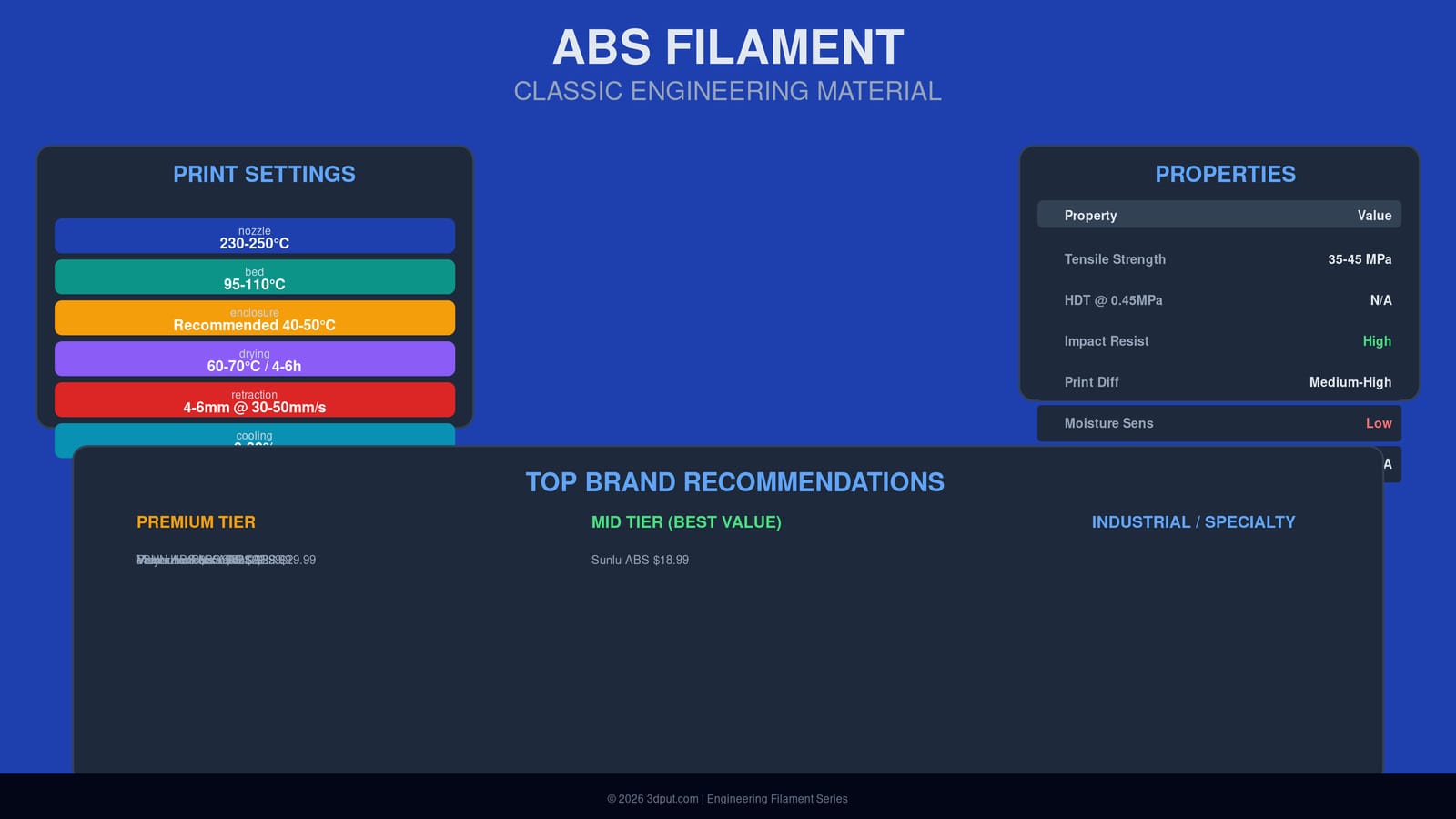
Introduction
Acrylonitrile Butadiene Styrene (ABS) holds a legendary place in 3D printing history. Before PLA became ubiquitous, ABS was the default engineering material for functional 3D-printed parts. Stronger and more heat-resistant than PLA, with better mechanical properties for demanding applications, ABS remains a workhorse for makers, engineers, and manufacturers who need parts that can actually perform.
However, ABS comes with a reputation: warping, fumes, enclosure requirements, and tricky bed adhesion. Many newcomers to 3D printing avoid it, fearing the challenges. Yet with proper setup—especially an enclosure—ABS can produce exceptionally strong, durable parts that outlast PLA and PETG in most functional applications.
This comprehensive 2026 guide covers everything you need to successfully print with ABS. We’ll examine its mechanical properties, compare it to alternatives like PLA, PETG, and ASA, recommend top brands (Hatchbox, eSUN, Overture, Sunlu), provide precise print settings, and identify ideal use cases. Whether you’re printing mechanical parts, automotive components, or enclosures that need to withstand heat, understanding ABS is essential for your engineering filament toolkit.
Understanding ABS: Composition and Characteristics
ABS is a terpolymer composed of three monomers:
- Acrylonitrile: Provides chemical resistance, heat resistance, and strength
- Butadiene: Imparts toughness and impact resistance (rubbery domains)
- Styrene: Contributes rigidity and processability
- Tensile Strength: 35-45 MPa (lower than PLA, but adequate for many applications)
- Flexural Strength: 70-100 MPa
- Flexural Modulus: 2000-2500 MPa (stiffer than PETG, less stiff than PLA)
- Impact Resistance: Excellent, especially compared to PLA (which is brittle)
- Elongation at Break: 10-30% (tougher than PLA’s 3-5%)
- Glass Transition Temperature (Tg): ~105°C (varies by formulation)
- Heat Deflection Temperature: 85-100°C at 0.455 MPa
- Continuous Use Temperature: Up to ~80-90°C
- Melting/Print Temperature: 220-250°C
- Chemical Resistance: Good resistance to dilute acids, alkalis, oils, greases. Swells in ketones, esters, chlorinated solvents, strong acids.
- Density: ~1.04 g/cm³
- Flammability: Burns readily but self-extinguishing when flame removed; not as flame-retardant as PC or specialized materials
- Moisture Absorption: Very low (<0.3% over 24h), so moisture storage less critical than with nylon or PETG (though drying still helps)
- Plastic extrudes at ~240°C
- Maintains ambient chamber temperature (40-60°C) so entire part cools slowly and uniformly
- Eliminates drafts that cause uneven cooling
- Increases success rate dramatically for anything beyond small parts (<3cm)
- Draft shield (enclosure that moves with print head)
- Cardboard box over printer (fire hazard if hot end contacts it—be cautious)
- PVC pipe draft shield
- Partially enclosed frame
- Fully enclosed printer frame with top and sides
- Passively heated by bed (chamber reaches 40-50°C)
- Active heating (ceramic heater) to maintain 50-60°C (better for large prints)
- Ventilation to exhaust fumes outside or through filter
- Enclosed printer with active chamber temperature control (e.g., QIDI Plus4, Prusa CORE One, self-built enclosure with thermostat)
- PEI sheet (textured or smooth): excellent adhesion, reusable
- Brim of 8-15mm is highly recommended (easily removable)
- Raft can be used but is wasteful and harder to remove; generally unnecessary if bed adhesion is properly configured
- Clean with isopropyl alcohol before each print
- Ensure bed is perfectly level
- For PEI, lightly roughen with fine sandpaper if adhesion degrades
- For ABS slurry, apply thin even coat, let dry to clear
- Start at manufacturer recommendation (typically 235-245°C)
- Increase by 5°C if layer adhesion is poor or extruder skips
- Decrease by 5°C if stringing is excessive or you see burning/dark spots
- Higher bed temp helps with adhesion and reduces warping
- Don’t exceed 115°C as it may cause PLA components (if any) to soften
- Retraction Distance: 4-6mm (Bowden); 1-2mm (direct drive)
- Retraction Speed: 30-50 mm/s
- Minimum Travel: 1.5-2mm
- Coasting: Optional, 0.2-0.8mm may reduce stringing
- Wipe: 2-4mm can help
- Outer Wall: 40-60 mm/s
- Inner Wall: 50-70 mm/s
- Infill: 60-80 mm/s
- Top/Bottom: 30-50 mm/s
- Travel: 120-180 mm/s
- First 2-3 layers: 0% fan
- Rest of print: 0-30% fan (only for small overhangs/bridges if needed)
- Excessive cooling causes layer separation and warping
- Layer Height: 0.2-0.3mm typical (can go up to 0.4mm for faster, rough prints)
- Extrusion Width: 100-110% (slight over-extrusion helps bonding)
- First Layer Height: 100-120% (extra squish for adhesion)
- Infill Density: 15-25% typical for functional parts; 20-30% for stronger parts
- Pressure Advance: 0.05-0.15 (direct drive); 0.10-0.25 (Bowden) to eliminate corner blobs
- Input Shaping: Can help reduce ringing/ghosting at higher speeds
- Max Volumetric Speed: ABS typically 12-15 mm³/s
- Z-hop: 0.2-0.4mm, but be cautious—can cause strings and blobs
- Benefits from drying if stored in humid environment
- Temperature: 60-70°C for 4-6 hours
- Store in dry box with desiccant for long-term
- Ensure enclosure is closed and warm (40-60°C if possible)
- Increase bed temperature to 105-110°C
- Use brim (10-15mm)
- Clean bed thoroughly with IPA
- Reduce first layer speed to 15-20 mm/s
- Ensure bed is perfectly level
- Use PEI, Garolite, or Kapton tape; or ABS slurry
- Increase first layer extrusion width to 120-125%
- Increase nozzle temperature (extruder may skip if too low)
- Ensure enclosure temp is adequate (40-60°C)
- Reduce cooling fan to 0%
- Slow print speed, especially outer walls
- Increase extrusion multiplier by 2-5%
- Check filament diameter consistency
- Tune retraction: 4-6mm at 30-50 mm/s (Bowden); 1-3mm for direct drive
- Enable coasting (0.2-0.8mm)
- Enable wiping (2-4mm)
- Reduce nozzle temp by 5°C
- Dry filament if wet
- Increase nozzle temperature (extruder can’t push filament at too low temp)
- Check for partial clog—perform cold pull
- Reduce retraction distance
- Ensure hot end is reaching correct temperature
- Check filament diameter (oversized filament causes jams)
- Use enclosure with ventilation (exhaust outside or through carbon filter)
- Print in well-ventilated room, open windows, use fans
- Some enclosures have built-in exhaust fans with carbon filters
- Consider using ABS in a garage or dedicated space
- Use respiratory protection (organic vapor respirator) for prolonged printing sessions
- Enclosure with exhaust: Route fumes outside through ducting or through a HEPA + carbon filter.
- Mechanical enclosures that need to hold up to handling and moderate abuse
- Gears, bearings, and mechanical components that benefit from ABS’s toughness
- Brackets and mounts for electronics, monitors, cameras
- Automotive interior parts (dash clips, brackets, covers) that see temperatures up to 80-90°C
- Tool housings and protective cases
- Ventilation ducts and shrouds (good heat resistance)
- Consumer product prototypes that will eventually be injection-molded in ABS or PC-ABS
- Hard-shell cases for electronics (though PETG or PC may be stronger)
- Hardware enclosures that need to feel solid and substantial
- Toys and figurines that will be handled roughly
- Low-volume production of functional components where ABS’s properties are sufficient
- Replacement parts for machinery and consumer products originally made from ABS
- Custom tooling where heat resistance is needed but PEEK/PC is overkill
- Electrical enclosures (non-load-bearing) that need some heat resistance
- Outdoor applications: Use ASA instead (UV resistant)
- High-temperature applications (>90°C): Use PC or PEEK
- Food contact: Not FDA-compliant for direct food contact
- Applications requiring transparency: ABS is opaque (use PETG or PC in clear formulations)
- When you have no enclosure: Warping will be frustrating; start with PETG
- Classroom or shared spaces without ventilation: Fumes are bothersome to others
- Filament Settings Database – Find optimal ABS settings for your printer
- 3D Printer Comparison Tool – Identify printers capable of printing ABS (enclosed models)
- ASA Filament Review – UV-resistant alternative to ABS
- Heated Enclosures Guide – How to build and use enclosures for ABS
- Polycarbonate Review – Next step up in temperature resistance
This combination yields a material that is stronger and more heat-resistant than PLA, yet easier to print than polycarbonate or nylon. The butadiene component makes ABS tough and impact-resistant, but also slightly less stiff than pure styrene-based plastics.
ABS vs. Other Common Filaments
| Property | ABS | PLA | PETG | ASA | PC |
|---|---|---|---|---|---|
| Tensile Strength | 35-45 MPa | 50-60 MPa | 45-50 MPa | 40-48 MPa | 65-70 MPa |
| Flexural Modulus | 2000-2500 MPa | 3000-3500 MPa | 1800-2200 MPa | 2000-2400 MPa | 2200-2500 MPa |
| Impact Resistance | High | Low | Medium-High | High | Very High |
| Heat Deflection Temp | 85-100°C | 55-60°C | 70°C | 90-100°C | 125-140°C |
| Print Difficulty | Medium-High | Low | Low-Medium | Medium-High | High |
| Enclosure Required | Recommended | No | No | Recommended | Yes |
| Fumes | Moderate | Low | Low | Moderate | Moderate |
| Moisture Sensitive | No | Slight | Moderate | Moderate | Moderate |
ABS sits in the middle ground: better mechanical properties than PLA and PETG, but easier to print than PC or PEEK. Its major drawback is warping and the need for good temperature control—hence the enclosure recommendation.
Material Properties: Strength with Temperature Resistance
Mechanical Properties
ABS offers reliable engineering performance:
ABS’s biggest mechanical advantage over PLA is impact toughness. PLA can shatter on impact; ABS flexes and absorbs energy. For parts that might be dropped or experience sudden loads, ABS is superior.
Thermal Properties
ABS’s thermal performance is a key differentiator:
Compared to PLA: PLA softens around 60°C; ABS maintains rigidity up to ~90°C. This means ABS parts can be used in warmer environments (car interiors, near electronics, near hot ends of other printers) where PLA would deform.
Other Properties
UV and Weather Resistance
Standard ABS degrades under UV exposure: yellows, becomes brittle over months to years. For outdoor applications, ASA (Acrylonitrile Styrene Acrylate) is a superior UV-resistant alternative with nearly identical mechanical properties but much better weather resistance.
The Enclosure Question: Do You Need One?
Why ABS Warps (and How to Prevent It)
ABS’s high shrinkage rate (~0.5-0.8%) combined with high glass transition temperature makes it extremely prone to warping if the environment is not properly controlled.
Warping mechanism:
2. Upper layers cool rapidly in open air
3. Lower layers, still warm, contract as they cool
4. Differential contraction between warm interior and cool exterior creates stress
5. Corners lift from bed as stress overcomes bed adhesion
Enclosure benefits:
Minimum vs. Recommended Enclosure
Minimum (can work for small parts):
Recommended:
Optimal:
Bed Adhesion: Getting It to Stick
Getting the first layer to adhere is crucial with ABS:
Build Surfaces:
2. Garolite (FR-4): durable, excellent for ABS, releases cleanly when cool
3. Kapton tape: traditional choice, works well but needs replacement periodically
4. Glass with ABS slurry (ABS dissolved in acetone): creates excellent chemical bond, reusable surface
5. BuildTak: works but can be hard to remove; may need replacement
Bed Temperature: 90-110°C (most users print at 100-105°C)
First Layer Temperature: Can use 105-115°C for first layer, then drop to 100°C
First Layer Speed: 15-20 mm/s (slow for good adhesion)
First Layer Squish: Use 100-125% first layer height for good squish
Brim or Raft:
Bed Preparation:
Print Settings for Reliable ABS
Temperature Settings
Nozzle Temperature: 220-250°C depending on specific filament and print speed
Bed Temperature: 90-110°C (most common: 100-105°C)
Enclosure Temperature: 40-60°C if actively heated; passive enclosure from bed heat alone may suffice for small parts
Retraction Settings
Retraction with ABS is important but less critical than with PLA:
Print Speed Recommendations
ABS can handle reasonably high speeds if temperatures are adequate and cooling is managed.
Cooling
Minimal cooling for ABS:
Why? ABS needs to stay warm to fuse layers properly. High cooling causes rapid contraction and warping.
Layer Height and Extrusion
Advanced Settings
Drying
ABS is not particularly hygroscopic but can still absorb moisture:
Top Brand Recommendations for ABS
Premium / Consistent Quality
| Brand | Product | Price/kg | Nozzle Temp | Bed Temp | Key Features |
|---|---|---|---|---|---|
| Prusa | Prusament ABS | $29.99 | 235-255°C | 100-110°C | Excellent quality control, consistent diameter, tested extensively |
| Polymaker | Polymaker ABS | $32.99 | 230-250°C | 95-110°C | Premium formulation, good bed adhesion, low warping |
| Bambu Lab | ABS Filament | $28.99 | 240-255°C | 100-115°C | Optimized for Bambu enclosures, reliable |
| MatterHackers | MH Build ABS | $29.99 | 235-250°C | 100-110°C | High consistency, good service |
Mid Tier / Best Value
| Brand | Product | Price/kg | Nozzle Temp | Bed Temp | Key Features |
|---|---|---|---|---|---|
| Hatchbox | Hatchbox ABS | $22.99 | 230-250°C | 90-110°C | Widely available, Amazon Prime, decent quality |
| eSUN | eSUN ABS | $20.99 | 230-250°C | 90-110°C | Budget-friendly, reliable for price |
| Overture | Overture ABS | $19.99 | 230-245°C | 90-105°C | Very affordable, acceptable quality |
| Sunlu | Sunlu ABS | $18.99 | 225-245°C | 85-105°C | Lowest price, best for practice prints |
ABS vs. ASA: Which to Choose?
With ASA available at similar price points, the choice between ABS and ASA deserves consideration:
| Criteria | ABS | ASA |
|---|---|---|
| UV Resistance | Poor; yellows and degrades in sunlight | Excellent; stable outdoors for years |
| Temperature Resistance | 85-100°C HDT | 90-100°C HDT (slightly better) |
| Mechanical Properties | Very good | Very similar to ABS |
| Print Difficulty | Medium-High | Medium-High (similar) |
| Warping | Significant | Similar warping tendency |
| Price | Generally cheaper (~$20-25/kg) | Slightly more expensive (~$25-35/kg) |
| Fumes | Moderate styrene fumes | Similar fumes |
Use ABS when: Indoor parts only, cost is a concern, you’re familiar with ABS printing, UV stability not required.
Use ASA when: Outdoor applications, UV exposure expected, long-term outdoor durability needed. For most indoor functional parts, ABS is fine and cost-effective.
Troubleshooting Common ABS Issues
Problem: Warping and Corner Lifting
Symptoms: Corners lift, part detaches, elephant’s foot.
Solutions:
Problem: Layer Delamination
Symptoms: Layer lines visible, part pulls apart easily along Z-axis.
Solutions:
Problem: Stringing and Oozing
Symptoms: Fine hairs between travel moves.
Solutions:
Problem: Extruder Skipping / Nozzle Clogging
Symptoms: Clicking noise, gaps in print, under-extrusion.
Solutions:
Problem: fumes and Smell
Symptoms: Strong odor, eye irritation, headaches.
Solutions:
Safety Considerations: Ventilation and Fumes
ABS emits styrene monomers and other volatile organic compounds (VOCs) during printing. While not acutely toxic in small amounts, prolonged exposure can cause headaches, eye irritation, and respiratory irritation.
Best practices:
2. Ventilation: If no enclosure, print in well-ventilated area with open windows and fans moving air away from you.
3. Air filtration: Use a dedicated air purifier with activated carbon filter near printer.
4. Respirator: For long prints or enclosed spaces without ventilation, wear an organic vapor respirator.
5. Avoid printing in bedrooms or occupied living spaces without ventilation.
6. Children and pets: Keep away from printing area due to fumes.
Note: ABS fumes are not as toxic as some fear (modern ABS formulations contain lower VOCs), but they’re still unpleasant and not ideal to breathe regularly. Take precautions.
Ideal Use Cases for ABS
Functional Prototypes and Mechanical Parts
Consumer Products
Engineering Applications
When NOT to Use ABS
Frequently Asked Questions
Q: Can I print ABS without an enclosure?
A: Yes, but with significantly reduced success rate, especially for parts larger than a few centimeters. If you must print without an enclosure, use a draft shield, keep ambient temperature stable (no air conditioning blowing on printer), print small parts, and use a brim. Expect warping and failed prints on anything substantial.
Q: How do ABS fumes compare to ABS?
A: Both emit noticeable fumes. ABS tends to smell sweeter (like burning plastic), while ABS fumes are more acrid. Neither are great to breathe; both require ventilation. ABS fumes contain styrene; ABS fumes contain acrylonitrile and butadiene. Both should be vented.
Q: Is ABS stronger than PLA?
A: It’s complicated. PLA has higher tensile strength (50-60 MPa vs 35-45 MPa), so PLA can support more weight before breaking. But ABS has much higher impact resistance—it won’t shatter on sudden impact like PLA can. ABS also has higher heat resistance (90°C vs 60°C). So for durability and toughness, ABS is superior; for pure strength, PLA wins.
Q: Can I use an enclosure designed for ABS with other materials?
A: Yes. Enclosures are generally beneficial or neutral for other materials. PLA prints fine in enclosures (may need more cooling). PETG is neutral. Nylon and PC benefit. ASA and ABS need them. An enclosure is arguably the single best upgrade for printing engineering materials.
Q: What causes ABS to warp and how can I prevent it?
A: Warping is caused by uneven cooling and shrinkage. Prevention: 1) Hot bed (100-110°C), 2) Enclosure to maintain warm ambient temperature (40-60°C), 3) First layer adhesion (PEI, Garolite, Kapton), 4) Brim for large prints, 5) Draft-free environment, 6) Slow cooling (don’t blast part with cold air).
Q: How does ABS-ESD (electrostatic dissipative) differ from standard ABS?
A: ABS-ESD contains additives (usually carbon) that make it slightly conductive (10^5-10^9 ohms/sq) to prevent static buildup. Used for electronic packaging, cleanroom parts. Otherwise similar print settings. More expensive.
Q: Can I paint ABS prints?
A: Yes, ABS paints well. Use spray paints formulated for plastics (Rust-Oleum Plastic, Krylon Fusion). Clean with IPA first. Multiple thin coats. ABS can also be chemically smoothed with acetone vapor (unlike PLA/PETG), which fuses layer lines for a smooth glossy finish—requires careful control in enclosed chamber with acetone-soaked rag or heated chamber with acetone.
Q: Is ABS food safe?
A: No. Not FDA-approved for food contact. ABS can leach chemicals, and layer lines harbor bacteria. Do not use for food containers, utensils, or anything that contacts food/drink. Use food-safe PETG or PLA instead.
Q: How does ABS moisture affect print quality?
A: ABS is less hygroscopic than nylon or PETG but still benefits from drying. Wet ABS can steam and cause bubbles, poor surface finish, and weak layer bonding. Dry at 60-70°C for 4-6 hours if stored in humid conditions.
Conclusion
ABS remains a cornerstone engineering material for 3D printing due to its excellent balance of strength, heat resistance, impact toughness, and printability. While it has earned a reputation for warping and fumes, these challenges are manageable with the right setup—particularly a stable enclosure and proper bed preparation.
For functional parts that need to withstand mechanical stress and higher temperatures, ABS delivers where PLA would fail. And with ASA offering UV stability at comparable cost, the ABS/ASA family covers a wide range of engineering needs.
Don’t fear ABS. Embrace its quirks, respect the enclosure requirement, and you’ll have a versatile workhorse material that can produce parts that actually last under real-world conditions.
—
Related Resources on 3dput.com: