
Researchers from Portugal are examining three issues concerning material extrusion (MEX) additive manufacturing (AM) of thermoplastic composites. Their findings are released in the recently published ‘Embedded Fiber Sensors to Monitor Temperature and Strain of Polymeric Parts Fabricated by Additive Manufacturing and Reinforced with NiTi Wires,’ after using nickel-titanium wires to reinforce composites, followed by a comprehensive evaluation regarding the performance of the materials.
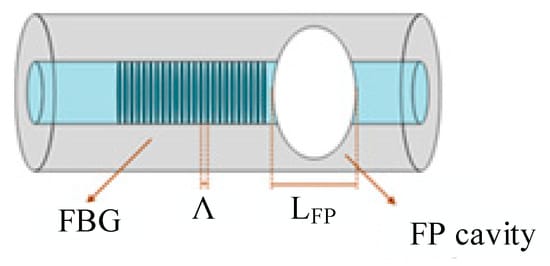
Creating a sensor to monitor both temperature and strain shifts on the PLA matrix, the researchers employed cascaded optical fiber sensors—formed by combined signals of the fiber Bragg grating (FBG) sensor and the FP cavity interferometer.
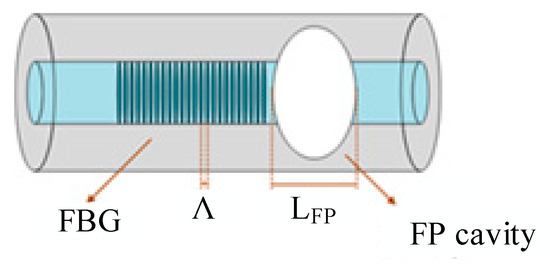
Diagram of the cascaded optical fiber sensor. LFP represents the cavity length.
“The FP cavity was fabricated by producing an air microbubble between a single-mode fiber (SMF 28e) and a multimode fiber (MMF, GIF625),” stated the authors. “To achieve point-of-care monitoring, the FBG was inscribed as close as possible to the FP interferometer.”
Ultimately, the team realized that the PLA matrix could be further refined in terms of strain and temperature by combining the reflection spectra of the cascaded optical sensor. PLA was used due to benefits such as low melting point, good tensile stiffness, and final surface quality.
Benefits of this process include:
- Different strain and temperature sensitivities between two sensing elements
- Decreased invasiveness inside the matrix composite
- No requirement for extra-material integration

Experimental setup, sample cross-section view. Fiber 1 was embedded in the sample together with NiTi wire, while the 3D printing process was stopped for a few seconds. The same procedure was adopted to embed in the PLA matrix the cascaded sensor, recorded on fiber 2.
Two sets of PLA + NiTi ribbon + sensor samples were fabricated on a commercial BQ Prusa i3 3D printer. A cavity was created at half-thickness to integrate the NiTi wire and fiber. Printer settings as follows:
- Printer core nozzle of 1.2 mm diameter
- Layer height of 0.5 mm
- Infill at 100%
- Print speed of 7 mm/s
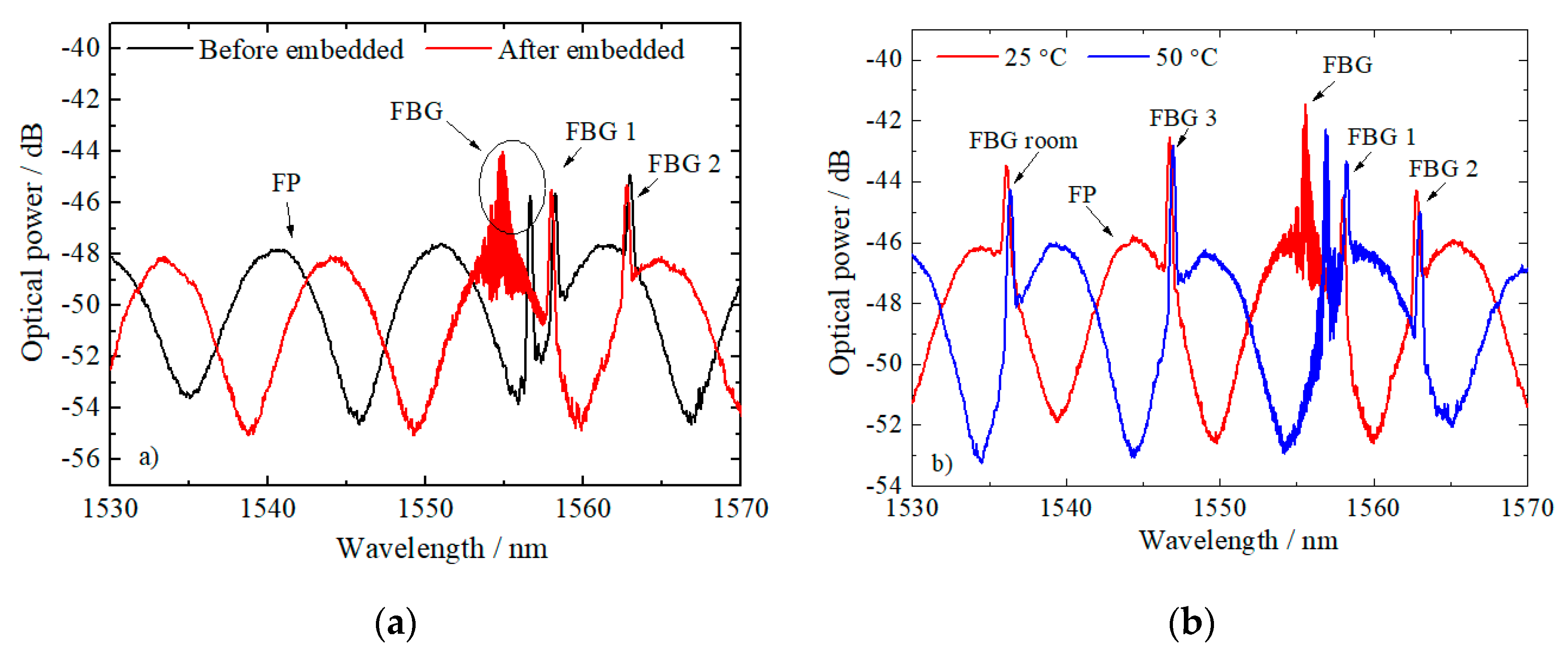
(a) Spectral response of the OFS after and before embedded in the polymeric sample. (b) The response of the cascaded optical sensor and FBGs after embedded on the sample at two different temperatures (25.0 °C and 50.0 °C).
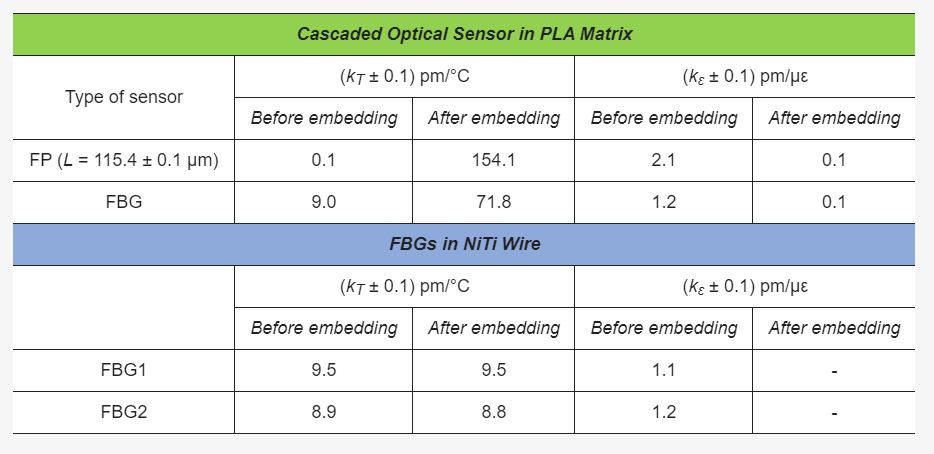
Temperature and strain sensitivities of the cascaded optical sensor and FBGs obtained before and after embedding in the PLA matrix and NiTi wire, respectively.
Samples were cooled to room temperature and then both variations in temperature and strain were monitored.
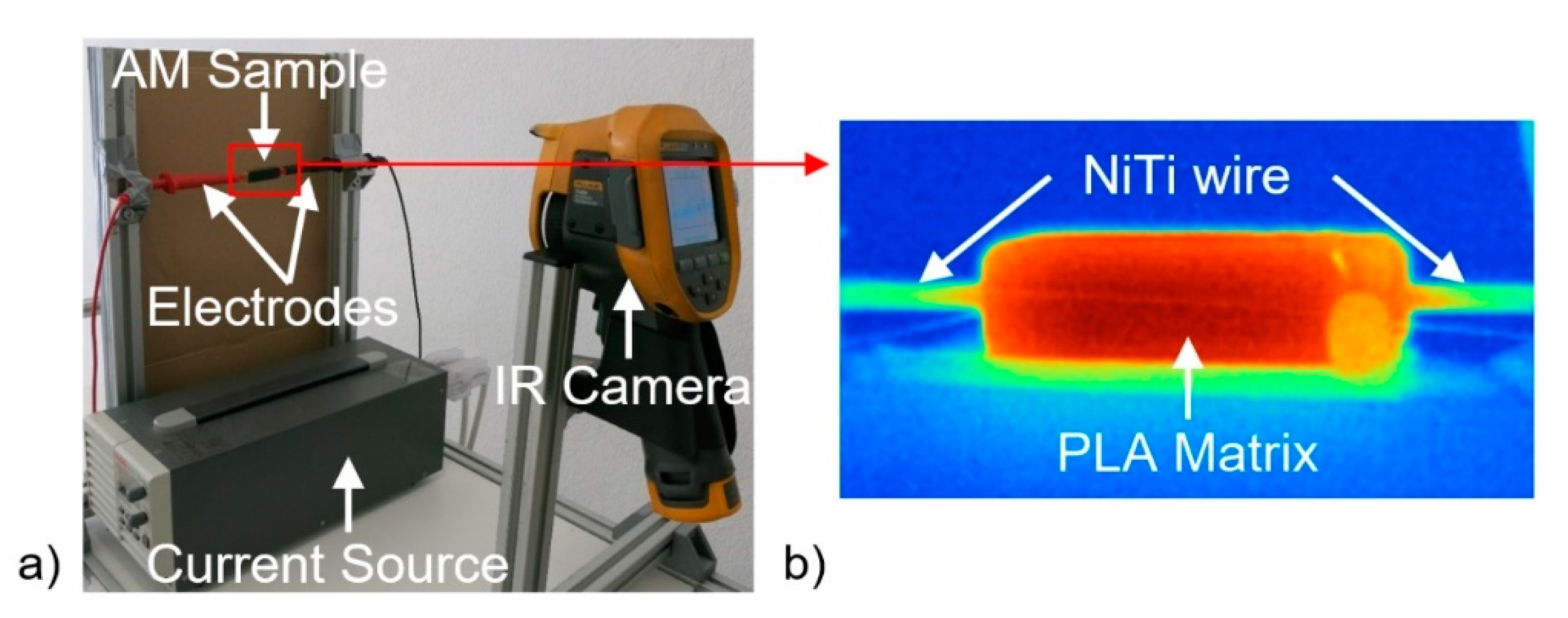
(a) Experimental setup used to perform the cycling Joule heating of the NiTi wire tests. (b) Inset of the external surface temperature measured by thermography in the sample.
Three cycling tests were performed for the study, as follows:
- First cycle – currents of 2.12, 2.81, and 3.1 A were applied
- Second cycle – 4.0 A current was used
- Third cycle – 4.0 A current was used
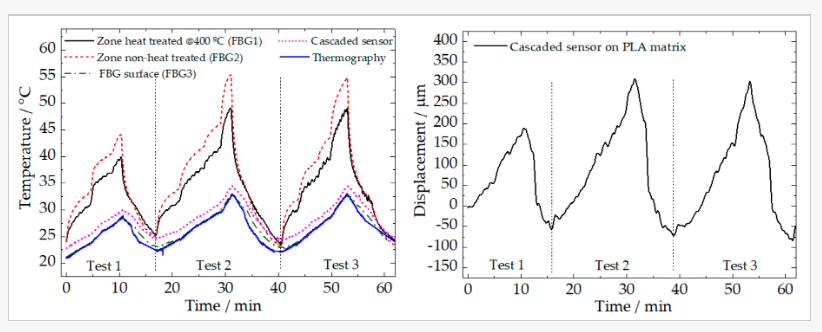
Temperature detected by all the sensing elements (left), and displacement sensed by the cascaded sensor in the PLA matrix (right), during the cyclic tests of heating by Joule effect, followed by natural cooling.
“The moments in which different currents were injected on the sample can be clearly proved and measured by all integrated fiber sensors. During the natural cooling, a thermal perturbation (structural transformation of R-phase to austenite) can be observed near 33.0 °C, and at the end of the cycling tests, a sample contraction of ~100 µm was detected on the PLA sample,” concluded the researchers.
“Regarding the tensile tests, the higher increase of temperature (exothermic behavior) arises when the applied force is between the 0.7 and 1.1 kN, on the heat-treated zone. See also: ABS 3D Printing Settings Guide: Temperature, Enclo…. During the unload step, a slope variation in the temperature behavior associated with the thermal-induced transformation in the heat-treated region (R-phase to austenite) was detected.”
3D printing with composites is becoming increasingly popular as it allows researchers much greater versatility in production, along with adding lighter weight and strength, whether using carbon fiber, bronze PLA, or wood composites. What do you think of this news? Let us know your thoughts! Join the discussion of this and other 3D printing topics at 3DPrintBoard.com.
[Source / Images: ‘Embedded Fiber Sensors to Monitor Temperature and Strain of Polymeric Parts Fabricated by Additive Manufacturing and Reinforced with NiTi Wires’]
The post Embedded Sensors for Monitoring Temperature & Strain of 3D Printed Polymeric Parts appeared first on 3DPrint.com | The Voice of 3D Printing / Additive Manufacturing.
Where to Buy
Where to Buy Filament
Disclosure: Some of the links below are affiliate links. If you make a purchase, we may earn a commission at no extra cost to you. This helps support this site.
- ASA: Hatchbox, eSUN, Overture
- CF: Hatchbox, eSUN, Overture
- Carbon Fiber: Hatchbox, eSUN, Overture
- PLA: Hatchbox
These links go to Amazon with our affiliate tag. If you prefer to support local retailers or buy directly from manufacturers, we encourage that as well!
Related Articles
Frequently Asked Questions
What is metal 3D printing?
Metal 3D printing (additive manufacturing) builds metal parts layer by layer using techniques like laser powder bed fusion, directed energy deposition, and binder jetting. It enables complex geometries impossible with traditional manufacturing while reducing material waste significantly.
How strong are 3D printed metal parts?
3D printed metal parts can achieve mechanical properties comparable to traditionally manufactured metals. Tensile strength and fatigue resistance depend on the process and post-processing, but many meet or exceed ASTM standards for wrought materials.
What are the main metal 3D printing technologies?
The primary technologies include Laser Powder Bed Fusion (LPBF), Electron Beam Melting (EBM), Directed Energy Deposition (DED), Binder Jetting, and Metal FDM (with bound filaments). Each has different strengths in terms of resolution, speed, and material options.
📌 Related Articles
- The Current State of Metal 3D Printing in 2020
- ABS 3D Printing Settings Guide: Temperature, Enclosure, and Cooling for Strong Parts
- 3D Printing News: Multi-Material Breakthrough and Aerospace Market Boom
- Prusa Research Mini+ vs Prusa MK4: Full Specs Comparison & Buyer’s Guide
- Best Budget 3D Printer Upgrades That Actually Improve Print Quality: Belts, Springs, Hotends & More