
Researchers are studying the use of new materials for greater strength in 3D printing, outlining their findings in the recently published ‘Zeolite-templated 3D printed carbon nanotube networks with enhanced mechanical properties.’ Greater knowledge in this area is especially critical for applications like aerospace and defense where high load-bearing architectures are often required, leading the authors to seek inspiration from nature, in the form of microporous minerals known as zeolite.
As materials science expands, so does the use of composites—additives used to enhance materials that may be otherwise limited for manufacturing certain projects. Scientists often draw from nature, whether from spider silk, wood, seashells, or a variety of other materials that can translate into other forms meant to improve manufacturing in numerous fascinating—and productive—ways.
“In spite of numerous successful biomimicry cases, its broad approach is difficult due to extreme structural complexity and the limitation imposed by material properties,” state the authors. “A simpler and desirable approach would be to combine easy processable but retaining structural complexity, especially for enhanced load-bearing applications.”
Understanding Zeolites and Carbon Nanotubes
Zeolites are naturally occurring or synthetic microporous aluminosilicate minerals with a highly ordered crystalline structure. Their unique porous architecture gives them exceptional surface area and ion-exchange capabilities, making them valuable in catalysis, gas separation, and water purification. For 3D printing applications, researchers are primarily interested in the structural geometry of zeolites—their intricate network of interconnected channels and cages that provide exceptional strength-to-weight ratios.
Carbon nanotubes (CNTs) are cylindrical molecules composed of rolled-up graphene sheets, exhibiting extraordinary mechanical, electrical, and thermal properties. Individual CNTs can be up to 100 times stronger than steel while being six times lighter, making them ideal candidates for reinforcing composite materials in load-bearing applications. When combined with zeolite-inspired architecture, CNTs create hierarchical structures that leverage both molecular-level precision and macro-scale structural integrity.
The Research Methodology
The research team employed a multi-scale approach, combining molecular dynamics (MD) simulations with experimental 3D printing to validate their theoretical models. They used a Flashforge Adventurer 3 FDM 3D printer with commercial-grade solid PLA filament to fabricate zeolite-templated carbon nanotube networks (CNTnets). The printing parameters included an extruder temperature of 210°C and a heated bed at 50°C, standard settings for PLA but carefully controlled to maintain dimensional accuracy for the complex geometries.
To create the CNTnets, the researchers first constructed junctions between CNTs by placing two CNTs within nearly BEA (Beta zeolite) channels, then added non-bonded carbon atoms to stabilize the connections. This process required precise control over molecular positioning and bonding, demonstrating the sophistication of their computational design approach. The resulting structures exhibited the characteristic zeolite topology with interconnected channels that provide both strength and porosity.
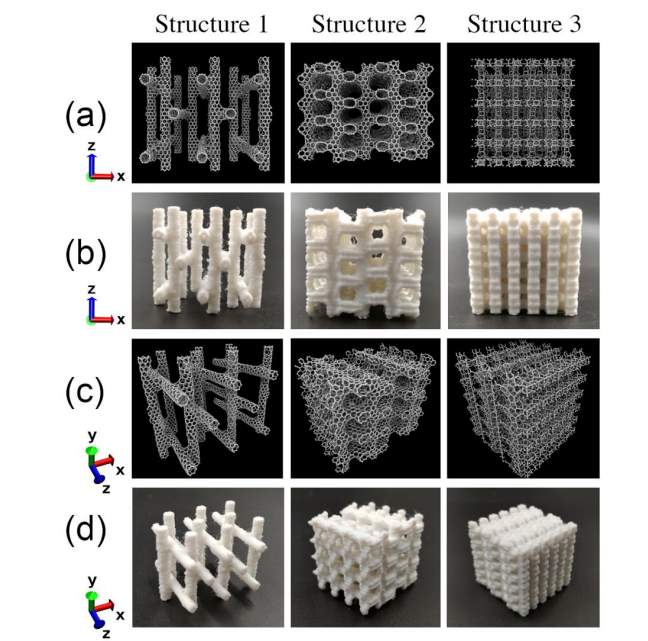
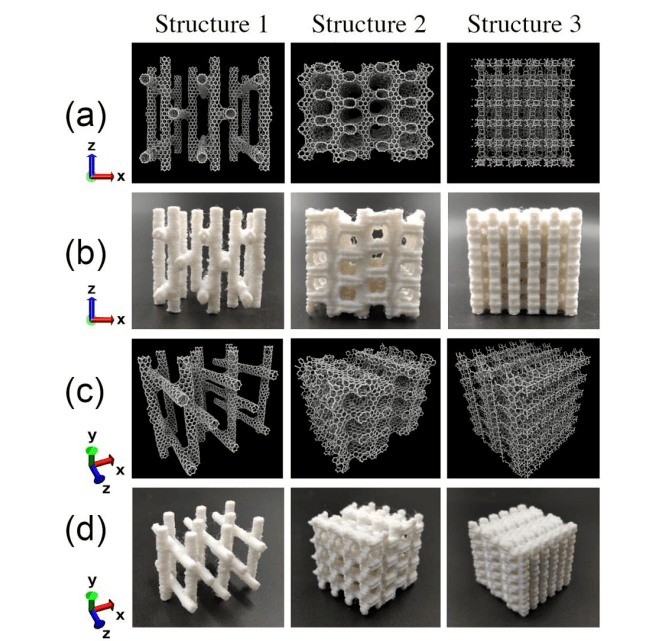
a) Front view of zeolite-templated molecular structures. b) Front view of 3D printed zeolite-inspired structures. c) 3D view of zeolite-inspired molecular structures. d) 3D view of 3D printed zeolite-inspired structures.
Mechanical Properties and Testing Results
Initial results demonstrated that porosity significantly influences the deformation behavior of printed parts. The researchers found that structures with lower porosity exhibited shorter elastic regimes, requiring greater stress to induce deformation and reach the plastic regime. This relationship between porosity and mechanical performance aligns with established principles in materials science, where denser materials typically demonstrate higher strength but reduced ductility.
Stress-strain analysis revealed that mechanical properties are not only scale-dependent but also strongly influenced by the topology of the structure. The direction perpendicular to nanotube arrangements (x-direction) consistently produced the toughest and most elastic structures, particularly as porosity decreased. This anisotropic behavior—where material properties vary with direction—is a well-documented characteristic of CNT-based materials, arising from the inherent difficulty of deforming tubes vertically compared to radially.
“… beyond the porosity of the structure, the relative tube orientation significantly affects the observed mechanical properties,” stated the researchers. See also: ABS 3D Printing Settings Guide: Temperature, Enclo…. “In general, we can see that the direction that is perpendicular to the nanotubes arrangements, which is the x-direction, presents the toughest and more elastic structures with decreasing porosity. Similar behavior was reported to other CNT nets, and the reasons are that is much more difficult to deform the tubes vertically than radially.”
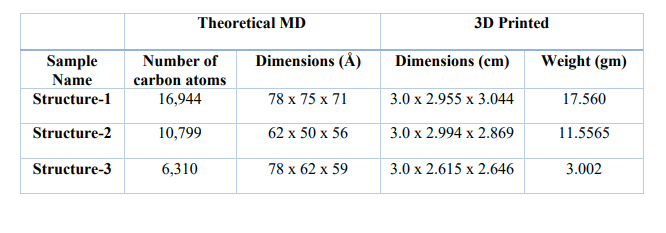
Specifications of the created molecular structures from MD simulations and the 3D printed corresponding ones.
Comparison: Molecular vs. 3D Printed Structures
The stress-strain curves from molecular dynamics simulations showed good qualitative agreement with experimental data from the 3D printed specimens. This consistency validates the computational approach as a valuable tool for predicting material behavior before physical fabrication. However, some discrepancies were observed, primarily attributed to the intrinsic layer-by-layer nature of FDM 3D printing, which can introduce anisotropic properties not present in the theoretical molecular models.
| Property | Molecular Model (MD) | 3D Printed (PLA) | Key Differences |
|---|---|---|---|
| Elastic Regime | Shorter, less porosity dependent | Longer, more porosity dependent | Layer adhesion affects elastic behavior |
| Anisotropy | Tube orientation dominated | Print layer + tube orientation | FDM adds layer-direction dependence |
| Scale Effects | Atomic-level precision | Macro-scale with tolerances | Resolution limits affect properties |
| Failure Mode | Predictable bond breaking | Layer delamination + fracture | Manufacturing defects introduce variability |
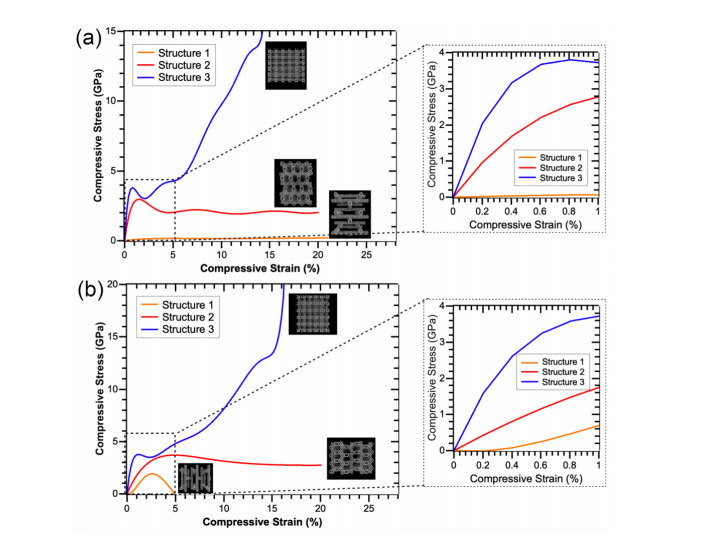
Stress-strain curves from MD simulations of structures 1, 2, and 3 for the compressive tests along (a) x-direction and (b) z-direction. The insets show the zoomed region of the initial compressive regimes.

Experimental stress-strain curves for compressive tests of structures 1, 2, and 3 along (a) x-direction and (b) z-direction. The insets show the zoomed region of the initial compressive regimes.
Comparison: Porosity Effects on Mechanical Properties
The research systematically investigated how varying porosity levels impact the mechanical performance of zeolite-templated structures. Understanding these relationships is crucial for designing materials optimized for specific applications, whether maximum strength or optimal energy absorption is required.
| Porosity Level | Compressive Strength | Elastic Modulus | Recommended Applications |
|---|---|---|---|
| High Porosity (70%+) | Lower strength | More flexible | Energy absorption, cushioning, filtration |
| Medium Porosity (50-70%) | Balanced strength/weight | Moderate stiffness | Lightweight structural components, thermal insulation |
| Low Porosity (<50%) | Highest strength | Highest stiffness | Load-bearing structures, aerospace components, medical implants |
Applications and Future Directions
The successful demonstration of zeolite-templated CNTnets opens numerous possibilities for advanced manufacturing applications. In aerospace engineering, these lightweight yet strong structures could replace traditional metal components in aircraft and spacecraft, reducing weight while maintaining or improving performance. The automotive industry could benefit from similar weight reductions, improving fuel efficiency without compromising safety standards.
In the biomedical field, such structures offer promising avenues for bone tissue engineering scaffolds, where the combination of strength, porosity, and biocompatibility is essential. The ability to customize pore size and distribution could enable creation of implants that better integrate with natural bone tissue and promote healing.
Energy storage represents another promising application area. See also: Best 3D Printer Upgrades That Actually Improve Pri…. The high surface area and conductive properties of CNTs, combined with the ordered porosity of zeolite architectures, could lead to advanced electrodes for batteries, supercapacitors, and fuel cells. Researchers are particularly interested in how these structures might improve charge storage capacity and cycling stability compared to conventional materials.
Quick Answer Box
Key Takeaways
- Zeolite inspiration: Natural zeolite minerals provide architectural models for strong, lightweight 3D printed structures
- CNT networks: Carbon nanotubes create exceptional strength-to-weight ratios when organized in zeolite-templated patterns
- Porosity matters: Lower porosity increases strength but reduces flexibility, enabling application-specific optimization
- Directional strength: Structures exhibit anisotropic properties, being strongest perpendicular to nanotube orientation
- Validation success: 3D printed specimens successfully bore high compressive loads without structural failure
FAQ
What makes zeolites good inspiration for 3D printing?
Zeolites have a naturally occurring porous crystalline structure that provides exceptional strength-to-weight ratios. Their intricate network of interconnected channels can be replicated at larger scales, creating 3D printed structures that maintain similar mechanical properties while being much lighter than solid materials. This natural architecture has been refined over millions of years of evolution, offering proven design principles for engineers.
How do carbon nanotubes improve 3D printed parts?
Carbon nanotubes are among the strongest known materials, with tensile strength up to 100 times that of steel. When incorporated into 3D printed parts, either as additives or as the primary structural material, they dramatically improve mechanical properties including strength, stiffness, and thermal conductivity. Their high aspect ratio and surface area also enable better load transfer between layers in printed components.
What was the biggest challenge in this research?
The primary challenge was bridging the gap between molecular-scale simulations and macro-scale 3D printing. While the computational models provided precise predictions of behavior, the actual 3D printed parts were subject to manufacturing limitations including layer adhesion issues, surface roughness, and dimensional tolerances. The research team had to carefully account for these factors when comparing experimental results with theoretical predictions.
Can these structures be printed with materials other than PLA?
Yes, while this study used PLA for proof-of-concept, the zeolite-templated approach is compatible with various 3D printing materials including ABS, PETG, nylon, and even engineering-grade polymers like PEEK. The choice of material would depend on the specific application requirements—for example, high-temperature environments would benefit from materials with better thermal stability than PLA. Additionally, multi-material printing could enable gradients in porosity or material composition within a single part.
What are the limitations of this approach?
Current limitations include the complexity of designing appropriate molecular junctions, which requires advanced computational resources and expertise. The FDM printing process also introduces anisotropy due to layer-by-layer deposition, which can affect mechanical properties. Additionally, while the demonstrated structures are promising, scaling this approach to industrial production may require development of specialized printing technologies or adaptation of existing ones. Cost of CNT-based materials, though decreasing, remains a consideration for widespread adoption.
How does this compare to other biomimetic 3D printing approaches?
Unlike direct replication of complex biological structures (such as attempting to exactly copy bone or nacre), the zeolite-templated approach focuses on abstracting the underlying geometric principles. This makes it more practical for manufacturing, as the designs are optimized for 3D printing while still benefiting from evolutionary refinement. Compared to other biomimetic approaches, this method offers better scalability and manufacturability while maintaining many of the performance advantages of natural materials.
Overall, results showed that the structures 3D printed by the researchers for this study were successfully fabricated as they were able to reach the intended goal of bearing the high compressive loads without giving into failure structurally.
“There is a good qualitative agreement for the mechanical behavior of the atomic models and the corresponding 3D printed macro-scale ones,” stated the researchers. “Some of the discrepancies are due to the intrinsic 3D printed layer-by-layer process.”
References and Further Reading
- Original Research: Zeolite-templated 3D printed carbon nanotube networks with enhanced mechanical properties
- Carbon Nanotubes: Properties and Applications
- 3D Printed Scaffolds for Bone Tissue Engineering
- Energy Storage Applications of CNT-Based Materials
Where to Buy Filament
Disclosure: Some of the links below are affiliate links. If you make a purchase, we may earn a commission at no extra cost to you. This helps support this site.
- PLA: Hatchbox PLA 1.75mm – Great for prototyping and general printing
- ABS: Hatchbox ABS 1.75mm – Stronger and heat-resistant for functional parts
- PETG: Hatchbox PETG 1.75mm – Combines strength and ease of printing
- Carbon Fiber PLA: Carbon Fiber PLA 1.75mm
Looking for Understanding Zeolites and Carbon Nanotubes
Zeolites are naturally occurring or synthetic microporous aluminosilicate minerals with a highly ordered crystalline structure. Their unique porous architecture gives them exceptional surface area and ion-exchange capabilities, making them valuable in catalysis, gas separation, and water purification. For 3D printing applications, researchers are primarily interested in the structural geometry of zeolites—their intricate network of interconnected channels and cages that provide exceptional strength-to-weight ratios.
Carbon nanotubes (CNTs) are cylindrical molecules composed of rolled-up graphene sheets, exhibiting extraordinary mechanical, electrical, and thermal properties. Individual CNTs can be up to 100 times stronger than steel while being six times lighter, making them ideal candidates for reinforcing composite materials in load-bearing applications. When combined with zeolite-inspired architecture, CNTs create hierarchical structures that leverage both molecular-level precision and macro-scale structural integrity.
The Research Methodology
The research team employed a multi-scale approach, combining molecular dynamics (MD) simulations with experimental 3D printing to validate their theoretical models. They used a Flashforge Adventurer 3 FDM 3D printer with commercial-grade solid PLA filament to fabricate zeolite-templated carbon nanotube networks (CNTnets). The printing parameters included an extruder temperature of 210°C and a heated bed at 50°C, standard settings for PLA but carefully controlled to maintain dimensional accuracy for the complex geometries.
To create the CNTnets, the researchers first constructed junctions between CNTs by placing two CNTs within nearly BEA (Beta zeolite) channels, then added non-bonded carbon atoms to stabilize the connections. This process required precise control over molecular positioning and bonding, demonstrating the sophistication of their computational design approach. The resulting structures exhibited the characteristic zeolite topology with interconnected channels that provide both strength and porosity.a) Front view of zeolite-templated molecular structures. b) Front view of 3D printed zeolite-inspired structures. c) 3D view of zeolite-inspired molecular structures. d) 3D view of 3D printed zeolite-inspired structures.
Mechanical Properties and Testing Results
Initial results demonstrated that porosity significantly influences the deformation behavior of printed parts. The researchers found that structures with lower porosity exhibited shorter elastic regimes, requiring greater stress to induce deformation and reach the plastic regime. This relationship between porosity and mechanical performance aligns with established principles in materials science, where denser materials typically demonstrate higher strength but reduced ductility.
Stress-strain analysis revealed that mechanical properties are not only scale-dependent but also strongly influenced by the topology of the structure. The direction perpendicular to nanotube arrangements (x-direction) consistently produced the toughest and most elastic structures, particularly as porosity decreased. This anisotropic behavior—where material properties vary with direction—is a well-documented characteristic of CNT-based materials, arising from the inherent difficulty of deforming tubes vertically compared to radially.“… beyond the porosity of the structure, the relative tube orientation significantly affects the observed mechanical properties,” stated the researchers. See also: ABS 3D Printing Settings Guide: Temperature, Enclo…. “In general, we can see that the direction that is perpendicular to the nanotubes arrangements, which is the x-direction, presents the toughest and more elastic structures with decreasing porosity. Similar behavior was reported to other CNT nets, and the reasons are that is much more difficult to deform the tubes vertically than radially.”
Specifications of the created molecular structures from MD simulations and the 3D printed corresponding ones.
Comparison: Molecular vs. 3D Printed Structures
The stress-strain curves from molecular dynamics simulations showed good qualitative agreement with experimental data from the 3D printed specimens. This consistency validates the computational approach as a valuable tool for predicting material behavior before physical fabrication. However, some discrepancies were observed, primarily attributed to the intrinsic layer-by-layer nature of FDM 3D printing, which can introduce anisotropic properties not present in the theoretical molecular models.Property
Molecular Model (MD)
3D Printed (PLA)
Key DifferencesElastic Regime
Shorter, less porosity dependent
Longer, more porosity dependent
Layer adhesion affects elastic behaviorAnisotropy
Tube orientation dominated
Print layer + tube orientation
FDM adds layer-direction dependenceScale Effects
Atomic-level precision
Macro-scale with tolerances
Resolution limits affect propertiesFailure Mode
Predictable bond breaking
Layer delamination + fracture
Manufacturing defects introduce variabilityStress-strain curves from MD simulations of structures 1, 2, and 3 for the compressive tests along (a) x-direction and (b) z-direction. The insets show the zoomed region of the initial compressive regimes.
Experimental stress-strain curves for compressive tests of structures 1, 2, and 3 along (a) x-direction and (b) z-direction. The insets show the zoomed region of the initial compressive regimes.
Comparison: Porosity Effects on Mechanical Properties
The research systematically investigated how varying porosity levels impact the mechanical performance of zeolite-templated structures. Understanding these relationships is crucial for designing materials optimized for specific applications, whether maximum strength or optimal energy absorption is required.Porosity Level
Compressive Strength
Elastic Modulus
Recommended ApplicationsHigh Porosity (70%+)
Lower strength
More flexible
Energy absorption, cushioning, filtrationMedium Porosity (50-70%)
Balanced strength/weight
Moderate stiffness
Lightweight structural components, thermal insulationLow Porosity (
Highest strength
Highest stiffness
Load-bearing structures, aerospace components, medical implantsApplications and Future Directions
The successful demonstration of zeolite-templated CNTnets opens numerous possibilities for advanced manufacturing applications. In aerospace engineering, these lightweight yet strong structures could replace traditional metal components in aircraft and spacecraft, reducing weight while maintaining or improving performance. The automotive industry could benefit from similar weight reductions, improving fuel efficiency without compromising safety standards.
In the biomedical field, such structures offer promising avenues for bone tissue engineering scaffolds, where the combination of strength, porosity, and biocompatibility is essential. The ability to customize pore size and distribution could enable creation of implants that better integrate with natural bone tissue and promote healing.
Energy storage represents another promising application area. See also: Best 3D Printer Upgrades That Actually Improve Pri…. The high surface area and conductive properties of CNTs, combined with the ordered porosity of zeolite architectures, could lead to advanced electrodes for batteries, supercapacitors, and fuel cells. Researchers are particularly interested in how these structures might improve charge storage capacity and cycling stability compared to conventional materials.
Quick Answer BoxKey Takeaways
Zeolite inspiration: Natural zeolite minerals provide architectural models for strong, lightweight 3D printed structures
CNT networks: Carbon nanotubes create exceptional strength-to-weight ratios when organized in zeolite-templated patterns
Porosity matters: Lower porosity increases strength but reduces flexibility, enabling application-specific optimization
Directional strength: Structures exhibit anisotropic properties, being strongest perpendicular to nanotube orientation
Validation success: 3D printed specimens successfully bore high compressive loads without structural failureFAQ
What makes zeolites good inspiration for 3D printing?
Zeolites have a naturally occurring porous crystalline structure that provides exceptional strength-to-weight ratios. Their intricate network of interconnected channels can be replicated at larger scales, creating 3D printed structures that maintain similar mechanical properties while being much lighter than solid materials. This natural architecture has been refined over millions of years of evolution, offering proven design principles for engineers.
How do carbon nanotubes improve 3D printed parts?
Carbon nanotubes are among the strongest known materials, with tensile strength up to 100 times that of steel. When incorporated into 3D printed parts, either as additives or as the primary structural material, they dramatically improve mechanical properties including strength, stiffness, and thermal conductivity. Their high aspect ratio and surface area also enable better load transfer between layers in printed components.
What was the biggest challenge in this research?
The primary challenge was bridging the gap between molecular-scale simulations and macro-scale 3D printing. While the computational models provided precise predictions of behavior, the actual 3D printed parts were subject to manufacturing limitations including layer adhesion issues, surface roughness, and dimensional tolerances. The research team had to carefully account for these factors when comparing experimental results with theoretical predictions.
Can these structures be printed with materials other than PLA?
Yes, while this study used PLA for proof-of-concept, the zeolite-templated approach is compatible with various 3D printing materials including ABS, PETG, nylon, and even engineering-grade polymers like PEEK. The choice of material would depend on the specific application requirements—for example, high-temperature environments would benefit from materials with better thermal stability than PLA. Additionally, multi-material printing could enable gradients in porosity or material composition within a single part.
What are the limitations of this approach?
Current limitations include the complexity of designing appropriate molecular junctions, which requires advanced computational resources and expertise. The FDM printing process also introduces anisotropy due to layer-by-layer deposition, which can affect mechanical properties. Additionally, while the demonstrated structures are promising, scaling this approach to industrial production may require development of specialized printing technologies or adaptation of existing ones. Cost of CNT-based materials, though decreasing, remains a consideration for widespread adoption.
How does this compare to other biomimetic 3D printing approaches?
Unlike direct replication of complex biological structures (such as attempting to exactly copy bone or nacre), the zeolite-templated approach focuses on abstracting the underlying geometric principles. This makes it more practical for manufacturing, as the designs are optimized for 3D printing while still benefiting from evolutionary refinement. Compared to other biomimetic approaches, this method offers better scalability and manufacturability while maintaining many of the performance advantages of natural materials.
Overall, results showed that the structures 3D printed by the researchers for this study were successfully fabricated as they were able to reach the intended goal of bearing the high compressive loads without giving into failure structurally.“There is a good qualitative agreement for the mechanical behavior of the atomic models and the corresponding 3D printed macro-scale ones,” stated the researchers. “Some of the discrepancies are due to the intrinsic 3D printed layer-by-layer process.”
References and Further Reading
Original Research: Zeolite-templated 3D printed carbon nanotube networks with enhanced mechanical properties
Carbon Nanotubes: Properties and Applications
3D Printed Scaffolds for Bone Tissue Engineering
Energy Storage Applications of CNT-Based MaterialsWhere to Buy Filament? Check the best deals on Amazon:
– Enhanced stiffness for structural applications
These links go to Amazon with our affiliate tag. If you prefer to support local retailers or buy directly from manufacturers, we encourage that as well!
Frequently Asked Questions
What is the best 3D printing filament for beginners?
PLA is the best starting filament — it prints easily at 190-220°C without an enclosure and produces good results. Once comfortable, PETG offers better strength and temperature resistance for functional parts.
How do I choose the right filament?
Consider the application: PLA for display models, PETG for functional parts, ABS/ASA for heat/sunlight exposure, TPU for flexible parts, and specialty filaments for engineering applications. Each has specific printer requirements.
What temperature should I print different filaments at?
PLA: 190-220°C nozzle / 50-60°C bed. PETG: 220-250°C / 70-80°C. ABS: 230-260°C / 100-110°C (enclosure needed). Nylon: 240-270°C / 70-90°C. Always check manufacturer recommendations for specific brands.
📌 Related Articles
- ABS 3D Printing Settings Guide: Temperature, Enclosure, and Cooling for Strong Parts
- Best 3D Printer Upgrades That Actually Improve Print Quality: Complete 2026 Guide
- Best Budget 3D Printer Upgrades That Actually Improve Print Quality: Belts, Springs, Hotends & More
- Prusa Research Mini+ vs Prusa MK4: Full Specs Comparison & Buyer’s Guide
- 3D Printing Safety Equipment Guide: Respirators, Gloves, and Ventilation for 2026