
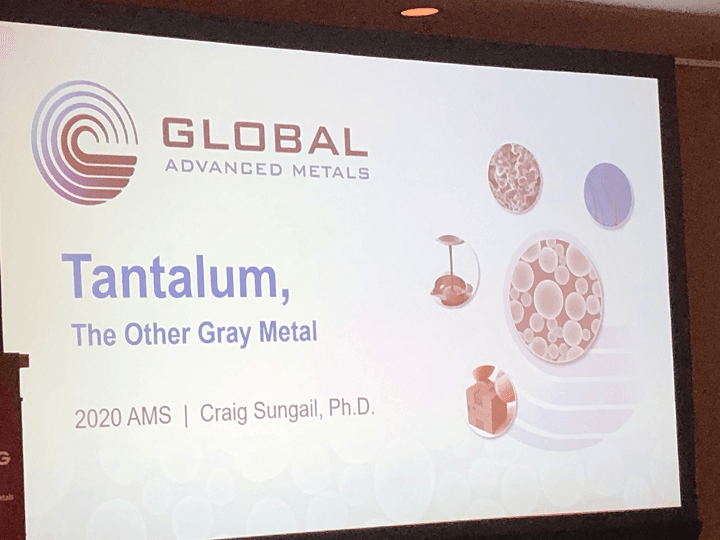
The final keynote presentation at our recent Additive Manufacturing Strategies, held in Boston and co-hosted by SmarTech Analysis, was given by Craig Sungail, the Vice President of Global Research and Development for Global Advanced Metals, which just so happened to be one of the event sponsors. Sungail was part of our new 3D printing metals track, and presented a very interesting talk about tantalum, “the other gray metal.”

“We’ve used other metals for years, like cobalt chrome and stainless steel, to make implants,” Sungail said. “In 80% of the cases, for most people, it’s successful. But 20% of the time, patients aren’t happy with the results.”
The State of Metal 3D Printing
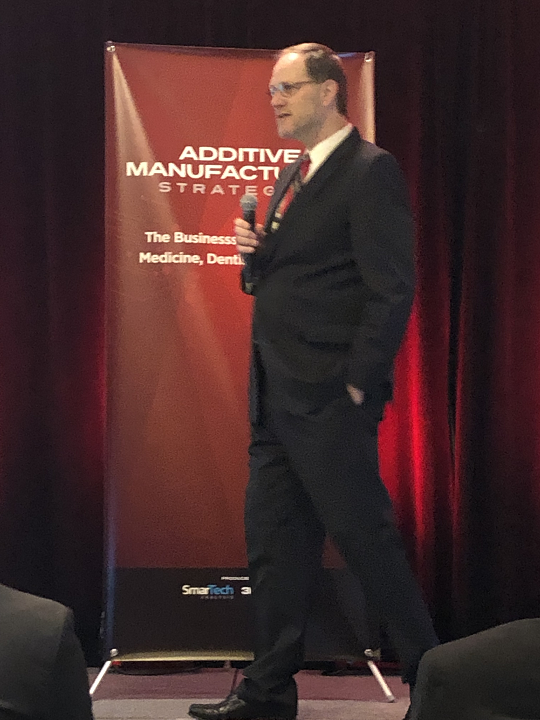 He went on to say that there is a 10% revision rate each year for surgical implants 3D printed out of these other materials, for reasons such as infection, fracture, and becoming dislodged. That’s why he said that we should all “consider tantalum as an alternative.”
“This metal has a long history. We’ve been reviewing the literature for the past 25 years. The authors vary – physicians, universities, etc. But there is a broad, diverse group of people investigating this metal for medical devices.”
Technical Challenges and Solutions
Sungail explained that these journals have determined that tantalum (Ta) is not toxic, which “can’t be said for some of the other metals out there today.” Additionally, the research shows that when using tantalum for implants, the osseointegration (bone ingrowth) of the implant into existing bone is pretty good, and perhaps even better than implants made with straight titanium or the Ti-64 alloy.
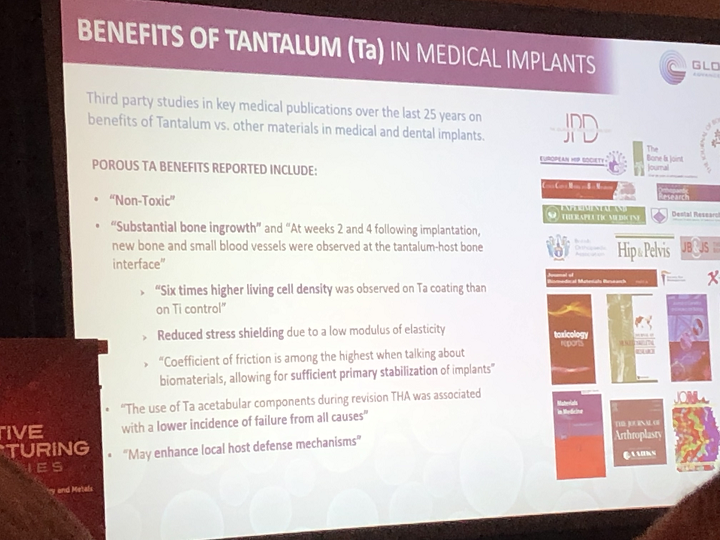
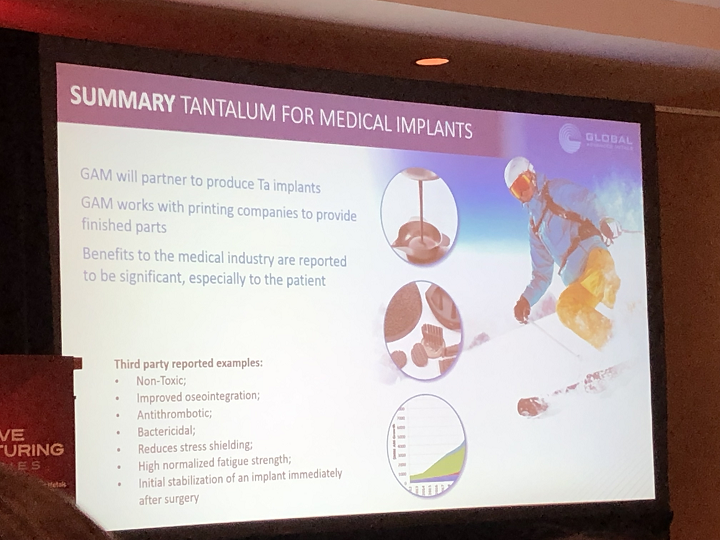
He pulled up a slide listing some of the other benefits of using tantalum to fabricate medical implants, including the fact that it could enhance local host defense mechanisms, and that it may even have some antibacterial properties.
Material Properties and Performance
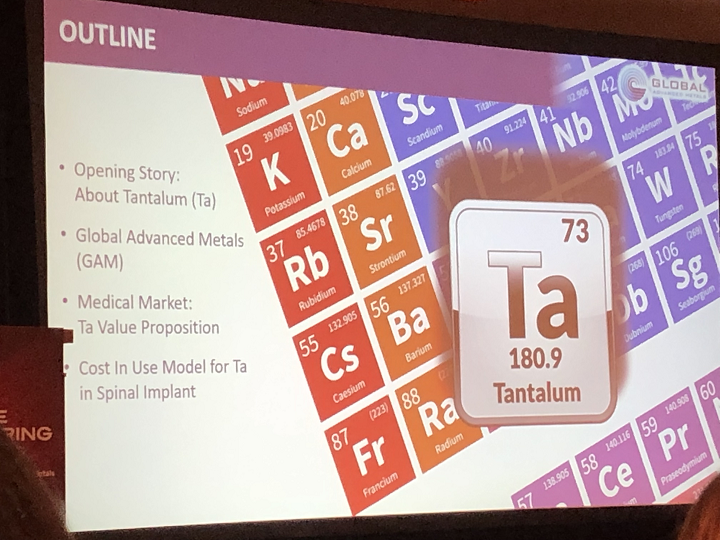
Sungail offered a brief history about tantalum, which is a transition metal/element. He explained how the material got its name, bringing up a slide about Greek mythology, which I had not been expecting and was very interesting. Tantalus, the son of Zeus and a nymph, stole ambrosia and nectar from his father, and the punishment definitely fit the crime in this case – he was forced to stand in a pool of water that was tantalizingly close to a fruit tree.
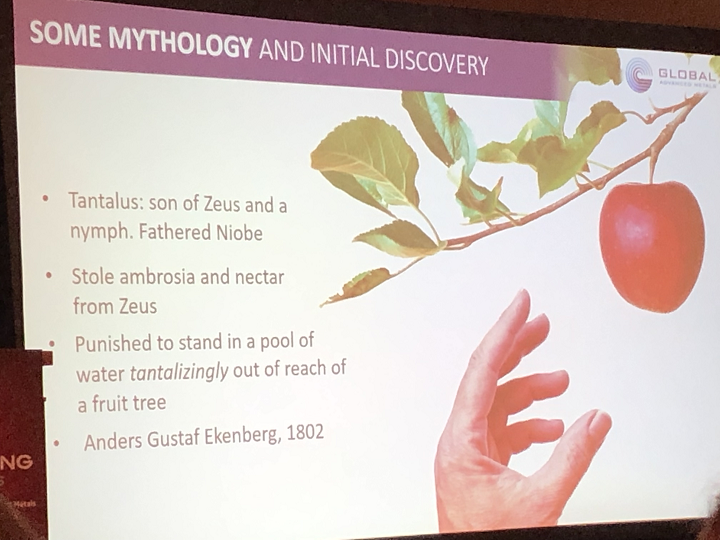
“The water would fade away, and the fruit was just out of reach,” Sungail went on.
Industrial Applications and Use Cases
Then, in 1802, Swedish analytical chemist Anders Gustaf Ekeberg became the first person to discover tantalum when he successfully separated it from nyobium. Ekeberg was tantalized for a long time attempting to achieve what many others had not, and once he’d succeeded, he was given the honor of naming both of the new elements.

“I’m confident that every one of you has been touched by tantalum in some way,” Sungail said. “It’s highly conductive, with a high melting point, chemical and corrosion-resistant, dense, hard, ductile, and biocompatible. We have to use biocompatible carefully, but I’m using it with the FDA definition – it’s been implanted in some way into the body, and studies concluded that the implant was biocompatible.”
Comparing Metal AM to Traditional Manufacturing
Sungail said that the most common application for tantalum is in the capacitor sector, such as when it’s used for cell phones. It does have a 40-year history in medical devices, and it can be mixed with materials in order to make super elements, which can be used in turbines for jet engines and energy generation.
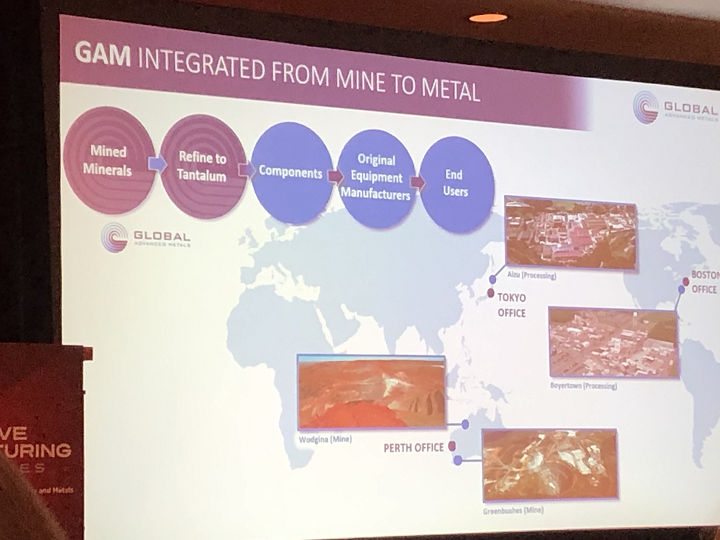
He explained that the company is “truly global,” with locations in the US and Japan. GAM also has a controlling interest in the largest reserve of tantalum in the world, which is in Australia. I’m skipping ahead a little, but I thought this was a good question – at the end of the presentation, an attendee asked Sungail about the potential environmental impact of mining tantalum. He explained that GAM does what he referred to as a “bag and tag” when they receive ore from a conflict country.
“We ensure the money isn’t going to terrorists, we do it ethically. If it wasn’t mined ethically, we wouldn’t have sales,” he stated.
Future Developments in Metal Additive Manufacturing
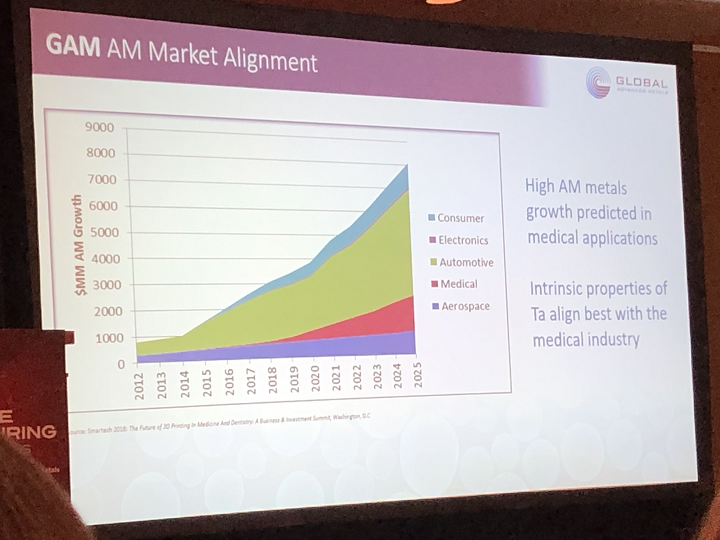
Back to where we were, Sungail said that two years ago, the company was taking a look at the various AM markets, wondering which would be the best to participate in with its tantalum. Just like the above graph shows, GAM determined that its “value proposition was best in medical, and not automotive.”
The State of Metal 3D Printing
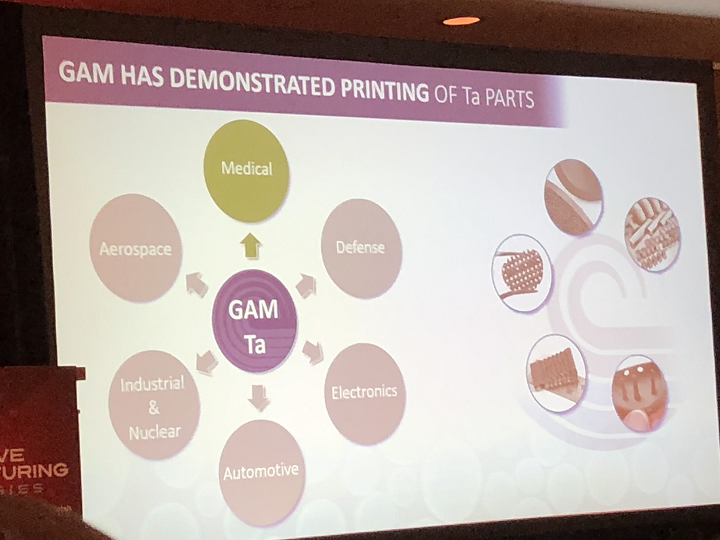
“We realized we’d have to bridge the chasm between early adopters and later innovators. We’d have to teach the industry about tantalum and that it can be printed,” he said.
Technical Challenges and Solutions
So the company got to work, using 200W and 300W lasers to 3D print medical devices like spinal implants and baseplates out of its tantalum; these fully dense parts are now in testing.
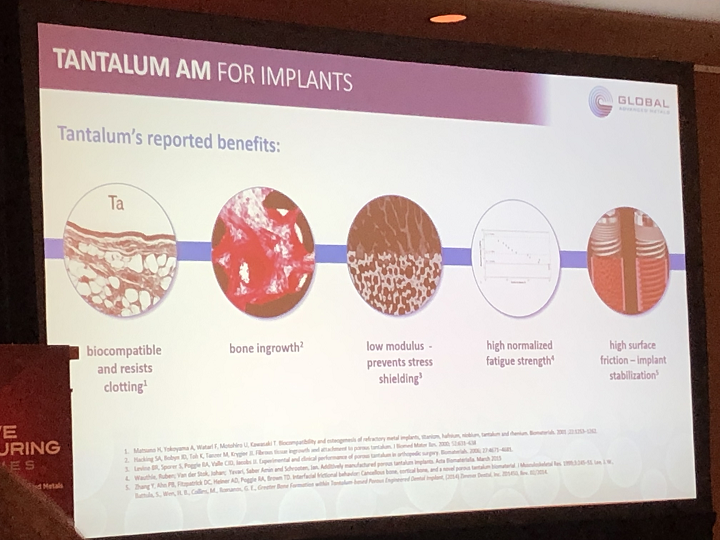
Sungail listed several reasons why tantalum is a good material to use in 3D printed medical devices – it resists blood clotting, so it can be used to fabricate stents, and its high surface friction, proven through several research studies done on animals, is good for implant stabilization.
Material Properties and Performance
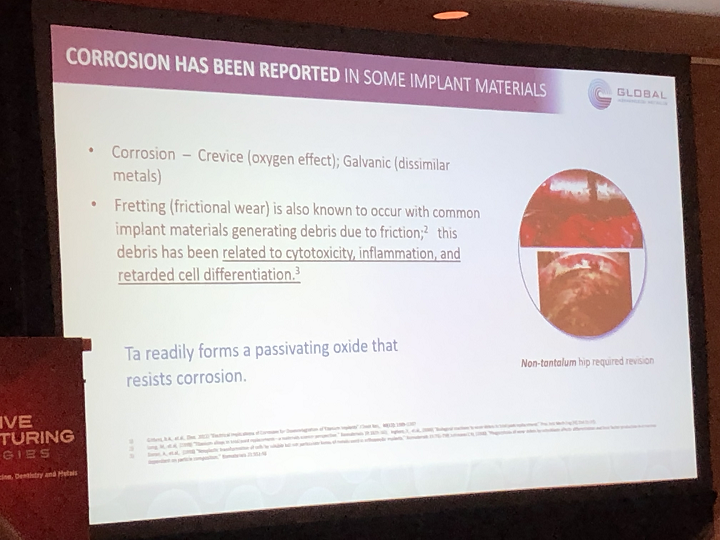
Tantalum also has no problem with corrosion, which has been reported as being an issue with other implant materials. Sungail had a slide that showed a picture of a non-tantalum 3D printed hip implant, which required revision post-surgery due to corrosion; researchers determined that it was caused due to crevice (the oxygen effect) and galvanic (dissimilar metals). He explained that debris due to friction can lead to even more issues with implants, such as inflammation in the tissue around the joint, which can cause severe pain, and that cobalt chrome and Ti-64 implants can even lead to toxic effects, like bone degradation, if absorbed into the body.
“Tantalum doesn’t corrode in a normal body,” Sungail said. “Its only attacker is hydrofloric acid, and threading should also not occur with tantalum.”
Industrial Applications and Use Cases
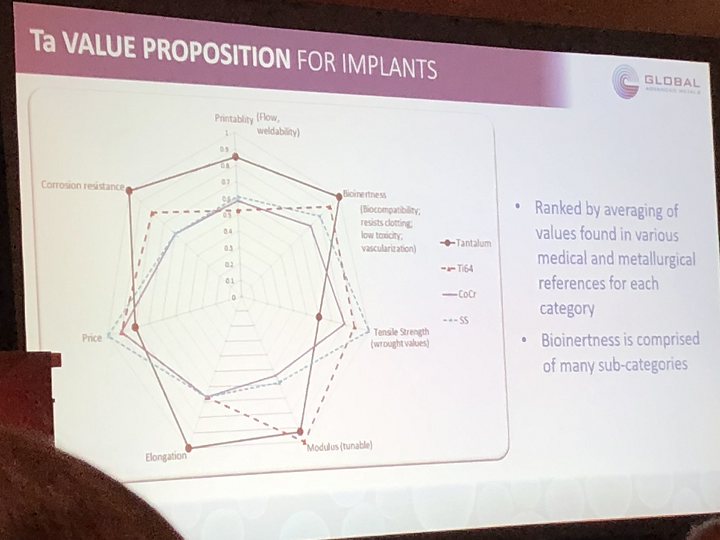
Looking at the graph above, you can see that the material’s printability comes down to several factors, of which bioinertness combines several; Sungail explained that “these are generic combinations of various features for easy reading.”
“It’s significantly more printable than some other metals we use for medical devices,” he continued. “Tensile and elongation properties unfortunately aren’t well reported, so we turned to engineering handbooks for this informnation, and modulus can be tuned with this material. There are four to five papers out now from researchers who printed tantalum and made it 70-80% porous, because this is the sweet spot for osseointegration. They noticed that the elastic modulus exactly matched bone in this range.”
Comparing Metal AM to Traditional Manufacturing
 Sungail said that he’s been at many conferences where people have concurred that tantalum is a great material, but don’t know how to justify using it since it’s more expensive than Ti-64.
“That’s the wrong question,” he said. See also: 3D Printing Tungsten Carbide: How Hot-Wire Laser T…. “Ask the cost to the patient.”
Future Developments in Metal Additive Manufacturing
While looking for a well-documented surgical study, GAM found an example with a 3D printed transforaminal lumbar interbody fusion (TLIF) implant, which is shown in the slide below with the cost benefit example analysis.
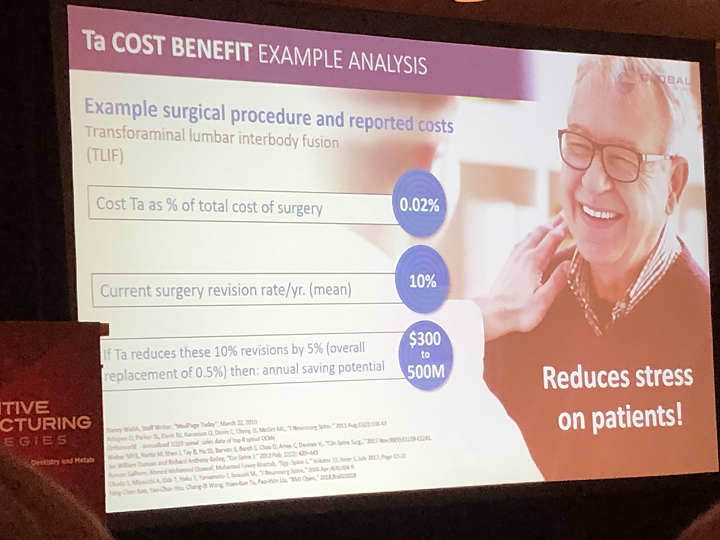
“We looked at the whole process, buying the raw material and printing and cleaning it and sterilizing it, packaging, surgery, to the point where the patient walks out,” Sungail explained. “Tantalum’s contribution to this implant on the slide is .02%. I think that’s nearly negligible. Tantalum will allow the patient to walk out much quicker and recover much quicker.”
The State of Metal 3D Printing
3D printing isn’t even the most expensive part of the whole process – it’s the surgery itself. If annual implant surgery revisions can be prevented by even 5% from switching to tantalum, the medical industry will save $300-500 million a year.
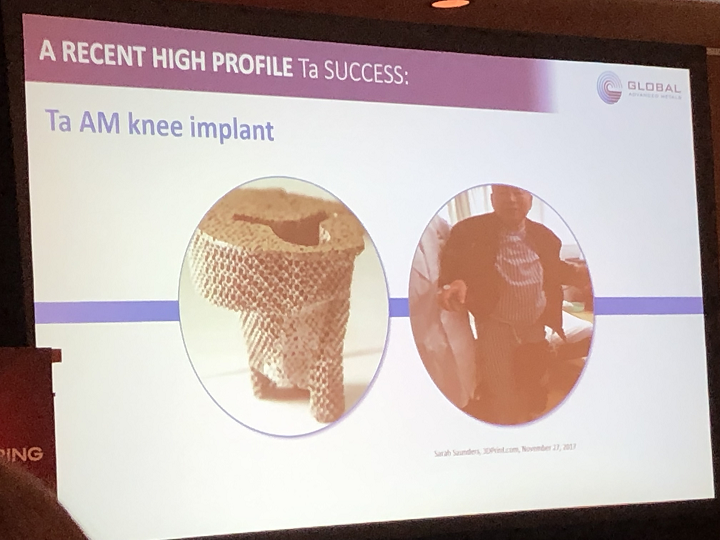
Another example Sungail shared was a 3D printed knee implant made out of tantalum. The surgery took place in China back in 2017, and the patient was actually able to stand up two hours post-op…that’s a pretty impressive feat.
Technical Challenges and Solutions
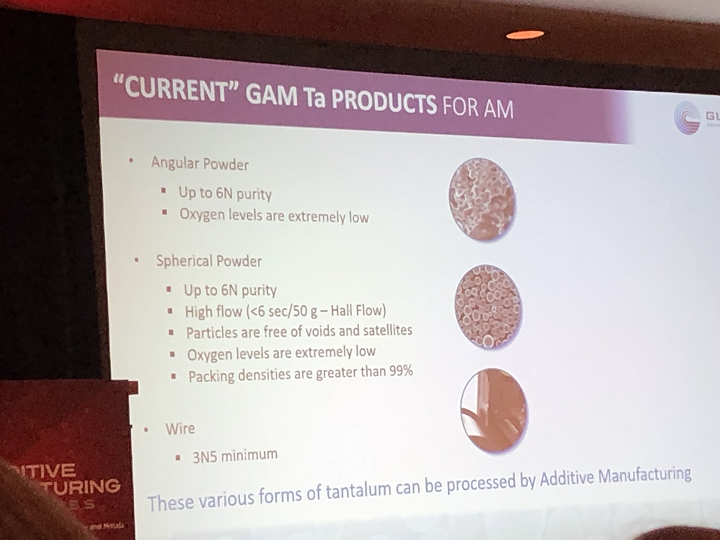
Wrapping things up, he pulled up a slide showing GAM’s “current” tantalum products for 3D printing. In its angular powder form, the material works for cold spray technology and DED printing, while spherical powder can be used with laser AM technologies. He said that the company is also working on tantalum tungsten, and is “always looking for partners,” especially since GAM doesn’t have its own 3D printing system yet and relies on its partnerships to print tantalum for them. However, Sungail said they are considering a 3D printer purchase…perhaps this is an announcement we’ll see in the near future?
Stay tuned to 3DPrint.com as we continue to bring you the news from AMS 2020.
Discuss this and other 3D printing topics at 3DPrintBoard.com or share your thoughts below.
Material Properties and Performance
[Photos: Sarah Saunders]
The post AMS 2020: 3D Printing Metals II Keynote by Craig Sungail, Global Advanced Metals appeared first on 3DPrint.com | The Voice of 3D Printing / Additive Manufacturing.
from Your daily news from 3DPrint.com http://bit.ly/39Hru6i
Industrial Applications and Use Cases
Related: AMS 2020 Panels: HP’s Binder Jetting Technology, New Metals for 3D Printing · AMS 2020: Keynote Presentations on 3D Printing in Metal and Medical Industries · AMS 2020: Panels on 3D Printing Materials and Applications for Dental Industry
Frequently Asked Questions
What is metal 3D printing?
Metal 3D printing (additive manufacturing) builds metal parts layer by layer using techniques like laser powder bed fusion, directed energy deposition, and binder jetting. It enables complex geometries impossible with traditional manufacturing while reducing material waste significantly.
How strong are 3D printed metal parts?
3D printed metal parts can achieve mechanical properties comparable to traditionally manufactured metals. Tensile strength and fatigue resistance depend on the process and post-processing, but many meet or exceed ASTM standards for wrought materials.
What are the main metal 3D printing technologies?
The primary technologies include Laser Powder Bed Fusion (LPBF), Electron Beam Melting (EBM), Directed Energy Deposition (DED), Binder Jetting, and Metal FDM (with bound filaments). Each has different strengths in terms of resolution, speed, and material options.
📌 Related Articles
- The Current State of Metal 3D Printing in 2020
- 3D Printing Tungsten Carbide: How Hot-Wire Laser Technology Creates Metal Harder Than Steel
- Best 3D Printer Upgrades That Actually Improve Print Quality: Complete 2026 Guide
- Best Budget 3D Printer Upgrades That Actually Improve Print Quality: Belts, Springs, Hotends & More
- 3D Printing News: Multi-Material Breakthrough and Aerospace Market Boom