
⚡ Quick Answer: Is 3D Printing Useful for Emergency Preparedness?
Yes, absolutely. Desktop 3D printers proved invaluable during the COVID-19 pandemic, with thousands of face shields, ventilator components, and medical supplies printed globally. Key advantages include:
- Rapid prototyping: Design and print critical parts in hours rather than weeks
- On-demand production: Print exactly what you need, when you need it
- Material flexibility: From durable PLA to antimicrobial copper-infused filaments
- No supply chain dependency: Bypass shipping delays and stockouts
While disaster has not yet befallen my humble family, there is no shortage of emergencies globally and the COVID-19 pandemic has demonstrated just how useful even desktop 3D printing can be during disaster situations. Provided with the opportunity to review an Ultimaker S3 3D printer and several unique filaments, I thought I’d explore the 3D printing of simple goods that might be useful during emergency situations to get an idea for just how useful a desktop 3D printer might be.
Real-World Emergency Response: Lessons from COVID-19
In a previous article, I reviewed the Ultimaker S3 and described most of the items I printed. To learn more about how these machines have actually been used for emergency situations, I spoke to Jeremy Evers, an Application Design Engineer with Ultimaker. As it turns out, Evers and the rest of the world were impacted by an emergency situation of pandemic proportions, with 3D printing often presenting itself as a novel solution to many global supply chain issues.
Evers noted that, as 3D printing was introduced to produce supplies in the critically hit Lombardi region of Italy, he took note of the ways that this technology could help.
“I remember there was a point in time when everybody needed to stay indoors. Nobody was allowed to go grocery shopping or do whatever outside. The same was true for me. I was still traveling in February, giving workshops, inspiring people with 3D printing and then, all of a sudden, I was also locked inside,” Evers said. “We also really saw these scenes from Italy, where 3D printing was enabling the production of certain parts that were not able to be produced on time or there were difficulties with supply as the amount of people in the hospitals were increasing.”
In response, Ultimaker launched an initiative to connect people, businesses and organizations with their local service providers to obtain supplies more quickly via 3D printing. As we have seen, face shields became an easy way for 3D printer owners to help fulfill a critical need even with desktop systems. In addition to designing new types of face shields that might be more ergonomic, faster to print, or made with no assembly required, Evers took note of Ultimaker users developing new stacking strategies making it possible to 3D print 48 face shield brackets in a single print.
Optimizing Emergency Prints: Materials and Design
As an application engineer, Evers typically assists customers in obtaining the best results with their prints, including CAD modeling and providing printing parameters. As demand for supplies peaked during the pandemic, he lent this expertise to help those creating personal protection equipment and other goods to achieve the best possible products.
“When they had an idea, I helped them by approaching the task with a 3D printing mindset, asking ‘How feasible is this design to be made with 3D printing technology? Would I make changes to the design to a certain extent to make it more printable? How can we minimize the amount of support material?’ Evers explained. “I would also help with Cura optimizations to, of course, produce designs as fast as possible, but also to make the parts as reliable as possible.”
Best Materials for Emergency 3D Printing
| Material | Best For | Emergency Applications | Print Speed |
|---|---|---|---|
| PLA | Beginners, fast prints | Face shield brackets, non-structural parts | ⚡⚡⚡ Very Fast |
| TPU | Flexible parts | Ergonomic face mask components, gaskets | ⚡⚡ Moderate |
| PETG | Durable, chemical-resistant | Medical device housings, tool parts | ⚡⚡ Fast |
| Antimicrobial Filament | Medical applications | Hospital equipment, hygiene tools | ⚡⚡ Moderate |
| ABS | High-temperature resistance | Ventilator components, automotive parts | ⚡ Slow (needs enclosure) |
Ultimaker’s machines are open to third-party materials, making it possible to print with a wide variety of materials. As noted in our review, introducing new materials to the S3 is as simple as downloading a material profile via the Ultimaker Marketplace. As a part of his work, Evers has an eye on the industry to see what materials are available and how they might serve particular applications. In terms of 3D printing face shield brackets and other items, materials began to play an important role.
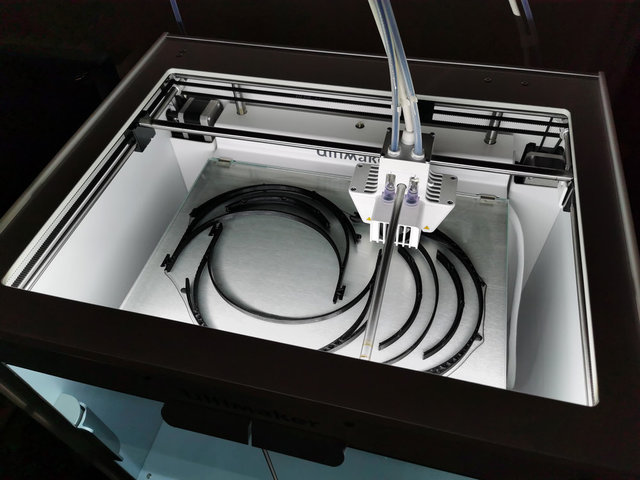
A member of the Ultimaker community 3D printing face shield brackets on an Ultimaker S5 3D printer. Image courtesy of DrCeeVee on the Ultimaker forums.
“What I’ve seen is that certain people start with material that is easy to print. They want fast results with PLA, but then they get feedback from people to make them more ergonomic,” Evers said. “They might change the shape. At some point you need to change more than just the shape. So, you can think of different kinds of materials. So, you saw people using TPU, a flexible, rubber-like material that bends around your head. But then, you might think about it from an ecological point of view. After a few hours of use of a face shield, it might get thrown away for medical safety reasons. So, people also began to explore antimicrobial filaments, with copper particles in it killing bacteria. And because of this open system, it’s really easy for users to experiment with different kinds of materials and see what’s best suitable for their application.”
Beyond Pandemics: Emergency 3D Printing in Business
Outside of the pandemic, desktop systems have been used in a crunch for what might be deemed a business emergency. See also: Best Budget 3D Printer Upgrades That Actually Impr…. Evers relayed an anecdote describing an operator from a long-time customer who took notice of the company’s Ultimaker printers and, when faced with the need for a critical part, was able to turn to 3D printing in a crunch. When a hook needed for automatically picking up boxes proved to be too short for a run, he designed a longer replacement in CAD and printed it on the fly so that, by the time the night shift took over the job, they had the right tool for the job.
“This was an emergency situation for the customer because the operation line was constantly stopping because it was jammed, since the wrong part was not really fulfilling its proper function,” Evers said.
Choosing the Right 3D Printer for Emergency Preparedness
When considering 3D printing for emergency preparedness, choosing the right equipment is crucial. Different printers offer varying capabilities that may be more or less suitable depending on your specific needs and budget.
| 3D Printer | Build Volume | Price Range | Best For Emergency Use | Reliability |
|---|---|---|---|---|
| Ultimaker S3 | 230 x 190 x 200 mm | $4,000+ | Professional-grade, dual extrusion, advanced materials | ⭐⭐⭐⭐⭐ Excellent |
| Prusa MK4 | 250 x 210 x 220 mm | $800-$1,000 | Open-source, self-repairable, reliable workhorse | ⭐⭐⭐⭐⭐ Excellent |
| Ender 3 V3 SE | 220 x 220 x 250 mm | $200-$250 | Budget-friendly, large community support, easy upgrades | ⭐⭐⭐ Good |
| Bambu Lab X1C | 256 x 256 x 256 mm | $1,200-$1,500 | Fastest prints, automated, enclosed for various materials | ⭐⭐⭐⭐ Very Good |
| Anycubic Kobra 2 | 250 x 250 x 250 mm | $300-$350 | Large build volume, fast, budget-friendly | ⭐⭐⭐ Good |
Understanding Limitations and Combining Technologies
There are, naturally, limitations with 3D printing. For instance, Z-axis strength for most technologies prevents the production of structurally critical parts. In both well-equipped local operations and a massive response to a global problem, such as the COVID-19 outbreak, multiple manufacturing technologies can be deployed to address supply needs. In the case of the pandemic, we saw laser cutters used to make the shields that would be attached to face mask brackets.
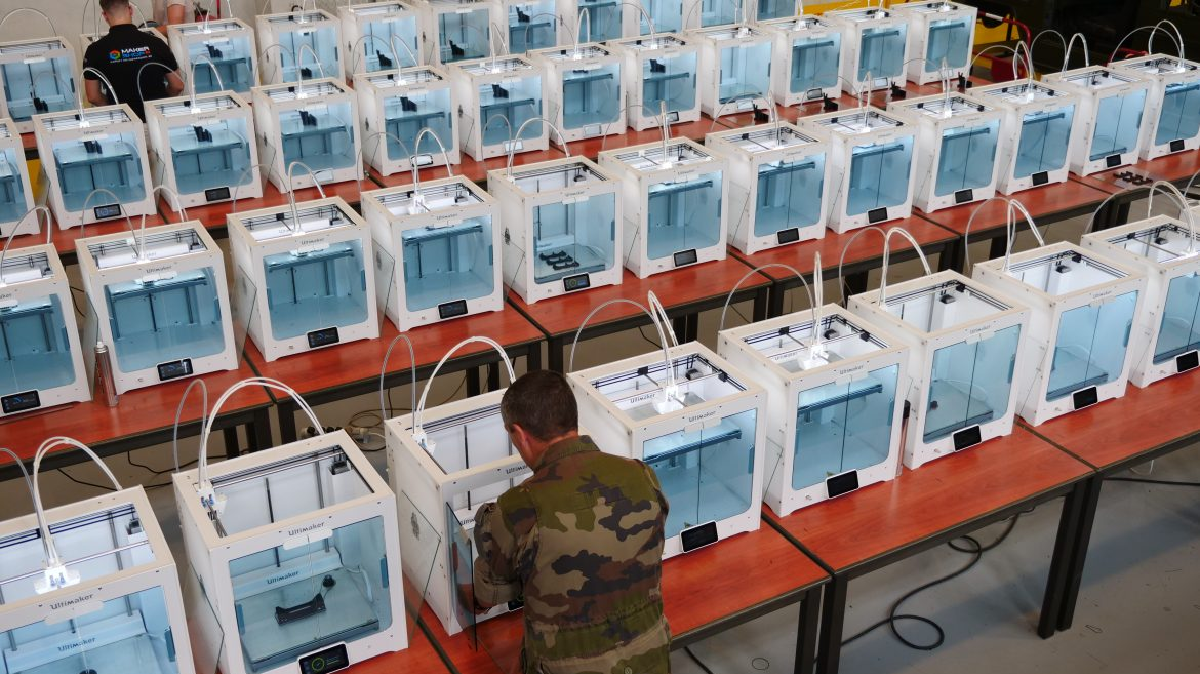
Amid the pandemic, the French Army established a 50-printer Ultimaker farm to 3D print spare parts.
In addition to emergencies, there are obviously numerous examples in which this is the case. 3D printing has been used in indirect production to make molds, jigs and fixtures, positives for investment casting or as end parts that become part of an assembly made with traditionally made components. Evers noted the possibilities of such strategies for emergency applications.
“I think in emergency situations you really need to be creative with the technology you have at hand. You can create molds and then, based on your requirements, you can cast it in metal or even in silicon. You can fill it with different kinds of additives to create better properties,” Evers said.
The Power of Open Source in Emergency Response
Particularly worth noting in the case of emergency production of parts is the proprietary nature of those items. As Michigan Technological University’s Joshua Pearce argues, in order to properly respond to an emergency such as the COVID-19 pandemic, it is necessary for companies to make their goods open source, thus enabling engineers and emergency responders to produce replicas on the fly.
“Open source is, of course, of great use during the emergency situations. If you’re not limited to the functionalities of the machine, you can upgrade certain parts,” Evers said. “If you need a bigger application, you can rebuild it. You change some parameters. Maybe you have the material, which you normally injection mold with pellets, but you want to use it for 3D printing, you could modify the printer in that way, as well.”
Essential Items to 3D Print for Emergency Preparedness
For preppers and those interested in emergency preparedness, having a list of printable items ready to go can make all the difference when disaster strikes. Based on real-world emergency response during the COVID-19 pandemic and other crisis situations, here are some of the most valuable items to consider:
Medical & Hygiene:
– Face shield brackets (proven effective during COVID-19)
– Respirator mask components
– Medical device holders and stands
– Antimicrobial door handles and touchpoints
– Splints and basic medical braces
– Hospital equipment replacement parts
Survival & Utility:
– Water filtration components
– Tool handles and replacement parts
– Container lids and caps
– Camping equipment replacements
– Fasteners, clips, and connectors
– Shelving and storage solutions
Communication & Power:
– Phone stands and chargers
– Battery holders
– Cable management solutions
– Antenna mounts and brackets
– Protective cases for electronics
Building Your Emergency 3D Printing Library
Start by downloading and organizing STL files for critical items before you need them. Platforms like Printables, Thingiverse, and MakerWorld offer thousands of emergency-ready designs. Store these locally on external drives and consider keeping backup copies in the cloud. Remember that during an emergency, internet access may be limited or unavailable, so having offline access to your 3D model library is essential.
Additionally, maintain a stock of essential filaments suitable for emergency use. Keep at least 5-10 kg of PLA for rapid prototyping, plus specialized materials like PETG for durability and TPU for flexible applications. Antimicrobial filaments, while more expensive, can be invaluable for medical and hygiene-related emergency items.
FAQ: Emergency 3D Printing for Preppers
1. Can I really print useful items with a desktop 3D printer during an emergency?
Yes. During the COVID-19 pandemic, thousands of people worldwide printed face shields, ventilator components, and medical supplies using desktop 3D printers. The key is having ready-to-print files and appropriate materials. While you won’t print complex machinery, you can produce many practical items that address immediate needs when supply chains are disrupted.
2. What’s the best filament for emergency 3D printing?
PLA is the best starting point due to its ease of use and fast print speeds. However, for more durable applications, PETG offers better strength and chemical resistance. For flexible items like comfortable face mask components, TPU is ideal. Keep a variety of filaments on hand, including antimicrobial options for medical-related applications.
3. How much filament should I store for emergency preparedness?
A minimum of 5-10 kg is a good starting point. Focus on PLA (60%), PETG (25%), and specialty filaments like TPU or antimicrobial (15%). This provides enough material for hundreds of small items like face shield brackets or dozens of larger items like tool parts. Rotate your stock annually to ensure filament freshness.
4. Do I need an expensive 3D printer for emergency use?
No. While professional machines like the Ultimaker S3 offer advanced features, reliable budget options like the Prusa MK4 ($800) or Ender 3 series ($200) can produce functional emergency items. The most important factors are reliability, ease of repair, and having spare parts on hand. Open-source printers are particularly valuable as they’re easier to modify and fix yourself.
5. What items should I have ready to print before an emergency happens?
Prioritize items with proven emergency utility: face shield brackets, simple tools, replacement parts for critical household systems, and medical device accessories. Download STL files from reliable sources and test-print them to ensure they work. Keep a curated library of these files offline on multiple storage devices. Consider joining emergency 3D printing communities to share designs and knowledge.
6. Can 3D printing replace traditional manufacturing during emergencies?
Not entirely. 3D printing excels at rapid prototyping and producing low-volume, customized parts quickly. However, for mass production of standardized items, traditional manufacturing remains more efficient. The best approach combines technologies—using laser cutters for flat parts, injection molding for high volumes, and 3D printing for rapid iteration and custom components. Understanding when to use each technology is key to effective emergency response.
7. How do I ensure my 3D printer is ready when I need it?
Practice regularly to maintain your skills and keep your printer in good working condition. Store spare parts like nozzles, belts, and hotend components. Keep your firmware updated and maintain a printed copy of calibration and troubleshooting procedures. Consider having a backup power solution and ensure your filament storage is climate-controlled to prevent degradation.
The post 3D Printing for Preppers: Ultimaker on Emergency 3D Printing appeared first on 3DPrint.com | The Voice of 3D Printing / Additive Manufacturing.
from 3DPrint.com | The Voice of 3D Printing / Additive Manufacturing https://bit.ly/3jZEadE
📌 Related Articles
- Best Budget 3D Printer Upgrades That Actually Improve Print Quality: Belts, Springs, Hotends & More
- Best 3D Printer Upgrades That Actually Improve Print Quality: Complete 2026 Guide
- 3D Printing Safety Equipment Guide: Respirators, Gloves, and Ventilation for 2026
- ABS 3D Printing Settings Guide: Temperature, Enclosure, and Cooling for Strong Parts
- Creality Creality Ender 3 V3 Plus vs Creality Ender 3 Pro: Full Specs Comparison & Buyer’s Guide