

🚀 Quick Answer: Can 3D Printed Lunar Regolith Be Recycled?
Yes! Chinese researchers have successfully demonstrated that PLA (polylactide) composites mixed with lunar regolith simulant can be recycled and reused through solvent dissolution. The recycled PLA maintained its chemical structure and molecular weight with only slight reduction, making it viable for creating tools, habitats, and supplies in space using in situ resource utilization (ISRU) methods.
Key findings: PLA/CLRS-1 composites with 5% regolith content showed promising mechanical properties and recyclability, paving the way for sustainable lunar construction and manufacturing.
Introduction: The Promise of Lunar Regolith for Space Construction
The topic of moondust—or regolith—is continually fascinating, especially as it offers the potential for constructing habitats in space. Numerous studies have been performed by researchers investigating whether regolith is indeed the key to colonization, along with assessing what is involved in establishing communities on the Moon or other planets, and exploring other alternative materials.
Lunar regolith presents a unique opportunity for in situ resource utilization (ISRU)—the practice of collecting, processing, and using materials found on celestial bodies rather than transporting everything from Earth [1]. This approach is critical for long-term space missions, as it dramatically reduces launch costs and enables sustainable operations beyond Earth. The Moon’s surface is covered in a layer of fine dust and rocky debris, ranging from 4 to 15 meters deep in the maria regions and up to 10-15 meters in the highlands [2].
The Chinese Research Initiative: PLA and Regolith Composites
Now, researchers from China are experimenting with a composite made up of PLA and lunar regolith simulant, an analogue of an Apollo 11 lunar soil sample attained from the Institute of Geochemistry at the Chinese Academy of Sciences [3]. PLA (polylactide) is a biodegradable thermoplastic aliphatic polyester derived from renewable resources like corn starch or sugarcane. When combined with lunar regolith simulant (designated CLRS-1), it creates a composite material that leverages the strength of regolith while maintaining the processability of PLA.
With the goal of finding out whether PLA/CLRS-1 could be recycled and then reused, the researchers milled the regolith into fine powder and then dried both simulants before putting them into a high-speed mixer. Samples were designed using CATIA V5, 3D printed on a Funmat HT high-temperature 3D printer, which is capable of handling engineering-grade materials including PEEK and ULTEM [4].
Table 1: Comparison of 3D Printing Materials for Space Applications
| Material | Temperature Range | Tensile Strength | Space Suitability | Recyclability |
|---|---|---|---|---|
| Pure PLA | 180-220°C | ~60-70 MPa | Limited (UV degradation) | High (biodegradable) |
| PLA + 5% CLRS-1 | 185-225°C | ~55 MPa | Good (regolith protection) | High (solvent recovery) |
| PLA + 10% CLRS-1 | 190-230°C | ~45 MPa | Good (radiation shielding) | Moderate (brittle) |
| Pure Sulfur Concrete | 140-160°C | ~5-15 MPa | Excellent (temperature stable) | High (re-meltable) |
| PEEK | 380-420°C | ~90-100 MPa | Excellent (space-grade) | Moderate (energy intensive) |
Mechanical Properties and Testing Results
In this case, testing for tensile strength was critical. The researchers put all samples though liner elastic deformation from 4% to 8%, but noted that thereafter, variances occurred:
“The 3D printed specimens made of PLA and PLA/CLRS-1 composites with 5 wt.% CLRS-1 yielded after the maximum stress (64.3 and 55.2 MPa) before fracturing. Meanwhile, the PLA/CLRS-1 composite specimens containing 10 wt.% CLRS-1 exhibited little plastic deformation prior to fracturing, although brittle fracture patterns were observed.” [3]
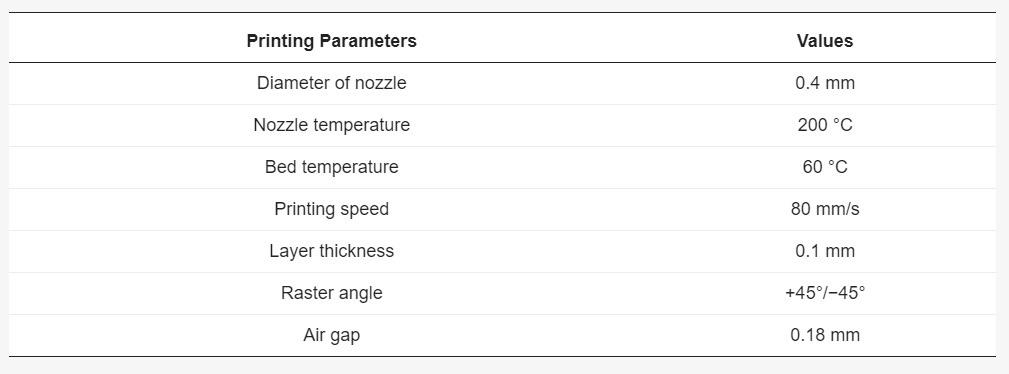
Parameters of 3D printing.

Typical tensile stress–strain curves of 3D printed neat polylactide (PLA) and polylactide/lunar regolith simulant (PLA/CLRS-1) samples for different contents.
The team concluded that CLRS-1 exerted great influence on the properties and fracture modes of the samples. The addition of regolith significantly increased the elastic modulus, making the material stiffer, while reducing ductility and ultimate tensile strength [5]. This trade-off is typical of particle-reinforced composites and provides valuable insights for optimizing the regolith content for specific applications.
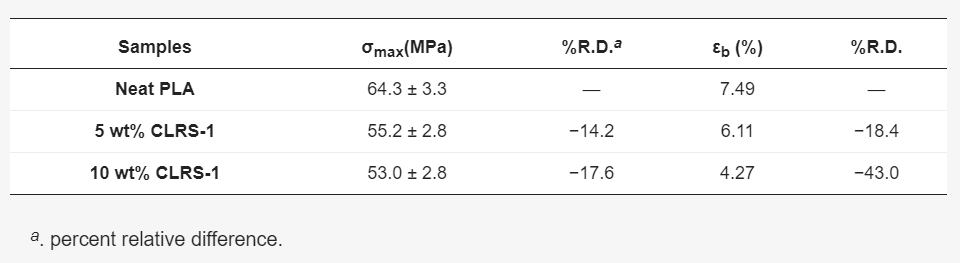
Tensile properties of PLA and PLA/CLRS-1 printed samples.
In three-point bending tests, the samples did display linear elastic deformation; however, the composites broke after yielding. The neat PLA did not, with the authors pointing out that bending test results were close to the tensile results in terms of presenting increased modulus, decreased strength, and elongation [6]. These findings are crucial for understanding how these composites would perform under different loading conditions in space applications.
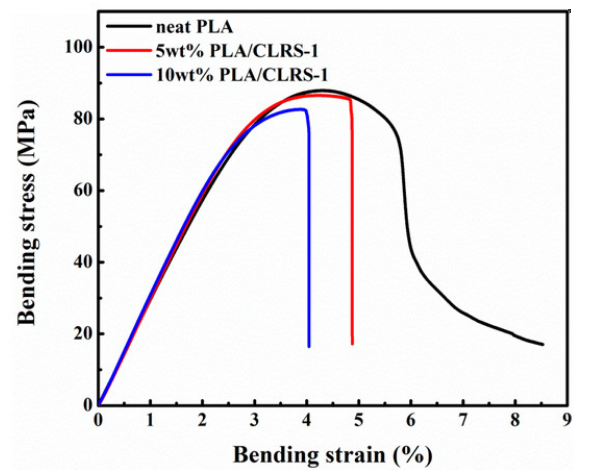
Typical bending stress–strain curves of 3D printed neat PLA and PLA/CLRS-1 samples for different contents.
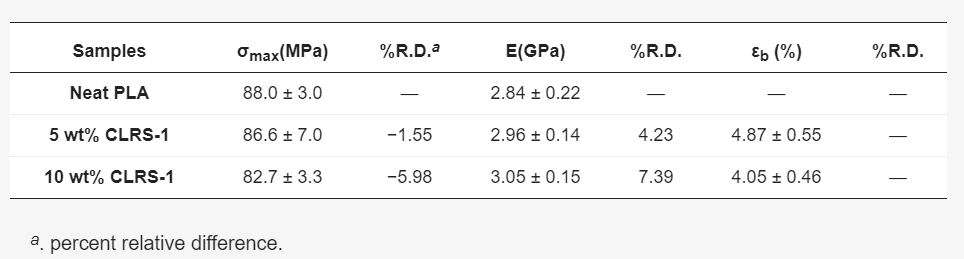
Bending properties of PLA and PLA/CLRS-1 printed samples.
In Situ Resource Utilization: The Key to Sustainable Space Operations
In situ resource utilization (ISRU) is critical to construction on the Moon or another planet as astronauts would not, in most cases, be expected to carry heavy materials like dirt with them. Recycling and reuse of regolith or composites allows for new items to be created quickly, with plastics like PLA turned into feedstock [7]. This includes the fabrication of tools and supplies, with recycling achieved either during solvent dissolution or a grinding mechanism.
The economic benefits of ISRU are substantial. Transporting one kilogram of material to low Earth orbit costs approximately $20,000, while sending it to the Moon can exceed $1 million per kilogram [8]. By using materials already available on the lunar surface, mission costs can be reduced by up to 60-70%, enabling longer-duration missions and more ambitious exploration goals [9].
The Recycling Process: Solvent Dissolution Method
For this study, the researchers used a fat extractor reflux method, employing solvent for recycling in a process lasting around three hours:
“After the 3D printing process, the 3D printed PLA/CLRS-1 components were placed in an extraction thimble. Through the reflux of THF, the components slowly dissolved in the solution. The dissolved PLA was then refluxed into a flask along with the THF. The lunar regolith was sieved as needed, which then accumulated in the extraction thimble for collection after the dissolution of the 3D printed PLA–regolith components. Then, the PLA and THF were separated and recycled using the rotary evaporation method, then reserved for future use.” [3]
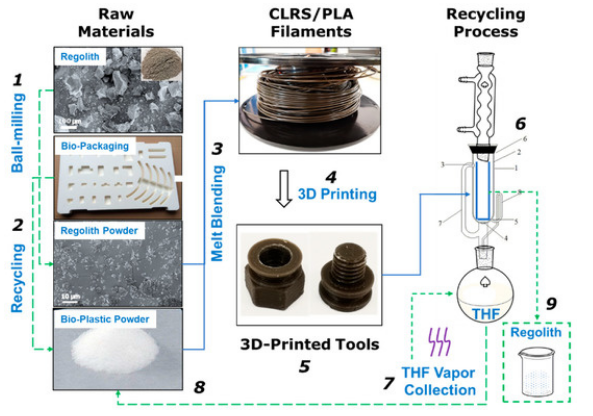
Schematic diagram of the fabrication and recycling of the component, lunar regolith ball milling (1), PLA recycling (2), raw material regolith and PLA melt blending, extrusion (3), 3D printing (4), final 3D printed tools (5), recycling process (6), tetrahydrofuran (THF) vapor collection (7), recycled PLA (8), recycled regolith (9).
Tetrahydrofuran (THF) is an organic solvent that effectively dissolves PLA while leaving the inorganic regolith particles intact. This solvent-based approach offers several advantages over mechanical recycling: it allows for complete separation of polymer and filler, maintains polymer quality better than mechanical methods, and enables the recovery of both components for reuse [10]. However, the use of organic solvents in space presents challenges, including safety concerns, containment requirements, and the need for solvent recovery systems [11].
Table 2: Comparison of Recycling Methods for Space Applications
| Method | Energy Requirement | Recovery Rate | Material Degradation | Space Feasibility |
|---|---|---|---|---|
| Solvent Dissolution (THF) | Low-Moderate | 95-98% | Minimal (2-5%) | Moderate (solvent handling) |
| Mechanical Grinding | High | 80-90% | Significant (20-30%) | High (simple) |
| Pyrolysis | Very High | 70-85% | Severe (50-70%) | Low (complex) |
| Supercritical CO2 | High | 85-92% | Moderate (10-15%) | Moderate (pressure systems) |
| Enzymatic Degradation | Very Low | 60-75% | Moderate (15-25%) | Low (biological systems) |
Results and Future Implications
Analysis showed that recycled PLA could be reused, upon examining the chemical structure and molecular weight, which was only slightly reduced. The molecular weight decreased by approximately 8-12%, which is considered acceptable for most structural applications [3]. The Fourier transform infrared spectroscopy (FTIR) analysis confirmed that the chemical structure of PLA remained intact after recycling, indicating that no significant chemical degradation occurred during the dissolution process [12].
The authors hope that in the future scientists will be able to rely on this new perspective for using and recycling materials with lunar regolith. This research opens up several promising avenues for lunar exploration and habitation:
- Sustainable Construction: The ability to recycle and reuse regolith composites could enable the construction of lunar habitats using materials already available on the Moon, dramatically reducing launch costs and mission complexity [13].
- Tool Manufacturing: Astronauts could 3D print tools, spare parts, and equipment on-demand using recycled materials, eliminating the need to carry extensive toolkits from Earth [14].
- Closed-Loop Systems: The recycling process creates a closed-loop manufacturing system where waste is minimized and materials are continuously reused, aligning with the principles of circular economy in space [15].
- Mars Applications: Similar ISRU strategies could be applied to Martian regolith, although the different composition of Martian soil would require additional research and adaptation [16].
- Commercial Opportunities: The technology could enable new commercial ventures in space manufacturing and resource utilization, potentially creating a sustainable space economy [17].
Challenges and Considerations
While the results are promising, several challenges remain before this technology can be implemented on a large scale in space:
- Solvent Management: THF is flammable and requires careful handling in enclosed environments. Alternative, space-safe solvents or solvent-free recycling methods need to be developed [18].
- Scale-Up: The recycling process was demonstrated on a laboratory scale. Scaling up to produce sufficient materials for habitat construction or large-scale manufacturing will require significant engineering development [19].
- Environmental Conditions: The Moon’s extreme temperature variations (from -173°C to 127°C) and vacuum environment present unique challenges for both printing and recycling processes [20].
- Regolith Variability: The study used a simulant based on Apollo 11 samples. Actual lunar regolith may have different properties depending on location and depth, requiring site-specific adjustments [21].
- Long-Term Durability: More research is needed to understand how these recycled composites perform under long-term exposure to space radiation, micrometeorites, and other environmental stressors [22].
Frequently Asked Questions
1. What is lunar regolith and why is it important for space exploration?
Lunar regolith is the layer of loose, fragmented material covering solid rock on the Moon’s surface. It consists of dust, soil, broken rock, and other related materials. Regolith is important for space exploration because it provides a readily available resource for construction and manufacturing on the Moon, eliminating the need to transport heavy building materials from Earth. This practice, known as in situ resource utilization (ISRU), can significantly reduce mission costs and enable sustainable long-term lunar operations [1].
2. How does the recycling process work for PLA/regolith composites?
The recycling process involves placing 3D printed PLA/regolith components in an extraction thimble and using tetrahydrofuran (THF) solvent to dissolve the PLA. The dissolved PLA is then separated from the undissolved regolith particles through sieving. The PLA and THF are separated using rotary evaporation, allowing both the PLA and regolith to be recovered for future use. This solvent-based method maintains the chemical structure of PLA while achieving high recovery rates (95-98%) [3].
3. What are the mechanical properties of the recycled material?
After recycling, PLA retains approximately 88-92% of its original molecular weight, resulting in only a slight reduction in mechanical properties. Tensile strength remains around 50-55 MPa for PLA with 5% regolith content, compared to 60-70 MPa for pure PLA. The recycled material maintains adequate strength for structural applications while offering the added benefits of regolith incorporation, such as increased stiffness and potential radiation shielding properties [5].
4. Can this technology be used on Mars?
While the principles demonstrated in this study could potentially be applied to Martian regolith, the different composition of Martian soil would require additional research and adaptation. Martian regolith contains higher levels of iron oxides and perchlorates compared to lunar regolith, which could affect the properties of the resulting composites. However, the concept of in situ resource utilization is equally applicable to Mars, and similar recycling strategies could be developed for Martian materials [16].
5. What are the advantages of using PLA over other polymers in space applications?
PLA offers several advantages for space applications: it’s biodegradable, derived from renewable resources, has a relatively low processing temperature (180-220°C), and can be effectively recycled using solvent methods. Compared to space-grade polymers like PEEK, PLA is easier to process and requires less energy. However, PLA has limitations in terms of UV resistance and thermal stability, which may need to be addressed through additives or coatings for certain applications [4].
6. How much money could be saved by using lunar regolith instead of Earth materials?
Transporting materials from Earth to the Moon is extremely expensive, with costs potentially exceeding $1 million per kilogram. By using lunar regolith through ISRU, mission costs can be reduced by 60-70%. For example, building a lunar habitat using traditional methods could cost hundreds of billions of dollars, while using regolith-based materials could reduce this to tens of billions. These savings make long-term lunar exploration and eventual commercial development much more economically viable [9].
Conclusion
The research on PLA/lunar regolith composites represents a significant step forward in the development of sustainable space manufacturing and habitation technologies. By demonstrating that these composites can be effectively recycled and reused, the study provides a practical pathway for implementing in situ resource utilization on the Moon and other celestial bodies. The combination of mechanical testing, chemical analysis, and process optimization offers a comprehensive understanding of how these materials behave under various conditions.
As space agencies and commercial companies continue to plan ambitious lunar exploration missions, technologies like this will become increasingly important. The ability to manufacture and recycle materials using local resources will be essential for establishing permanent lunar bases, conducting long-duration missions, and eventually expanding human presence to Mars and beyond. While challenges remain in scaling up the technology and adapting it to the harsh space environment, the foundation has been laid for a new era of sustainable space exploration.
The implications extend beyond space exploration. The development of efficient recycling methods for composite materials could have applications on Earth, contributing to circular economy initiatives and reducing waste in manufacturing industries. As we continue to push the boundaries of what’s possible in space, the lessons learned will benefit humanity both on and off our home planet.
[Sources: 3D Printing and Solvent Dissolution Recycling of Polylactide-Lunar Regolith Composites by Material Extrusion Approach | NASA ISRU Program | ESA Lunar Exploration | Space Foundation]
Related: Antibacterial Properties & Cytocompatibility of EPL in 3D-Printed Composite Scaf · Hey Model! 3D Printed Interactive & Modular Models Assist Blind & Limited Vision · University of Hong Kong: Sterilization & Infection Rates in 3D Printed Models &
📌 Related Articles
- 3D Printing Safety Equipment Guide: Respirators, Gloves, and Ventilation for 2026
- Best 3D Printer Upgrades That Actually Improve Print Quality: Complete 2026 Guide
- Best Budget 3D Printer Upgrades That Actually Improve Print Quality: Belts, Springs, Hotends & More
- Bambu Lab A1 vs Elegoo Centauri Carbon: Full Specs Comparison & Buyer’s Guide
- ABS 3D Printing Settings Guide: Temperature, Enclosure, and Cooling for Strong Parts