
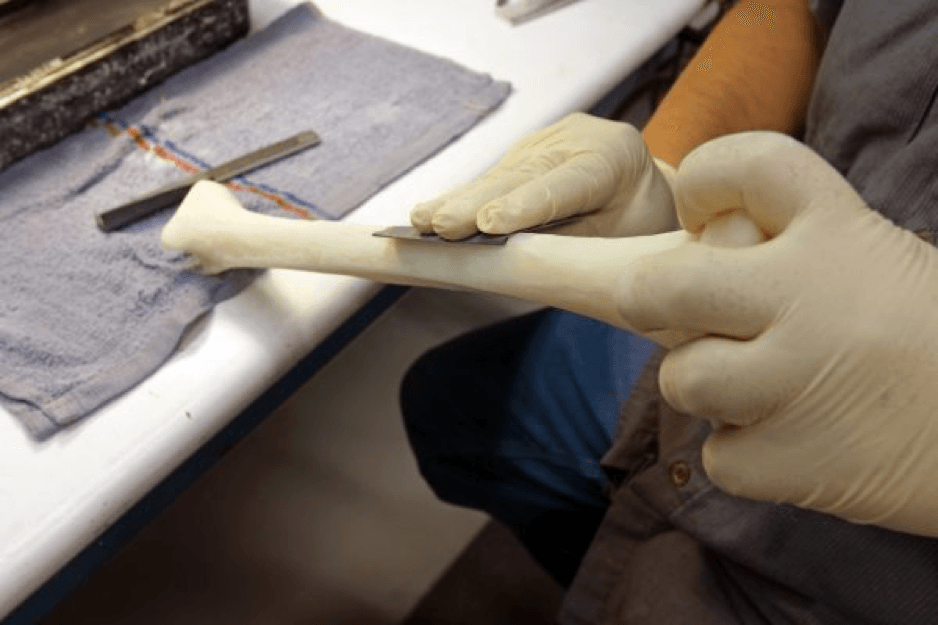
The tibia, which is the frontal of the two leg bones below the knee, is also referred to as the shinbone, or shankbone, and connects the knee to the ankle bones. Next to the femur, it’s the second largest bone in the body, and as the legs support the rest of the body, the leg bones are our strongest long bones. So, when a medical issue arises that’s related to the tibia, you want to get it fixed fast.
The State of Metal 3D Printing
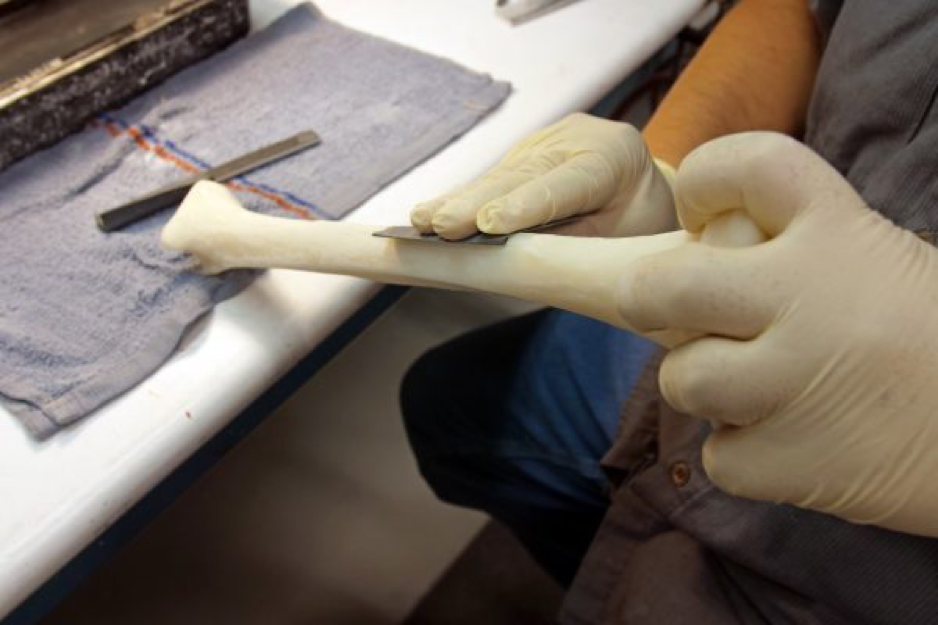
3D-printed tibia using SLA technology (Image: Dinsmore Inc.)
Recently, an 18-year-old girl in India received a disc-shaped 3D-printed titanium implant to repair her tibia. Research has shown that 3D technology can make a positive difference when it comes to planning for and fixing tibial injuries, and while we’ve certainly seen a 3D-printed tibia before, this young woman was the first person in the state of Karnataka, located in the southwest region of India, to receive a 3D-printed shinbone.
Dr. Deepak Shivarathre, the chief of ortho oncology at Hosmat Hospital, explained, “The woman came to the hospital on May 12 with a tumour in the knee.”
Technical Challenges and Solutions
In the making of traditional medical implants, doctors will often fabricate bone grafts using an imported, off-the-shelf implant, or even make one from the cartilage of a cadaver. But as these are not patient-specific devices, they lack customization, which means they not be a perfect fit—thus causing a longer healing process.
 That’s why the surgeons at Hosmat Hospital contacted the Peenya, India office of 3D printing service bureau Supercraft3D, which is headquartered in Singapore and focuses on applications in the healthcare and medical sectors.
“Currently the company is focused in providing medical models for variety of end users such as surgeons, educational institutes, patients undergoing CMF procedures, diagnostic centers among others, which helps in precise planning of surgical procedures,” Supercraft3D’s website states.
Material Properties and Performance
”The company is extensively involved with medical institutions in both Singapore & India in exploring new materials that could mimic tissue and flesh features to overcome the limitations of current cadaver based learning. In addition we work with some of the globally recognized institutions in metal 3D printing for regulatory approved implants and medical devices.”
Supercraft3D fabricated a medical model of the shinbone for pre-surgical planning purposes, as well as the titanium implant, which cost Rs 30,000 (USD$398). It took about 40 hours of 3D printing time to complete both the implant and the tibia model. Dr. Shivarathre said that the implant features porous contours, and was 3D printed to match the teenage patient’s contours perfectly:
“A part of the tibia was lost to the tumour and was replaced by the 3D-printed titanium implant. This was supported by a 7 cm 3d-printed titanium metal implant too.”
Industrial Applications and Use Cases
The 3D-printed shinbone model was important in helping the surgeons at Hosmat Hospital better understand the patient’s specific anatomy; specifically, the tumor had left a hole in her knee, and the 3D-printed implant was tailored so that it completely filled up the hole.
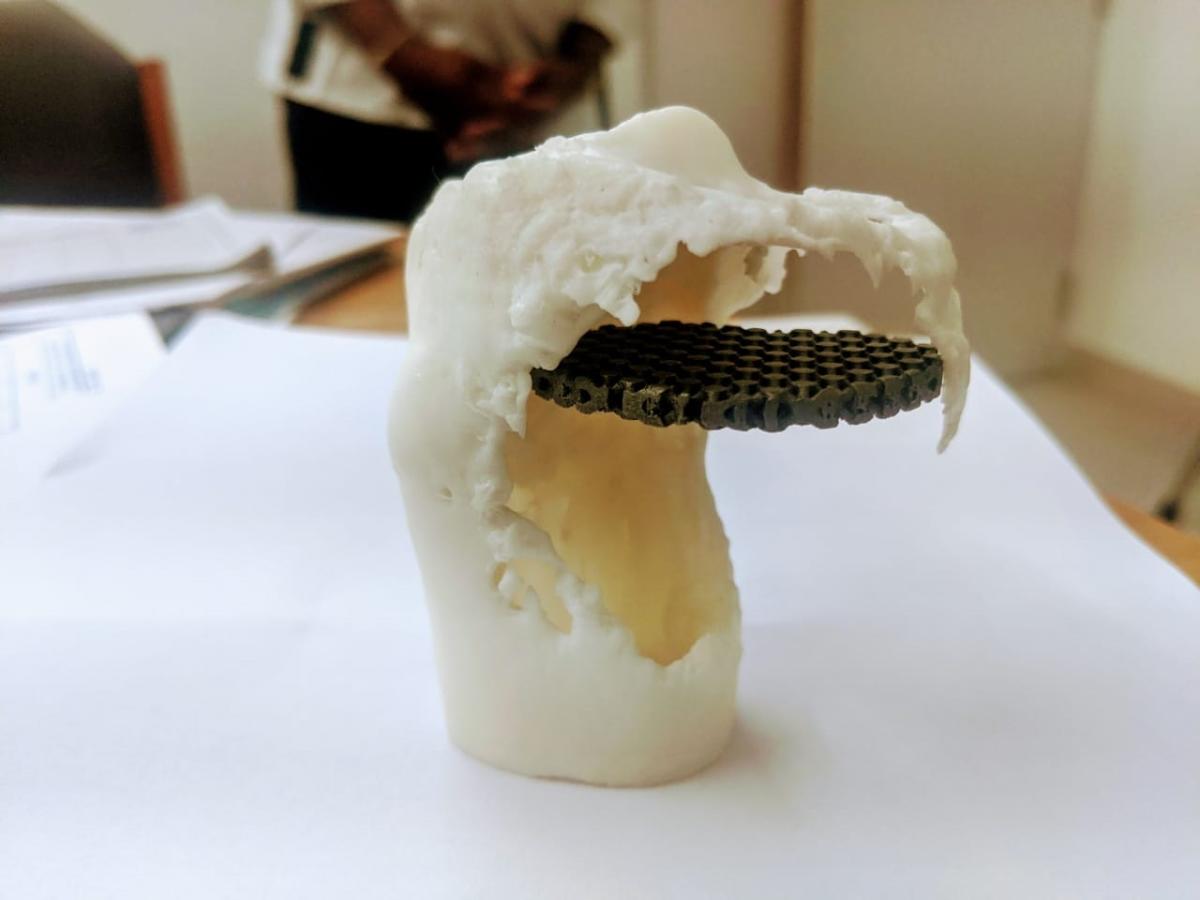
“We did the surgery on May 19 to fix the 3D-printed titanium disc in the tibia to support the native cartilage of the knee joint,” Dr. Shivarathre said. “The reconstruction wouldn’t be mechanically strong or reliable in the traditional bone graft from cadavers or the patient’s own bone.”
Comparing Metal AM to Traditional Manufacturing
The surgeons chose to go the 3D-printed route because they would have been unable to tailor an off-the-shelf version to fit this specific patient’s knee. See also: Best 3D Printer Upgrades That Actually Improve Pri…. However, they are also quick to state that the technology should not be used in every case.
“But the 3D implants aren’t for routine cases. It is only for complex cases where standard implants can’t fulfill the patient’s needs,” Dr. Shivarathre noted.
Future Developments in Metal Additive Manufacturing
What do you think? Discuss this story and other 3D printing topics at 3DPrintBoard.com or share your thoughts in the Facebook comments below.
(Source: Deccan Herald)
The post 18-Year-Old in India Receives 3D-Printed Shinbone Implant appeared first on 3DPrint.com | The Voice of 3D Printing / Additive Manufacturing.
The State of Metal 3D Printing
from Your daily news from 3DPrint.com https://bit.ly/3cv7AMo
Related Articles
Frequently Asked Questions
What is metal 3D printing?
Metal 3D printing (additive manufacturing) builds metal parts layer by layer using techniques like laser powder bed fusion, directed energy deposition, and binder jetting. It enables complex geometries impossible with traditional manufacturing while reducing material waste significantly.
How strong are 3D printed metal parts?
3D printed metal parts can achieve mechanical properties comparable to traditionally manufactured metals. Tensile strength and fatigue resistance depend on the process and post-processing, but many meet or exceed ASTM standards for wrought materials.
What are the main metal 3D printing technologies?
The primary technologies include Laser Powder Bed Fusion (LPBF), Electron Beam Melting (EBM), Directed Energy Deposition (DED), Binder Jetting, and Metal FDM (with bound filaments). Each has different strengths in terms of resolution, speed, and material options.
📌 Related Articles
- The Current State of Metal 3D Printing in 2020
- Best 3D Printer Upgrades That Actually Improve Print Quality: Complete 2026 Guide
- The Ultimate Guide to 3D Printer Calibration: Complete Step-by-Step Manual
- 3D Printing Tungsten Carbide: How Hot-Wire Laser Technology Creates Metal Harder Than Steel
- ABS 3D Printing Settings Guide: Temperature, Enclosure, and Cooling for Strong Parts