
Frequently Asked Questions
What is ucsd researchers 3d print shape-shifting liquid crystal elastomers?
Quick Answer: What Are Liquid Crystal Elastomers (LCEs) and Why Do They Matter. This topic is increasingly relevant in the 3D printing community as the technology continues to advance and become more accessible to hobbyists and professionals alike.
Disclosure: As an Amazon Associate, 3dput.com earns from qualifying purchases. This supports our independent testing and reviews.
How does this relate to 3D printing?
This topic is directly connected to additive manufacturing and 3D printing technology. Understanding these concepts helps improve print quality, expand capabilities, and explore new applications for desktop and industrial 3D printing.
What are the practical applications?
The practical applications span from rapid prototyping and custom manufacturing to educational projects and functional parts production. These techniques can be applied with most consumer-grade and professional 3D printers available today.
Quick Answer: What Are Liquid Crystal Elastomers (LCEs) and Why Do They Matter?
Liquid Crystal Elastomers (LCEs) are smart materials that can change shape and stiffness when exposed to heat or light, making them ideal for artificial muscles, soft robots, and wearable devices. UCSD researchers led by Zijun Wang and Professor Shengqiang Cai developed a breakthrough 3D printing method using direct ink writing (DIW) to create “functionally graded” LCEs—materials with different properties in different regions of the same structure. By controlling printing parameters like temperature, nozzle size, and print speed, they can precisely tune actuation behavior, enabling complex shape-shifting structures that contract, expand, or bend on demand. This research, published in Science Advances (DOI: 10.1126/sciadv.abc0034), solves a critical challenge in manufacturing programmable materials for soft robotics and bio-inspired devices.
A team of materials science and engineering researchers from UC San Diego (UCSD) closely studied the qualities of liquid crystal elastomers, or LCEs, in order to figure out how to make shape-shifting 3D printed structures out of the material. The results will lead to easier shape control, and manufacturing, of things like artificial muscles, soft robots, and wearable devices. Their inspiration for a material featuring varying degrees of actuation (ability to contract and degree of stiffness) came from real-life examples in the world around us, such as a squid’s beak, which is really stiff at the tip but more malleable and soft where it connects to the cephalopod’s mouth.
The team—Zijun Wang, Zhijian Wang, Yue Zheng, Qiguang He, Yang Wang, and Shengqiang Cai—published a paper about their research, titled “Three-dimensional printing of functionally graded liquid crystal elastomer,” in the journal Science Advances.
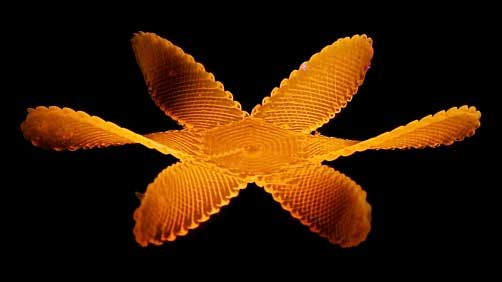
Researchers 3D printed structures made of two layers of LCE with different properties and showed that this gave the material even more degrees of freedom to actuate.
The abstract states, “As a promising actuating material, liquid crystal elastomer (LCE) has been intensively explored in building diverse active structures and devices. Recently, direct ink writing technique has been developed to print LCE structures with various geometries and actuation behaviors. Despite advancement in printing LCE, it remains challenging to print three-dimensional (3D) LCE structures with graded properties. Here, we report a facile method to tailor both actuation behavior and mechanical properties of printed LCE filaments by varying printing parameters. On the basis of the comprehensive processing-structure-property relationship, we propose a simple strategy to print functionally graded LCEs, which greatly increases the design space for creating active morphing structures.”
Understanding Liquid Crystal Elastomers
Liquid Crystal Elastomers (LCEs) represent a remarkable class of smart materials that combine the ordered molecular structure of liquid crystals with the elastic properties of rubber-like polymers. This unique combination gives LCEs their signature ability to undergo large, reversible shape changes—typically 20-400% strain—when triggered by external stimuli such as heat, light, or electric fields. The liquid crystal mesogens (rod-like molecules) align during processing and create anisotropic properties, meaning the material behaves differently along different directions.
When heated above their phase transition temperature (typically 40-100°C depending on composition), the liquid crystal domains lose their orientation, causing the material to contract along the alignment axis. Upon cooling, the liquid crystal domains re-align, causing the material to expand. This reversible shape change can be cycled thousands of times without significant degradation, making LCEs ideal for applications requiring repeated actuation like artificial muscles, soft robotic grippers, and adaptive optics.
The key advantage of LCEs over traditional shape-memory alloys or polymers is their exceptional strain capabilities and energy density. While shape-memory polymers might achieve 100-200% strain, LCEs can exceed 400% in some formulations, producing more forceful movements with less mass. This makes them particularly attractive for bio-inspired robots that need to match the performance of natural muscles like octopus tentacles or elephant trunks.
The UCSD Breakthrough: Functional Grading
The core innovation of the UCSD research is the concept of “functional grading”—creating LCE structures with spatially varying properties. Instead of printing a homogeneous material with uniform behavior throughout, researchers found they could control local actuation characteristics by adjusting printing parameters during the printing process.
Key Discovery: Core-Shell Structure Formation
Both a core and a shell make up 3D printed LCE filaments. In learning how to control its material properties, researchers discovered a critical phenomenon: post-print, the shell stiffens and cools down quickly, but it takes longer for the core to cool, so it remained pliant for longer periods of time. This temperature gradient creates different mechanical behaviors in different regions of the same filament, enabling functionally graded properties without changing the material composition.
By manipulating the printing temperature, researchers could control how quickly the shell forms and solidifies versus the core. Higher printing temperatures lead to faster shell formation and more pronounced property gradients, while lower temperatures allow more uniform cooling. This discovery provided the foundation for creating LCE structures with complex, programmable actuation behaviors.
Printing Parameters and Their Effects
The research systematically investigated how different printing parameters influence the final properties of LCE structures:
| Parameter | Effect on LCE Properties | Practical Implications |
|---|---|---|
| Printing Temperature | Higher temperature = higher flexibility, increased actuation strain | Enables tuning of contraction strength and range |
| Nozzle Diameter (d) | Smaller nozzle = finer features, more precise control | Affects resolution and alignment of liquid crystal domains |
| Print Speed (V) | Slower speed = better alignment, higher anisotropy | Controls mesogen orientation and final actuation direction |
| Nozzle-to-Plate Distance (h) | Optimal distance = consistent filament deposition | Ensures uniform material properties along print path |
| Layer Height | Thinner layers = smoother surfaces, less warping | Affects final surface quality and dimensional accuracy |
Wang, the paper’s first author and a PhD student in Cai’s research group, explained, “3D-printing is a great tool to make so many different things–and it’s even better now that we can print structures that can contract and stiffen as desired under a certain stimuli, in this case, heat.”
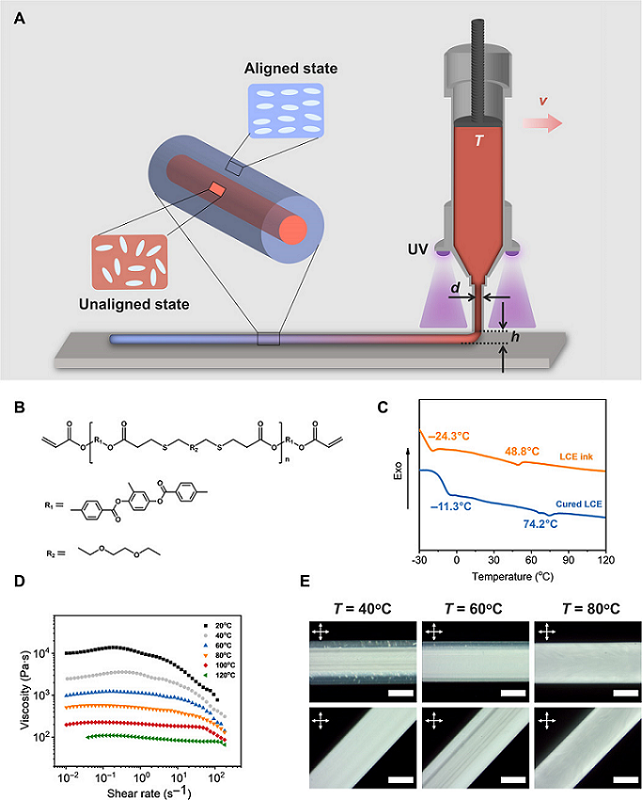
DIW printing of LCE with tailorable thermomechanical properties. (A) Schematic of DIW printing setup of LCE. The LCE ink is heated up to temperature T and extruded out of nozzle with an inner diameter d. The nozzle tip moves at a speed of V during printing, and distance between the nozzle tip and build plate is h. Because of the shear stress generated through extrusion, liquid crystal mesogens are initially aligned along the print path. After a period of time, the extruded LCE filament cools down to room temperature and a core-shell structure forms inside. The outer shell cools down much faster than the inner core. As a result, well-aligned liquid crystal mesogens in the outer shell are temporarily fixed by high material viscosity, while mesogens have enough time to reorientate to a polydomain state in the inner core. (B) Molecular structure of uncrosslinked liquid crystal oligomer in the ink. (C) DSC traces of LCE ink and cured LCE. (D) Viscosity of ink as a function of shear rate at different temperatures. (E) Polarized optical microscope (POM) images of LCE filaments printed at different temperatures. Scale bars, 0.5 mm.
The point is, researchers figured out that LCE’s degree of actuation could be easily controlled through print temperature, and that by exposing the material to heat, they could also control the stiffness of various areas in the same material. So by changing print parameters, especially temperature, they were able to tune the material’s mechanical properties: higher printing temperature, higher flexibility of LCE.
“By controlling printing parameters, such as printing temperature, nozzle size, and distance between the nozzle and build plate, we can print LCE filaments with tailorable properties including actuation strain, actuation stress, and mechanical stiffness,” researchers wrote.
Demonstrations and Proof of Concept
The UCSD team conducted several demonstrations to showcase their functional grading approach:
Bilayer Petal Structures
They used direct ink writing (DIW) to print an LCE disk at 104°F, and then placed it in hot water, which heated the disk up to 194°F and shifted it into a conical shape. Researchers found that when heating up an LCE disk that included areas printed at different temperatures, it would deform in a different shape. By creating bilayer structures with different properties in each layer, they could achieve complex, programmable morphologies when immersed in hot water.
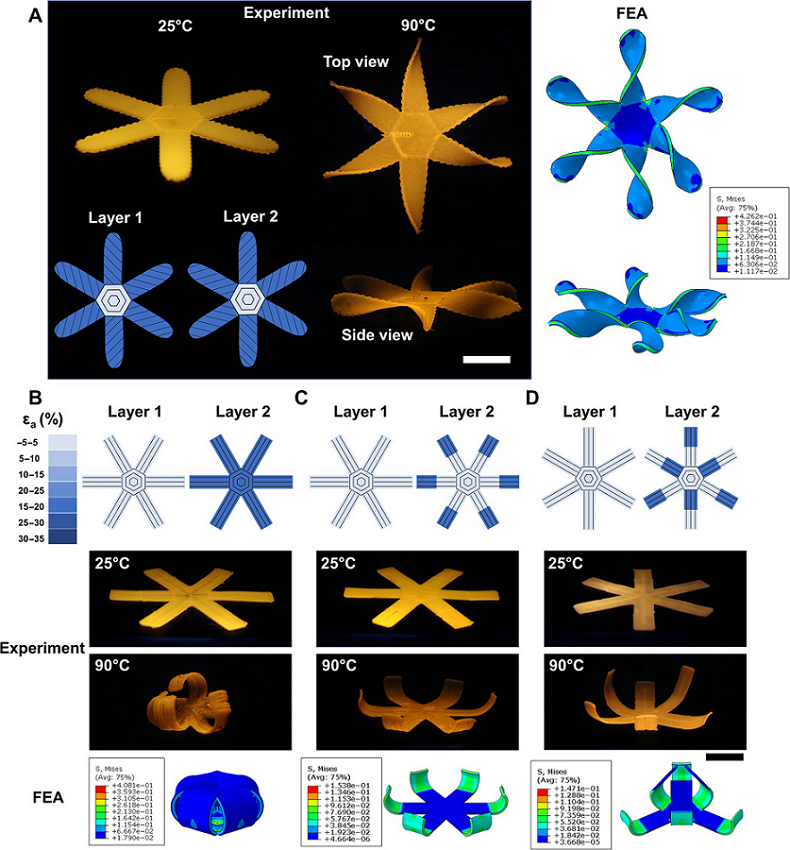
3D printed LCE bilayer structures with six petals. Fluorescent dye RhB was added to the ink before printing, and photos taken under 365-nm UV illumination. (A) Each petal is composed of two layers of LCE with different print paths but the same parameters. The angle between the two paths in two layers is 90°. When the bilayer structure is immersed in hot water of 90°C, all petals twist. (B to D) The print paths of two layers of petals are the same along the length direction. Also, for the bottom layer, LCE is printed with minimal actuation strain. For the top layer of a petal, actuation strain is homogeneous in (B) but with customized gradient in (C) and (D). When bilayer structures are immersed in hot water of 90°C, their bending morphologies are distinct from each other in (B) to (D). FEA simulations were used to calculate the deformed shapes of printed bilayer structures. The stress field is represented by different colors. The gradient printing strategy increases the design space for active morphing structures. Scale bars, 20 mm.
This six-petal structure demonstrated remarkable control: each petal twisted in a different direction when heated, creating a complex 3D shape change from a simple 2D pattern. The bilayer approach enabled combining different actuation strains and directions within a single structure, vastly expanding design possibilities for shape-morphing devices.
Lattice Structures
They also printed lattice structures, and structures with two LCE layers, each with different properties, to show that the material would then have even more degrees of actuation freedom. Lattice geometries are particularly valuable for creating lightweight, high-strength structures with predictable mechanical behavior. By combining functional grading with lattice design, researchers could create materials that change shape in specific ways while maintaining structural integrity.
Mitigating Stress Concentration
For proof of concept, which consisted of using one ink to print an LCE tube that had been tuned during the print process, the team demonstrated how it would adhere longer to a rigid glass plate if it had been actuated in warmer temperatures, as opposed to a tube with “homogenous properties.”
“We further demonstrate mitigation of stress concentration near the interface between an actuatable LCE tube and a rigid glass plate through gradient printing,” they wrote.
This specific finding could help improve the fabrication of robotic grippers and feet. By using gradient printing to create a gradual transition from soft LCE to rigid substrate, the team reduced stress concentrations that typically cause delamination or failure at material interfaces.
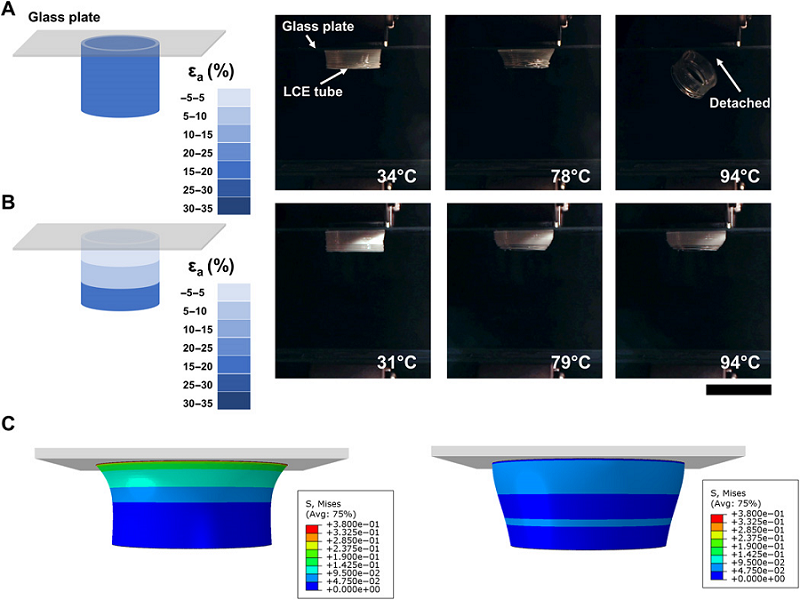
Demonstration of mitigating stress concentration near the interface between active LCE tube and glass plate. (A) Homogeneous LCE tube printed on rigid glass plate. When the tube is heated to 94°C, the tube detaches from the plate. (B) LCE tube with gradient properties printed on rigid glass plate. The tube stays attached to the glass plate when the temperature is increased to 94°C. (C) FEA simulations of the tubes’ stress field at 94°C with homogeneous properties (L) and graded properties (R). The stress field is represented by different colors. Scale bars, 20 mm.
Actuation Methods and Stimuli
Hot water isn’t the only thing researchers used to activate the material’s actuation: they also infused LCE with heat-sensitive particles, or ones that could convert absorbed light into heat, such as graphene or black ink powder. This multi-stimuli capability makes LCEs even more versatile for different applications:
| Stimulus Type | Mechanism | Advantages | Applications |
|---|---|---|---|
| Thermal (Heat) | Heating above phase transition temperature (40-100°C) | Simple to implement, high energy density | Artificial muscles, soft robotics |
| Photothermal (Light) | Infused with graphene or black ink; light converts to heat | Remote activation, precise spatial control | Micro-actuators, biomedical devices |
| Photochemical | Light triggers molecular rearrangement | Fast response, no heat generation | Optical devices, micro-robotics |
| Electric Field | Dielectric heating from applied voltage | Rapid response, easy integration | Haptic feedback, adaptive structures |
Applications of Shape-Shifting LCEs
The ability to create functionally graded LCEs opens up numerous practical applications across industries:
Artificial Muscles and Soft Robotics
LCEs are particularly well-suited for artificial muscles due to their high strain capacity (often exceeding 300-400%) and energy density comparable to natural muscle tissue. By creating graded properties within a single muscle structure, engineers can design muscles that contract more forcefully at one end while remaining flexible at another, mimicking the tapered structure of natural muscle fibers. This capability could lead to more efficient and lifelike robotic actuators.
Soft robotics benefit from LCEs because they can generate smooth, continuous movements without the need for complex joint systems. A single LCE actuator can produce bending, twisting, or extending motions depending on how the material is graded and oriented, simplifying robot design and reducing failure points.
Wearable Devices and Haptics
Wearable technology applications include adaptive clothing, compression garments, and haptic feedback devices. Functionally graded LCEs could create clothing that changes shape based on environmental temperature or body heat—for example, sleeves that automatically tighten when cold or loosen when warm. Similarly, haptic devices could use LCEs to create variable-stiffness interfaces that provide different feedback sensations depending on the application.
Graduated compression garments using LCEs could provide medical benefits for conditions requiring precise pressure control. By grading the material properties, different areas of the garment could exert different pressures, improving comfort and effectiveness for patients with circulation issues or lymphedema.
Biomedical Devices and Implants
The biocompatibility of certain LCE formulations makes them suitable for biomedical applications including minimally invasive surgical tools, stents, and implantable actuators. The ability to program shape change enables devices that can be inserted in a compact form and then expand to their functional shape inside the body, reducing surgical trauma and improving patient outcomes.
LCE-based surgical grippers could navigate delicate anatomy while remaining rigid enough to manipulate tissue when actuated. By using graded properties, the gripper could have soft, flexible tips for safety and stiffer bases for force transmission, optimizing performance for specific surgical tasks.
Adaptive Structures and Morphing Architecture
Beyond robotics and medical devices, LCEs enable adaptive structures for aerospace, automotive, and civil engineering applications. Shape-shifting panels could change aerodynamic properties of aircraft wings or reduce drag on vehicle surfaces. Morphing building facades could optimize light transmission, shading, or ventilation in response to environmental conditions.
The functional grading approach allows creating structures with smooth property transitions, avoiding stress concentrations that cause failure. This is particularly valuable for load-bearing applications where different areas of a component experience different stresses.
Future Directions and Research Implications
After researchers determine how to tune material properties more efficiently and accurately, they will then focus on modifying LCE ink so 3D printed structures can be made that are reprogrammable, or even self-repairing.
Cai, a professor in the Department of Mechanical and Aerospace Engineering at UCSD Jacobs School of Engineering, stated, “Based on the relationship between the properties of LCE filament and printing parameters, it’s easy to construct structures with graded material properties.”
Reprogrammable LCEs
Current LCEs are programmed during printing—their actuation behavior is permanently set by the processing conditions. Future research aims to develop LCEs that can be reprogrammed after printing, allowing the same structure to perform different functions at different times. This could involve incorporating photo-switchable molecules that can be reoriented with light, or using multi-stimuli LCEs that respond differently to heat, light, or electric fields.
Self-Repairing Materials
Another promising direction is developing LCEs with self-repair capabilities. By incorporating dynamic covalent bonds or healing agents into the polymer matrix, damaged LCE structures could autonomously repair small cracks or tears, extending their lifespan in demanding applications like soft robotics or aerospace components.
Multi-Functional Composites
Researchers also envision creating LCE composites with multiple functionalities—combining actuation with conductivity, sensing, or optical properties. For example, LCEs infused with conductive nanomaterials could serve as artificial muscles that also monitor their own strain or temperature, creating self-sensing actuators for intelligent soft robots.
Best 3D Printers and Materials for LCE Research
For researchers and developers working with liquid crystal elastomers, specific equipment and materials are essential:
Direct Ink Writing 3D Printers – Specialized printers for LCE and soft material research with precise extrusion control. For more on this topic, see our guide on ABS 3D Printing Settings Guide: Temperat….
Liquid Crystal Elastomer Filament – Smart materials for shape-morphing applications and soft robotics.
Heated Chamber 3D Printers – Printers with temperature control for LCE processing and functional grading.
Soft Robotics Materials – Elastic and programmable materials for soft robot fabrication.
Lab 3D Printing Equipment – Professional-grade printers and tools for advanced materials research.
3D Printer Nozzle Kits – Various nozzle sizes and materials for LCE printing with functional grading.
Frequently Asked Questions (FAQ)
Q: What makes liquid crystal elastomers (LCEs) special?
LCEs are unique materials that combine liquid crystal molecular order with rubber elasticity, giving them the ability to undergo large, reversible shape changes (typically 20-400% strain) when stimulated by heat, light, or electric fields. This combination allows LCEs to contract and expand repeatedly like biological muscles, making them ideal for artificial muscles, soft robots, and adaptive structures. What distinguishes LCEs from other smart materials is their exceptionally high energy density and ability to maintain strength over thousands of actuation cycles.
Q: How does UCSD’s functional grading approach improve LCE 3D printing?
UCSD researchers discovered that by controlling printing parameters—especially temperature, nozzle size, and print speed—they can create LCE structures with spatially varying properties within a single print. The key insight was that the outer shell of an LCE filament cools faster than the inner core, creating a natural property gradient. This “functional grading” allows designers to program different actuation behaviors in different regions of a structure without changing the material formulation or using multiple printing passes.
Q: What printing parameters can be tuned to control LCE properties?
The research identified several critical parameters: printing temperature (higher = more flexible, higher actuation strain), nozzle diameter (smaller = finer features, better alignment), print speed (slower = better liquid crystal alignment, higher anisotropy), nozzle-to-plate distance (affects filament deposition consistency), and layer height (thinner = smoother surfaces). By systematically varying these parameters during printing, researchers can create complex gradients of mechanical and actuation properties throughout a structure.
Q: What are the applications of functionally graded LCEs?
Functionally graded LCEs have applications across multiple fields: artificial muscles and soft robotics (high-strain actuators that mimic natural muscle), wearable devices (adaptive clothing, compression garments, haptic interfaces), biomedical devices (surgical tools, implantable actuators, minimally invasive instruments), adaptive structures (morphing aircraft wings, variable-geometry building facades), and smart materials (self-sensing composites, reprogrammable actuators). The ability to vary properties spatially within a single structure enables sophisticated design possibilities for all these applications.
Q: How can LCEs be activated or triggered?
LCEs respond to multiple stimuli: thermal heating (exceeding phase transition temperature of 40-100°C), photothermal (light absorbed by graphene or black ink particles, converted to heat), photochemical (light directly rearranges molecular structure), and electric fields (dielectric heating from applied voltage). Multi-stimuli LCEs that respond to different triggers enable remote activation, spatial control, and integration with electronic control systems for advanced robotic applications.
Q: What are the advantages of LCEs over traditional actuators?
LCEs offer several advantages: exceptional strain capability (often exceeding 300-400% compared to 100-200% for shape-memory polymers), high energy density (more forceful actuation per unit mass), reversible shape change (thousands of cycles without degradation), quiet operation (no mechanical motors or gears required), and bio-inspired design possibilities (smooth, organic-like movements). These advantages make LCEs particularly suitable for applications requiring natural motion patterns and high reliability.
Q: What challenges remain in LCE research and manufacturing?
While the UCSD breakthrough addresses functional grading, other challenges remain: developing reprogrammable LCEs (materials that can be reconfigured after printing), improving long-term durability under repeated actuation, scaling up manufacturing for industrial production, reducing cost of LCE materials and processing equipment, integrating LCEs with traditional manufacturing processes, and ensuring consistent quality across large batches. Addressing these challenges will be crucial for widespread commercial adoption of LCE technologies.
Q: Who published the UCSD LCE research and where can I find it?
The research was published in Science Advances, a high-impact, peer-reviewed journal from the American Association for the Advancement of Science. The paper, titled “Three-dimensional printing of functionally graded liquid crystal elastomer,” was authored by Zijun Wang, Zhijian Wang, Yue Zheng, Qiguang He, Yang Wang, and Shengqiang Cai from UCSD Jacobs School of Engineering. It is available via DOI 10.1126/sciadv.abc0034 and has been cited extensively in subsequent research on smart materials and soft robotics.
Q: How does the core-shell structure affect LCE properties?
The core-shell formation discovered by UCSD researchers creates different cooling rates in different parts of the printed filament. The outer shell cools rapidly, fixing the liquid crystal alignment and creating stiffer, less actuating regions. The inner core cools more slowly, allowing liquid crystal domains to reorient into a polydomain (more disordered) state, resulting in softer, more actuating regions. This natural property gradient enables functionally graded behavior without needing to change material composition or use complex multi-material printing setups.
Q: Can LCEs be used with other 3D printing technologies besides DIW?
While the UCSD research focused on direct ink writing (DIW), the principles of functional grading could be adapted to other 3D printing methods including fused deposition modeling (FDM), stereolithography (SLA), and digital light processing (DLP). Each method would require different approaches to creating property gradients—for example, varying exposure energy in SLA or layer temperature in FDM. However, the fundamental insight that processing parameters can tune actuation behavior applies broadly to LCE fabrication across technologies.
Q: What is the significance of the bilayer petal demonstration?
The six-petal bilayer structure demonstrated two key advances: first, it showed that different actuation behaviors could be combined in a single structure (each petal twisted differently when heated), and second, it proved that functional grading works reliably at complex geometries. The ability to print multiple layers with different properties and achieve predictable, distinct morphologies in each layer validates the approach for creating sophisticated shape-morphing devices. This demonstration is particularly relevant for applications like soft grippers that need different actuation modes in different regions or adaptive structures that change shape in complex, coordinated ways.
Conclusion
UCSD’s breakthrough in 3D printing functionally graded liquid crystal elastomers represents a significant advancement in smart materials fabrication. By discovering how printing parameters create natural property gradients, particularly through the core-shell structure formation, researchers have opened new possibilities for designing and manufacturing shape-shifting structures with programmable actuation behaviors.
The ability to create LCEs with spatially varying properties within a single printing operation addresses a critical challenge in soft robotics and artificial muscles. This functional grading approach enables more complex, efficient, and reliable actuators that better mimic the sophisticated design of natural systems—from squid beaks to elephant trunks to human muscles.
As research continues toward reprogrammable and self-repairing LCEs, and as manufacturing techniques mature, we can expect to see these remarkable materials transition from laboratory demonstrations to practical applications. From medical devices that improve patient outcomes to soft robots that work alongside humans in factories, from adaptive aerospace structures to wearable technology that enhances daily life, functionally graded LCEs are poised to transform how we think about actuation and shape change in engineered systems.
(Source: Nanowerk News / Images: Zijun Wang, UCSD)
The post UCSD Researchers 3D Print Shape-Shifting Liquid Crystal Elastomers appeared first on 3DPrint.com | The Voice of 3D Printing / Additive Manufacturing.
from 3DPrint.com | The Voice of 3D Printing / Additive Manufacturing https://bit.ly/3ngEJ4V
Where to Buy
Buy Direct Ink Writing 3D Printers on Amazon
Buy Liquid Crystal Elastomer Filament on Amazon
Buy Heated Chamber 3D Printers on Amazon
📌 Related Articles
- The Current State of Metal 3D Printing in 2020
- ABS 3D Printing Settings Guide: Temperature, Enclosure, and Cooling for Strong Parts
- 3D Printing Safety Equipment Guide: Respirators, Gloves, and Ventilation for 2026
- Best 3D Printer Upgrades That Actually Improve Print Quality: Complete 2026 Guide
- Best Budget 3D Printer Upgrades That Actually Improve Print Quality: Belts, Springs, Hotends & More