
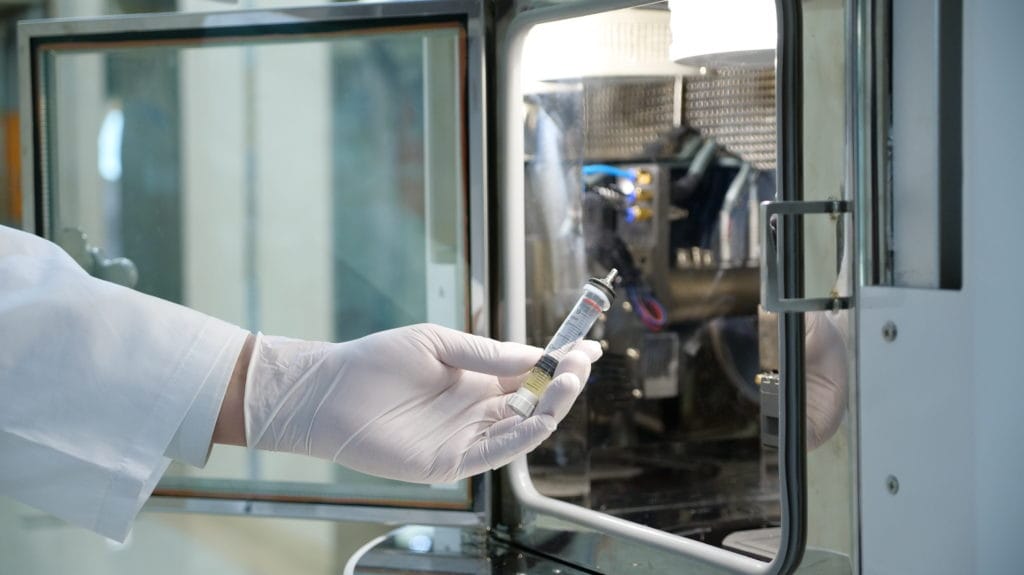
ROKIT Healthcare announced the launch of the Dr. INVIVO 4D6, a bioreactor-based bioprinting platform with a built-in cell incubator and low-temperature plasma sterilizer as the first of its kind. It is designed and built with the vision of in-hospital manufacturing and offers a controlled cellular environment in aseptic conditions in combination with the complex biofabrication technologies of six rotary printheads. ROKIT Healthcare is a South Korea-based regenerative medicine solutions company that develops hardware, software, and clinical application platforms employing 4D bioprinting technology for customized human organ and tissue regeneration.
Quick Answer Box: Dr. INVIVO 4D6 at a Glance
What is the Dr. INVIVO 4D6? The Dr. INVIVO 4D6 is the world’s first all-in-one bioprinting platform that integrates a built-in cell incubator, low-temperature plasma sterilizer, and six rotary printheads into a single sterile chamber system.
Who makes it? ROKIT Healthcare, a South Korean regenerative medicine company founded in 2012.
What makes it unique? It’s designed for in-hospital use with point-of-care bioprinting capabilities, allowing bedside bioprinting directly in operating theaters.
Key Applications: Skin regeneration for burns and diabetic foot ulcers, organ tissue engineering, and high-throughput drug screening with up to 384-well capacity.
Price Range: Contact ROKIT Healthcare directly for pricing as it’s a specialized medical device.
Revolutionary Point-of-Care Bioprinting
Chief Executive Officer at ROKIT Healthcare, Seok Hwan You, explains: “Bioprinting right by the bedside inside the operating theatre means minimized time, risks, and costs in the transfer of patient cells to the bioprinter and in the transfer of printed tissues back to the patient. It is a new kind of point-of-care, personalized healthcare solution that maximizes the benefits of autologous regenerative medicine technologies. Dr. INVIVO 4D6, which we call the Organ Regenerator, is designed to pave the way with features that have been added after feedback from physicians and scientists.“
This point-of-care approach represents a significant shift from traditional bioprinting workflows that typically require centralized facilities and complex logistics. By bringing bioprinting capabilities directly to hospitals and clinics, ROKIT Healthcare aims to dramatically reduce the time between tissue sample collection and implantation, potentially improving patient outcomes and reducing treatment costs [1].
Features on the Dr. INVIVO 4D6 from ROKIT Healthcare
Achieving three-dimensional architecture is just one of several factors to consider in tissue engineering. Cell environment factors, like incubation temperature, oxygen/carbon dioxide level, and humidity are key to successful human tissue and organ development with optimal cell viability and functionality. Moving beyond the capacity to dispense cells and biomaterials with multiple printheads, Dr. INVIVO 4D6 offers an integrated system to meet clinical needs in human tissue engineering and its translational applications.
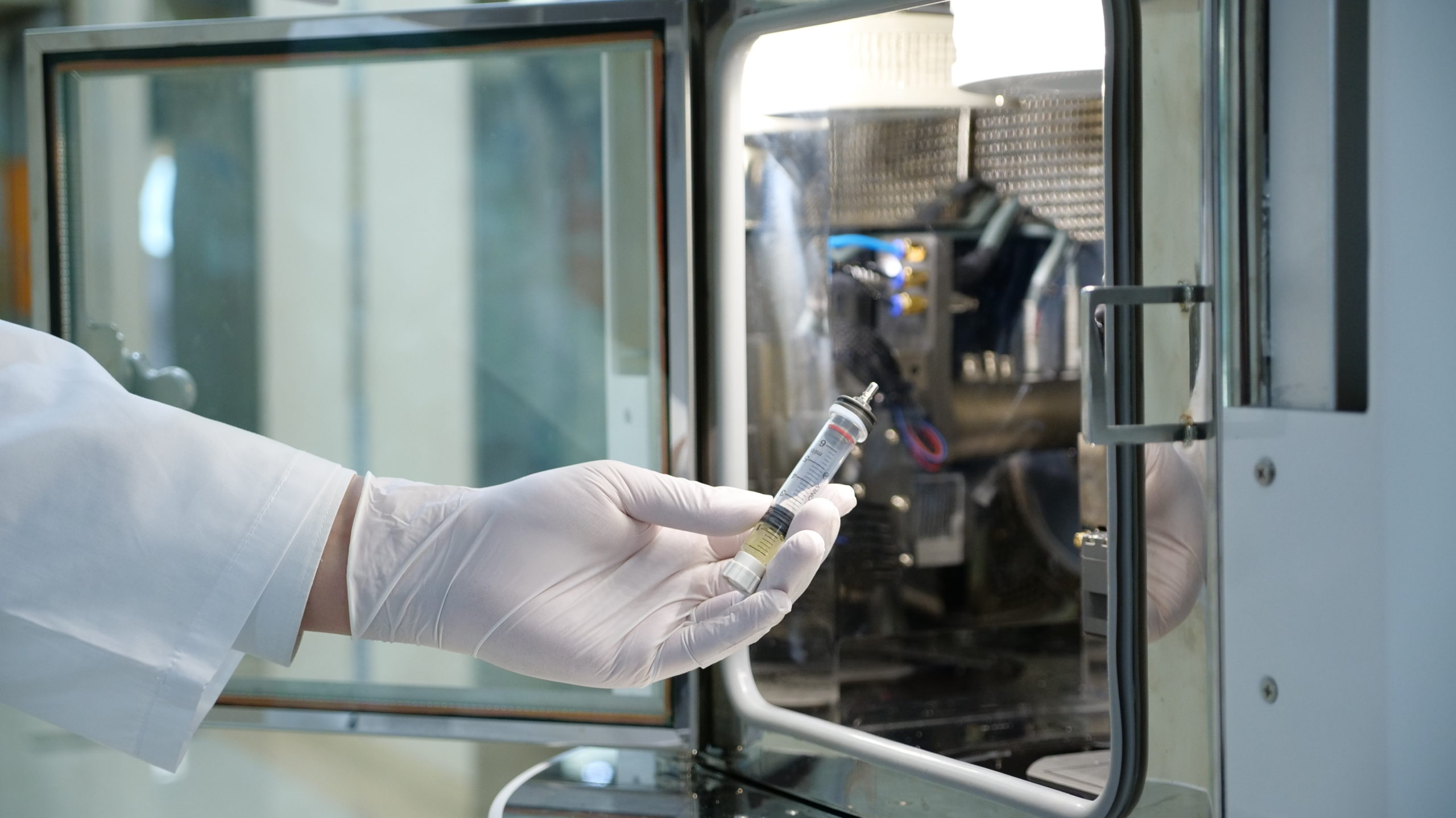
Dr. INVIVO 4D6 optimizes tissue engineering and regenerative medicine research with:
- Built-in cell incubator with temperature, humidity and CO2 control – Maintains optimal growth conditions for living cells throughout the printing process
- 6 printheads for complex tissue fabrication – Enables simultaneous dispensing of hydrogels, filaments, polymer pellets, and diverse FDA-approved materials
- Complete particle control with circular air flow generation technology – Functions much like a biosafety cabinet to maintain sterile conditions
- High-throughput to the max with up to 384-well tissue screening – Supports extensive assay development for drug screening applications
Additional features include HEPA filtration, UV lamps for disinfection, bioink warmer, chamber temperature display and HD camera for real-time monitoring [2]. This comprehensive integrated approach eliminates the need for separate incubation and sterilization equipment, reducing contamination risk and workflow complexity.
Comparison Table: Dr. INVIVO 4D6 vs. Leading Bioprinting Platforms
| Feature | Dr. INVIVO 4D6 | CELLINK BIO X | Allevi 6 | Organovo NovoGen MMX |
|---|---|---|---|---|
| Built-in Incubator | Yes (temp, CO2, humidity) | Optional add-on | No (external required) | No |
| Plasma Sterilizer | Yes (built-in) | UV only | UV only | No |
| Printheads | 6 rotary heads | 6 interchangeable heads | 6 printheads | 2 dual-extrusion |
| Sterile Chamber | Yes (HEPA + airflow) | Partial | Partial | No |
| 384-well Capacity | Yes | 96-well max | 96-well max | Custom only |
| Intended Use | Clinical/Point-of-care | Research/Clinical | Research | Research/Pharma |
| Real-time Monitoring | HD camera + temp display | Optional camera | Basic monitoring | Limited |
Table 1: Feature comparison of major bioprinting platforms. Dr. INVIVO 4D6 stands out with its comprehensive integrated system designed specifically for clinical and point-of-care applications.
Clinical Applications and Real-World Impact
Translation of Bioprinting in the Operating Room
In addition to being a bioprinter manufacturer, ROKIT Healthcare works as a medical contractor that partners with state agencies, biotech firms and academic research centers to develop applications for bioprinting technology in the hospital operating room. ROKIT Healthcare has been awarded a $3 million grant by the South Korean government to co-develop an in-situ 3D bioprinting system for skin regeneration. Since 2019, ROKIT Healthcare has partnered with specialty plastic surgery hospitals around the world to offer 3D scan-print skin regeneration platforms for patients suffering from chronic diabetic foot ulcers and burns. The company has completed clinical studies in India and Korea [3].
Skin Regeneration Applications
The creation of artificial skin grafts is one of the most mature applications of 3D bioprinting technology. These grafts can act as advanced bandages for wound and burn healing, reducing healing times and improving cosmetic outcomes for patients. Dr. INVIVO 4D6’s ability to create vascularized skin constructs using multiple cell types represents a significant advancement in this field. Clinical studies have demonstrated that bioprinted skin grafts show improved integration with host tissue compared to traditional split-thickness grafts [4].
Drug Discovery and High-Throughput Screening
Beyond tissue regeneration, the Dr. INVIVO 4D6’s 384-well capacity makes it an invaluable tool for pharmaceutical research. The ability to create standardized 3D tissue models that more accurately mimic human physiology compared to traditional 2D cell cultures is transforming drug discovery workflows. Researchers can use these models to test drug efficacy and toxicity earlier in the development process, potentially reducing late-stage clinical trial failures and bringing safer treatments to market faster [5].
Comparison Table: Bioprinting Applications and Market Position
| Application Area | Dr. INVIVO 4D6 Strengths | Market Leaders | Technology Maturity |
|---|---|---|---|
| Skin Regeneration | Clinical studies completed, diabetic wound focus, in-situ printing | ROKIT Healthcare, Cellink, Organovo | Clinical trials phase |
| Cartilage/Bone Repair | Multi-material printing, osteogenic bioinks | 3D Systems, Stratasys, RegenHU | Preclinical/early clinical |
| Organ-on-Chip | 384-well screening, real-time monitoring | Cellink, Emulate, Mimetas | Research/Pharma use |
| Drug Screening | High-throughput, automated workflows | Cellink, Aspect Biosystems, Allevi | Established pharma use |
| Complex Organ Fabrication | 6-head system, vascularization research | Organovo, Prellis Biologics | Early research phase |
Table 2: Application areas and market positioning. Dr. INVIVO 4D6 shows particular strength in clinical applications and high-throughput drug screening.
The Future of Bioprinting Technology
The global 3D bioprinting market is experiencing rapid growth, with projections estimating it will reach $5.3 billion by 2035 as the technology matures and clinical applications expand [6]. Leading companies in the bioprinting industry include 3D Systems, Organovo, Stratasys, Aspect Biosystems, CELLINK, and Allevi, with ROKIT Healthcare emerging as a key player in the Asian market and clinical applications.
The development goal of 3D printing technology in the field of organ reconstruction is mainly to build artificial organs with morphological bionics and functional bionics, developing toward multi-organ reconstruction [7]. Important progress has been made in morphological bionics, including accurate replication of organ microstructures and vascular networks. However, functional bionics—ensuring that bioprinted organs can perform the complex physiological functions of their natural counterparts—remains a significant challenge that will require continued research and development.
Regulatory Landscape and Clinical Translation
As bioprinting technologies move from research laboratories to clinical applications, regulatory approval becomes increasingly important. The FDA and other regulatory agencies are developing frameworks for evaluating bioprinted products, which vary depending on whether they’re classified as medical devices, biologics, or combination products. ROKIT Healthcare’s focus on clinical applications and partnerships with medical institutions positions them well to navigate this evolving regulatory landscape. The company’s established track record of clinical studies in India and Korea provides valuable experience for future regulatory submissions in other markets.
FAQ: Dr. INVIVO 4D6 and Bioprinting
1. What makes Dr. INVIVO 4D6 different from other bioprinters?
Dr. INVIVO 4D6 is unique in its comprehensive integration of all critical bioprinting components into a single sterile system. Unlike other platforms that require separate incubators, sterilizers, and clean chambers, Dr. INVIVO 4D6 includes a built-in cell incubator with precise temperature, humidity, and CO2 control, a low-temperature plasma sterilizer, and HEPA-filtered air circulation. This all-in-one design reduces contamination risk, simplifies workflows, and makes it suitable for point-of-care use in hospitals. Additionally, its six rotary printheads enable simultaneous printing with multiple bioinks and biomaterials, supporting more complex tissue structures than most competing systems.
2. Can Dr. INVIVO 4D6 print functional organs for transplantation?
Currently, no bioprinter on the market can produce fully functional transplantable organs. Dr. INVIVO 4D6, like all existing bioprinting platforms, is primarily used for research applications, tissue model development, and clinical trials of simpler tissues like skin grafts. The technology for creating complex, vascularized organs with full physiological function is still in early development stages. However, Dr. INVIVO 4D6’s advanced capabilities make it a valuable tool for advancing organ bioprinting research. The company’s current focus is on proven clinical applications like skin regeneration for diabetic foot ulcers and burn treatment, where it has completed clinical studies demonstrating efficacy.
3. What are the main applications of Dr. INVIVO 4D6 in hospitals?
Dr. INVIVO 4D6’s primary hospital applications include: (1) In-situ skin bioprinting for treating burns and chronic diabetic ulcers, where patient cells can be printed directly at the bedside; (2) High-throughput drug screening using 384-well tissue models that better mimic human physiology than traditional 2D cell cultures; (3) Personalized tissue engineering for creating patient-specific grafts and implants; and (4) Surgical planning by creating anatomical models for pre-operative visualization. The system’s sterile chamber design and integrated incubation make it particularly suitable for clinical environments where maintaining aseptic conditions is critical.
4. How much does Dr. INVIVO 4D6 cost?
ROKIT Healthcare does not publicly list standard pricing for Dr. INVIVO 4D6, as it’s a specialized medical device with pricing that varies based on configuration, included bioinks, service agreements, and regional market factors. Bioprinters in this professional and clinical category typically range from $150,000 to over $500,000 depending on features and capabilities. For accurate pricing information, interested organizations should contact ROKIT Healthcare directly or their regional distributors. The company offers both purchase and lease options, and in some cases, the $3 million government grants and research funding may be available to support acquisition by qualified research institutions and hospitals.
5. What types of bioinks can Dr. INVIVO 4D6 use?
Dr. INVIVO 4D6 is designed to work with a wide variety of bioinks and biomaterials thanks to its six rotary printheads with different dispensing mechanisms. Supported materials include: Hydrogels such as alginate, gelatin methacrylate (GelMA), and fibrin; Thermoplastic polymers in filament or pellet form; Decellularized extracellular matrix (dECM) bioinks; and various FDA-approved biomaterials for clinical applications. The system’s temperature control and bioink warming capabilities enable printing with temperature-sensitive cell-laden bioinks. ROKIT Healthcare also develops proprietary bioinks optimized for specific clinical applications, particularly for skin regeneration and wound healing.
6. Is Dr. INVIVO 4D6 approved by the FDA for clinical use?
As of the current information available, Dr. INVIVO 4D6 has completed clinical studies in India and Korea for skin regeneration applications, but FDA approval status in the United States would require separate regulatory submissions and clinical trials. The regulatory pathway for bioprinting devices and bioprinted tissues is evolving, with the FDA treating different applications as medical devices, biologics, or combination products depending on the specific use case. Hospitals and research institutions interested in clinical applications should work with ROKIT Healthcare to understand the current regulatory status and requirements for their intended use. The company’s established clinical partnerships and completed studies in Asia provide a foundation for future regulatory approvals in other markets.
Conclusion
Founded in 2012 and active in more than 50 countries, ROKIT Healthcare is advancing the scientific and healthcare revolution in regenerative medicine by providing on-demand human tissue manufacturing solutions in vivo and in vitro. The Dr. INVIVO 4D6 represents a significant step forward in making bioprinting technology practical for real-world clinical applications, with its integrated sterile chamber system, point-of-care design, and proven results in skin regeneration trials.
As the bioprinting industry continues to grow and evolve, platforms like Dr. See also: ABS 3D Printing Settings Guide: Temperature, Enclo…. INVIVO 4D6 will play an increasingly important role in bringing regenerative medicine from research laboratories to patient care. The combination of advanced engineering, clinical focus, and practical hospital deployment positions ROKIT Healthcare as a key player in the emerging field of personalized, on-demand tissue fabrication.
What do you think of the Dr. INVIVO 4D6 from ROKIT Healthcare? Let us know in a comment below or on our Facebook and Twitter pages! Sign up for our free weekly Newsletter, all the latest news in 3D printing straight to your inbox!
Sources:
[1] 3D Bioprinting in Tissue Engineering: Advancements, Challenges, and Pathways to Clinical Translation – JSM Regenerative Medicine and Bioengineering
[2] ROKIT Dr. Invivo 4D Bioprinting for Regenerative Medicine – Nexus Scientific
[3] Current Developments in 3D Bioprinting for Tissue and Organ Regeneration–A Review – Frontiers in Mechanical Engineering
[4] Three Dimensional Bioprinting of a Vascularized and Perfusable Skin Graft Using Human Keratinocytes, Fibroblasts, Pericytes, and Endothelial Cells – Tissue Engineering Part A
[5] Recent advances in 3D bioprinting of tissues and organs for transplantation and drug screening – Virtual and Physical Prototyping
[6] 3D Bioprinting Market Industry Trends and Global Forecasts – ResearchAndMarkets.com
[7] Applications, advancements, and challenges of 3D bioprinting in organ transplantation – Biomaterials Science (RSC Publishing)
Related: Robotic Bioprinting Platform Aims to Cure Gastric Wounds from Inside the Body · Indianapolis VA Medical Center and NASA To Explore 3D Bioprinting for Healthcare · Bioprinted Skin Patches for Diabetic Foot Ulcers Commercialized by Rokit Healthc
📌 Related Articles
- Best 3D Printer Upgrades That Actually Improve Print Quality: Complete 2026 Guide
- ABS 3D Printing Settings Guide: Temperature, Enclosure, and Cooling for Strong Parts
- 3D Printing Safety Equipment Guide: Respirators, Gloves, and Ventilation for 2026
- Best Budget 3D Printer Upgrades That Actually Improve Print Quality: Belts, Springs, Hotends & More
- Prusa Research Mini+ vs Prusa MK4: Full Specs Comparison & Buyer’s Guide