
Quick Answer: Roboze’s Munich Expansion
Why Munich? Roboze opened a Munich office because Germany is Europe’s largest 3D printing market, with high demand for industrial-grade polymer 3D printing solutions. The strategic location in Bavaria’s industrial hub provides direct access to automotive, aerospace, and manufacturing customers seeking metal replacement solutions.
What’s the Impact? Local presence enables faster support, better technical assistance, and stronger partnerships with German manufacturers transitioning from traditional manufacturing to additive manufacturing using high-performance materials like PEEK and ULTEM.
After creating numerous working relationships with German companies interested in using high-performance 3D printing polymers, the Italy-headquartered Roboze has taken the leap to open up a new facility in Munich. Known for much more than just beer and bratwurst, the capital of Bavaria is a European industrial hub. With that in mind, the Roboze team will also be able to better meet the continued demand of German manufacturers 3D printing with Roboze super polymers.
Roboze: A Leader in Industrial 3D Printing
Founded in 2013 by CEO Alessio Lorusso, Roboze is known for providing AM solutions in the metal replacement field. This means industrial-grade 3D printers representative of the third-wave of fused filament fabrication, capable of 3D printing high-temperature plastics. Roboze is strengthening its position not only in Germany but in Europe overall—seeking out “strategic European markets for additive manufacturing,” as stated in a recent press release sent to 3DPrint.com. Their expansion has already been impressive throughout Europe, the Middle East, and Africa (EMEA) with a variety of partnerships, along with the creation of Roboze Spa in Italy and this year—Roboze, Inc., headquartered in Houston, TX.
Roboze’s proprietary 3D printing technology focuses on industrial applications requiring high-performance materials. Their printers are designed to process engineering-grade thermoplastics like PEEK, ULTEM, and carbon-fiber reinforced composites, which are essential for aerospace, automotive, and medical applications where strength, heat resistance, and chemical resistance are critical requirements [1].
Why Germany? The Strategic Importance of the German Market
Germany represents one of the world’s most important markets for additive manufacturing. According to recent industry reports, Germany accounts for approximately 20% of the European 3D printing market, with projected annual growth rates exceeding 15% through 2025 [2]. The country’s strong manufacturing base, particularly in automotive and aerospace sectors, creates natural demand for Roboze’s metal-replacement 3D printing solutions.
German manufacturers are increasingly adopting additive manufacturing for production applications, moving beyond prototyping into end-use parts. This transition requires robust, reliable systems capable of producing parts with the same mechanical properties as traditionally manufactured components—exactly what Roboze’s high-temperature polymer 3D printing technology provides [3].
With further presence within major international target markets for their solutions, the new Roboze GmbH team will offer the convenience of being in closer proximity to customers currently branching out further in terms of new technology, innovation, production processes, and more.
“The decision has been a natural one and has taken on board the strong demand from our current and future German customers and partners,” said Lorusso.
Strategic Location: Munich as Industrial Hub
Munich, the capital of Bavaria, serves as Germany’s second-largest industrial center after the Ruhr region. The city and surrounding area host numerous Fortune 500 companies, including BMW, Siemens, and MAN, all of which are actively exploring or implementing additive manufacturing technologies in their production processes [4].
The choice of Munich also positions Roboze near key research institutions and universities, including the Technical University of Munich (TUM), which operates one of Europe’s leading additive manufacturing research programs. This proximity to academic research helps ensure Roboze stays at the forefront of material science and 3D printing technology development [5].
Hiring and Expansion Plans
The Munich office will soon be welcoming new staff, experienced in both the technical and commercial areas of Roboze’s business—assisting German customers as they continue to transform their manufacturing processes (from what may have been years or even decades of using traditional technology) with 3D printing and the use of a wide range of new composites and polymers.
Over the next several years, the Roboze strategy in terms of human resources is to recruit dozens of new team members for the German office. They are actively seeking the following critical personnel right now:
- A native DACH Territory Manager for sales management and business development
- Marketing professionals
- Application engineers
- Field service engineers
“Germany is an extremely competent and competitive reality, with a high degree of selectivity in terms of quality and professionalism,” said Lorusso. “This strong character has pushed us to have a direct dialogue in this market and to invest in new resources and energy in order to be always at the forefront and close to our German customers.”
The new office is expected to be open within the next few months.
Roboze’s Technology and Material Portfolio
Roboze’s competitive advantage lies in its proprietary beltless system and advanced heating technology, which enables precise, consistent printing of high-performance engineering polymers. Unlike standard FDM printers that struggle with materials requiring chamber temperatures above 100°C, Roboze systems can handle processing temperatures exceeding 450°C with build chamber temperatures up to 200°C [6].
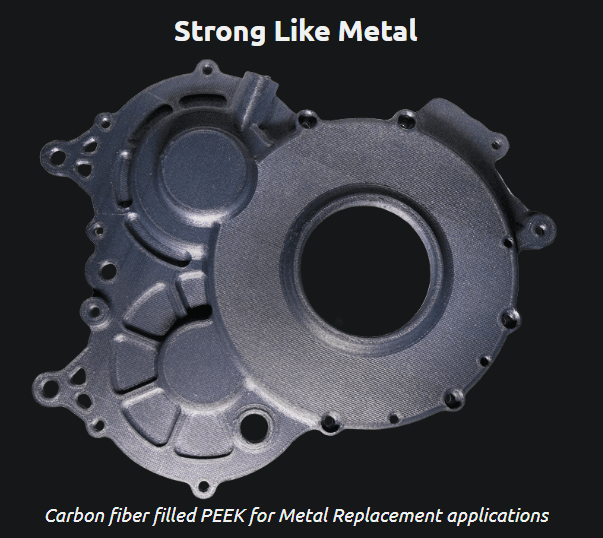
Key materials in Roboze’s portfolio include:
- PEEK (Polyetheretherketone): A high-performance thermoplastic with excellent mechanical properties, chemical resistance, and thermal stability up to 260°C. PEEK parts can replace metal components in aerospace, automotive, and medical applications while reducing weight by up to 70% [7].
- ULTEM (PEI): Polyetherimide offers flame resistance, high strength-to-weight ratio, and thermal stability, making it ideal for aerospace interior components and electrical insulators [8].
- Carbon-Fiber Reinforced Composites: Materials like Carbon PA and Carbon PEEK combine the processability of polymers with the strength and stiffness of carbon fiber, creating parts with exceptional mechanical properties suitable for demanding industrial applications [9].
Comparison: Roboze vs. Competing Industrial 3D Printing Technologies
| Feature | Roboze FFF | SLS (Powder) | Metal Binder Jetting |
|---|---|---|---|
| Materials | PEEK, ULTEM, Carbon Composites | PA, TPU, PEEK (limited) | Stainless Steel, Tool Steel |
| Max Temperature | 260°C continuous | 180°C typical | 1100°C (post-process) |
| Part Strength | Near-isotropic, high | Isotropic, medium-high | Isotropic, very high |
| Cost per Part | $$ (moderate) | $$$ (high) | $$$$ (very high) |
| Build Volume | Up to 500×500×500mm | Up to 340×340×600mm | Up to 220×220×200mm |
| Post-Processing | Minimal (support removal) | Media blasting, dyeing | Sintering, infiltration |
Comparison: High-Performance 3D Printing Materials
| Property | PEEK | ULTEM 9085 | Carbon PEEK | Carbon PA12 |
|---|---|---|---|---|
| Tensile Strength | 90-100 MPa | 70-80 MPa | 115-130 MPa | 75-85 MPa |
| Modulus (GPa) | 3.6-4.0 | 2.0-3.0 | 12-18 | 6-8 |
| Max Service Temp | 260°C | 160°C | 260°C | 150°C |
| Flame Rating | HB | V-0 | HB | HB |
| Density (g/cm³) | 1.30 | 1.27 | 1.40-1.45 | 1.15-1.20 |
| Typical Applications | Aerospace, Medical implants | Aircraft interiors | Structural components | Functional prototypes |
Applications in German Industry
German companies across multiple sectors are increasingly adopting Roboze’s technology for production applications:
Aerospace: Companies like Airbus and Boeing’s German operations are exploring 3D printed PEEK components for aircraft interiors, ducting, and structural brackets. The weight savings offered by polymer parts, combined with certification pathways for flame-retardant materials like ULTEM, make additive manufacturing attractive for both new aircraft designs and retrofits [10].
Automotive: BMW, Mercedes-Benz, and Volkswagen are investing in additive manufacturing for production parts. Applications include custom fixtures, end-use brackets, and components for electric vehicles where weight reduction is critical. Roboze’s ability to print carbon-fiber reinforced polymers with properties approaching aluminum makes these systems particularly valuable for automotive R&D and limited-production runs [11].
Medical: Germany’s medical device industry, centered around companies like Siemens Healthineers and numerous specialized manufacturers, uses PEEK and other biocompatible polymers for surgical guides, custom implants, and medical device components. The ability to produce patient-specific devices on-demand through additive manufacturing is transforming the medical field [12].
Market Outlook and Future Growth
The global industrial 3D printing market is projected to reach $35.6 billion by 2026, with high-performance polymer 3D printing representing one of the fastest-growing segments [13]. Within this market, Europe accounts for approximately 30% of total demand, with Germany serving as the largest national market.
Roboze’s expansion into Germany positions the company to capture a significant share of this growth, particularly as more manufacturers transition from traditional metalworking to additive manufacturing for specific applications. The cost advantages, design freedom, and time-to-market benefits of 3D printing are driving adoption across multiple industries, with German companies often leading in implementation of advanced manufacturing technologies [14].
Challenges and Opportunities
While the German market offers significant opportunities, Roboze also faces challenges in its expansion:
Competition: The German market is already served by established 3D printing companies including EOS (industrial SLS), Stratasys (industrial FDM), and numerous local resellers representing various technology providers. Roboze must differentiate itself through its specific focus on high-temperature polymers and metal replacement applications [15].
Certification Requirements: German industries, particularly aerospace and medical, operate in highly regulated environments requiring extensive certification for production parts. See also: ABS 3D Printing Settings Guide: Temperature, Enclo…. Roboze will need to support customers through these processes, potentially requiring investment in quality systems and partnerships with certification bodies [16].
Customer Education: While awareness of 3D printing is high, many potential customers still require education on the specific capabilities and limitations of high-performance polymer printing. Roboze’s new German team will need to invest in demonstrations, case studies, and technical training to build market confidence [17].
Curious about Roboze and their product offerings? Find out more here. This is a company we have followed over a number of years, from continued expansion and agreements with partners in other regions to strategic research collaborations; however, their greatest contribution to the 3D printing industry has been 3D printers, new polymers, and associated equipment.
Frequently Asked Questions (FAQ)
Why did Roboze choose Munich for their German office?
Roboze selected Munich because it’s Germany’s second-largest industrial center, home to major companies like BMW, Siemens, and MAN. The city also hosts leading research institutions including the Technical University of Munich, which has a strong additive manufacturing program. Munich’s location in Bavaria provides access to Germany’s strongest industrial region and positions Roboze near key automotive, aerospace, and manufacturing customers actively adopting 3D printing technologies.
What makes Roboze’s 3D printing technology different from other industrial systems?
Roboze specializes in high-performance polymer 3D printing using a proprietary beltless system and advanced heating technology. Unlike standard FDM printers, Roboze systems can process materials requiring temperatures exceeding 450°C with build chamber temperatures up to 200°C. This capability enables reliable printing of engineering-grade materials like PEEK, ULTEM, and carbon-fiber reinforced composites, which are essential for demanding industrial applications where metal replacement is desirable.
What are the main applications for Roboze’s 3D printers in German industry?
Primary applications include aerospace components (aircraft interiors, ducting, structural brackets), automotive parts (custom fixtures, end-use brackets, EV components), and medical devices (surgical guides, custom implants, medical device components). German companies are particularly interested in Roboze’s carbon-fiber reinforced polymers, which offer properties approaching aluminum at a fraction of the weight, making them ideal for weight-critical applications.
How does PEEK 3D printing compare to traditional metal manufacturing?
PEEK 3D printing offers several advantages over traditional metal manufacturing: 70% weight reduction, excellent chemical resistance, thermal stability up to 260°C, and biocompatibility for medical applications. While PEEK doesn’t match the ultimate strength of metals like aluminum or steel, its strength-to-weight ratio is often superior. Additionally, 3D printing enables design complexity and part consolidation that’s impossible with traditional manufacturing, reducing assembly time and improving performance.
What materials can Roboze printers process?
Roboze’s portfolio includes high-performance engineering thermoplastics: PEEK (Polyetheretherketone) for aerospace and medical applications, ULTEM (PEI) for flame-resistant components, carbon-fiber reinforced PEEK for structural parts, and various other high-temperature polymers. Each material is optimized for specific applications requiring different combinations of strength, heat resistance, chemical resistance, and flame retardancy.
How will the Munich office support German customers?
The Munich office will provide local sales support, technical assistance, application engineering, and field service. Having a German-based team enables faster response times, better understanding of local requirements and standards, and stronger relationships with customers undergoing digital transformation in their manufacturing processes. The team will include native German speakers familiar with both the technical and commercial aspects of the German market.
[Source / Images: Roboze]
The post Roboze Opens Munich Office for German 3D Printing Customers appeared first on 3DPrint.com | The Voice of 3D Printing / Additive Manufacturing.
Related: Evonik Opens Center for Plastic 3D Printing in Austin, Texas · 3D Printing News Briefs, August 30, 2020: Roboze, BCN3D & CREA3D, 3D Systems, AS · Carbon Opens Up: Henkel Brings Loctite Materials to Carbon’s DLS 3D Printing
Frequently Asked Questions
What is the best 3D printing filament for beginners?
PLA is the best starting filament — it prints easily at 190-220°C without an enclosure and produces good results. Once comfortable, PETG offers better strength and temperature resistance for functional parts.
How do I choose the right filament?
Consider the application: PLA for display models, PETG for functional parts, ABS/ASA for heat/sunlight exposure, TPU for flexible parts, and specialty filaments for engineering applications. Each has specific printer requirements.
What temperature should I print different filaments at?
PLA: 190-220°C nozzle / 50-60°C bed. PETG: 220-250°C / 70-80°C. ABS: 230-260°C / 100-110°C (enclosure needed). Nylon: 240-270°C / 70-90°C. Always check manufacturer recommendations for specific brands.
📌 Related Articles
- Best 3D Printer Upgrades That Actually Improve Print Quality: Complete 2026 Guide
- ABS 3D Printing Settings Guide: Temperature, Enclosure, and Cooling for Strong Parts
- 3D Printing Safety Equipment Guide: Respirators, Gloves, and Ventilation for 2026
- Best Budget 3D Printer Upgrades That Actually Improve Print Quality: Belts, Springs, Hotends & More
- Prusa Research Mini+ vs Prusa MK4: Full Specs Comparison & Buyer’s Guide