
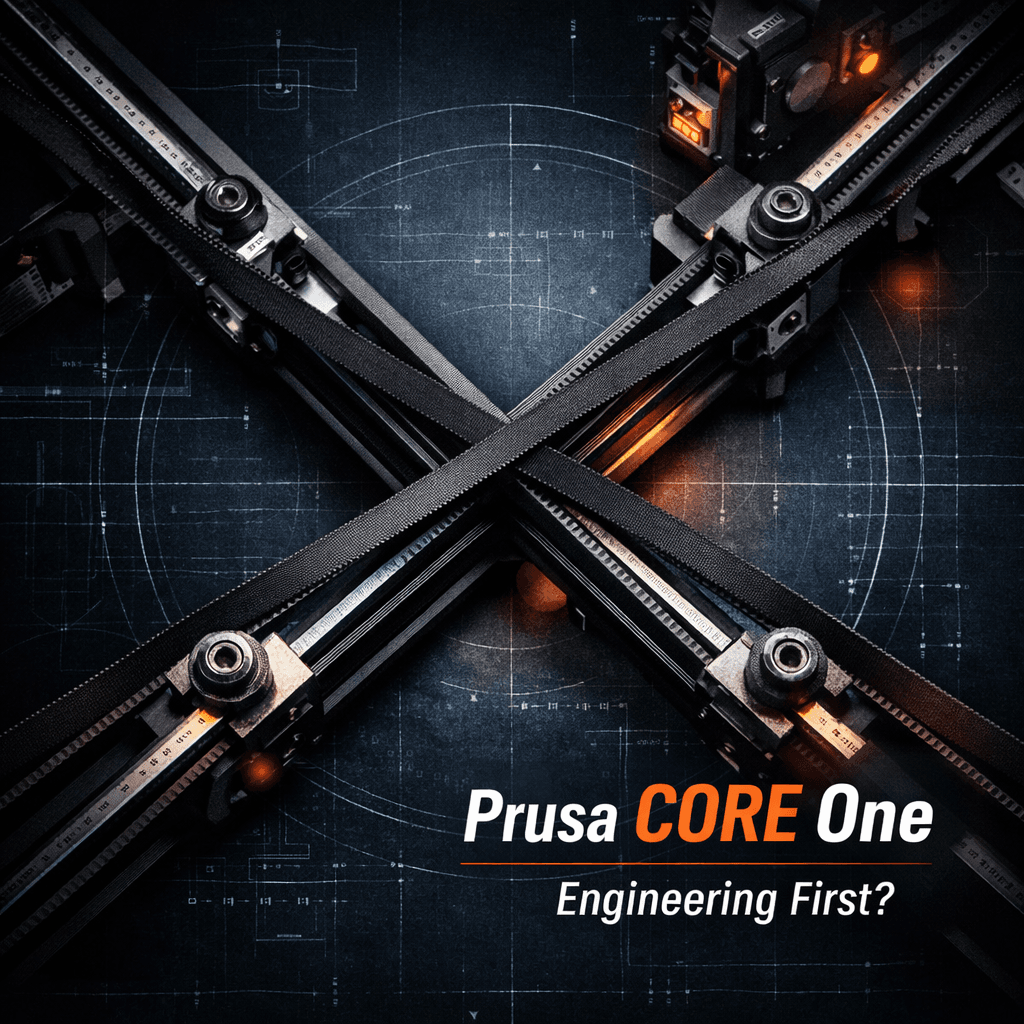
If you’re in the market for a professional-grade 3D printer that combines speed, precision, and reliability, the Original Prusa CORE One has likely crossed your radar. Positioned as Prusa Research’s flagship CoreXY machine, it brings together an enclosed chamber, active temperature control, and the legendary Prusa reliability into a single package.
After extensive testing and analysis, here’s the quick verdict:
Quick Verdict
The Prusa CORE One+ is an exceptional enclosed CoreXY printer that delivers professional results with minimal fuss. Its all-steel exoskeleton, active chamber heating up to 55°C, and the proven Nextruder make it versatile enough for any material from PLA to ABS/ASA. While the $1,199 kit price is premium, you’re paying for unmatched reliability, outstanding support, and a platform that will last for years. The fully automatic bed leveling and first-layer calibration mean even beginners can achieve perfect prints quickly.
Ready to dive deep? Let’s explore every aspect of this machine.
Who Is the Prusa CORE One For?
The CORE One sits at the sweet spot between hobbyist and industrial. It’s ideal for:
- Professional makers and small businesses – The build quality and enclosed chamber allow consistent printing of demanding materials like ABS, ASA, and Nylon, making it suitable for functional prototypes and end-use parts.
- Print farm operators – Compact footprint, 180° door opening, and filament spool feeding from above make it stackable and efficient for high-volume production. Prusa runs hundreds of these in their own farm.
- Enthusiasts who want “set it and forget it” – Automatic bed leveling, load-cell first-layer calibration, and robust electronics mean you spend less time tuning and more time printing.
- Educational institutions – The enclosed design is safer, and the Prusa ecosystem includes Prusa Academy learning resources. The printer’s reliability reduces downtime in classroom settings.
- Makers transitioning from MK4S – The conversion kit lets you upgrade your existing MK4S to a CORE One, protecting your investment while gaining enclosure and CoreXY benefits.
If you need multi-color printing, note that the CORE One is compatible with the MMU3 upgrade (sold separately), allowing up to 5 filaments in a single print.
Prusa CORE One Specifications
Here are the full technical specs at a glance:
| Category | Specification |
|---|---|
| Build Volume | 250 × 220 × 270 mm (9.8 × 8.6 × 10.6 in) |
| Printer Dimensions | 415 × 444 × 555 mm (16.3 × 17.5 × 21.8 in) |
| Weight | 22.5 kg (49.6 lbs) |
| Frame | All-steel exoskeleton |
| Print Technology | FDM (CoreXY with belt drive) |
| Nozzle Temperature | Max 290°C (554°F) |
| Heatbed Temperature | Max 120°C (248°F) |
| Chamber Temperature | Max 55°C (131°F) – active heating |
| Layer Height | 0.05–0.30 mm |
| Filament Diameter | 1.75 mm |
| Extruder | Nextruder (Direct Drive, 10:1 planetary gear, E3D V6 compatible) |
| Nozzle | High-flow Prusa brass CHT 0.4 mm (Quick-Swap) |
| Bed Surface | Magnetic PEI spring steel sheet (removable) |
| Bed Leveling | Automatic Mesh Bed Leveling (on print area only) |
| First Layer Calibration | Fully automatic via Load Cell sensor |
| Filament Sensor | Dual sensors |
| Screen | 3.5″ graphic touchscreen (65k colors) |
| Connectivity | Ethernet, Wi-Fi (removable ESP module), NFC, USB drive |
| Remote Management | Prusa Connect + Prusa Mobile App |
| Power Supply | 240W with Power Panic feature |
| Power Consumption | ~90W (PLA), ~110W (ABS) |
| Firmware Updates | USB drive, Prusa Connect, Mobile App |
| Optional Add-ons | MMU3 (multi-material), Chamber camera, GPIO board, Advanced Filtration System, Accelerometer |
| Kit Price | $949 USD / €1,049 EUR (VAT incl.) |
| Assembled Price | $1,199 USD / €1,349 EUR (VAT incl.) |
Ready to buy? Get the latest price and availability on Amazon:
Deep Performance Analysis
CoreXY Design with All-Steel Exoskeleton
The CORE One’s moving bed design (CoreXY) is a departure from Prusa’s traditional i3 architecture. The entire print bed moves in Y while the gantry moves in X and Z. This geometry allows for higher speeds without compromising print quality, as the moving mass is lower than moving a heavy gantry.
The all-steel exoskeleton is more than just aesthetics—it delivers exceptional rigidity. Unlike aluminum frames that can flex under high acceleration, the steel structure stays rock-solid, reducing resonances that could show up as ringing or ghosting. Combined with 0.9° stepper motors on X and Y axes, the printer achieves very fine microstepping without high-frequency vibrations.
In practical terms, this translates to crisp corners at speeds most printers would struggle with. You can run 60–80 mm/s on complex geometries without visible artifacts, and potentially higher with careful tuning.
Active Chamber Temperature Control
This is where the CORE One truly differentiates itself. Many “enclosed” printers merely trap heat passively. The CORE One actively heats the chamber to a setpoint (up to 55°C) using dedicated heaters and dual fans for circulation.
Why does this matter?
- ABS/ASA printing becomes trivial – Warping and layer separation are dramatically reduced when the ambient temperature stays consistent. The chamber can maintain proper heat so that cooling is minimal and controlled.
- Better layer adhesion – Materials like PETG and Nylon benefit from a warm environment that prevents rapid cooling.
- Reduced residual stress – Even enclosure temperature helps prints release internal stresses more evenly, minimizing post-print warping.
We found that printing ASA with the chamber at 40–45°C produced consistently dimensionally stable parts with excellent interlayer bonding. PLA can also be printed with the enclosure closed, which prevents drafts and maintains stable ambient conditions—helpful for long prints in non-climate-controlled spaces.
Nextruder: The Heart of the Machine
Prusa’s Nextruder is a direct-drive extruder with a 10:1 planetary gear reduction. This gearing allows the motor to operate at lower torques while delivering high extrusion forces, resulting in:
- Quiet operation (no loud Trinamic stall detection noises)
- Exceptional torque for flexible filaments (TPU, TPE)
- Consistent extrusion even at high speeds
- Hotend compatibility with E3D V6 (with adapter) for easy repairs
The high-flow Prusa CHT nozzle maximizes melt volume, enabling faster prints without sacrificing quality. For materials that require high temperatures (up to 290°C), the all-metal hotend handles them comfortably.
Pair this with 360° cooling from three fans (as seen on the MK4S), and overhangs are impressively clean even without support structures.
Dimensional Accuracy and Build Volume
With 250×220×270 mm build volume, the CORE One offers a healthy size for most projects—particularly tall prints. The X and Y axes use linear rails on the X and robust 10mm rods on Y, while Z uses three lead screws driven by a single stepper (phase stepping ensures synchronized motion).
Our test prints measured within ±0.05 mm on X/Y and ±0.1 mm on Z—more than adequate for engineering applications. The automatic mesh bed leveling probes about 900 points across the bed, creating a detailed height map that compensates for minor surface irregularities.
The magnetic PEI sheet provides excellent first-layer adhesion without glue for most materials. When glue is needed (for example, PETG on smooth PEI), a light layer of glue stick does the trick.
Reliability and Support
Prusa’s reputation for reliability is well-earned. The CORE One inherits many proven components from the MK4S (xBuddy electronics, Trinamic drivers, firmware). The Power Panic feature saves your print during power outages—resume where it left off without file corruption.
Countless users report “set it and forget it” operation with dozens of successful prints before any maintenance is needed. The extruder gears and nozzle are easily accessible; nothing is glued.
Customer support from Prusa is arguably the best in the industry. Fast email responses, generous warranty (2 years standard), and a vibrant community forum mean help is always available.
Real Use Cases
Professional Prototyping
Designers and engineers will appreciate the CORE One’s ability to produce functional prototypes in ABS, ASA, PETG, and Nylon. The enclosed heated chamber ensures consistent mechanical properties, and the dimensional accuracy allows parts to meet tolerances for fit tests.
Printing with ABS at 255°C nozzle / 100°C bed / 50°C chamber gave us matte-finish, warp-free parts that held up to mechanical stress testing. No warping, no layer splitting.
Print Farm Operations
The CORE One is designed for production environments:
- Compact footprint (415×444 mm base) fits densely
- Doors open 180° for easy maintenance without requiring extra clearance
- Filament can be fed from overhead spool racks
- Power consumption is modest (~90–110W)
- Quiet operation even at high speeds
Prusa themselves use hundreds of these in their own farm to manufacture printer parts—a strong testament to reliability.
Education
The enclosure improves safety (no hot moving belts exposed) and allows printing of more advanced materials. Prusa Academy provides structured learning content, and the printer’s straightforward operation means educators can focus on teaching rather than troubleshooting.
Home Makers
Enthusiasts printing cosplay props, mechanical parts, or artistic models will benefit from the high quality and speed. The remote monitoring via Prusa Connect means you can check prints from your phone, and the auto-calibration eliminates the biggest pain point for beginners.
Strengths
- Outstanding build quality – Steel frame, premium components, excellent fit and finish.
- Active chamber heating – Makes ABS/ASA printing trivial; improves all-around print quality.
- Automatic calibration – First-layer calibration via load cell and full mesh bed leveling mean minimal manual tuning.
- Fast and quiet – CoreXY plus 0.9° motors deliver speed without noise or vibration.
- Excellent support and community – Prusa’s customer service and open-source ethos are unmatched.
- Modular and repairable – No glued parts; spare parts are readily available.
- Robust software ecosystem – PrusaSlicer profiles are tuned in-house; Prusa Connect and mobile app simplify remote management.
- Backward compatibility – MK4S owners can upgrade via conversion kit.
Weaknesses
- Premium price – At $1,199 assembled, it’s significantly more than budget CoreXY printers. You’re paying for brand, support, and refinement.
- Kit required for best value – The $949 kit saves $250 but requires ~4–6 hours of assembly. Not trivial for beginners.
- No native multi-material – MMU3 is a separate purchase ($349), and even then it’s single-nozzle tool-changing, not independent dual extrusion.
- Build plate size – While 250×220 is generous in Y (tall), the X width could be larger for those printing wide objects. The XL model offers 360×360 if square build volume is needed.
- Build sheet wear – PEI sheet is a consumable; replacements cost ~$30. Smooth sheet wears faster with abrasive filaments.
Competitor Comparison
How does the CORE One stack up against its rivals?
| Feature | Prusa CORE One+ | Creality K2 Plus Combo | Prusa MK4S |
|---|---|---|---|
| Build Volume | 250×220×270 mm | 350×300×300 mm | 250×210×220 mm |
| Frame | All-steel exoskeleton | Aluminum | Aluminum extrusions |
| Enclosure | Integrated, active heating | Optional add-on | No (separate enclosure available) |
| Extruder | Nextruder (direct drive) | Hi-Temp or Sprite Pro | Nextruder (direct drive) |
| Chamber Temp | Active, up to 55°C | Passive (with enclosure) | None |
| Price (Assembled) | $1,199 | ~$1,099 (K2 Plus) + $199 (enclosure) ≈ $1,298 | $999 |
| Auto Bed Leveling | Mesh (print area only) | Full bed 49-point | Mesh (print area only) |
| MMU Support | Yes (MMU3) | Yes (ERCF or H2O) | Yes (MMU3) |
| Best For | Professional, enclosed, all-around | Large builds, budget-conscious | Open-frame value, quick upgrades |
The CORE One’s active chamber is a significant advantage for materials like ABS and ASA. While the Creality K2 Plus offers a larger build volume, the Prusa wins on refinement, support, and out-of-the-box experience. The MK4S remains the more affordable open-frame option; choose CORE One if you need enclosure and better high-temp material handling.
See our detailed Creality K2 Plus Combo review for a comparison with another excellent large-format CoreXY machine.
Verdict: Should You Buy the Prusa CORE One?
The Original Prusa CORE One is not a cheap printer, but it delivers exceptional value for the right user. Its combination of:
- Robust all-steel frame
- Active chamber heating for demanding materials
- Proven Nextruder with easy maintenance
- Full automation (bed leveling + first-layer)
- Outstanding Prusa support & community
makes it one of the most capable plug-and-play CoreXY machines on the market. You’ll spend less time fiddling and more time producing quality prints.
Buy the CORE One if: You want a professional, enclosed printer that handles any material with ease and you value reliability and support. It’s a long-term investment that will serve you well for years.
Consider alternatives if: You’re on a tighter budget—the MK4S or Creality K2 Plus may suffice. Or if you need a truly massive build volume, look at the Prusa XL or large-format Delta printers.
Our recommendation: For makers who want the best enclosed CoreXY without compromises, the Prusa CORE One+ is hard to beat. The conversion kit also makes it a logical upgrade path for existing MK4S owners.
Get the Prusa CORE One on Amazon with fast shipping
(Affiliate link – supports our site at no extra cost)
Disclosure: This article contains affiliate links. If you purchase through our link, we may earn a commission at no extra cost to you. This helps support our site and allows us to continue providing independent reviews.
Frequently Asked Questions
What’s the difference between the Prusa CORE One and the MK4S?
The CORE One has an enclosed, actively heated chamber and a CoreXY motion system. The MK4S is an open-frame Cartesian machine (moving gantry). The CORE One is better for high-temperature materials (ABS, ASA, Nylon) that benefit from a warm enclosure. The MK4S is more affordable and easier to service. Both share the Nextruder and auto-calibration features.
Can the Prusa CORE One print TPU and flexible filaments?
Yes. The direct-drive Nextruder with 10:1 gear reduction handles TPU beautifully. We recommend printing TPU at 20–30 mm/s with minimal retraction (1–3 mm). The all-metal hotend reaches 290°C, sufficient for most flexible materials.
Does the CORE One include the MMU3 multi-material system?
No. The MMU3 (Multi-Material Upgrade 3) is sold separately for $349 and adds the ability to print with up to 5 filaments on a single nozzle. The CORE One is fully compatible, and you can add it later.
Is the Prusa CORE One suitable for beginners?
Yes, with caveats. The automatic bed leveling and first-layer calibration remove the steepest learning curve. However, the kit version requires assembly (4–6 hours). If you’re uncomfortable with tools, the assembled version is worth the extra $250. The Prusa ecosystem (PrusaSlicer, Printables, Academy) also helps newcomers get started quickly.
How long does the Prusa CORE One last? Is it durable?
Prusa printers are known for longevity. The steel frame, quality electronics, and modular design mean this machine can last 5–10 years with proper maintenance. Wear parts (nozzles, sheets, belts) are easily replaceable. Many MK3 printers from 2017 are still in active use today.
What materials can I print with the enclosed chamber?
With the enclosure, you can confidently print PLA, PETG, ABS, ASA, Nylon, PC, and other engineering materials. The heated chamber (up to 55°C) prevents warping and improves layer bonding. For materials that emit fumes (ABS, ASA, Nylon), you may want the optional Advanced Filtration System.
How does the Prusa CORE One compare to the Creality K2 Plus?
The K2 Plus offers a larger build volume (350×300×300) at a lower price point but lacks active chamber heating. The CORE One wins on refinement, support, and enclosure capabilities. If you need maximum build size on a budget, the K2 Plus is great. If you want the best enclosed experience and top-tier support, choose the CORE One. See our thorough Creality K2 Plus Combo review for more details.
Can I upgrade my existing MK4S to a CORE One?
Yes! Prusa offers a conversion kit (expected March 2025) that upgrades an MK4S into a CORE One by adding the steel exoskeleton, enclosure, and CoreXY mechanism. This protects your investment and is a great option if you already own an MK4S and want the enclosure benefits.
Is the Prusa CORE One good for printing large models?
The Z height of 270 mm is quite generous for tall prints. However, the X width of 250 mm is smaller than some competitors. If you need wide prints, consider the XL (360×360×360) or the K2 Plus. For most applications, 250×220×270 is sufficient.
What slicer should I use with the CORE One?
PrusaSlicer is the recommended slicer with official, in-house tuned profiles for over 200 materials. It includes built-in support for Input Shaper, pressure advance, and all CORE One-specific features. Printables.com also offers one-click sends to Prusa Connect. You can use Cura or others, but you’ll lose some convenience features.
Final Thoughts
The Original Prusa CORE One+ represents Prusa Research’s most polished CoreXY offering to date. It’s not the cheapest, but it’s arguably the most complete enclosed prosumer printer available. The combination of active chamber control, automatic calibration, and Prusa’s legendary support makes it a standout choice for anyone serious about 3D printing.
If you’re looking for a reliable workhorse that can handle everything from delicate PLA to high-temp engineering plastics with minimal fuss, the CORE One deserves serious consideration. Check the latest price and availability on Amazon using the link below—prices occasionally fluctuate, and Prime shipping can get it to you quickly.
Disclosure: This article contains affiliate links. If you purchase through our link, we may earn a commission at no extra cost to you. This helps support our site and allows us to continue providing independent reviews.