

Researchers from China have been inspired by origami structures and materials, leading them to the more complex development of robotics, as presented in the recently published “Origami spring-inspired metamaterials and robots: An attempt at fully programmable robotics.”
This is not the first time we have seen origami-inspired work, from innovative surgical instruments to expandable applications for engineering, antennas, and even folding robots. Moving far past just the art of folding delicate papers, in this study, the researchers sought to program materials into a robotic system. This meant examining not only 3D printability but also foldability and the required mechanical properties.
“In addition to mechanics approaches, the art of origami is now being accepted as an intuitive and fertile inspiration for mechanical metamaterial design due to its foldability, deployability, flexibility, scale-free geometry as well as programmable reconfiguration,” explained the researchers, noting that previous research has yielded miniaturized robots, soft robots, ingestible robots for medical tasks, compliant modules, medical devices, grippers, and more.
The Role of 3D Printing in Medicine
The team began with a foldable origami spring, and then moved on to metamaterial characters—exploring properties derived from geometries that fold. Ultimately, their prototype was capable of crawling behavior due to 3D printed materials that collapsed as needed.

Biocompatible Materials and Processes
Flowchart of transforming an origami model into a fully programmable robotic system.
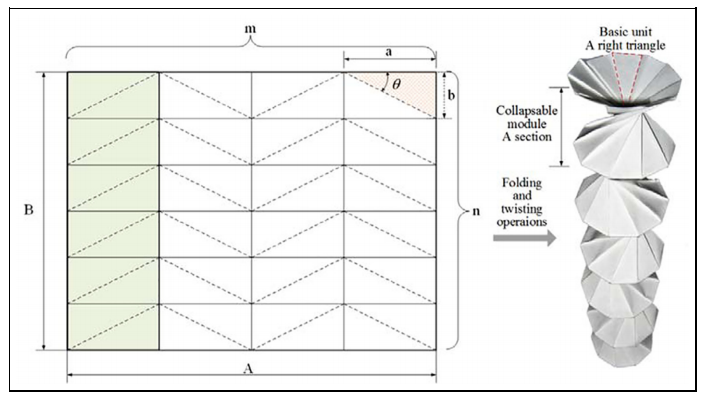
The collapsible spring was inspired by a paper rectangle folded and twisted with uniform right triangles.
Clinical Applications and Case Studies
Geometry of the paper spring from a crease pattern to spiral form.
“From the top view, when the paper spring is being deployed, the width of the spring shrinks in a spiral manner and the overlapping areas between fans increase until complete overlapping in the maximum deployable state,” explained the researchers.

Intrinsic metamaterial mechanisms of the collapsible paper spring: (a) Status #1–#2: highly reversible compressibility, (b) status #2–#3: good switchability between transverse compression and longitudinal stretchability, and (c) status #4: curvilinear deployment.
Regulatory Considerations and Safety
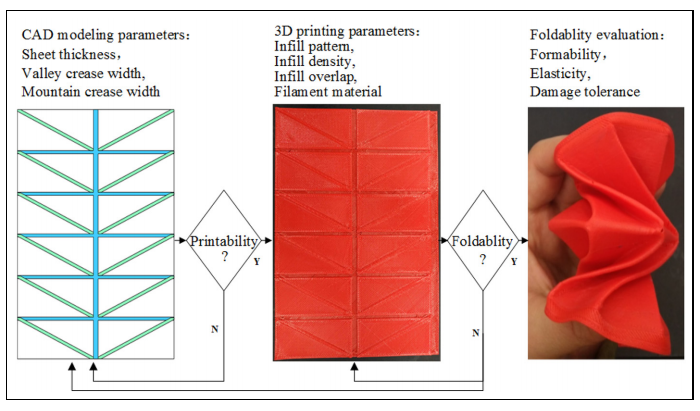
Digital fabrication flowchart of origami-inspired spring metamaterials.
Using their own customized 3D printer, PLA, and a 0.3mm FDM nozzle, they were able to “digitally work out the origami-inspired spring metamaterials.” They were able to create a soft gripper that proved to be “fully 3D printable” and helpful for picking up objects with more irregular shapes.
Research Breakthroughs and Innovations
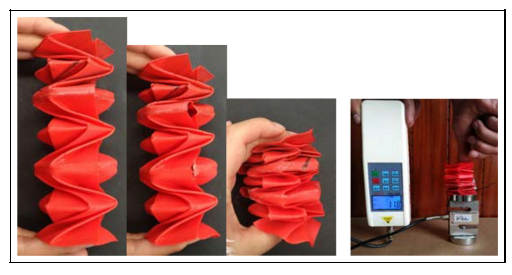
Origami-inspired spring metamaterials and their elasticity.
Overall, the team was able to employ 3D printing as a programmable control method, with the required mechanical properties—overcoming any obstacles regarding printability, foldability, and the need for better damage tolerance. Two types of soft robots were successfully fabricated, including their “creeping robot.”

The Future of Bioprinting and Medical AM
A fully soft manipulator with a highly reversible compressible arm: (a) fully soft
robotic arm with a three-finger gripper. (b) Pick and place a carton. (c) Pick and place a plastic
bag
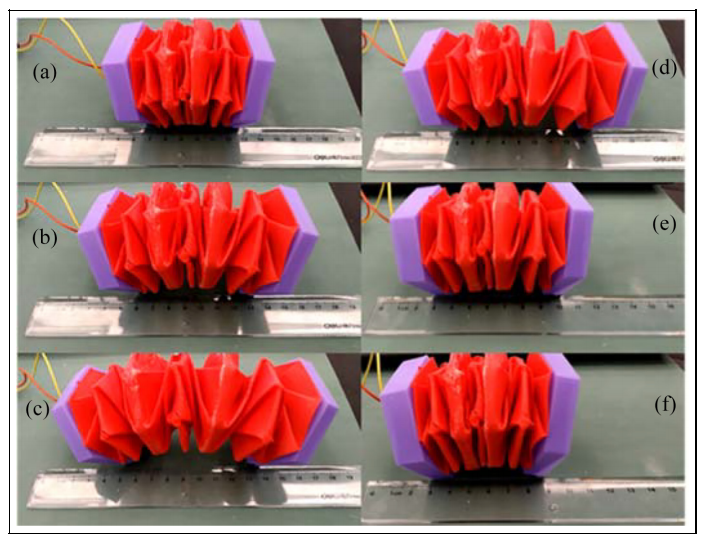
A peristaltic crawling robot with undulatory movements induced by curvilinear deployment. (a) Fully compressed state; (b) elongating state; (c) fully curvilinear deployment; (d) starting to compress; (e) compressing sate; and (e) fully compressed state
While 3D printing, 4D printing, and the use of metamaterials continue to expand via global research, soft robotics is also becoming more possible through more progressive technology like digital fabrication—leading to a variety of innovations to include biomimetic soft robots, integrated actuators, and even swimming soft robots.
The Role of 3D Printing in Medicine
[Source / Images: “Origami spring-inspired metamaterials and robots: An attempt at fully programmable robotics”]
The post Origami Inspires 3D Printed Soft Robotics appeared first on 3DPrint.com | The Voice of 3D Printing / Additive Manufacturing.
from 3DPrint.com | The Voice of 3D Printing / Additive Manufacturing https://bit.ly/3mo2FmJ
Related Articles: Intel Develops $50 3D Printed OpenBot to Advance Robotics Accessibility · Somatosensitive Actuators Integrated into Soft Robotics via 3D Printing · Harvard Develops New Method for 3D Printing Soft Robots with Built-In Programmable Movement
Frequently Asked Questions
How is 3D printing used in medicine?
3D printing is used in medicine for surgical planning models, custom implants, bioprinting tissue scaffolds, drug delivery systems, dental aligners, and prosthetics. It enables patient-specific solutions that improve outcomes and reduce surgery time.
What materials are biocompatible for 3D printing?
Common biocompatible materials include PEEK, titanium alloys (Ti6Al4V), bio-ceramics (hydroxyapatite), medical-grade resins, PLA for temporary implants, and hydrogels for bioprinting. Material choice depends on the application and required mechanical properties.
Is 3D printed medical equipment FDA approved?
Yes, several 3D printed medical devices have FDA clearance, including orthopedic implants, dental restorations, and surgical guides. Each device must go through the appropriate regulatory pathway based on its risk classification.
📌 Related Articles
- The Complete 3D Printing Filament Guide: Types, Properties & When to Use Each
- The Ultimate Guide to 3D Printer Calibration: Complete Step-by-Step Manual
- The Current State of Metal 3D Printing in 2020
- Best 3D Printer Upgrades That Actually Improve Print Quality: Complete 2026 Guide
- Best Budget 3D Printer Upgrades That Actually Improve Print Quality: Belts, Springs, Hotends & More