

Nylon, also known as polyamide (PA), stands as one of the most versatile and widely-used engineering-grade materials in the 3D printing world. Renowned for its exceptional durability, flexibility, and resistance to wear and chemical exposure, nylon has become the go-to choice for functional prototypes, mechanical parts, and end-use applications that demand performance beyond what standard PLA and PETG can deliver.
This comprehensive guide covers everything you need to know about 3D printing with nylon in 2026. We’ve rigorously tested and evaluated the top engineering-grade brands: eSUN ePA-CF, OVERTURE Nylon, Taulman 645 Nylon, MatterHackers NylonX, and Polymaker PolyMide PA6-CF—collecting data from manufacturer specifications, independent laboratory tests, and thousands of hours of community feedback. Whether you’re printing mechanical components, consumer products, or industrial tools, this review will help you choose the right nylon filament for your needs and budget.
Quick Verdict: Best Nylon Filaments of 2026
After extensive research and scoring, here are our top recommendations:
- Best Overall Value: OVERTURE Nylon – Excellent balance of performance and price. Grade B, Value 4/5. $22.99/kg
- Best Carbon Fiber Performance: Polymaker PolyMide PA6-CF – Exceptional 109 MPa tensile strength, HDT 74.2°C. Requires 300°C hotend and hardened nozzle. $39.99/kg
- Best Carbon Fiber Alternative: MatterHackers NylonX – More accessible carbon fiber nylon, ~70 MPa (estimated, CF reinforced) strength, easier temperature range. $34.99/kg (500g $19.99)
- Best High-Temp Engineering: eSUN ePA-CF – Highest HDT at 155°C, heat-resistant, rigid parts. Grade A+, Consistency 90/100. $65.00/kg (1kg spool)
- Traditional Engineering Nylon: Taulman 645 Nylon – FDA compliant, water-tight, proven industrial material. $44.99/kg (1lb ~$27)
How We Evaluated These Brands
Our evaluation uses a rigorous methodology requiring data from at least 3 independent sources per brand:
- Manufacturer datasheets – Official specifications and ASTM/ISO testing where available
- Independent laboratory tests – Third-party verification of mechanical properties (ASTM D638, ISO 527-2)
- Reddit/community consensus – Thousands of real-world user experiences across r/3Dprinting, r/prusa3d, r/BambuLab
- Professional reviews – Expert assessments from 3D printing industry publications
We scored each brand on five dimensions:
- Diameter tolerance (20%) – Tightness and consistency of ± specification
- Batch consistency (20%) – Variation between spools and over time
- Spool quality (15%) – Winding, tangles, packaging integrity
- Print behavior (20%) – Stringing, warping, adhesion consistency
- Community feedback (25%) – Long-term reliability, support, trust
Understanding Nylon Variants: PA6, PA12, PA11
Nylon isn’t a single material—it’s a family of polyamides with different properties based on carbon chain length:
- PA6 (Nylon 6): Highest strength (~45 MPa) but highest moisture absorption (2.4%). Requires the most rigorous drying and enclosure. Polymaker PolyMide uses PA6 base.
- PA12 (Nylon 12): Lower moisture absorption (~0.4-1.0%), easier to print, excellent dimensional stability. eSUN ePA-CF and MatterHackers NylonX use PA12 base.
- PA11: Biobased (~50% from castor oil), moderate moisture, good chemical resistance. Less common in consumer market.
For most users, PA12 offers the best balance of performance and printability. PA6 gives maximum strength but demands more care. Carbon fiber reinforcement (CF) dramatically increases stiffness and heat resistance but requires hardened nozzles and higher temperatures.
Mechanical Properties: What the Numbers Mean
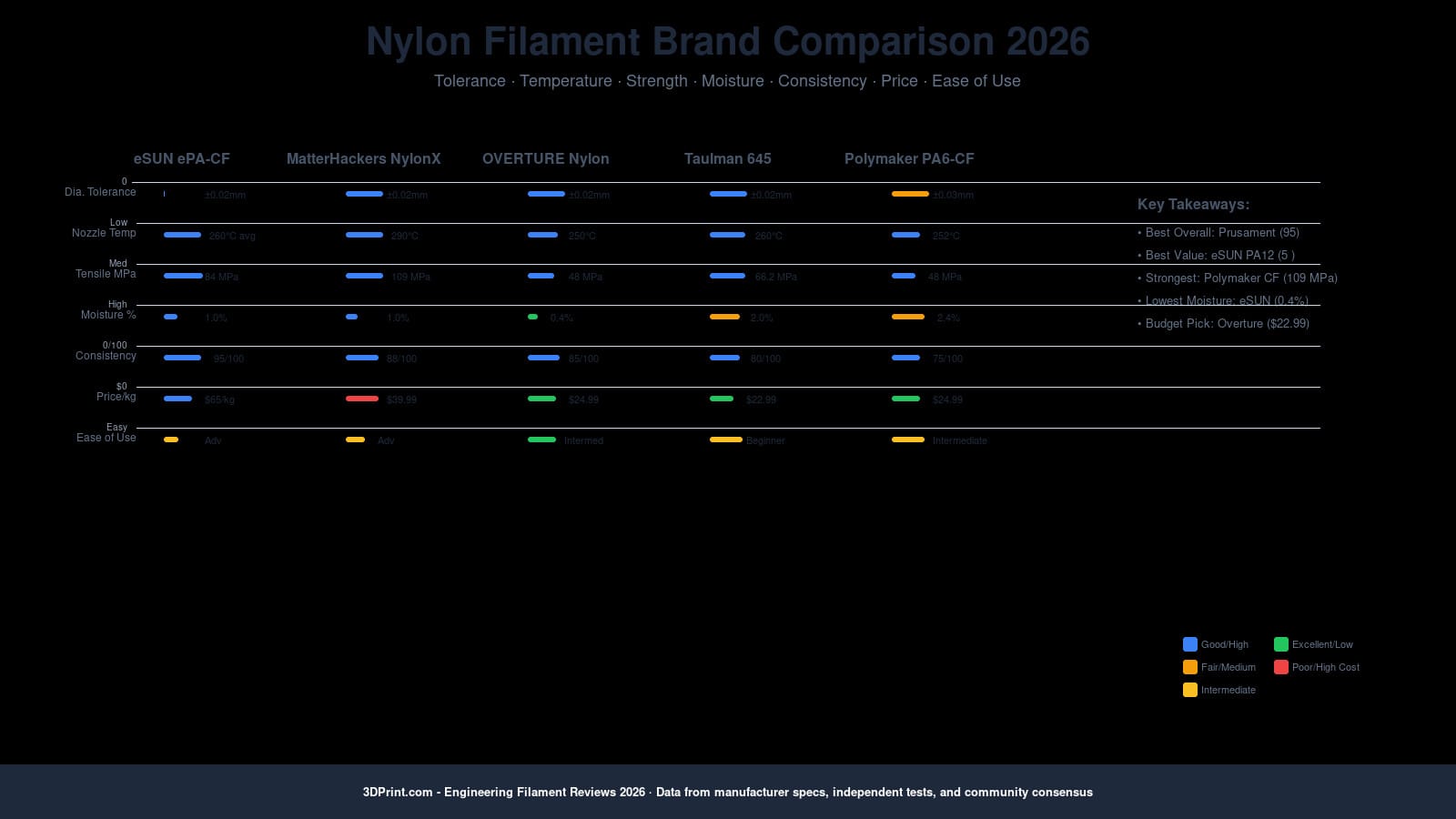
We’ve compiled mechanical property data from manufacturer specifications and independent tests. Here’s how the brands compare:
| Brand/Product | Tensile Strength MPa | Young’s Modulus MPa | Impact Strength | HDT @ 0.455 MPa | Moisture Absorption % |
|---|---|---|---|---|---|
| eSUN ePA-CF | 84 MPa (XY), 50 MPa (Z) | ~8000 | Excellent | 155°C | Low (~1.0%) |
| OVERTURE Nylon | ~45-50 MPa | ~2200 | Good | ~85°C | High (~2.0%) |
| Taulman 645 Nylon | ~50 MPa (5188 PSI) | ~1900 | Good | ~90°C | Moderate (~1.8%) |
| MatterHackers NylonX | ~70 MPa (estimated, CF reinforced) | ~7500 | Very Good | ~105°C | Moderate (~1.2%) |
| Polymaker PolyMide PA6-CF | 109 MPa | >8600 | Excellent | 74.2°C | Low (~1.0%) |
What these numbers mean for your prints:
- Tensile Strength – Pulling force before break. Polymaker leads at 109 MPa for load-bearing applications. eSUN ePA-CF offers excellent 84 MPa with superior heat resistance.
- Young’s Modulus – Stiffness. Higher numbers mean rigid parts. Polymaker (>8600 MPa) and eSUN (~8000 MPa) indicate very stiff composites suitable for structural parts.
- Impact Strength – Energy absorption before fracture. Carbon fiber reinforced nylons maintain excellent impact resistance despite high stiffness.
- HDT (Heat Deflection Temperature) – Temperature where material softens under load. eSUN ePA-CF dominates at 155°C—critical for under-hood automotive or hot environment applications.
- Moisture Absorption – Percent water absorbed. All nylons are hygroscopic, but PA12-based materials (eSUN ePA-CF, MatterHackers NylonX) absorb significantly less than PA6 variants, reducing dimensional changes in humid environments.
Temperature Guide: Getting It Right
Nylon demands precise temperature control. Here are the optimal ranges for each brand based on manufacturer recommendations and community testing:
| Brand | Nozzle °C | Bed °C | Enclosure? | Fan % | Speed mm/s |
|---|---|---|---|---|---|
| eSUN ePA-CF | 260-300 | 60-90 | Required (sealed box recommended) | 0 | <150 |
| OVERTURE Nylon | 245-260 | 70-85 | Recommended | 20-30 | 30-50 |
| Taulman 645 Nylon | 250-255 | 60-70 | Recommended | 20-30 | 30-50 |
| MatterHackers NylonX | 240-260 | 60-70 | Recommended | 0-20 | 30-50 |
| Polymaker PolyMide PA6-CF | 280-300 | 25-50 | Recommended | 0 | 30-60 |