
German company ViscoTec develops systems needed for conveying, dosing, applying, filling, and emptying fluids, which includes printheads for viscous fluids and two-component 3D printing. Its innovations are used in many industries, from aerospace, e-mobility, and food to medical and pharmaceutical, and now textiles as well. French company Lynxter, which manufactures modular industrial machine tools and 3D printers, is using ViscoTec’s printheads for an interesting textile 3D printing project.
While 3D printing has been used before with textiles, the thermoplastics typically used in this application don’t have the elasticity, flexibility, texture, and wear resistance needed when you’re working with fabric. Lynxter sees 3D printing as a true production tool, and decided to take a closer look at how silicone 3D printing material behaves with textiles, since its modular S600D 3D printer can work with the soft, elastic material.
The Role of 3D Printing in Medicine
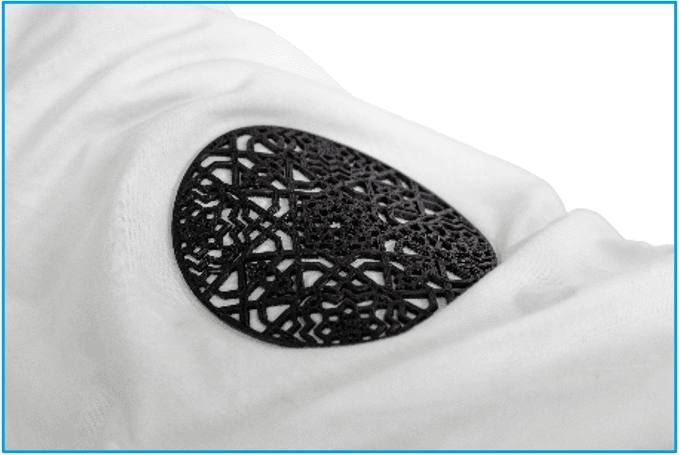
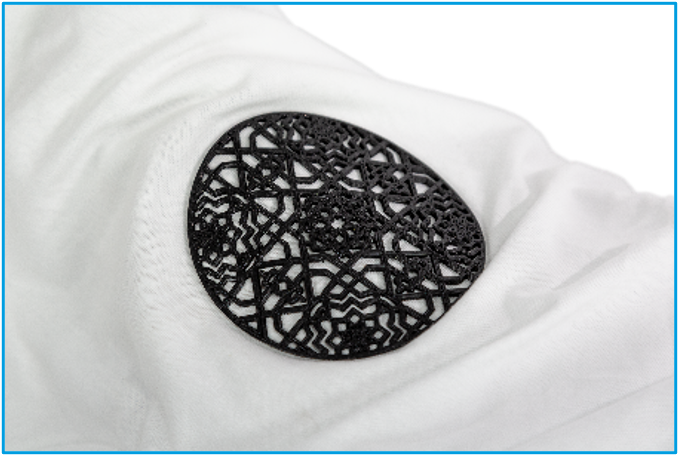
3D printed filigree structures on a textile
Silicone is a polymer with great chemical and UV ray resistance, which makes it good for fabricating medical prosthetics. But, the material also adheres well to fabric, a quality Lynxter is putting to good use in optimizing technical functions of textiles for its luxury goods and sportswear clients.
“3D printing of silicone makes it possible to meet the growing demand for product customization from consumers looking for uniqueness,” Lynxter wrote in an interview with ViscoTec. “This solution also gives the freedom to create patterns with complex 3-dimensional shapes or different layer heights, which are impossible to achieve with traditional processes. It offers greater possibilities for designing custom-made patterns, as well as a wide choice of positioning patterns on the fabric which were not always accessible with other processes. The user will be able to work more creatively, and the silicone’s characteristics ensure the expected comfort of a garment.”
Biocompatible Materials and Processes

(Image courtesy of Lynxter)
Lynxter needed a compact printhead with limited mass and the ability to embed electrical components with standard AM control boards. It also had to be able to handle different compatible flow rates and viscosities. The tool head on Lynxter’s S600D printer can be easily changed in order to print different materials, which is why the company chose ViscoTec’s vipro-HEAD 3 for silicone printing, after testing it with several kinds of fabric, like polyesters and cottons, as well as standard and custom silicones, with multiple extrusion speeds, string width, and thicknesses. Lynxter also explained that the company’s accurate, reliable, and quality components made the choice a no-brainer.
Clinical Applications and Case Studies
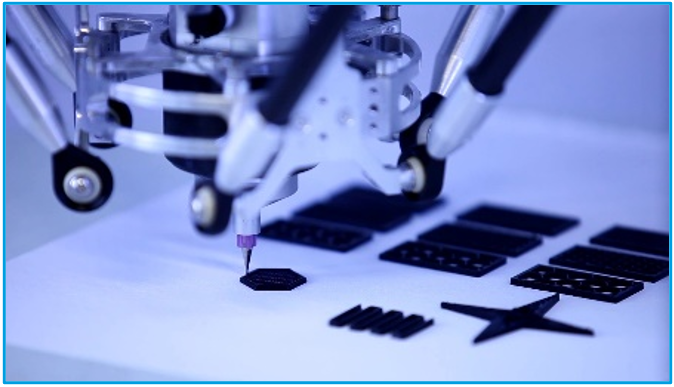
Used S600D 3D printer for individually created textile structures made of silicone
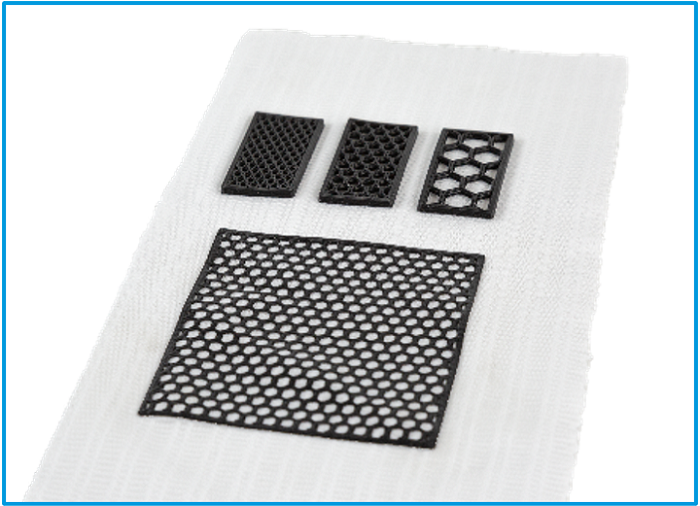
The company selected a one-component RTV silicone, with a shore hardness of 34, to 3D print on the textile, as the “characteristics meet the constraints of use and maintenance of textiles: elasticity (high elongation rate), heat resistance, and resistance to moisture and chemicals.”
“Once the printing project has been defined, the machine deposits silicone beads on the fabric to create a 3D pattern. Printing and drying times will vary depending on the size and complexity of the project,” Lynxter wrote.
Regulatory Considerations and Safety
“We quickly and precisely create a 3-dimensional pattern on the fabric. The printing integrates perfectly with the type of textile, e.g. comfort, fluidity, elasticity. This ensures that the garment is pleasant to wear after the process. The aesthetic result is highly satisfactory. Following the various wear tests carried out, the silicone held well on the fabric when in use and showed good stability during washing.”
Lynxter says that 3D printing silicone on textiles can be considered “a real asset for companies,” as items can be fabricated in the actual area where products are made, which negates the use of go-between companies and shipping—creating a lower carbon footprint in the process. See also: Best Budget 3D Printer Upgrades That Actually Impr…. An additional benefit is an economic one, as this can lower “the margins linked to intermediaries and constitutes a gain in reaction time and efficiency for companies.”
Research Breakthroughs and Innovations
Textiles with 3D printed silicone can be used in many applications requiring personalized and branded fabrics, such as furniture, fashion, sporting equipment, and others.
“Interesting projects will be further developed and implemented in the coming months,” Lynxter wrote. “We are still only just discovering the potential of this technology, but the feedback from the field is already very positive.”
The Future of Bioprinting and Medical AM
(Images courtesy of ViscoTec unless otherwise noted)
The post Lynxter 3D Printing Silicone onto Fabric with ViscoTec Printheads appeared first on 3DPrint.com | The Voice of 3D Printing / Additive Manufacturing.
from Your daily news from 3DPrint.com https://bit.ly/3fP3HnX
Related Articles
Frequently Asked Questions
How is 3D printing used in medicine?
3D printing is used in medicine for surgical planning models, custom implants, bioprinting tissue scaffolds, drug delivery systems, dental aligners, and prosthetics. It enables patient-specific solutions that improve outcomes and reduce surgery time.
What materials are biocompatible for 3D printing?
Common biocompatible materials include PEEK, titanium alloys (Ti6Al4V), bio-ceramics (hydroxyapatite), medical-grade resins, PLA for temporary implants, and hydrogels for bioprinting. Material choice depends on the application and required mechanical properties.
Is 3D printed medical equipment FDA approved?
Yes, several 3D printed medical devices have FDA clearance, including orthopedic implants, dental restorations, and surgical guides. Each device must go through the appropriate regulatory pathway based on its risk classification.
📌 Related Articles
- 3D Printing News: Multi-Material Breakthrough and Aerospace Market Boom
- Best Budget 3D Printer Upgrades That Actually Improve Print Quality: Belts, Springs, Hotends & More
- Best 3D Printer Upgrades That Actually Improve Print Quality: Complete 2026 Guide
- 3D Printing Safety Equipment Guide: Respirators, Gloves, and Ventilation for 2026
- The Complete 3D Printing Filament Guide: Types, Properties & When to Use Each