
Researchers from the UK and Australia continue the trend in exploring 3D printing technology for patient-specific treatment, releasing their findings in the recently published ‘A review of 3D printed patient-specific immobilization devices in radiotherapy.’
3D printing has been a boost to cancer treatments in terms of medical models, devices, phantoms and more. In this study, the authors explore how 3D printing is improving radiotherapy, ensuring that cancer patients are delivered correct—and optimal—doses of medication. With the use of immobilization devices, patients are restricted from making movements during treatment that could jeopardize proper targeting of cancer cells during radiotherapy. Accuracy is critical so healthy tissue is not affected.
Immobilization devices are critical to this treatment process, minimizing patient movement, and ensuring repeatability of the treatment over as much as 40 sessions [30].
‘Non-invasive fixation’ is the most common treatment today, consisting of a customized mask made from thermoplastic fitted directly to the patient’s anatomy. Masks may be erratic in quality, however, depending on the competency of the operator creating the mask, and changes in the patient’s weight that could cause masks to become too big or too small. The researchers note that in previous studies, opinions regarding accuracy range from suitable to impossible in terms of reaching ‘high accuracy.’
The Role of 3D Printing in Medicine
The benefits of 3D printing and additive manufacturing processes can be applied not only to that of models, implants, prosthetics, and tissue engineering, but also in the fabrication of such devices mentioned in this review study.

Biocompatible Materials and Processes
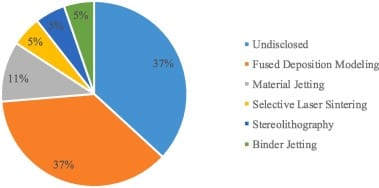
AM technologies utilised in literature.
“In particular, AM has the capacity to reproduce the complexities of the human form, resulting in a new generation of patient tailored medical solutions,” stated the authors. “More recently, AM has been applied to upper body splint-based applications, and there is growing interest for uses in radiotherapy treatments.”
“As a result, it has gained the attention of researchers as a new method for producing non-invasive immobilization devices utilizing 3D patient models, such as those captured during Computed Tomography (CT) or Magnetic Resonance Imaging (MRI), combined with advanced Computer-Aided Design (CAD), 3D scanning and virtual planning software.”
Initially, 4,152 related papers were discovered via 38 different databases and journals. After removing 4,080 results for various rules of exclusion, the authors were left with 18 papers to read and analyze. Benefits of using 3D printing included:
- Patient comfort
- Decreased number of medical visits
- Elimination of ‘stressful’ thermoforming process to create masks
- High accuracy
- Decreased damage to healthy tissue
Drawbacks included:
- Negative influence regarding material behavior of a device
- Inaccuracies stemming from conversion of scanned data
- Slower process
- Lower accuracy
- Minimal difference in affordability, or even greater expense in some cases
The researchers note that although the range of studies performed CTs, MRIs, optimal 3D scanning and other CAD methods, they did not demonstrate a prevailing option about the best method for creating data—despite that CT scanning was the method used in almost half of the studies analyzed.
“It will become increasingly important for practitioners to learn how to manipulate DICOM files within 3D CAD software to progress this field of research, and may require collaborations between clinicians and surgeons with expertise in human anatomy, with designers and engineers with expertise in advanced CAD software systems,” stated the authors.
Clinical Applications and Case Studies
More study is also necessary regarding cost, as the numbers varied wildly from one research study to another. The authors also noted that production times vary, remaining ‘unclear’; for example, one study claims it took five days to 3D print a mask, while another reported only 36 hours to print a human head for thermo-forming a mask over.
“These times are significantly longer than more immediate traditional methods of thermoforming or surgically attaching immobilizers, however, a lack of information reported in literature does not provide enough evidence to provide a clear understanding of the time to 3D print immobilization devices,” concluded the researchers.
Regulatory Considerations and Safety
What do you think of this news? Let us know your thoughts! Join the discussion of this and other 3D printing topics at 3DPrintBoard.com.
[Source / Images: ‘A review of 3D printed patient specific immobilization devices in radiotherapy’]
The post International Researchers Review 3D Printed Immobilization Devices for Cancer Treatment appeared first on 3DPrint.com | The Voice of 3D Printing / Additive Manufacturing.
Related Articles
Frequently Asked Questions
How is 3D printing used in medicine?
3D printing is used in medicine for surgical planning models, custom implants, bioprinting tissue scaffolds, drug delivery systems, dental aligners, and prosthetics. It enables patient-specific solutions that improve outcomes and reduce surgery time.
What materials are biocompatible for 3D printing?
Common biocompatible materials include PEEK, titanium alloys (Ti6Al4V), bio-ceramics (hydroxyapatite), medical-grade resins, PLA for temporary implants, and hydrogels for bioprinting. Material choice depends on the application and required mechanical properties.
Is 3D printed medical equipment FDA approved?
Yes, several 3D printed medical devices have FDA clearance, including orthopedic implants, dental restorations, and surgical guides. Each device must go through the appropriate regulatory pathway based on its risk classification.
📌 Related Articles
- Best 3D Printers Under $500: 2026 Comparison Guide
- The Current State of Metal 3D Printing in 2020
- Best 3D Printer Upgrades That Actually Improve Print Quality: Complete 2026 Guide
- Best Budget 3D Printer Upgrades That Actually Improve Print Quality: Belts, Springs, Hotends & More
- How Divergent Technologies Is 3D Printing Cruise Missiles for the U.S. Military