
Researchers from China continue in the quest to continually top 3D printing capabilities, adding complex layers with other technologies into the fold, as detailed in the recently published ‘Smart additive manufacturing: Current artificial intelligence-enabled methods and future perspectives.’
The authors are quite blunt—and accurate—in their abstract, regarding needs in additive manufacturing, stating that “because of its rapid growth, the efficiency and robustness of AM-based product development processes should be improved.”
This point of view is shared by researchers around the world who not only want to stretch the limits of technology like 3D printing, but also ambitiously reach for the rewards of potential, and seemingly infinite, innovations. Such strides are revolutionizing fields like medicine and architecture, as well as bolstering production in applications like automotive and aerospace.
The greatest benefits of 3D printing are undeniably felt within manufacturing, as industrial users realize faster turnaround in production, better affordability, and the ability to make products that would have been impossible with conventional methods. As the researchers explain, however, success is based on user expertise as they engage in product development, to include:
- Design
- Process planning
- Production planning
- Process monitoring
Accentuated by other technologies like artificial intelligence, manufacturing processes can be further streamlined with smart agents capable of searching for answers, learning, and acting. In this study, the authors sought to identify what gaps and limitations might exist in using AI, as well as considering future potential for smarter AM, defined as: “a fully integrated, collaborative additive manufacturing system that responds in real time to support ubiquitous and intelligent design, manufacturing and services of 3D printed products.”
Understanding Filament Properties
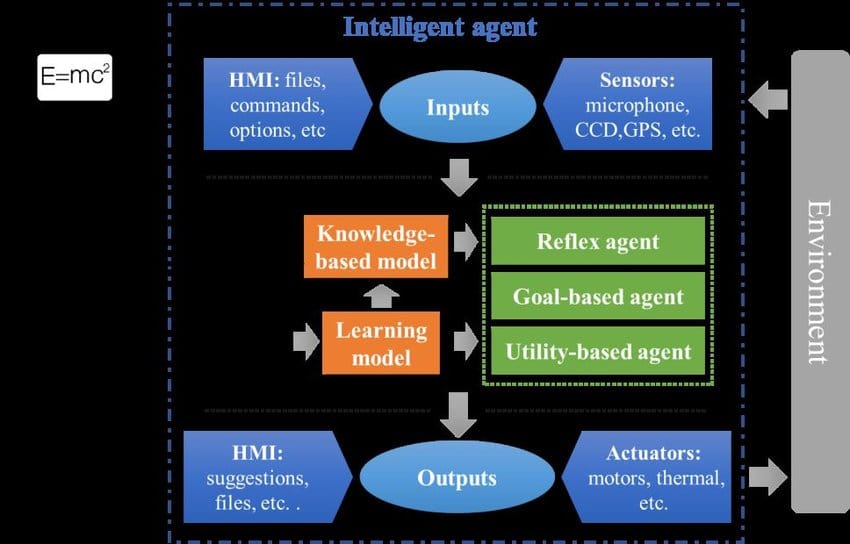
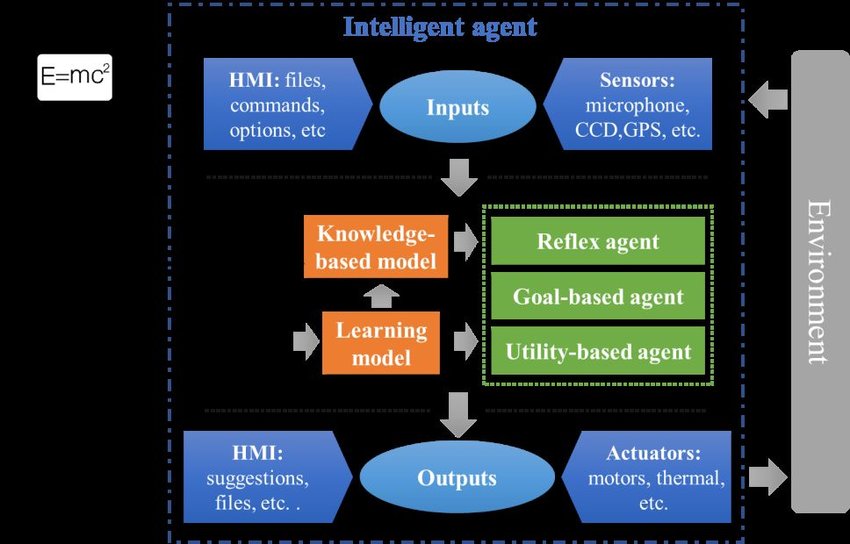
The basic structure of intelligent agents
Separated into three types, smart agents are considered to be reflex agents, goal-based agents, and utility-based agents. They may be involved in software or hardware processes, responsible for input and output of commands and files, or they may function as sensors for images, direction, or sound.
Material Comparison and Selection
The basic structure of intelligent agents
“The layer between the inputs and outputs contains the core functions that form problems and generate solutions. These functions can be based on various structured and unstructured information and knowledge,” explained the researchers.
Each type of AI agent allows users to optimize processes; for instance, knowledge-based agents are able to compile data for users who may be lacking in experience regarding specific production, while goal-based agents may be used in optimization for more expansive design spaces. Current knowledge gaps exist in terms of:
- Lack of comprehensive integration of knowledge in applications
- Need for improvement in current accuracy and generality of models, especially as a deeper understanding of AM processes is met
- Standard databases for the gathering of data
- Lack of integration for a variety of models
- Application of learning models
An underlying theme in this study is the continued need for high-quality and high-volume knowledge in AM-based processes.
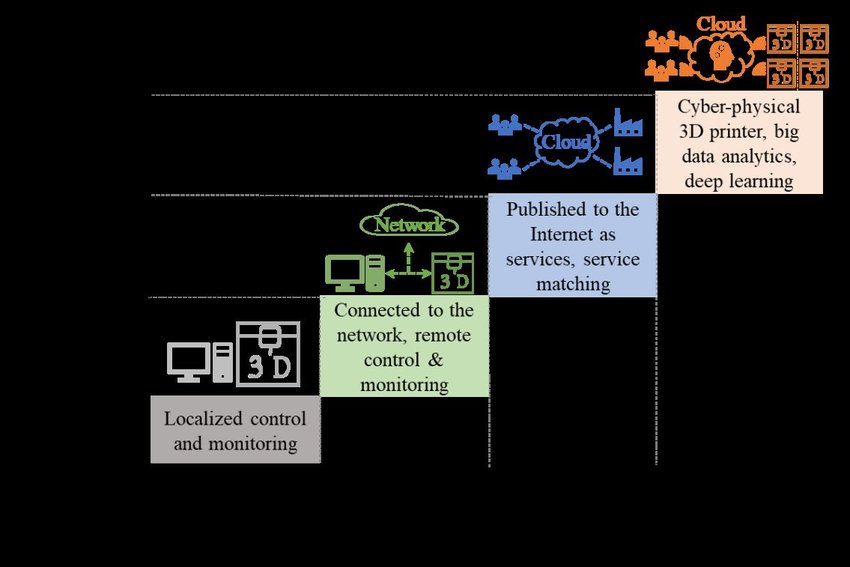
“The agents with searching and planning algorithms usually require a large computational power. See also: The Complete 3D Printing Filament Guide: Types, Pr…. In addition, some tasks require a fast response. Learning-based real-time control and monitoring is required for the training and execution stages, respectively,” stated the researchers. “Although cloud-based design and simulation software have been developed, real-time tasks cannot be performed. Therefore, a new efficient computational framework should be studied to fulfil both requirements.”
Print Settings and Optimization
“Because of deep learning development, AI use has increased in many fields. The unique capabilities of AI have also increased the attention given to the improvement of AM-based product development,” concluded the researchers.
What do you think of this news? Let us know your thoughts! Join the discussion of this and other 3D printing topics at 3DPrintBoard.com.
[Source / Images: ‘Smart additive manufacturing: Current artificial intelligence-enabled methods and future perspectives’]
The post Greater Potential for Artificial Intelligence in Additive Manufacturing appeared first on 3DPrint.com | The Voice of 3D Printing / Additive Manufacturing.
Strength and Durability Testing
from Your daily news from 3DPrint.com https://bit.ly/3hJPUR7
Related Articles
Frequently Asked Questions
What is the best 3D printing filament for beginners?
PLA is the best starting filament — it prints easily at 190-220°C without an enclosure and produces good results. Once comfortable, PETG offers better strength and temperature resistance for functional parts.
How do I choose the right filament?
Consider the application: PLA for display models, PETG for functional parts, ABS/ASA for heat/sunlight exposure, TPU for flexible parts, and specialty filaments for engineering applications. Each has specific printer requirements.
What temperature should I print different filaments at?
PLA: 190-220°C nozzle / 50-60°C bed. PETG: 220-250°C / 70-80°C. ABS: 230-260°C / 100-110°C (enclosure needed). Nylon: 240-270°C / 70-90°C. Always check manufacturer recommendations for specific brands.
📌 Related Articles
- The Current State of Metal 3D Printing in 2020
- The Complete 3D Printing Filament Guide: Types, Properties & When to Use Each
- Best Budget 3D Printer Upgrades That Actually Improve Print Quality: Belts, Springs, Hotends & More
- 3D Printing News: Multi-Material Breakthrough and Aerospace Market Boom
- How Divergent Technologies Is 3D Printing Cruise Missiles for the U.S. Military