

 If we could visualize the future of medicine, drug testing, and artificial tissue and organ development, we would most certainly find bioprinters in the spotlight. Part of the vanguard vision of many companies and researchers alike is that the machines will become a familiar resource used in every bioengineering lab, university and even school around the globe. But building up to that momentum might take many years, even decades, yet this is becoming one of the most interesting times for the field, with a widening array of companies boosting bioprinting technology commercially, we can’t help but get excited when we hear about recent advances and newly launched machines.
“The BIOprinter has been designed to be the ultimate bio research instrument in a cost-effective package, and has been developed alongside the brightest minds in the bioprinting sector,” suggested Wilgo Feliksdal, co-founder of FELIXprinters. “Uniquely, the BIOprinter combines dual sterilizable printheads which have a modular design for easy changeovers, and separate heads are available to print different bioinks at the same time. This integrates different material properties into a single scaffold structure.”
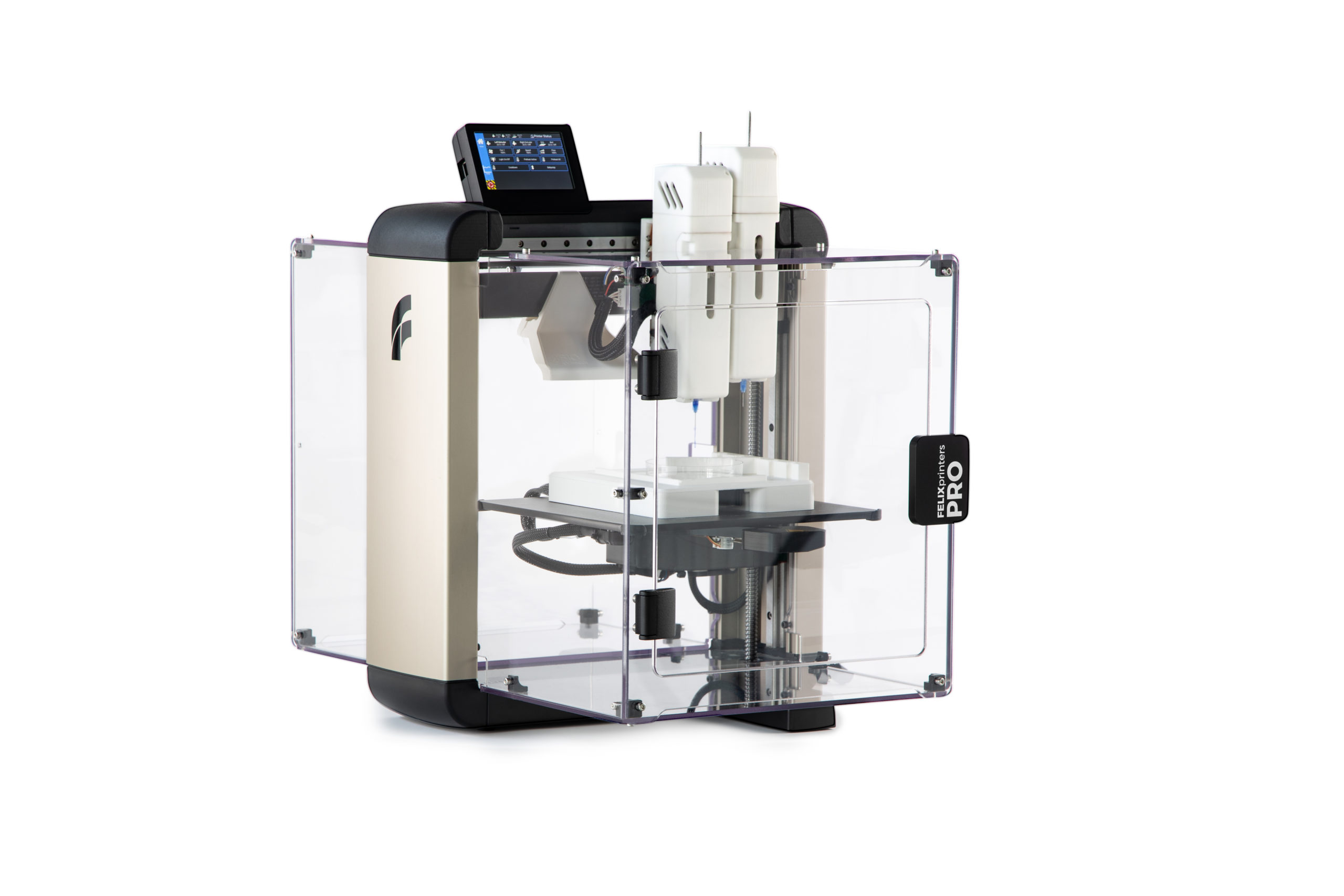
The new BIOprinter (Image: FELIXprinters)
It is also equipped with a touchscreen that has a user-friendly interface and embedded print server that allows remote print file monitoring, use in a multi-user environment, and print-file management. A nozzle probing system enables automated bed leveling and calibration of the nozzles, plus a camera module that allows users to monitor prints remotely from their smartphone or computer complete the features of this machine. FELIX indicates that the BIOprinter also retracts with a highly precise motor for better dosage or materials and more accurate material flow versus alternative air pressure systems.
“The BIOprinter consists of an adaptable and flexible ecosystem to ensure that it can meet a wide range of researchers’ needs without generating unnecessary costs. One major advantage is the source control system which enables the user to use standard slicing software and make changes themselves if needed. Also, syringes are not restricted to expensive brand-specific or in-house produced products that essentially drive up operating costs. The machine instead has been designed to use a standard 5ml syringe, and standardized Petri dishes and culture plates, so there are no limitations on auxiliary parts and materials,” continued Feliksdal.
The Role of 3D Printing in Medicine
A big plus is that the machine uses familiar slicing software Simplify 3D, to allow fully in-control and customizable user experience. The BIOprinter is also WIFI and LAN enabled, comes with a one-year warranty, and lifetime customer support.
The post FELIXprinters Launches Its First Bioprinter the FELIX BIOprinter appeared first on 3DPrint.com | The Voice of 3D Printing / Additive Manufacturing.
from Your daily news from 3DPrint.com http://bit.ly/2TCjuOn
Frequently Asked Questions
How is 3D printing used in medicine?
3D printing is used in medicine for surgical planning models, custom implants, bioprinting tissue scaffolds, drug delivery systems, dental aligners, and prosthetics. It enables patient-specific solutions that improve outcomes and reduce surgery time.
What materials are biocompatible for 3D printing?
Common biocompatible materials include PEEK, titanium alloys (Ti6Al4V), bio-ceramics (hydroxyapatite), medical-grade resins, PLA for temporary implants, and hydrogels for bioprinting. Material choice depends on the application and required mechanical properties.
Is 3D printed medical equipment FDA approved?
Yes, several 3D printed medical devices have FDA clearance, including orthopedic implants, dental restorations, and surgical guides. Each device must go through the appropriate regulatory pathway based on its risk classification.
📌 Related Articles
- ABS 3D Printing Settings Guide: Temperature, Enclosure, and Cooling for Strong Parts
- The Ultimate Guide to 3D Printer Calibration: Complete Step-by-Step Manual
- The Current State of Metal 3D Printing in 2020
- Best 3D Printer Upgrades That Actually Improve Print Quality: Complete 2026 Guide
- Best Budget 3D Printer Upgrades That Actually Improve Print Quality: Belts, Springs, Hotends & More