

New research is emerging from Saarbrücken, Germany as Professor Dirk Bähre and his team at Saarland University work to improve 3D printing with metal. Combining electrochemical machining (ECM) with metal fabrication, their new method allows for many of the benefits of 3D printing to come together at once, with the ability to make complex geometries that may not have been possible before using conventional techniques. Strong, lightweight parts can be constructed with accuracy, “precision-finish,” and dimensional tolerances measuring at just a few thousandths of a millimeter.

The State of Metal 3D Printing
Professor Dirk Bähre
While automotive companies and organizations like NASA have been enjoying the advantages of 3D printing for years—mainly with rapid prototyping in the beginning—today metal additive manufacturing processes are used to make many different, highly functional parts. More importantly though, these parts can be heavily customized to meet the needs of industrial users. Precision is key in designing and producing parts that may be responsible for auto, aircraft, or rocket performance—and in many cases, there are many different parts, most of which are specialized in terms of specific applications.
“Tolerances can be down in the micrometer range,” says Professor Dirk Bähre.
Technical Challenges and Solutions
In this current research, the scientists—experienced in both precision machining and finishing—set out to improve metal fabrication further, and especially in regard to dimensional tolerances. Hoping to print parts that are even more complex, and more precise, they decided to combine electrochemical machining for improvement, using metal alloys such as aluminum, titanium, or steel.
“Our technology for post-processing additively manufactured metal parts offers a cost-effective means of producing high-precision functional surfaces for applications where extremely tight tolerances are crucial. It enables large numbers of parts to be post-processed efficiently and economically,” explained Bähre. “Our non-destructive, non-contact manufacturing technology enables us to efficiently machine parts with intricate geometries even when made from high-strength materials,”
Material Properties and Performance

Precision machining is a specialty of the Saarbrücken manufacturing technicians led by Professor Dirk Bähre (left, here with the technical assistant Stefan Wilhelm from his research group). Using innovative processes, they form components made of heavy-duty metals with a precision of a thousandth of a millimeter by combining 3D printing and electrochemical removal. (Photo credit: © Oliver Dietze)
Only an electrical connection is necessary for production as the 3D printed parts are bathed in an electrolyte solution and then machined to the proper specifications. No mechanical contact is required, and no mechanical stress is placed on the part. Any metal particles are eliminated during this phase.
“By adjusting the duration of the current pulses and the vibration of the tool, we can remove surface material very uniformly leaving particularly smooth surfaces and achieving high dimensional precision,’ says Bähre.
Industrial Applications and Use Cases
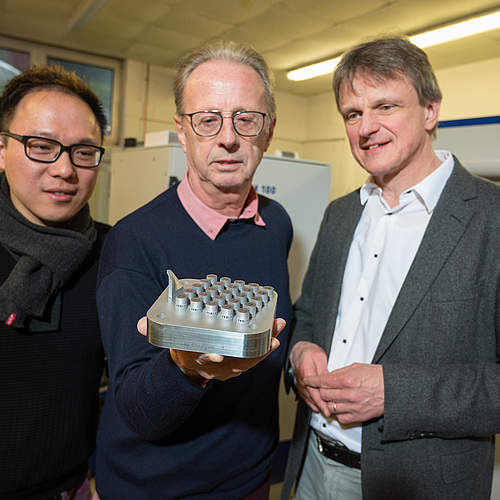
(Photo credit: © Oliver Dietze)
The performed numerous experiments, along with “rigorously examining” every step involved in the novel technique:
“Optimizing post-processing requires a thorough understanding of both the material and the process. We need to know, for example, exactly what happened to the metal during the preceding 3D printing stage. That’s why we carefully study the microstructure of the metal produced in the 3D printing process. By meticulously examining both process technology and material behavior, we can improve and optimize the electrochemical methods in order to obtain even smoother surfaces or more complex geometries at even higher levels of precision,” Bähre said. “We examine in detail how the different material and process parameters interact and then determine how the overall production process should be configured.”
Comparing Metal AM to Traditional Manufacturing
While Dirk Bähre and his research team also work with numerous business and industry-related partners, some of their projects are also funded by the European Regional Development Fund.
What do you think of this news? Let us know your thoughts! Join the discussion of this and other 3D printing topics at 3DPrintBoard.com.
[Source / Images: EurekAlert; images: © Oliver Dietze]
Future Developments in Metal Additive Manufacturing
The post Electrochemical Machining & Metal 3D Printing Yield Micrometer Dimensional Tolerances appeared first on 3DPrint.com | The Voice of 3D Printing / Additive Manufacturing.
from Your daily news from 3DPrint.com https://bit.ly/3fo78S5
Related Articles
Frequently Asked Questions
What is metal 3D printing?
Metal 3D printing (additive manufacturing) builds metal parts layer by layer using techniques like laser powder bed fusion, directed energy deposition, and binder jetting. It enables complex geometries impossible with traditional manufacturing while reducing material waste significantly.
How strong are 3D printed metal parts?
3D printed metal parts can achieve mechanical properties comparable to traditionally manufactured metals. Tensile strength and fatigue resistance depend on the process and post-processing, but many meet or exceed ASTM standards for wrought materials.
What are the main metal 3D printing technologies?
The primary technologies include Laser Powder Bed Fusion (LPBF), Electron Beam Melting (EBM), Directed Energy Deposition (DED), Binder Jetting, and Metal FDM (with bound filaments). Each has different strengths in terms of resolution, speed, and material options.
📌 Related Articles
- ABS 3D Printing Settings Guide: Temperature, Enclosure, and Cooling for Strong Parts
- Best Budget 3D Printer Upgrades That Actually Improve Print Quality: Belts, Springs, Hotends & More
- Best 3D Printer Upgrades That Actually Improve Print Quality: Complete 2026 Guide
- Prusa Research Mini+ vs Prusa MK4: Full Specs Comparison & Buyer’s Guide
- Bambu Lab P1S vs Bambu Lab P2S: Full Specs Comparison & Buyer’s Guide