
Niek Groot takes on the topic of layer deposition in printing with resin, detailing his findings in ‘The influence of coater velocity on layer deposition in the 3D-printing process,’ a thesis submitted to Eindhoven University of Technology. With a focus on vat photopolymerization, the author investigates challenges that arise during layer deposition.
How 3D Printing Responded to COVID-19
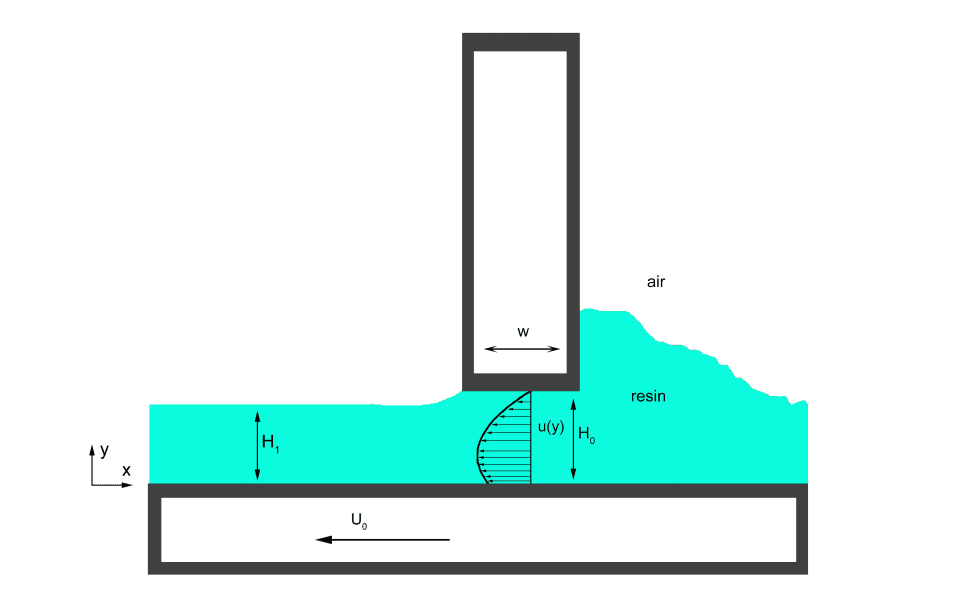
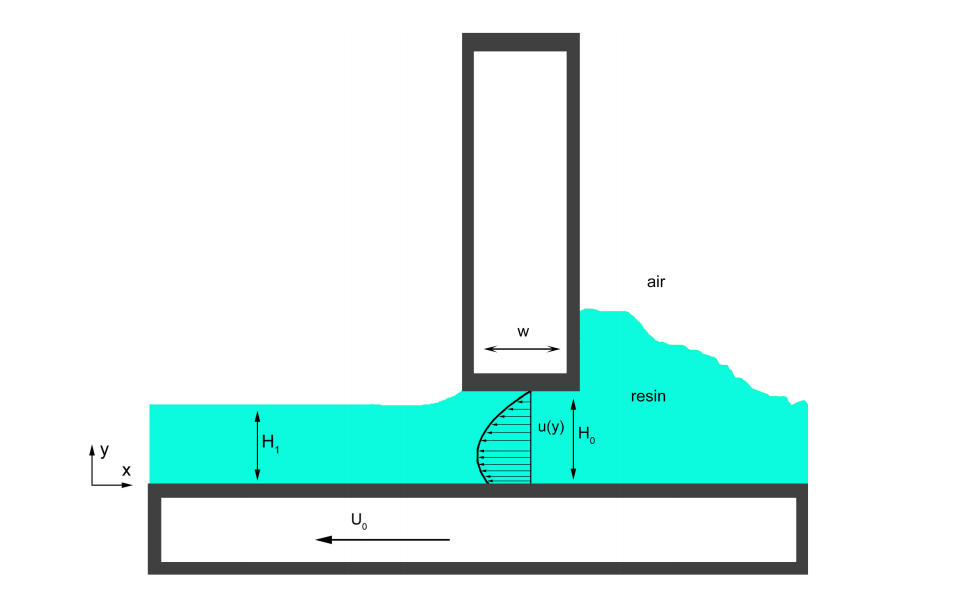
A schematic view of the process of layer deposition in which the velocity profile
can be seen in between the coater blade and the bottom plate
Printing ceramics is becoming increasingly more popular with users around the globe, as they streamline techniques, experiment with new materials and composites, and create new molds and templates. Groot points out though that during printing, small deformations may occur. If this happens multiple times, leaving deformations stacked on top of each other throughout the 3D printed layers, there may be imperfections that threaten the integrity of the overall product.
HP and the Pandemic Manufacturing Shift
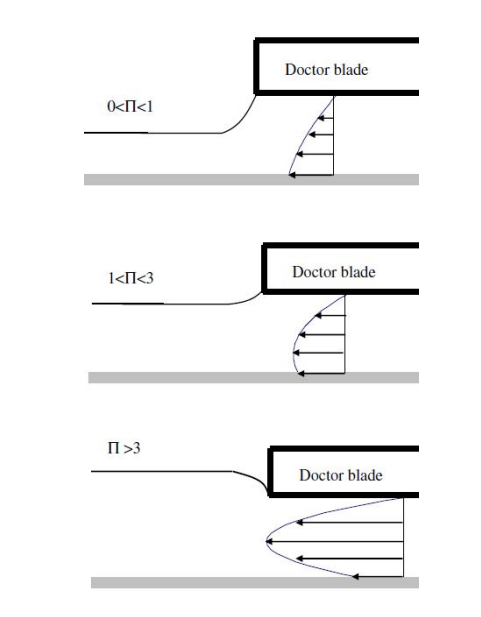
An overview of the velocity profile beneath the coater and resin thickness depending on Π with courtesy to [3].
Groot used a Lepus Next Gen vat photopolymerization machine to experiment with parameters and the resulting effects on layers.
“The main parameters which are investigated are the coater height above the bottom plate and the coater velocity,” explains Groot, seeking to find setting adjustments that control flow and resin layers.
Supply Chain Disruptions and Digital Solutions
Layer adhesion is an issue many users must deal with, but when deformations are persistent throughout numerous layers there is greater concern due to the potential for structural failure and serious imperfections in shape.
“When looking at the effect of velocity on the height profiles for 100 µm, almost no difference can be seen when altering the coater velocity. However, when looking at the influence of the coater velocity on the height profile in case of a coater height of 150 µm and 200 µm, one can see a small decrease in the height profile for a faster coater velocity,” stated the author.
Medical PPE and Equipment Production

A schematic view of a laser triangulation sensor.
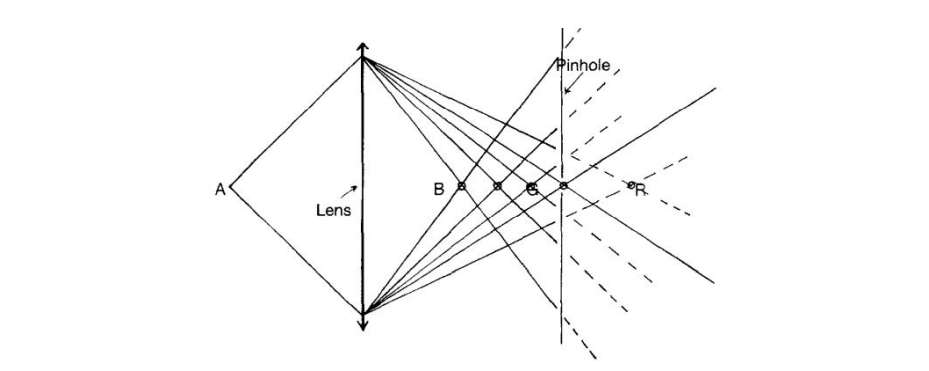
A schematic representation of chromatic aberration, where A is a polychromatic
light source and B,G and R are the focal points of red, blue and green light. With courtesy to [2].
Lessons Learned for Future Emergencies
Measuring of height in layers was critical in this study, as Groot considered a couple of different sensors to be used: the laser triangulation sensor (information derived from triangles) and the confocal chromatic sensor (seeking aberrations in optics). Comparisons were made between the computational fluid dynamics (CFD) model and results compiled during experimentation.

How 3D Printing Responded to COVID-19
A schematic representation of the experimental setup which was used. See also: Best 3D Printer Bed Leveling Tools for Perfect Fir…. The
confocal chromatic sensor, coater and resin injector are all mounted to the same movable stage (not to scale).
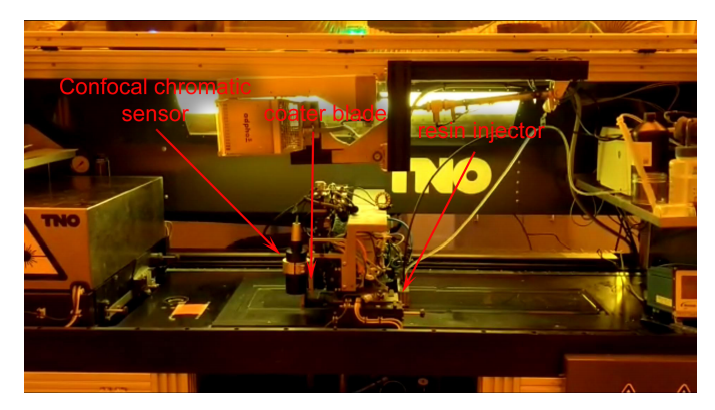
A picture of the Lepus Next Gen, where one can see the bottom plate and the movable stage containing the confocal chromatic sensor, coater and the resin injector. (Image: AMSYSTEMS)
“The results gathered by the Comsol model are very logical. The model resulted in a resin layer of exactly half the coater height above the bottom plate. This result is predicted by formula (8). This is also the case for most of the gathered data. Therefore, the model is in good accordance with the experimental data gathered,” concluded the researchers.
HP and the Pandemic Manufacturing Shift
“As one can see, most results found during this thesis are not perfect. First, it can be clearly seen that the measurements for a coater height of 100µm, which can be found in Appendix B, are all negative. This is of course very unrealistic. Furthermore, it can be noticed that every measurement fluctuates more than what was expected. Sometimes these fluctuations were up to 50 µm. At first sight 50 µm does not seem a lot, however if it is stated that the thickest layer is 200 µm it can be easily seen that 50 µm is a very large fluctuation in this case.”
What do you think of this news? Let us know your thoughts! Join the discussion of this and other 3D printing topics at 3DPrintBoard.com.
[Source / Images: ‘The influence of coater velocity on layer deposition in the 3D-printing process’]
The post Eindhoven University of Technology: Thesis Student Studies Layer Deposition Issues in 3D Printing appeared first on 3DPrint.com | The Voice of 3D Printing / Additive Manufacturing.
Related Articles
Frequently Asked Questions
How did 3D printing help during COVID-19?
During the COVID-19 pandemic, 3D printing enabled rapid production of critical medical supplies including face shields, ventilator components, nasal swabs, and PPE. Distributed manufacturing allowed makers worldwide to produce items locally without waiting for traditional supply chains.
What was the pandemic digital manufacturing shift?
The pandemic accelerated adoption of digital manufacturing including 3D printing, as companies sought more resilient supply chains. Organizations shifted from centralized to distributed production, using digital files to produce parts locally on demand.
Can 3D printing supply chains be resilient in emergencies?
Yes, 3D printing provides supply chain resilience through distributed manufacturing — designs can be shared digitally and produced anywhere with compatible equipment, eliminating the need for physical inventory and shipping of parts.
📌 Related Articles
- The Current State of Metal 3D Printing in 2020
- Best 3D Printer Bed Leveling Tools for Perfect First Layers in 2026
- 3D Printing Tungsten Carbide: How Hot-Wire Laser Technology Creates Metal Harder Than Steel
- The Complete 3D Printing Filament Guide: Types, Properties & When to Use Each
- Bambu Lab P1S Review: The Enclosed CoreXY Speed Demon That Just Works