
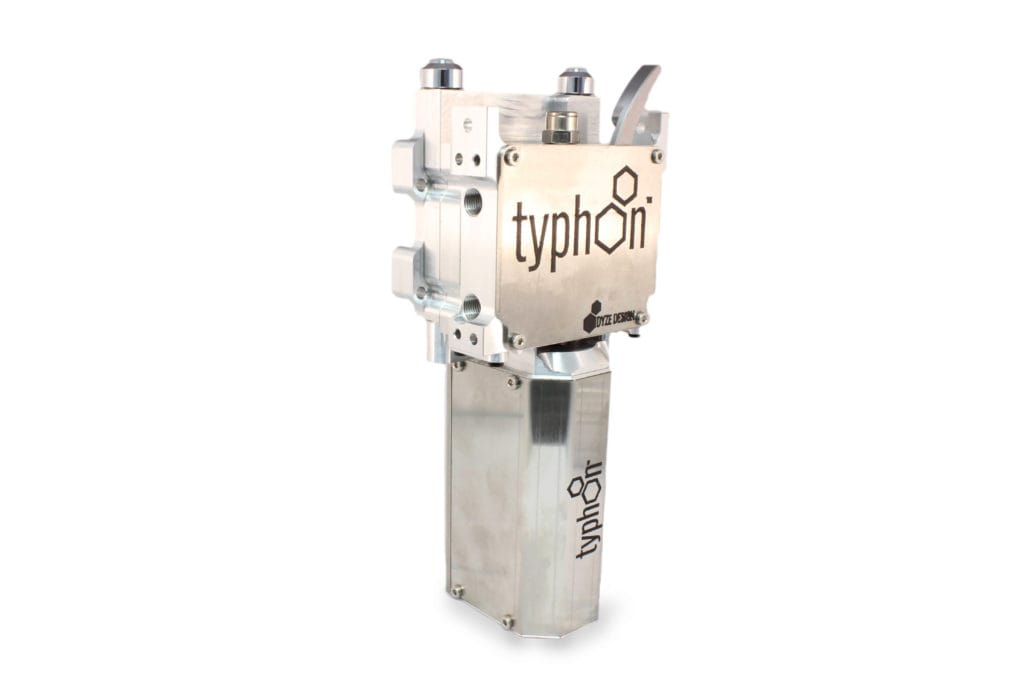
Canadian-based OEM Dyze Design is officially releasing its new print head, Typhoon . Designed for large-scale 3d printers, the Typhoon extruder can output 0.9 kg of material per hour, 10 times the speed of a standard extruder such as DyzEnd/DyzeXtruder. Simply put, a generic 16 hours print would only take from 1 to 3 hours with the Typhoon extruder.

Typhoon Fast Print Extruder
“With PLA, we achieved a flow rate of 200mm3/s. However, with materials such as carbon fiber or any filled material, you could even reach 25% to 50% more speed compared to PLA. By using the Typhoon on a part production line, for instance, you could literally multiply your production rate. Each printer is able to make more parts, so at the end of the day, it means more money in your pocket” says Philippe Carrier, Chief Technology Officer and cofounder of Dyze Design.
The Typhoon is described as a high flow industrial extruder enabling printing of any materials, from common polymers to more advanced engineering filaments, thanks to its maximum operating temperature of 500 °C and its integrated liquid-cooling loop.
“Typhoon is really your go-to solution for any 2.85 mm filament. Obviously, PLA and ABS works like a charm, but the extruder was designed with professional or industrial printing in mind. PETG, Nylon, PEEK, PEI, PVA, HIPS; all that can be printed really, really fast with Typhoon,” adds Philippe.
Not to mention that Dyze focused on improving the overall performance with flexible materials like TPU or TPE, a lot harder to print at higher speed. Typhoon features a NEMA23 motor and a 4.6:1 gear ratio. The heat core benefits from a dual heating zone to make sure that the temperature remains constant. Finally, the feeding mechanism is an innovative quad pinch geared system, allowing four points of contact with the filament to reduce slipping. All those characteristics ensure a maximal flow rate with each and every filament.

Typhoon Innovative Quad Pinch Filament Driving Mechanism
Moreover, usability was at the forefront of Typhoon development. That’s why Dyze Design added some interesting functionalities such as an easy filament swap or quick nozzle change.
“Using the top lever moves all driving mechanisms away from the filament, allowing filament switching in just a second. Each heat core, or nozzle if you will, can also be switched easily with a few knob turns. The advantage is that you could dedicate one heat core per material type, speeding up the cleaning and purging process,” says Dyze’s CTO.

Typhoon Heat Core. Inside the heat shield, there’s the “hotend”, nozzle and all the cables and insulation
This rugged extruder is also compatible with any standard open source firmware (Marlin, RepRap, Repetier, etc.)
Last year, Dyze Design managed to do rigorous testing of the extruder through a beta-testing program. See also: The Current State of Metal 3D Printing in 2020. Several 3d printer manufacturers tested and provided feedback, such as Modix 3D, Trideo, Filament Innovations to name a few. Besides, they all announced the integration of Typhoon in their current ecosystem or new printer line.
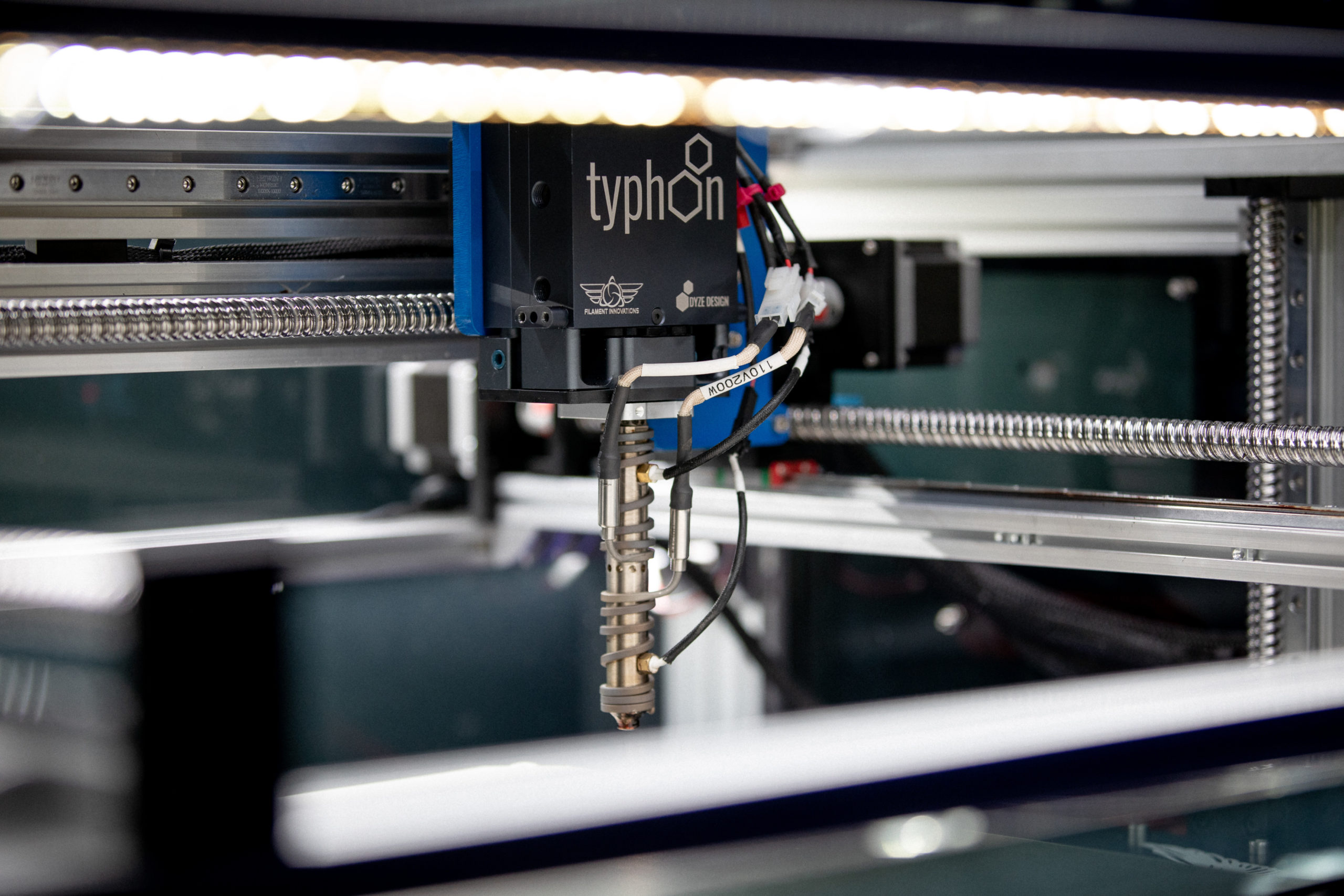
Typhoon “beta version” mounted on Filament Innovations BFP-ICARUS
The Typhoon extruder is now officially open for preorders. Visit https://dyzedesign.com/typhoon-extruder/ to order a unit. Preorders will be fulfilled in August.
About Dyze Design
Montréal-based company Dyze Design has been an OEM in the 3D printing industry since 2015 developing and manufacturing cutting-edge high performance, reliable, and innovative extrusion systems and 3D printer components. They are renowned for their extruder line, DyzeXtruder GT and DyzeXtruder Pro and their SENTINEL filament detector or Tungsten Carbide Nozzles. Today, many 3D printer manufacturers such as Roboze, Sharebot, Blackbelt, Dynamical 3D, Aon3d, Trideo, 3DPlatform, Filament Innovations, Mark One and Cincinnati have chosen their hotends, extruders, and nozzles as OEM parts for their industrial or high-end printers.
The post Dyze Design Releases Typhoon™ Fast Print Large-Scale 3D Printer Extruder appeared first on 3DPrint.com | The Voice of 3D Printing / Additive Manufacturing.
from Your daily news from 3DPrint.com https://bit.ly/2WhnZi7
Frequently Asked Questions
How did 3D printing help during COVID-19?
During the COVID-19 pandemic, 3D printing enabled rapid production of critical medical supplies including face shields, ventilator components, nasal swabs, and PPE. Distributed manufacturing allowed makers worldwide to produce items locally without waiting for traditional supply chains.
What was the pandemic digital manufacturing shift?
The pandemic accelerated adoption of digital manufacturing including 3D printing, as companies sought more resilient supply chains. Organizations shifted from centralized to distributed production, using digital files to produce parts locally on demand.
Can 3D printing supply chains be resilient in emergencies?
Yes, 3D printing provides supply chain resilience through distributed manufacturing — designs can be shared digitally and produced anywhere with compatible equipment, eliminating the need for physical inventory and shipping of parts.
📌 Related Articles
- 3D Printing Tungsten Carbide: How Hot-Wire Laser Technology Creates Metal Harder Than Steel
- The Current State of Metal 3D Printing in 2020
- ABS 3D Printing Settings Guide: Temperature, Enclosure, and Cooling for Strong Parts
- Best Budget 3D Printer Upgrades That Actually Improve Print Quality: Belts, Springs, Hotends & More
- Specialty Engineering Filaments: CF, PEEK, PPS, PEI (2026)