
Researchers in Poland are studying materials for more unique applications, sharing their results in the recently published ‘Thermoplastic polyurethanes for mining application processing by 3D printing.’
Mining is undeniably hard work, and materials related to this industry must be extremely tough as they are continually vulnerable to harsh elements, as well as abrasive contact and strong chemicals.
TPU is commonly used due to benefits such as:
- High tensile and breaking strength
- Excellent and varying levels of hardness
- High maximal strain
- Excellent elasticity
- Fatigue resistance
- Low deformation, low absorptivity
TPU can be used to make different high-performance parts like hoses, cables, screens, conveyor belts, and more. Previous studies for making products used in mining have centered around injection molding for manufacturing, leading the researchers to point out the obvious limitations of using models that only have a mold:
“The 3D printing technology developing rapidly throughout the recent years allows for high-precision, personalized elements’ printing, made of thermoplastic materials,” stated the researchers. “In design’s terms, however, it is significant to develop and print stuff exhibiting mechanical properties comparable to the mechanical properties of stuff produced by injection molds’ means.”
“The use of 3D printing to produce elements help a miner in his work can be possible only when the products produced will be resistant to the conditions prevailing in a mine.”
The researchers are focused on the concept of making a wide range of personalized items for the miners, but testing was required to make sure they would be resistant to the challenging conditions as well as strong enough to hold up to exposure to mine water.
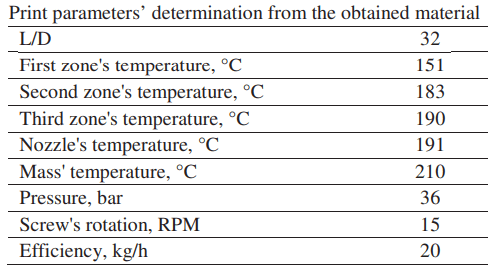
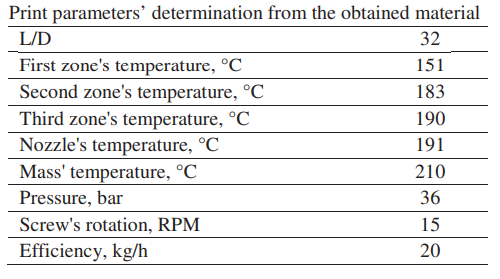
The researchers used Elastollan 1185A to create their samples, drying the material in a convection oven and then extruding it in a customized single-screw extruder.
The researchers left the samples in an aging chamber, immersed in synthetic mine water.
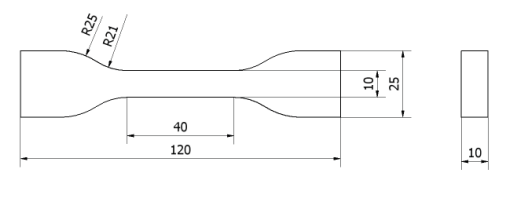
Sample’s geometry
“The aging process was carried out for two, seven, and thirty days at a temperature of 70°C. The sample population for each aging time was five,” explained the researchers.
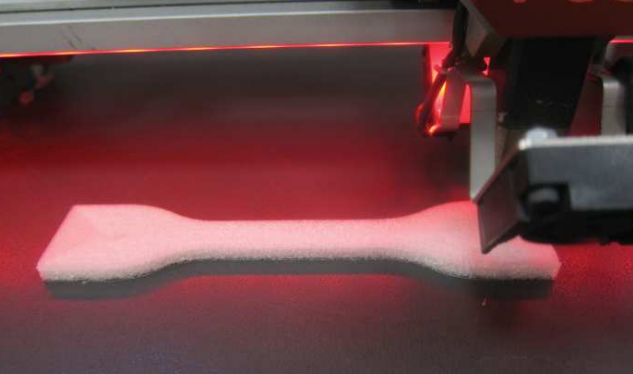
Samples being 3D printed
The aged samples were then stretched on a universal testing machine, along with the native samples, with five measurements made for each.
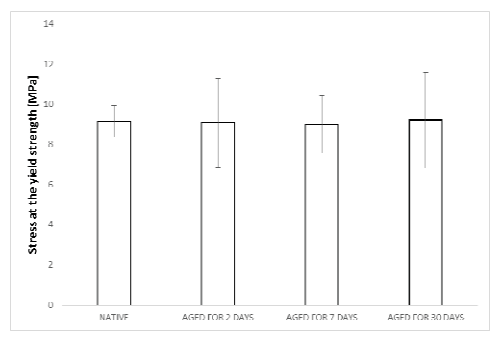
Stress at the yield strength, MPa
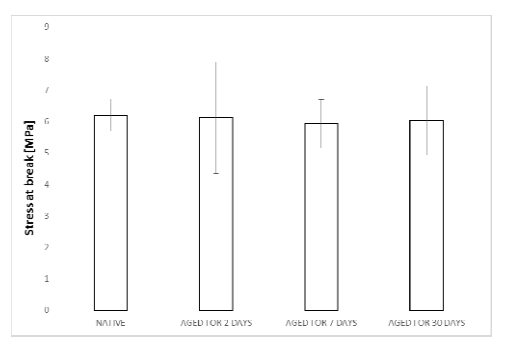
Stress at break, MPa
Overall, testing showed that the synthetic mine water did not affect the samples—evaluating hardness, mechanical properties, and ultimately, examining degradation of the polyurethane structure (using an infrared spectrometer). The researchers noted that there were no ‘new peaks’ in any of the samples that would have caused ‘the emergence of new chemical groups or bonds.’
“To sum up, it can be concluded that polyurethane samples obtained by 3D printing are resistant to the action of synthetic mine water and as such can be widely used in many branches of mining,” stated the researchers upon concluding their study.
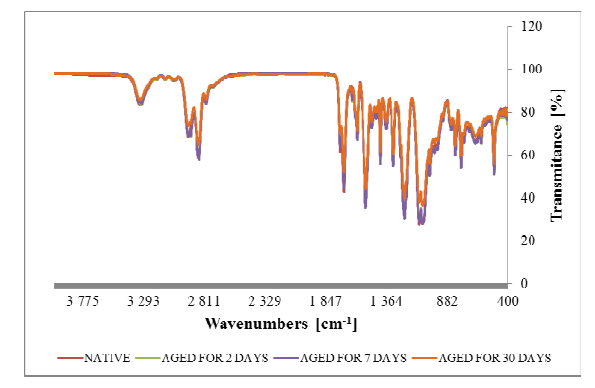
IR spectrum of the tested samples
TPU has been tested in a variety of different research studies over the years as scientists, manufacturers, and users create new filaments and products as well as working through issues with adhesion, improving post-processing surfaces, and more.
What do you think of this news? Let us know your thoughts! Join the discussion of this and other 3D printing topics at 3DPrintBoard.com.
[Source / Images: ‘Thermoplastic polyurethanes for mining application processing by 3D printing’]
The post Customized 3D Printed TPU Products for Mining? appeared first on 3DPrint.com | The Voice of 3D Printing / Additive Manufacturing.
from Your daily news from 3DPrint.com http://bit.ly/38VbtbH
Where to Buy Filament
Disclosure: Some of the links below are affiliate links. If you make a purchase, we may earn a commission at no extra cost to you. This helps support this site.
These links go to Amazon with our affiliate tag. If you prefer to support local retailers or buy directly from manufacturers, we encourage that as well!
Frequently Asked Questions
What is the best 3D printing filament for beginners?
PLA is the best starting filament — it prints easily at 190-220°C without an enclosure and produces good results. Once comfortable, PETG offers better strength and temperature resistance for functional parts.
How do I choose the right filament?
Consider the application: PLA for display models, PETG for functional parts, ABS/ASA for heat/sunlight exposure, TPU for flexible parts, and specialty filaments for engineering applications. Each has specific printer requirements.
What temperature should I print different filaments at?
PLA: 190-220°C nozzle / 50-60°C bed. PETG: 220-250°C / 70-80°C. ABS: 230-260°C / 100-110°C (enclosure needed). Nylon: 240-270°C / 70-90°C. Always check manufacturer recommendations for specific brands.
📌 Related Articles
- The Complete 3D Printing Filament Guide: Types, Properties & When to Use Each
- The Current State of Metal 3D Printing in 2020
- ABS 3D Printing Settings Guide: Temperature, Enclosure, and Cooling for Strong Parts
- Best Budget 3D Printer Upgrades That Actually Improve Print Quality: Belts, Springs, Hotends & More
- 3D Printing Tungsten Carbide: How Hot-Wire Laser Technology Creates Metal Harder Than Steel