
Jaroslav Zechmeister, with support for research from the Internal Grant Agency of Brno University of Technology, has developed a horn antenna as part of the Doctoral Degree Programme. With findings recently published in ‘3D-Printed Lens for High Directional Low-Profile Antenna,’ Zechmeister explains what techniques and materials were used.
Reminding us of the valuable benefits of 3D printing, Zechmeister points out that this method of production is rapidly growing and applies to many different areas of industry, including microwave technology—allowing for faster turnaround, greater affordability and accessibility, and the ability to design without having to wait on a middleman for prototypes or changes to parts. 3D printing has also been used in many different projects featuring antennas, from liquid metal antennas to multiple input/multiple output antennas, and multi-beam applications.
While other studies have been published regarding the 3D printed dielectric lens, they were not directly related to this type of work, with Zechmeister opting for a hyperbolic lens, featuring a curved edge on only one side.
Understanding Filament Properties
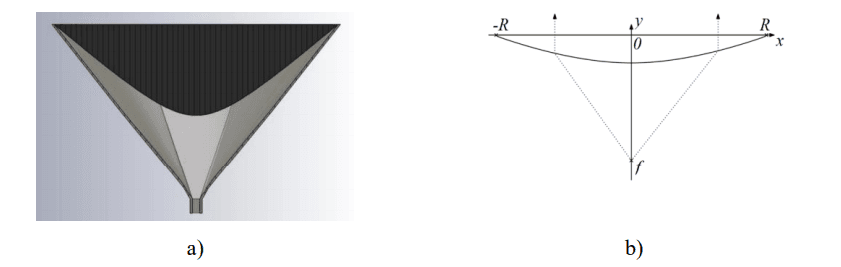
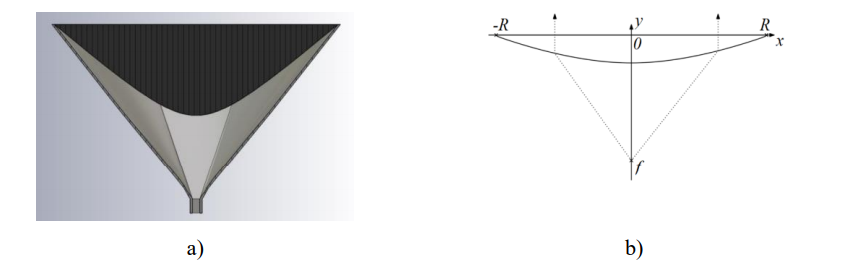
Model of antenna with hyperbolic lens a) and hyperbolic lens scheme b).
Due to the curved side, the lens offers the benefit of not interfering above the aperture plane. The gain is fed by the horn antenna, accentuated via increase of the aperture radius—a feature that can be enlarged so much that radiation energy is sent through the side lobes.
Material Comparison and Selection
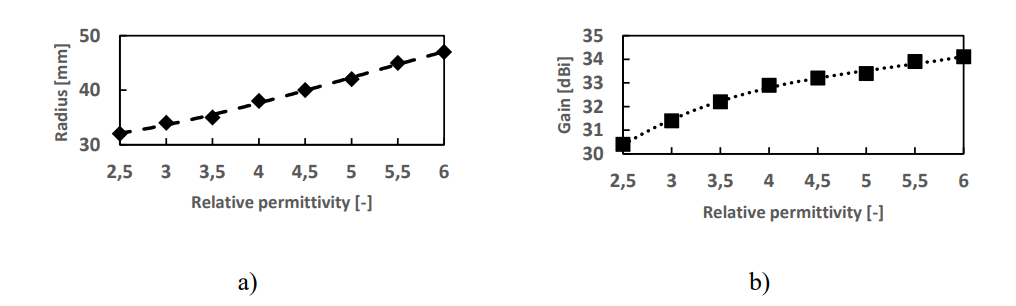
Dependence of ideal radius a) and maximal gain b) on the relative permittivity of lens material.
Zechmeister chose both ABS and a photopolymer for 3D printing, as well as measuring the dielectric lens fabrication for use with the silon and ertacel.
“The method is based on the measurement of scattering parameters of a sample located in a sample holder,” stated Zechmeister. “In this case, a piece of a waveguide WR10 was used as the sample holder.”
Print Settings and Optimization

Measured frequency dependence of relative permittivity and conductivity of ABS
material a) and photopolymer b) for frequency band 70 – 80 GHz.
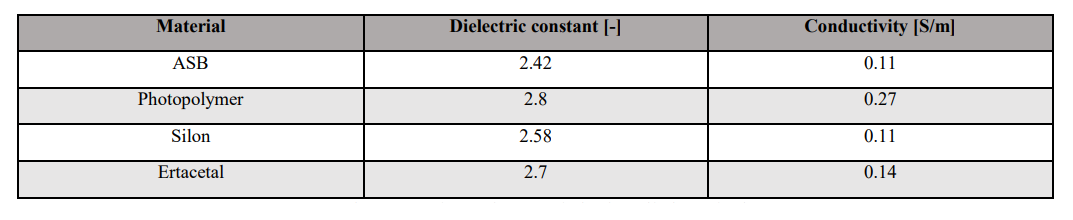
Measured properties of materials for dielectric lens at 77 GHz.
Strength and Durability Testing
Using the previously measured parameters, Zechmeister was able to design the lenses with theoretical maximum gain of the antenna with the ABS lens at 30.2 dBi and the photopolymer lens at 31 dBi.
“However, these values are theoretical, considering lossless materials and the ideal radius of the aperture. For the numerical models, the measured losses of the materials were included, and the radius of the aperture was chosen 33 mm which represents compromise between the ideal radii for the ABS material and the photopolymer,” explained Zechmeister.
Cost and Availability Considerations
“The optimized antenna with the lens made from the ABS material has at 77 GHz the gain 27.7 dBi and the angular width of the main lobe in the E-plane and the H-plane is 4.1˚ and 6.5˚, respectively. The level of the side lobes was more than 20 dB below the maximal value. The simulated gain of the antenna with the photopolymer lens is 27 dBi, the angular width of the main lobe in the E-plane and in the H-plane are 3.5˚ and 5.7˚, respectively. The level of the side lobes is 19 dB below the maximum value.”
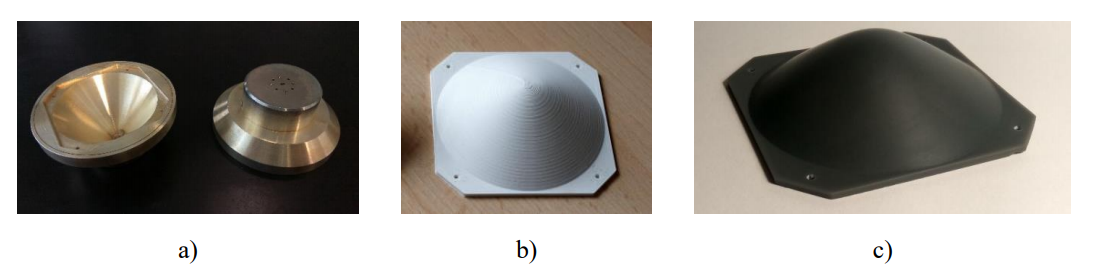
Although printer layers were clearly noted on the ABS lens surface, Zechmeister stated that photopolymer surface was ‘almost perfectly smooth.’ The drawback, however, was that the photopolymer lens also exhibited ‘poor geometrical precision.’
Advanced and Specialty Filaments
The brass horn a), the ABS lens b) and the photopolymer lens c).
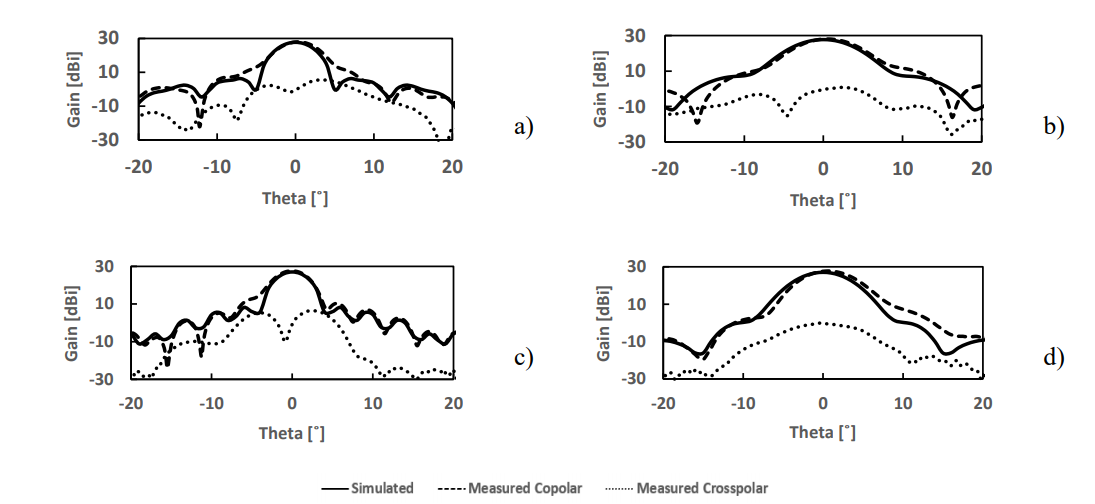
Comparison between measured and simulated gain of antenna with ABS lens in E-plane a) and H-plane b) and of antenna with photopolymer lens in E-plane c) and H-plane d).
“The achieved results show that 3D printed dielectric lenses are usable up to W frequency band,” concluded Zechmeister.
Understanding Filament Properties
What do you think of this news? Let us know your thoughts! Join the discussion of this and other 3D printing topics at 3DPrintBoard.com.
[Source / Images: ‘3D-Printed Lens for High Directional Low-Profile Antenna’]
The post Brno University of Technology: 3D Printed Lens for High Directional Low-Profile Antenna appeared first on 3DPrint.com | The Voice of 3D Printing / Additive Manufacturing.
Frequently Asked Questions
What is the best 3D printing filament for beginners?
PLA is the best starting filament — it prints easily at 190-220°C without an enclosure and produces good results. Once comfortable, PETG offers better strength and temperature resistance for functional parts.
How do I choose the right filament?
Consider the application: PLA for display models, PETG for functional parts, ABS/ASA for heat/sunlight exposure, TPU for flexible parts, and specialty filaments for engineering applications. Each has specific printer requirements.
What temperature should I print different filaments at?
PLA: 190-220°C nozzle / 50-60°C bed. PETG: 220-250°C / 70-80°C. ABS: 230-260°C / 100-110°C (enclosure needed). Nylon: 240-270°C / 70-90°C. Always check manufacturer recommendations for specific brands.
📌 Related Articles
- Best 3D Printer Upgrades That Actually Improve Print Quality: Complete 2026 Guide
- Best Budget 3D Printer Upgrades That Actually Improve Print Quality: Belts, Springs, Hotends & More
- Prusa Research Mini+ vs Prusa MK4: Full Specs Comparison & Buyer’s Guide
- ABS 3D Printing Settings Guide: Temperature, Enclosure, and Cooling for Strong Parts
- Bambu Lab P1S vs Bambu Lab P2S: Full Specs Comparison & Buyer’s Guide