
A new startup called Boston Micro Fabrication (BMF) has launched a high-resolution microscale 3D printer series dubbed microArch. BMF claims the system is the industry’s “most accurate and precise” microscale 3D printer. It should not be difficult to validate those claims due to the fact that over 40 microArch machines have already been operating across Asia for the past 18 months.
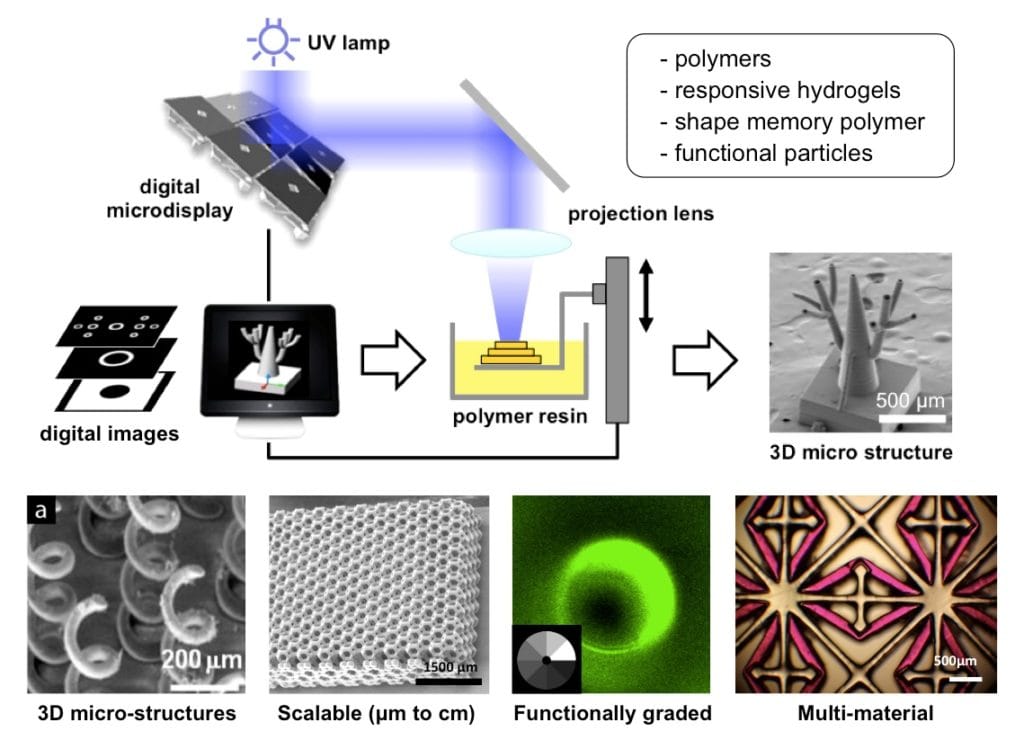
The microArch series relies on the firm’s proprietary Projection Micro-Stereolithography (PμSL) process. Similar to traditional digital light processing (DLP) 3D printing technology, PμSL uses a digital micro display projector to cure photopolymer resin one layer at a time at the microscale. In turn, PμSL is capable of printing objects 100 times smaller than a human hair.

Understanding Filament Properties
The PμSL 3D printing process. Image courtesy of MIT.
BMF is a spin-out of MIT, where professor Nick Fang developed PμSL technology. Along with entrepreneur Xiaoning He and 3D printing technologist Chunguang Xia, Fang established BMF to commercialize his research. To head the firm as CEO, the team turned to former Zcorp CEO and Ultimaker executive John Kawola. The company is targeting the medical and electronics fields, among others, for use in rapid prototyping and possible mass production.
Fang explained the story behind the launch of the startup: “Curiosity was one of the primary drivers of this discovery. After realizing that we could print using light, we started to imagine the broader technology and business implications – envisioning how we might break down the barriers that previously prevented manufacturers from taking advantage of 3D printing for the production of microscale parts. At that moment we created the business to explore the possibilities and I am incredibly excited to see what our customers will accomplish using the microArch.”

Material Comparison and Selection
Microscale 3D-printed parts made using PμSL. Image courtesy of BMF.
Among those clients is the University of Nottingham, is the first European customer for a microArch 3D printer. There, Dr. Yinfeng He says that the school will be utilizing the technology for researching electronics and biomedical devices.
In his research at MIT, Fang was able to demonstrate several unique capabilities with PμSL. For instance, unlike existing DLP technology, the light intensity of individual pixels in PμSL can be controlled, which results in the ability to modify the material properties of the object throughout the part. Moreover, multiple materials can be used in a single print process, including polymers responsive hydrogels, shape memory polymers and biological materials.
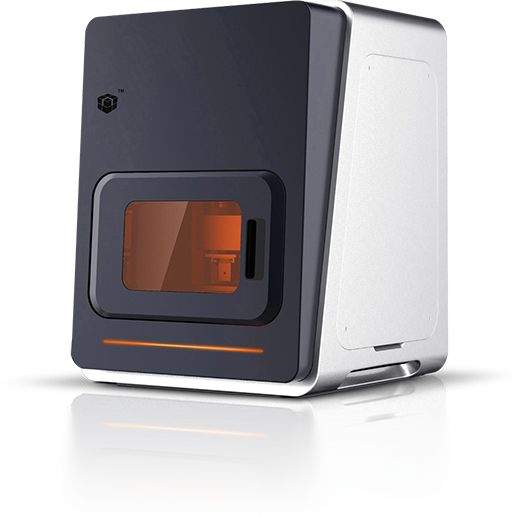
We don’t yet know if these capabilities will be available with the microArch series, but, out of the box, the systems are able to print down at a resolution of 2µ with tolerances of ±10µm /±25µm and at volumes that are cost competitive with injection molding. It will also support tough, elastic, casting, biocompatible and high-temperature resins. The series consists of five different printers ranging in printing area from 3.84 × 2.16 × 10mm to 48 × 27 × 50mm, in optical resolution from 2μm to 25μm, and in layer height from 5μm to 50μm.
Print Settings and Optimization
A rendering of the microArch P140/S140/P150 machine. See also: How Divergent Technologies Is 3D Printing Cruise M…. Image courtesy of BMF.
There are already numerous researchers who deploy microscale 3D printing, particularly for medical and electronics applications, as mentioned. A Northwestern University team used a form of microscale fabrication to create a terahertz lens. Lawrence Livermore National Laboratory has performed a great deal of research in this area, often creating meta materials that use unique microscale lattice structures to create different physical properties at the marcroscale.
The micro- and nanoscale 3D printing space is a small one, but it is growing as research like Fang’s is commercialized. The Vienna University of Technology, for instance, recently spun out its own micro-printing startup, UpNano, after previously spinning out another called Cubicure. Other companies include SwissLitho AG, Nanoscribe and Microlight3D. When these technologies herald a revolution of nanomedicines and electronics remains to be seen, but they demonstrate that we are witnessing the first steps in that revolution.
Strength and Durability Testing
The post BMF Debuts microArch, Claims to be the “Most Accurate and Precise” Microscale 3D Printer appeared first on 3DPrint.com | The Voice of 3D Printing / Additive Manufacturing.
from Your daily news from 3DPrint.com http://bit.ly/38kmtQa
Frequently Asked Questions
What is the best 3D printing filament for beginners?
PLA is the best starting filament — it prints easily at 190-220°C without an enclosure and produces good results. Once comfortable, PETG offers better strength and temperature resistance for functional parts.
How do I choose the right filament?
Consider the application: PLA for display models, PETG for functional parts, ABS/ASA for heat/sunlight exposure, TPU for flexible parts, and specialty filaments for engineering applications. Each has specific printer requirements.
What temperature should I print different filaments at?
PLA: 190-220°C nozzle / 50-60°C bed. PETG: 220-250°C / 70-80°C. ABS: 230-260°C / 100-110°C (enclosure needed). Nylon: 240-270°C / 70-90°C. Always check manufacturer recommendations for specific brands.
📌 Related Articles
- Best Budget 3D Printer Upgrades That Actually Improve Print Quality: Belts, Springs, Hotends & More
- How Divergent Technologies Is 3D Printing Cruise Missiles for the U.S. Military
- Best 3D Printer Upgrades That Actually Improve Print Quality: Complete 2026 Guide
- 3D Printing Tungsten Carbide: How Hot-Wire Laser Technology Creates Metal Harder Than Steel
- ABS 3D Printing Settings Guide: Temperature, Enclosure, and Cooling for Strong Parts