
With 3D printing, any and all parts could be unique, which is a key advantage of the technology. It is also presents complex challenges when it comes to such crucial tasks as quality control and traceability. My hearing aid is perfect for me, but will not fit you properly. At the same time for quality assurance and quality control processes, the right parts have to be identified and they have to be checked. Furthermore, for regulated industries, it is necessary to correctly identify which part is which at major steps in the production process. Traceability and quality control are becoming increasingly important as we gain more traction in true manufacturing applications within medical and aerospace.
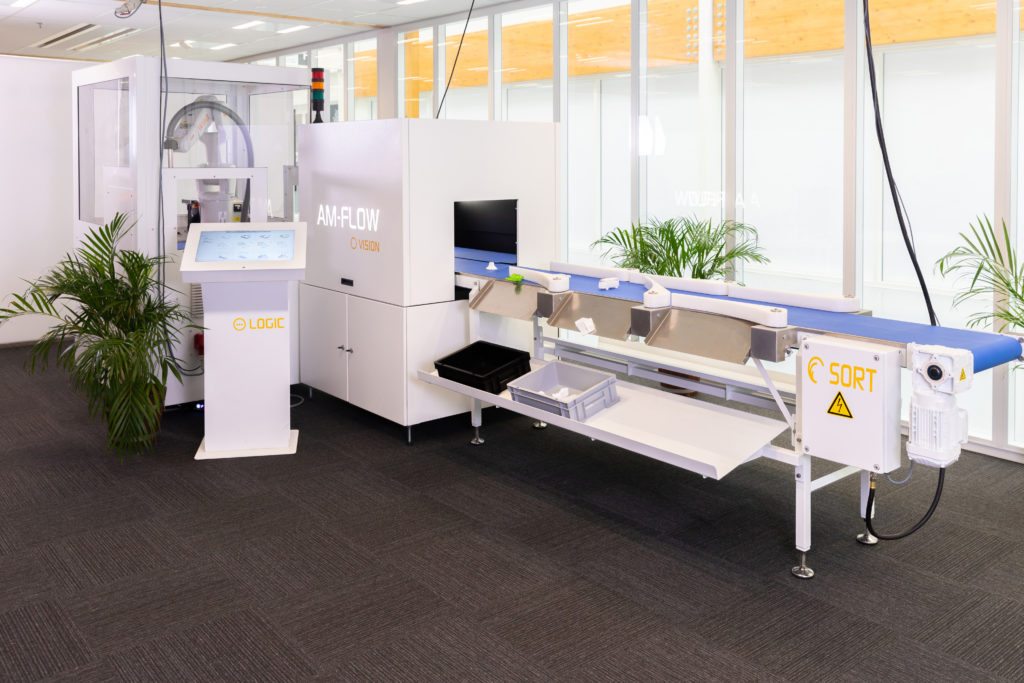
Dutch 3D printing company AM-Flow aims to address this issue. AM-Flow’s sorting and identification solutions aid in quality control, inspection, and identification of parts using sorting equipment, machine vision, machine learning, and cameras. In other words, it helps businesses automate many steps that would be time-consuming or very costly. At the same time, it connects business data via its software AM-LOGIC to MES and ERP software. Together with companies such as Dye Mansion and Post Process it is therefore a key enabler in manufacturing. It should be of no surprise, then, that the firm has recently raised $4 million in a series A investment round.
The round was led by BOM Brabant Ventures and included other investors such as Materialise, Midwest Prototyping, Innovatiefonds Noord-Holland, Miller Turner, and DOEN Participaties. AM-Flow CEO Stefan Rink said of the recent funding:
“We are delighted to welcome our new investors, and I would like to thank our existing shareholders for their continued support. This strong syndicate of high-tech investors validates our approach and the funding enables us to expand our solution portfolio and market presence. We have a team that is passionate about enabling Additive Manufacturing to live up to its sustainability promise: local, distributed manufacturing. To drive further adoption of Additive Manufacturing, the industry must get to competitive price and quality levels per part, and shift her focus from the 3D-printer to the AM Factory.”
The Role of 3D Printing in Medicine
AM-Flow CCO Carlos Zwikker contributed:
”Where we are now wouldn’t have been possible without the support of our launching customers BMW, Shapeways, Midwest Prototyping, Oceanz, Marketiger and Materialise. We’re hugely indebted to the vision these leading companies are propagating with their sustainable, smart factories!”
Biocompatible Materials and Processes
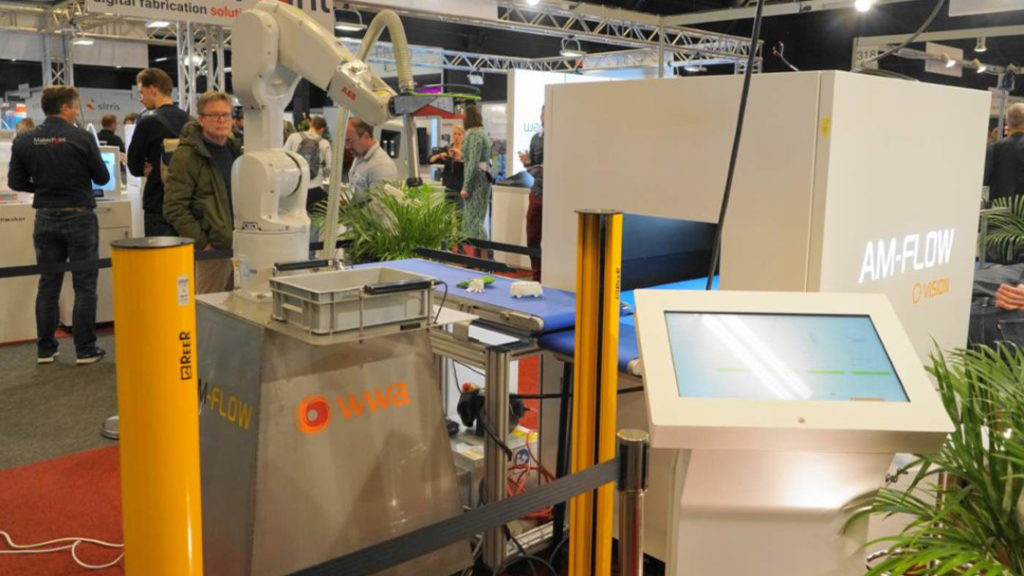
Starting in 2018, the company was focused on handling and identification. They first had a part identification solution called Vision, which helped accelerate sorting. The firm’s Am Sort system is a conveyor that gently sorts identified parts. “Pick” is a bin-picking robot. Am Route is an integration with autonomous Omron robots that transport things through factories. AM Package configures custom boxes every seven seconds, so you can automate packaging, as well. All of these operations can be integrated with your ERP and the like via the firm’s Logic software. The company also mentions re-shoring, manufacturing close to consumers, sustainability and efficiency as key parts of their offering.
It’s good to see that two of the investors are large service bureaus that use 3D printing for manufacturing and in high-value applications. Materialise and Midwest are both putting their money where their mouths are and demonstrating that they believe in a solution that would be necessary for them to advance their business as well. It’s also a good sign that the firm already has such good references, especially in large volume firms like Oceanz, as well as lighthouse customers, such as BMW. This bodes well for the Eindhoven-based startup.
Bart Van der Schueren, Materialise CTO, added:
“The success of scaling Additive Manufacturing as part of an end-to-end digital platform is not just dependant on continued innovation of the printing process itself, but also on whether we’ll be able to handle the high variety of printed components in a cost-efficient way. That’s why we are excited by AM-Flow’s product portfolio, which creates a path towards cost-efficient scaling of the handling process”.
Clinical Applications and Case Studies
Whereas a lot of the excitement in 3D printing is usually centered around 3D printers, as much as a third of all costs are in handling. If we are to make millions of manufactured goods using 3D printing, handling costs need to go down. Dye Mansion, Rosler’s AM Solutions, and Post Process have been focusing on de-powdering and surface treatment, which are very important steps indeed. But it’s rather sad that handling in 3D printing is often the physical carrying around of parts on pieces of paper. This simply wont do if we want to make parts for airliners or orthopedic implants. In order to scale up, we must therefore reduce error rates and costs in the handling of parts.
By deploying cameras and machine vision, while subsequently integrating the results with other sorting, conveyancing and packaging equipment as well as software, AM-Flow has put itself at a crucial crossroads in 3D printing. See also: ABS 3D Printing Settings Guide: Temperature, Enclo…. For many applications, the old, artisanal way of handling parts will have to make way for more automation, either because of increased regulatory or operational excellence requirements or through cost alone. Whether industry players choose to race to the bottom to offer low-cost 3D printed parts or shift to focus on ultra high-end products, they would both make their goals easier to achieve through using AM-Flow.
Another issue is that we don’t have systems integrators in 3D printing. This is something that we discussed with Jos Burger’s Ultimaker on the 3DPOD. There are currently precious few value-added resellers or companies that do integration in 3D printing that you can turn to if you would need to set up a 3D printing factory. Exceptions are SMS Group, which can help you build a 3D printing car factory, and Alan Guyan’s Additive Accelerator, which can help you design and build your factory, as well. EOS’ Additive Minds consultancy should be able to help, too. Apart from them, there is no one to turn to.
Regulatory Considerations and Safety
AM-Flow offers consultancy as well, integration, customization, and turnkey solutions. This is a very tempting offering in a market where there are few players but the tide is clearly moving in your direction.
The post AM-Flow Raises $4 Million to Automate Handling and Quality Control in 3D Printing appeared first on 3DPrint.com | The Voice of 3D Printing / Additive Manufacturing.
from 3DPrint.com | The Voice of 3D Printing / Additive Manufacturing https://bit.ly/3dCTomL
Related Articles: Sigma Labs’ First Contract for Newest 3D Printing Quality Control Software Goes to Coherent · 3D Hubs’ 3D Printing Warehouses Introduce Quality Control and Reduced Risk · Azul 3D Raises $12.5 Million for Large, Fast HARP 3D Printing Technology
Frequently Asked Questions
How is 3D printing used in medicine?
3D printing is used in medicine for surgical planning models, custom implants, bioprinting tissue scaffolds, drug delivery systems, dental aligners, and prosthetics. It enables patient-specific solutions that improve outcomes and reduce surgery time.
What materials are biocompatible for 3D printing?
Common biocompatible materials include PEEK, titanium alloys (Ti6Al4V), bio-ceramics (hydroxyapatite), medical-grade resins, PLA for temporary implants, and hydrogels for bioprinting. Material choice depends on the application and required mechanical properties.
Is 3D printed medical equipment FDA approved?
Yes, several 3D printed medical devices have FDA clearance, including orthopedic implants, dental restorations, and surgical guides. Each device must go through the appropriate regulatory pathway based on its risk classification.
📌 Related Articles
- The Current State of Metal 3D Printing in 2020
- ABS 3D Printing Settings Guide: Temperature, Enclosure, and Cooling for Strong Parts
- 3D Printing Tungsten Carbide: How Hot-Wire Laser Technology Creates Metal Harder Than Steel
- Best Budget 3D Printer Upgrades That Actually Improve Print Quality: Belts, Springs, Hotends & More
- Best 3D Printer Upgrades That Actually Improve Print Quality: Complete 2026 Guide