
One of the world’s leading steel and mining companies, ArcelorMittal, is partnering with Dutch company Additive Industries to investigate the use of metal 3D printing to make large spare parts for the steel industry. Additive manufacturing is used to fabricate spare parts for plenty of applications and industries, including maritime, railways, the military, consumer appliances, automotive, and many more. It makes a lot of practical business sense, as 3D printing spare parts offers companies, like ArcelorMittal, flexibility, a reduced production cycle, and on-demand manufacturing; if this happens onsite, it can even save on shipping costs.

The State of Metal 3D Printing
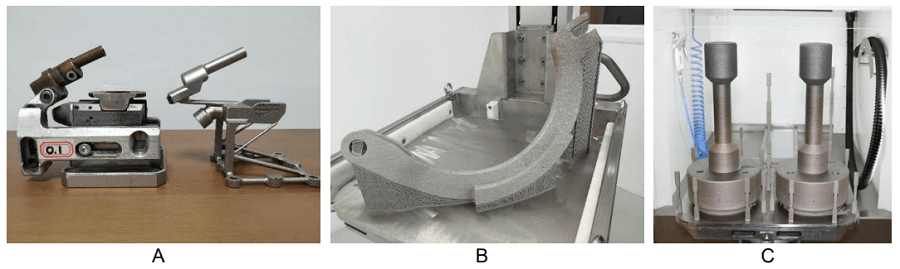
3D printed spare parts used in ArcelorMittal facilities: (A) Example of part consolidation application with 316L original part on the left and 3D printed part on the right; (B) example of functional large parts with internal lattice structure made with 316L above 500 mm; and (C) lightweight (hollow) functional spare parts made with Maraging Steel with ArcelorMittal’s optimized parameters.
By collaborating with Additive Industries on metal 3D printing over the last few years, and using the technology to build on-demand spare parts, ArcelorMittal has improved its quality and process performance – allowing the company to print large, complex components that are ready to use.
“Additive Manufacturing is an exponential technology, moving very fast. Our collaboration with Additive Industries is a clear demonstration of our ability to remain at the cutting-edge of this technology: we started by printing small specimens and have now progressed to large size and complex parts,” said Jose López Fresno, Head of the Additive Manufacturing department, ArcelorMittal Global R&D in Avilés, Spain.
Technical Challenges and Solutions
Operations in the steelmaking industry require components, and spare parts, that must hold up under difficult conditions. In the beginning of the ArcelorMittal and Additive Industries collaboration, they had to figure out how best to achieve the necessary requirements for component size and quality. But over the last two years of working together, the two have achieved an up to fourfold increase in component size, in addition to improving their reliability and quality. This means that the steel company has been able to increase the amount of applications for its 3D printed spare parts from small size part consolidation to jobs that need complex, functional, large, and strong parts.
Material Properties and Performance
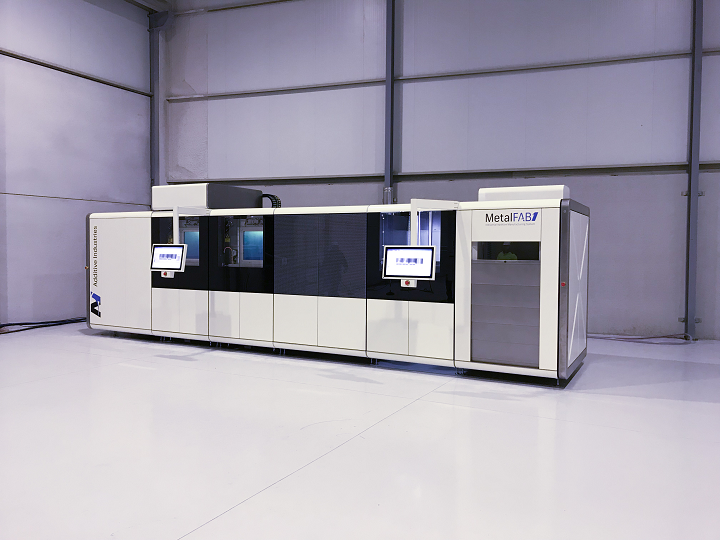
MetalFab1 on the day of installation in ArcelorMittal R&D facilities in Avilés.
Now, the two are looking at what metal 3D printing can do for the steel industry with the MetalFAB1 by Additive Industries, which is one of the market’s largest 4-laser metal AM systems.
“Innovation and market leader ArcelorMittal have helped us to stress-test our MetalFAB1 system for critical spare-part production,” stated Daan A.J. Kersten, Co-Founder and CEO Additive Industries. “This enabled us to expand our experience to the steel industry from our main application markets in aerospace and automotive. It has become clear that metal 3D printing is a serious alternative for a large variety of cast parts.”
Industrial Applications and Use Cases
 First introduced back in 2015, the unique MetalFAB1 printer has a 420 x 420 x 400 mm build volume, which makes it possible to fabricate large steel spare parts for the mining and steelmaking industries. But at the same time, it also ensures high productivity because it automated the manual steps of regular powder bed fusion 3D printers; this, in turn, equals the lowest cost per 3D printed part.
The modular MetalFAB1 has multiple build chambers, up to four 500W lasers, and can be configured for up to 11 different modules for more productivity or post-processing automation. It’s also well-designed for safety, which is perfect for ArcelorMittal and its focus on operator safety. In addition, 3D printing spare parts can help reduce waste – meeting another of the company’s objectives in terms of environmental safety.
“We are proud to work together with ArcelorMittal, jointly driving the business case for 3D-printed parts in the steel industry,” said Harry Kleijnen, Key Account Manager for Additive Industries. See also: Best Budget 3D Printer Upgrades That Actually Impr…. “ArcelorMittal’s typical applications have enabled us to further adapt the MetalFAB1 system to print high density, high volume parts. We are looking forward to expanding the range of applications and materials in this intense and strong collaboration.”
Comparing Metal AM to Traditional Manufacturing
Since the first MetalFAB1 3D printer was installed at ArcelorMittal’s R&D facilities, the company has already used several of the 3D printed spare parts. To see the assembly and installation of the MetalFAB1 at ArcelorMittal, check out Additive Industries’ video here.
Discuss this story and other 3D printing topics at 3DPrintBoard.com or share your thoughts in the Facebook comments below.
(Source/Images: Additive Industries)
Future Developments in Metal Additive Manufacturing
The post Additive Industries & ArcelorMittal Using MetalFAB1 3D Printer to Make Spare Steel Parts appeared first on 3DPrint.com | The Voice of 3D Printing / Additive Manufacturing.
Related Articles
Frequently Asked Questions
What is metal 3D printing?
Metal 3D printing (additive manufacturing) builds metal parts layer by layer using techniques like laser powder bed fusion, directed energy deposition, and binder jetting. It enables complex geometries impossible with traditional manufacturing while reducing material waste significantly.
How strong are 3D printed metal parts?
3D printed metal parts can achieve mechanical properties comparable to traditionally manufactured metals. Tensile strength and fatigue resistance depend on the process and post-processing, but many meet or exceed ASTM standards for wrought materials.
What are the main metal 3D printing technologies?
The primary technologies include Laser Powder Bed Fusion (LPBF), Electron Beam Melting (EBM), Directed Energy Deposition (DED), Binder Jetting, and Metal FDM (with bound filaments). Each has different strengths in terms of resolution, speed, and material options.
📌 Related Articles
- The Current State of Metal 3D Printing in 2020
- Best Budget 3D Printer Upgrades That Actually Improve Print Quality: Belts, Springs, Hotends & More
- Best 3D Printer Upgrades That Actually Improve Print Quality: Complete 2026 Guide
- 3D Printing Tungsten Carbide: How Hot-Wire Laser Technology Creates Metal Harder Than Steel
- ABS 3D Printing Settings Guide: Temperature, Enclosure, and Cooling for Strong Parts