
Introduction
When you need the mechanical properties of ABS but plan to leave your 3D-printed part outdoors, ASA (Acrylonitrile Styrene Acrylate) is your answer. This unsung hero of engineering filaments combines ABS’s strength and toughness with exceptional UV and weather resistance, making it the go-to material for outdoor applications, automotive parts, and any component that will face prolonged sun exposure.
For years, ABS was the default engineering material, but its Achilles’ heel—UV degradation—limited its use outdoors. ASA fixes that problem without sacrificing the familiar print characteristics that make ABS popular. With similar strength, temperature resistance, and print settings, ASA is essentially “ABS with sunblock.”
This comprehensive 2026 guide covers everything you need to know about ASA filament. We’ll explore its unique UV-stable chemistry, compare it to ABS and other materials, recommend top brands (Polymaker, Sunlu, eSUN), provide print settings for success, and identify ideal applications. If you’re printing parts for outdoor use, automotive applications, or any environment where UV rays are present, ASA deserves your consideration.
Understanding ASA: What Makes It UV-Resistant?
ASA is very similar to ABS chemically—both are copolymers with acrylonitrile and styrene. The key difference is the third monomer:
- ABS: Uses butadiene rubber for toughness and impact resistance. But butadiene degrades under UV exposure, leading to yellowing and embrittlement.
- ASA: Uses acrylic ester rubber instead of butadiene. This acrylic component provides the same impact toughness but is inherently UV-stable, resisting the chain reactions that cause degradation.
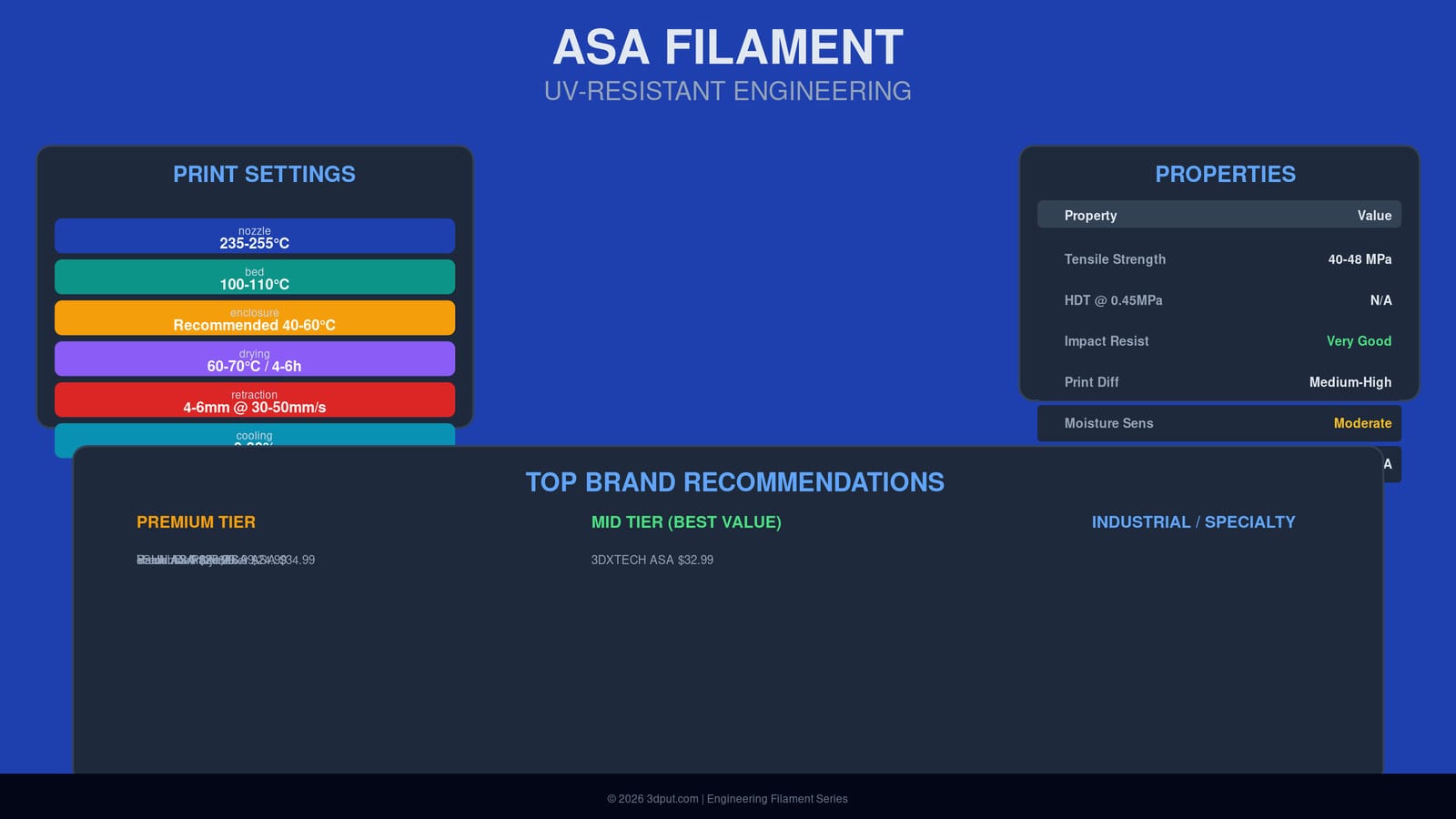
- Tensile Strength: 40-48 MPa (slightly higher than ABS)
- Flexural Strength: 70-100 MPa
- Flexural Modulus: 2000-2400 MPa
- Impact Resistance: Excellent (similar to ABS)
- Elongation at Break: 10-30%
- Glass Transition Temperature (Tg): ~100-105°C
- Heat Deflection Temperature: 90-100°C at 0.455 MPa
- Continuous Use Temperature: Up to ~80-90°C
- Print Temperature: 230-255°C (similar to ABS)
- UV Resistance: Does not yellow or become brittle under UV exposure; maintains color and mechanical properties for years
- Chemical Resistance: Similar to ABS—resists oils, greases, dilute acids; swells in ketones, esters
- Moisture Resistance: Low moisture absorption (<0.3%)
- Temperature Cycling: Handles thermal cycling well
- Start at manufacturer recommendation
- Increase by 5°C if layer adhesion is poor
- Decrease by 5°C if stringing is excessive
- ASA benefits from the high bed temps that work for ABS
- Ensure first layer adhesion with proper bed prep
- Retraction Distance: 4-6mm (Bowden); 1-2mm (direct drive)
- Retraction Speed: 30-50 mm/s
- Coasting: 0.2-0.8mm (optional)
- Wipe: 2-4mm
- Outer Wall: 40-60 mm/s
- Inner Wall: 50-70 mm/s
- Infill: 60-80 mm/s
- Top/Bottom: 30-50 mm/s
- Travel: 120-180 mm/s
- First 3 layers: 0% fan
- Rest of print: 0-30% fan maximum
- Excessive cooling causes warping and layer delamination
- Build Surface: PEI, Garolite, Kapton tape, or ABS slurry
- Bed Temp: 100-110°C
- First Layer Speed: 15-20 mm/s
- First Layer Squish: 100-120% height
- Brim: 8-15mm highly recommended
- Dry at 60-70°C for 4-6 hours if filament has been exposed to humidity
- Store in dry box with desiccant
- Black: Excellent UV resistance, best for harsh outdoor exposure
- Dark Gray, Dark Blue: Very good UV resistance
- Red, Yellow, Light Colors: Still UV-resistant but may fade slightly over many years
- Increase enclosure temperature (aim for 50-60°C)
- Use brim/raft
- Ensure bed is perfectly level and clean
- Increase bed temp to 110-115°C if needed
- Use proper build surface (PEI, Garolite)
- Increase nozzle temp (+5-10°C)
- Reduce cooling fan to 0%
- Ensure enclosure is warm
- Slow print speed slightly
- Increase extrusion width to 115%
- Tune retraction (4-6mm Bowden, 1-2mm direct)
- Enable coasting (0.2-0.6mm)
- Enable wiping (2-4mm)
- Reduce temp by 5°C
- Raise temperature
- Check for clogs
- Ensure filament diameter matches slicer setting
- Reduce retraction distance
- Automotive exterior parts: Side mirror covers, grille inserts, trim pieces, emblems, headlight housings
- Garden and patio items: Planters, decorative pieces, hose guides, sprinkler components
- Exterior architectural models: Building facades, landscape features
- Outdoor enclosures: For electronics, sensors, weather stations
- Boat and marine fittings: Non-structural interior parts, brackets, organizers (not immersed)
- Outdoor signage and letters: Address markers, name plaques
- Withstands under-hood temperatures near engine? No, too hot; but interior and exterior trim is fine
- Resists UV from sun through windows and exterior exposure
- Good chemical resistance to fuels, oils, cleaners (test specific application)
- Easily painted if desired
- Functional prototypes requiring impact resistance and moderate heat resistance
- Consumer product casings and enclosures
- Mechanical parts that need to withstand abuse
- Snap-fits and clips (good flexibility balance)
- Over ABS: Whenever UV/outdoor exposure is expected, or if you want slightly better thermal stability
- Over PETG: When you need higher heat resistance (PETG softens ~70°C, ASA ~90°C) and better UV stability
- Over PC: When you don’t need as high temperature resistance but want easier printing and lower cost
- Over Nylon: When moisture sensitivity is unacceptable and UV resistance is needed
- Filament Settings Database – ASA print parameters for your printer
- 3D Printer Comparison Tool – Find enclosed printers capable of ASA
- ABS Filament Review – Compare ASA to its close cousin
- Heated Enclosures Guide – Enclosure builds for ABS/ASA
- Outdoor 3D Printing Projects – Ideas and tips for outdoor prints
- ABS: Hatchbox
- ASA: Hatchbox, eSUN, Overture
- CF: Hatchbox, eSUN, Overture
- Carbon Fiber: Hatchbox, eSUN, Overture
- Nylon: Hatchbox, eSUN, Overture
- PC: Hatchbox, eSUN, Overture
- PEEK: Hatchbox, eSUN, Overture
- PEI: Hatchbox, eSUN, Overture
- PETG: Hatchbox
- PLA: Hatchbox
- PPS: Hatchbox, eSUN, Overture
- Creality Creality Ender 3 V3 Plus vs Creality Ender 3 Pro: Full Specs Comparison & Buyer’s Guide
- Best 3D Printer Upgrades That Actually Improve Print Quality: Complete 2026 Guide
- ABS 3D Printing Settings Guide: Temperature, Enclosure, and Cooling for Strong Parts
- Best Budget 3D Printer Upgrades That Actually Improve Print Quality: Belts, Springs, Hotends & More
- Bambu Lab A1 vs Elegoo Centauri Carbon: Full Specs Comparison & Buyer’s Guide
The result: ASA maintains ABS’s mechanical properties while gaining excellent weatherability. ASA parts can last years outdoors without significant degradation in color or mechanical properties.
ASA vs. ABS: Direct Comparison
| Property | ASA | ABS |
|---|---|---|
| Tensile Strength | 40-48 MPa | 35-45 MPa |
| Flexural Modulus | 2000-2400 MPa | 2000-2500 MPa |
| Impact Resistance | Very good | Very good |
| Heat Deflection Temp | 90-100°C | 85-100°C |
| UV Resistance | Excellent | Poor (yellows, brittles) |
| Weather Resistance | Excellent | Poor |
| Print Difficulty | Medium-High | Medium-High |
| Warping | Similar to ABS | Similar |
| Price (2026) | $25-35/kg | $20-25/kg |
ASA costs ~20-40% more than ABS but adds critical outdoor durability. For any part exposed to sunlight, the price premium is justified.
Material Properties: Outdoor-Ready Engineering
Mechanical Properties
ASA’s mechanical performance nearly matches ABS:
ASA maintains these properties over time even with UV exposure, whereas ABS’s impact resistance degrades as it yellow and become brittle.
Thermal Properties
ASA can handle most automotive interior and exterior temperature environments (engine bay too hot, but dashboards and exterior trim are fine).
Weatherability
This is ASA’s killer feature:
Anycubic claims their ASA has a heat distortion temperature up to 90°C and is resistant to UV rays, weather, and chemical corrosion.
Comparison of Outdoor Materials
| Material | UV Resistance | Temperature Rating | Notes |
|---|---|---|---|
| ASA | Excellent | 90°C HDT | Best overall for outdoor prints |
| ABS | Poor | 85°C HDT | Not suitable for outdoor use |
| PETG | Moderate | 70°C HDT | Can be used outdoors but will degrade over time |
| Polycarbonate | Moderate | 130°C HDT | Good but yellows somewhat; more expensive |
| PPS-CF | Excellent | 260°C HDT | Overkill for most applications |
| ASA (pigmented) | Excellent | 90°C HDT | Pigmented (color) ASA better than natural |
Recommendation: For outdoor applications, use pigmented ASA (darker colors typically have better UV stabilizers). Natural/clear ASA can work but pigmented is superior.
Print Settings for ASA: Almost Identical to ABS
If you can print ABS successfully, ASA will feel familiar. The settings are nearly identical:
Temperature Settings
Nozzle Temperature: 230-255°C (most ASA filaments recommend 240-250°C)
Bed Temperature: 90-110°C (most commonly 100-105°C)
Enclosure Temperature: 40-60°C recommended (same as ABS)
Retraction Settings
Print Speed
Cooling
ASA, like ABS, needs minimal cooling:
Bed Adhesion
Same strategies as ABS:
Drying
ASA benefits from drying but not as critically as nylon:
Top Brand Recommendations for ASA
Premium / Known Quality
| Brand | Product | Price/kg | Nozzle Temp | Bed Temp | UV Stabilized |
|---|---|---|---|---|---|
| Polymaker | Polymaker ASA | $34.99 | 240-255°C | 100-110°C | Yes |
| Sunlu | Sunlu ASA | $27.99 | 235-250°C | 95-110°C | Yes |
| eSUN | eSUN ASA | $28.99 | 240-255°C | 100-110°C | Yes |
| MatterHackers | MH ASA | $36.99 | 240-255°C | 100-110°C | Yes |
Value Tier
| Brand | Product | Price/kg | Notes |
|---|---|---|---|
| Overture | Overture ASA | $24.99 | Budget option, decent quality |
| Hatchbox | Hatchbox ASA | $26.99 | Widely available, reliable |
| 3DXTECH | 3DXTECH ASA | $32.99 | Good consistency, mid-tier price |
Color Choices and UV Performance
Darker pigments generally provide better UV protection:
ASA manufacturers typically add UV stabilizers to all colors, so any ASA color will outperform ABS in outdoor conditions. For maximum longevity, choose darker colors.
Troubleshooting ASA (Same as ABS)
Since ASA prints almost identically to ABS, troubleshooting is similar:
Warping
Layer Delamination
Stringing
Extruder Skipping
Ideal Use Cases: Where ASA Outshines All Others
Outdoor Applications (ASA’s Specialty)
ASA’s UV stability means it won’t yellow, chalk, or become brittle after months in the sun. Unlike ABS, which starts degrading in weeks to months outdoors, ASA can last years.
Automotive
ASA is a popular choice for car modifications and replacements because:
Common applications: interior dashboard components, door panel inserts, custom vents, gauge surrounds, non-structural exterior trim.
Indoor Engineering Applications
Even when UV isn’t a concern, ASA is a solid engineering material:
In these applications, ASA is essentially a drop-in replacement for ABS with slightly better properties and similar printability. The small price premium may be worth it for the improved weatherability.
When to Choose ASA Over…
ASA vs. Other Materials: Quick Decision Guide
| Application | Best Choice | Why |
|---|---|---|
| Outdoor functional part | ASA | UV-resistant, strong, easy to print |
| High-temp functional part (>100°C) | Polycarbonate | Higher HDT than ASA |
| Food container | Food-safe PETG | ASA not FDA-compliant |
| Transparent part | Clear PETG | ASA is opaque |
| Cheapest engineering material | ABS | ASA costs more |
| Moisture-prone environment | Nylon (CF) | ASA doesn’t like constant moisture |
| Maximum UV resistance | ASA or PPS-CF | Both excellent, PPS-CF is industrial grade |
| Easy print, good general use | PLA, PETG | ASA needs enclosure |
| Automotive under-hood | PC or PEEK | ASA not hot enough |
Frequently Asked Questions
Q: Is ASA worth the extra cost over ABS?
A: For outdoor use, absolutely. ASA’s UV resistance means your part won’t degrade in the sun. For indoor-only parts, ABS is fine and cheaper. The cost difference (~$5-10/kg) is worth it when outdoor durability matters.
Q: Does ASA print exactly like ABS?
A: Practically identical: same temperature ranges, same enclosure needs, same bed adhesion techniques. If you have ABS dialed in, ASA will work with the same settings (maybe ±5°C). ASA may be slightly less prone to warping in some formulations.
Q: Can I paint ASA?
A: Yes. ASA takes paint well. Use plastic-compatible spray paints. Because ASA is UV-resistant, painting is optional for outdoor use—ASA maintains color well, though you may want pigment-based outdoor paint for specific colors. For automotive applications, ASA can be painted with standard automotive paints after proper surface prep.
Q: Does ASA emit fumes?
A: Yes, similar to ABS. While slightly different chemical composition, ASA still emits VOCs during printing. Ventilation is recommended. Not as foul-smelling as ABS to some people, but still requires precautions.
Q: Can ASA be smoothed chemically?
A: ASA is not soluble in acetone like ABS. Cannot be acetone-smoothed. Sanding is the primary smoothing method. Some specialized chemical smoothing processes exist but are not common.
Q: Is ASA FDA-approved for food contact?
A: No. ASA is not considered food-safe. Stick with FDA-approved PETG or PLA for food applications.
Q: How long does ASA last outdoors?
A: Manufacturers claim 5+ years without significant degradation. Real-world user reports show ASA parts remaining flexible and color-stable after 2-3 years of direct sun exposure, while ABS parts of the same age have yellowed and become brittle. Exact lifespan depends on pigment and UV stabilizer formulation, climate, and sun exposure intensity.
Q: Can ASA be welded or glued?
A: Yes. ASA welds with acetone (similar to ABS) but more slowly because it’s less soluble. Epoxy glues work. Use mechanical fasteners for critical joints. Test adhesives for your specific formulation.
Q: What nozzle material for ASA?
A: Brass is fine for standard ASA. Filled ASA variants (glass fiber, carbon fiber) require hardened steel nozzles due to abrasiveness.
Conclusion
ASA is the engineering filament for outdoor applications. It combines the mechanical properties and printability of ABS with exceptional UV and weather resistance, making it uniquely suited for automotive, architectural, and outdoor use cases where other filaments would degrade.
If you’re already comfortable printing ABS, transitioning to ASA is trivial—same temperatures, same enclosure needs, same bed prep. The only difference is you’ll get parts that last outdoors for years instead of months.
For makers who need functional parts that can handle the elements, ASA is essential. Keep a spool in your materials inventory for whenever outdoor durability is required.
—
Related Resources on 3dput.com:
Where to Buy Filament
Disclosure: Some of the links below are affiliate links. If you make a purchase, we may earn a commission at no extra cost to you. This helps support this site.
These links go to Amazon with our affiliate tag. If you prefer to support local retailers or buy directly from manufacturers, we encourage that as well!
Frequently Asked Questions
What is the best 3D printing filament for beginners?
PLA is the best starting filament — it prints easily at 190-220°C without an enclosure and produces good results. Once comfortable, PETG offers better strength and temperature resistance for functional parts.
How do I choose the right filament?
Consider the application: PLA for display models, PETG for functional parts, ABS/ASA for heat/sunlight exposure, TPU for flexible parts, and specialty filaments for engineering applications. Each has specific printer requirements.
What temperature should I print different filaments at?
PLA: 190-220°C nozzle / 50-60°C bed. PETG: 220-250°C / 70-80°C. ABS: 230-260°C / 100-110°C (enclosure needed). Nylon: 240-270°C / 70-90°C. Always check manufacturer recommendations for specific brands.