
/
Company and Business Focus
/
/
Technology and Innovation
/
Company and Business Focus
/
/
/
Company and Business Focus
/
/
Research and Development
/
Company and Business Focus
/
/
Technology and Innovation
/
Company and Business Focus
/
/
/
Company and Business Focus
/
/
/
Company and Business Focus
/
/
Technology and Innovation
/
Company and Business Focus
/
/
/
Company and Business Focus
/
Singapore has been positioning itself as a 3D printing hub for a number of years now. Through the National Additive Manufacturing – Innovation Cluster (NAMIC), it has coordinated investment, meetings, research and events to focus the city-state’s efforts in the industry. A key part of that effort is the NAMIC Global AM Summit, a, now-online, series of events that brings together practitioners from all over the world. This year, the NAMIC Summit was a filled program of two days. It was exceptionally well-organized and, as a participant through leading a session and as an audience member, I thoroughly enjoyed it.
/
Company and Business Focus
/
/
Technology and Innovation
/
Company and Business Focus
/
/
/
Company and Business Focus
/
/
Company and Business Focus
/
/
Technology and Innovation
/
Company and Business Focus
/
/
/
Company and Business Focus
/
Key Highlights and Main Points
/
Company and Business Focus
/
/
Technology and Innovation
/
Company and Business Focus
/
/
/
Company and Business Focus
/
Phil Ward, CEO of the Molyworks Material Corporation, spoke about recycling metals. Do check out the Mollyworks site—it is super trippy and cool. The company has an innovative process that can turn scrap metals into powder feedstock for powder bed fusion systems. This is not only very environmentally friendly, but also very advantageous cost-wise. What’s more, this could be of particular interest, not only to those who wish to go green, but also those who wear green as this could extend the war-fighting capabilities of militaries to in-country manufacturing of powder from scrap that could be turned into spare parts. It will not be a surprise that Molyworks has received numerous US government grants to do just that.
/
Technology and Innovation
/
/
Technology and Innovation
/
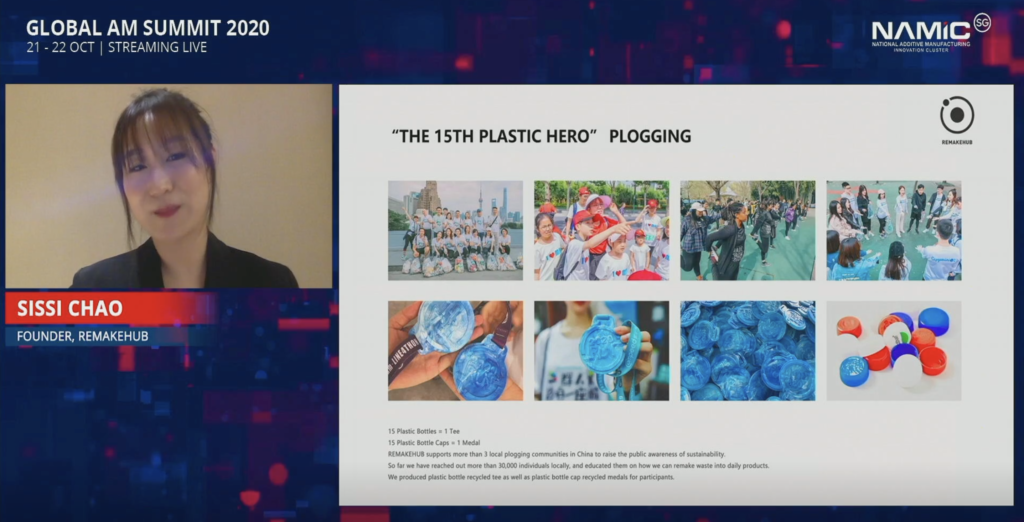
Sissi Chao, founder of REMAKEHUB, showed us how to turn fishing nets into renewable products, which can then be sold to aid charities. Her vision is to go from pollution to solution and the model seems like it could be a very fruitful one. Then, there was a panel discussion lead by John Barnes, who wore a suit for the occasion.
/
Technology and Innovation
/

/
Technology and Innovation
/
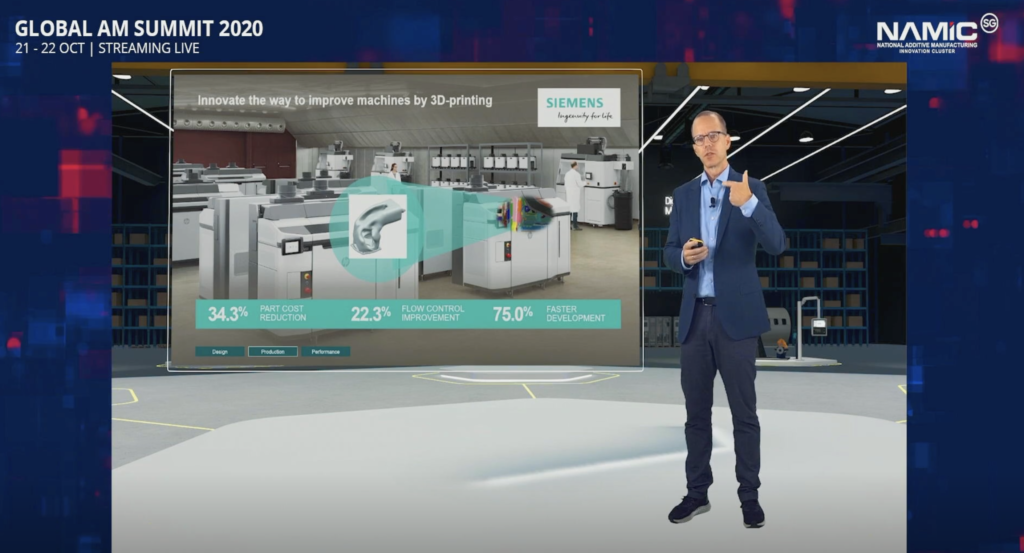
Dr. Karsten Heuser, Vice President of Additive Manufacturing at Siemens, spoke about the use of Siemens software. He had a super-slick presentation that was a really good example of how a big company could use technology to really set itself apart in a virtual world. He spoke about using Siemens NX to “reinvent” parts and simulate behavior, as well as use a Digital Twin to see if parts can be printed on specific machines. Its software can identify 3D printing problems that could occur given a particular collection of settings on one machine.
Blake Perez, of nTopology, spoke about implicit modeling and parts optimization. Then, there was a panel discussion lead by Nora Toure. The best panel was, of course, the 3D printed food panel lead by yours truly.
Dr Ling Ka Yi, Co-Founder & Chief Scientific Officer of Shiok Meats, spoke about how she was relying on her cell biology technology to use stem cells to make shrimp and other crustacean meats. The company also wants to apply the same approach to commercialize other sustainable meats going forward. Then, we heard from Gladys Wong, a Senior Principal Dietician and Nutritionist at Khoo Teck Puat Hospital. She is super passionate about dignified eldercare using 3D printed foods, especially for dementia patients. Her hospital is looking working on how to make mushy, safe foods look appealing. so that patients will enjoy eating them. Melissa Snover, the CEO and Founder of Nourish3D which makes an individualized 3D printed gummy vitamin product.
All in all, this was a great event. I missed the Singaporean food and hanging out with everyone, but,at the same time, was able to learn a lot from my desk. This was especially due to Namic’s Mahendran Reddy, who did a great job hosting the entire event. I’ll be back next year for sure!
The post NAMIC Global AM Summit 2020: Sustainability, Food 3D Printing, and More appeared first on 3DPrint.com | The Voice of 3D Printing / Additive Manufacturing.
from 3DPrint.com | The Voice of 3D Printing / Additive Manufacturing https://bit.ly/3mdnErm
Related Articles
- cura 5.11.0 released
- 3D Printing Finally Enters the “It Just Works” Era in 2026
- Harvard Develops New Method for 3D Printing Soft Robots with Built-In Programmable Movement
Frequently Asked Questions
How is 3D printing used in medicine?
3D printing is used in medicine for surgical planning models, custom implants, bioprinting tissue scaffolds, drug delivery systems, dental aligners, and prosthetics. It enables patient-specific solutions that improve outcomes and reduce surgery time.
What materials are biocompatible for 3D printing?
Common biocompatible materials include PEEK, titanium alloys (Ti6Al4V), bio-ceramics (hydroxyapatite), medical-grade resins, PLA for temporary implants, and hydrogels for bioprinting. Material choice depends on the application and required mechanical properties.
Is 3D printed medical equipment FDA approved?
Yes, several 3D printed medical devices have FDA clearance, including orthopedic implants, dental restorations, and surgical guides. Each device must go through the appropriate regulatory pathway based on its risk classification.
📌 Related Articles
- The Current State of Metal 3D Printing in 2020
- ABS 3D Printing Settings Guide: Temperature, Enclosure, and Cooling for Strong Parts
- Best 3D Printer Upgrades That Actually Improve Print Quality: Complete 2026 Guide
- Best Budget 3D Printer Upgrades That Actually Improve Print Quality: Belts, Springs, Hotends & More
- 3D Printing Tungsten Carbide: How Hot-Wire Laser Technology Creates Metal Harder Than Steel